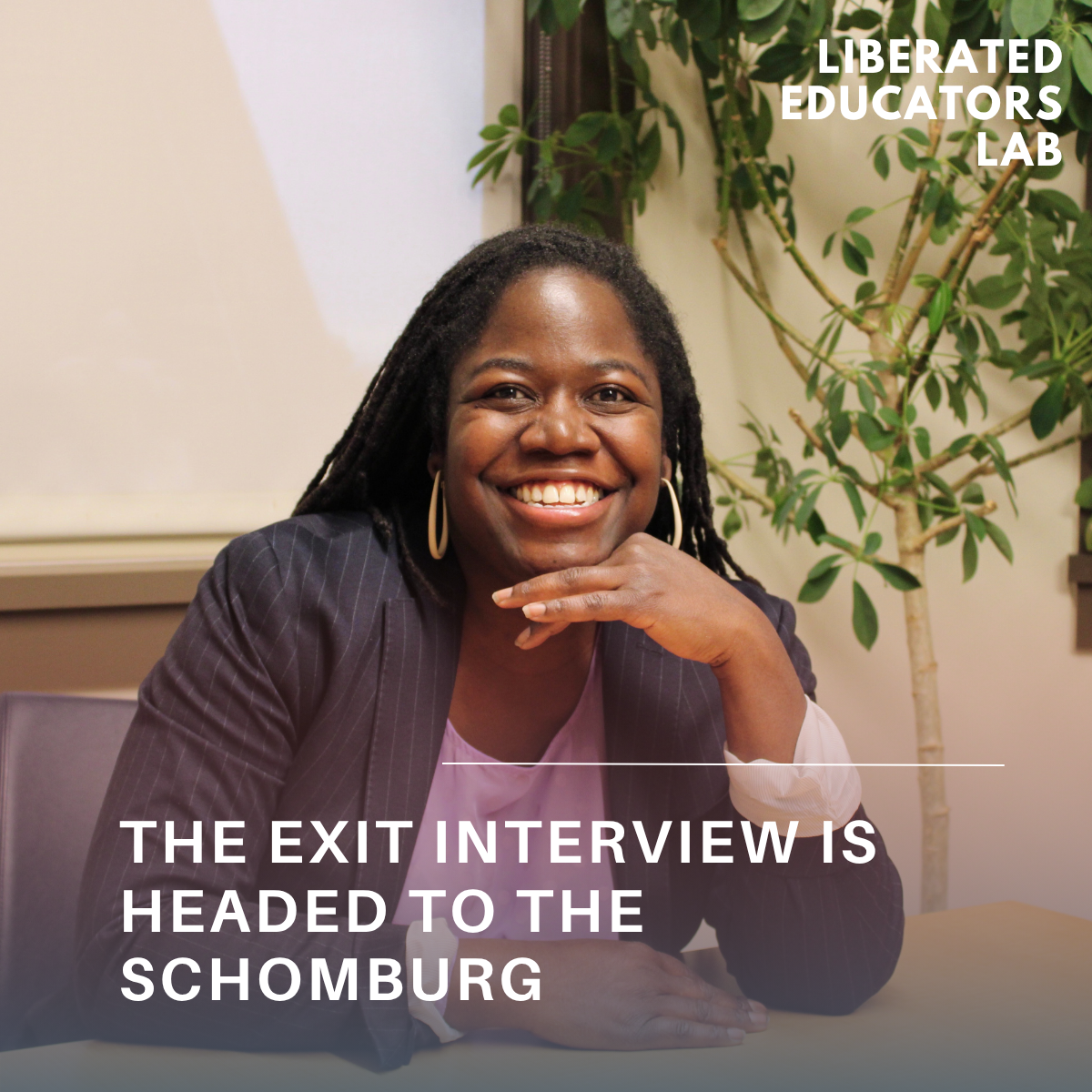
The Cost of Caring Too Much with Elisha Roberts

What happens when you care deeply about education, but the personal cost becomes too great? Elisha Roberts, M.Ed didn't just want to change schools. She built one.
From challenging traditional school practices to creating spaces where students had a voice in their own education, Elisha spent years pushing the boundaries of what was possible. But innovation came with resistance, institutional politics, and sacrifices that extended far beyond the school building. In this episode, Elisha gets candid about navigating leadership as a Black queer woman, the painful reality of fighting for change, and why she ultimately chose to leave. She also shares how she's continuing her commitment to young people while redefining what wellness looks like for her. Because sometimes you don't leave because you stopped caring. You leave because caring shouldn't cost you everything.

 RSS Feed

 Apple Podcasts

 Spotify

 Amazon Music

 iHeartRadio

 PlayerFM

 Deezer
The Cost of Caring Too Much with Elisha Roberts
What happens when you dedicate your career to creating the education every child deserves, only to find yourself fighting the very systems meant to support that vision?
In this episode of The Exit Interview: A Podcast for Black Educators, host Dr. Asia Lyons sits down with Elisha Roberts, a former teacher, school founder, principal, and chief academic officer whose journey spans classrooms in Japan, educational leadership in Denver, and a career dedicated to student voice, civic engagement, and educational equity.
Growing up in Denver, Elisha experienced firsthand what education could look like when curiosity, creativity, and student interests drove learning. Those early experiences, combined with studying abroad in Botswana, teaching in Japan, and studying the work of Black intellectuals, shaped her belief that young people deserve more than standardized instruction and rigid school structures. They deserve opportunities to explore the world, question systems, discover their interests, and participate in shaping their own education.
Elisha brought that philosophy into her work as a teacher and eventually as the founder of STRIVE Prep Rise, a high-performing, social justice-centered high school in northeast Denver. She shares how listening to students transformed everything from school schedules to discipline practices. Students helped develop school policies, participated in peer accountability processes, and experienced learning opportunities designed around their interests and needs.
But creating something different came with challenges.
Elisha speaks candidly about navigating sexism, homophobia, workplace intimidation, and institutional politics as a queer Black woman in educational leadership. She recalls the moment a confrontation with school administrators made her question whether she could safely continue working in that environment. Later, as a school leader, she encountered resistance to the very innovations she had spent years building.
The COVID-19 pandemic, organizational changes, leadership instability, and a difficult school merger further challenged her commitment to remaining in traditional education. As practices she had worked to dismantle were reintroduced, Elisha found herself confronting a painful reality: she could continue fighting for the education she believed children deserved, but the personal cost was becoming too high.
In one of the conversation's most powerful moments, Elisha explains that she didn't leave because she stopped caring about education. She left because she cared so deeply that continuing to encounter resistance was painful, particularly when her work had already required sacrifices in her own family life.
Today, Elisha serves as Director of School Recruitment for the National Speech & Debate Association, where she continues helping young people develop the critical thinking, communication, and civic engagement skills that have defined her career.
Dr. Asia and Elisha also discuss what institutions must do to genuinely support Black educators, why representation without institutional accountability is insufficient, and how Elisha is redefining wellness after years of putting her work before herself.
This episode challenges listeners to consider an important question: What does it say about our educational institutions when the people fighting hardest to improve them eventually have to leave to protect their own well-being?
In This Episode
-
A childhood shaped by educational possibility: How attending Denver's Logan School introduced Elisha to curiosity-driven learning and influenced her beliefs about what every child deserves.
-
Learning beyond borders: How studying in Botswana, teaching in Japan, and traveling internationally expanded Elisha's understanding of education, community, and opportunity.
-
From teaching to school leadership: Elisha's journey from teaching U.S. history and government to founding a high-performing high school in Denver.
-
The politics of being a Black woman in education: How gender, race, sexuality, workplace power, and institutional hierarchies shaped Elisha's professional experiences.
-
Building schools with students, not just for them: Innovative practices that gave young people meaningful opportunities to shape their educational experiences.
-
The promise and contradictions of charter education: Elisha's evolving perspective on charter schools, innovation, accountability, and the politics of school choice.
-
When institutional change erases progress: How COVID-19, leadership turnover, and organizational restructuring disrupted the school culture Elisha had worked to create.
-
The personal cost of educational leadership: What happens when fighting for children requires sacrificing time with your own family, emotional well-being, and peace.
-
What retaining Black educators actually requires: Why listening, institutional support, and refusing to assign unpaid diversity work matter more than symbolic gestures.
-
Purpose and wellness beyond traditional education: How Elisha continues supporting young people while redefining success, balance, and peace.
Five School Innovations Worth Reconsidering
During the conversation, Elisha shares several practices she implemented as a school founder and leader. These examples offer educators and administrators concrete ways to rethink how schools operate.
1. Build student interests into the school day. Rather than expecting students to participate in extracurricular activities after school, Elisha's team created a dedicated club and tutoring block during regular school hours. At one point, students had access to more than 20 clubs, removing transportation and scheduling barriers that prevented participation.
2. Use peer accountability and restorative practices. Through peer advisory boards, students helped determine appropriate responses to harmful behavior, emphasizing accountability, restitution, and repairing relationships rather than relying exclusively on punitive discipline.
3. Create meaningful community meetings. Instead of limiting schoolwide gatherings to celebrations and announcements, Elisha's school used community meetings to address harm, strengthen relationships, and reinforce collective responsibility.
4. Give students a genuine voice in school leadership. Scholar ambassadors and a Student Design Team provided opportunities for students to share honest feedback, represent their school, and participate in decisions affecting their everyday experiences.
5. Design learning experiences around student needs. From reimagining the first week of school to creating Intersession, a four-day, conference-style learning experience focused on social justice issues, Elisha demonstrates how student feedback can inform more engaging and responsive educational environments.
These practices challenge the assumption that strong academic outcomes require rigid, compliance-centered school cultures.
Episode Highlights
00:00 – An education shaped by curiosity and identity
Elisha reflects on growing up in Denver, attending different types of schools, and how her experiences as a mixed-race Black child influenced her understanding of identity and belonging.
06:30 – From Supreme Court dreams to the classroom
A childhood interest in law, followed by reading Jonathan Kozol's Savage Inequalities, inspires Elisha to reconsider her career aspirations and pursue education.
09:00 – What international experiences taught her about learning
Studying in Botswana and teaching in Japan expose Elisha to different approaches to education, community responsibility, and student development.
18:30 – Entering Denver classrooms
Elisha recalls her early teaching experiences, crowded classrooms, restorative justice practices, and the freedom to develop culturally relevant curriculum.
24:00 – Why civics must be more than a textbook
Elisha explains her commitment to connecting government and history instruction to students' everyday lives and opportunities for civic participation.
31:30 – When workplace power becomes personal
Elisha recounts the institutional dynamics and administrative confrontation that led her to leave her first teaching position, including the impact of sexism, homophobia, and intimidation.
40:00 – Entering the charter school world
Previously skeptical of charter schools, Elisha describes what attracted her to the possibility of innovation and what she discovered about the contradictions within charter education.
43:00 – Designing a school around student voice
Elisha shares the student-centered practices that helped define the culture of the school she founded, including club blocks, restorative accountability, and student-led design.
51:30 – When COVID and organizational change disrupt a school's vision
Elisha discusses leadership transitions, the effects of the pandemic, and how an organizational merger contributed to the loss of practices she had spent years developing.
58:00 – Why she finally decided to leave
After years of institutional resistance and personal sacrifice, Elisha explains why continuing to fight for educational change was no longer sustainable.
1:04:00 – What Black educator retention actually requires
Dr. Asia and Elisha discuss practical ways schools can support Black educators, including meaningful listening, administrative accountability, and ending expectations that Black staff carry unpaid diversity and equity responsibilities.
1:10:30 – Continuing the work through speech and debate
Elisha describes her current role with the National Speech & Debate Association and why young people's ability to think critically, communicate, and advocate for themselves matters so deeply.
1:13:00 – Redefining wellness after leaving
Elisha reflects on finding peace with the past, present, and unknown future, and the importance of balancing the heaviness of the world with moments of joy.
Connect With Elisha Roberts
Elisha Roberts currently serves as Director of School Recruitment for the National Speech & Debate Association (NSDA).
Through her work, she supports schools interested in developing speech and debate programs that help students strengthen communication, critical thinking, research, and civic engagement skills.
Interested in bringing speech and debate to your school?
-
Website: https://www.speechanddebate.org/
A Question to Carry With You
Elisha's story raises an important question for educators, administrators, and education policymakers:
If our schools benefit from the creativity, commitment, and leadership of Black educators, what responsibility do those institutions have to create environments where that genius can thrive without requiring personal sacrifice?
Preserving Black Educator Stories | The Schomburg Center
The Exit Interview: A Podcast for Black Educators has been accepted for archival preservation at the Schomburg Center for Research in Black Culture, part of the New York Public Library. This historic milestone ensures that the experiences, knowledge, and voices of Black educators who have left traditional education will be preserved for future generations.
Learn more: https://www.liberatededucatorslab.com/schomburg
The Migration of Black Genius
Where does Black genius go when it leaves an institution?
Through The Migration of Black Genius, Dr. Asia Lyons examines how Black knowledge, creativity, and expertise move, evolve, and expand beyond the institutions where they were once cultivated or constrained.
The Exit Interview contributes to this ongoing intellectual work by documenting not only why Black educators leave, but what they carry with them and what becomes possible afterward.
Explore the framework: https://www.liberatededucatorslab.com/migration-of-black-genius
About the Creator
Dr. Asia Lyons is a qualitative researcher, storykeeper, public scholar, speaker, and founder of Liberated Educators Lab, where research, storykeeping, and healing/wellness intersect to illuminate Black experiences, preserve community knowledge, and imagine possibilities beyond institutional boundaries.
Learn more: https://www.liberatededucatorslab.com/
Elisha Robert's Episode
[00:00:00]
dr--asia-lyons--she-her-_1_10-08-2026_140859: All right, folks. Welcome back to The ExceInterview, a podcast for Black educators with me, your host, Dr. Asia. folks, it's been a minute. Today we are talking to Elisha Roberts. Elisha and I met, I don't know, a couple years back
elisha--she-her-_1_10-08-2026_140859: Yeah
dr--asia-lyons--she-her-_1_10-08-2026_140859: and I said, "You know, come on, let's talk about all the things, a podcast." And, uh, she popped up in my DMs or something, and we're, we're back, we're here, and I'm super excited.
Welcome to the show, Elisha. How are you today?
elisha--she-her-_1_10-08-2026_140859: I'm doing well. Thanks so much for having me, and it's
great that we reconnected.
I definitely wasn't-- I was not in a space to do that years ago, but I'm, I'm ready now
dr--asia-lyons--she-her-_1_10-08-2026_140859: Yeah, I appreciate that. And you, you know, I've said this so many times that people will, um, transition out of ed- traditional education space, and it may take two, three, four, five years before they're ready to share their story. And so just know, [00:01:00] again, for everybody listening, it's totally normal. Come on when you're ready, you know, and it's, it's okay to change your mind.
So we'll go ahead and get started. Um, first, tell us a little bit about yourself.
elisha--she-her-_1_10-08-2026_140859: Thank you. Uh, I was born and raised in Denver, and I was very fortunate to have attended a lot of different types of schools that I think were really formative in forming who I am as a person. Uh, as a mixed race Black person growing up with a white mom, I wasn't as, uh, familiar with my Black side of my family, and I think it was really important for my mom to make sure that I knew who I was fully, and I appreciate that so much about my upbringing because, you know, growing up in the '80s and '90s, you got called everything.
You're, you're not white enough, you're not Black enough, you're
not this, you're not that. And I, I feel like I always knew who I was, regardless of what other people would say about me. And so I'm, I'm grateful for that. I had a lot of formative experiences in my early childhood that also made me who I am [00:02:00] today, and I would say that it's a combination between ra- being raised by a single parent, having an adopted Black brother, having, um, a, just I would say a complicated mixed race family.
Uh, I think you see the world growing up in a different way than you would if you were in a, in a monolithic type family. Not that many are in, in families like that.
But that's kind of me in a nutshell. I mean, I I think we'll get into it, but
dr--asia-lyons--she-her-_1_10-08-2026_140859: Y- yeah, yeah, I appreciate that. And I'm sure that the way that you were raised will probably c- show up in lots of parts of your story, so I'm excited to hear it. So let's go ahead and get started. Tell us, um, how you got into education. How did you know that education was for you?
elisha--she-her-_1_10-08-2026_140859: Yeah. So kind of getting into that, I, I like to say I start my thinking about education when I went to the Logan School here in Denver. It's a gifted school for creative learning, and both being one of the only Black people at the school, my brother and I, I would say there might have been a handful of others throughout our, our entirety of being at the school at the time.
It might be [00:03:00] more of mixed now, but at the time it was not. That gave me a foundation in education where I was like, oh, I get to like... What I thought education was at that, when I was younger,
was not what it came to be. And this is a huge part of my journey because I, when I was seven or eight, I got to decide what I wanted to learn about, and, like, my entire day, it felt like, was based around my interest, and I didn't even know I was learning. And that
is what, at the crux of learning, like, what any child should get to experience is, like, it should be driven by what you're interested in. Yes, there were always things I had to learn that I wasn't as interested in, but you get to know that as you get older. And so you fall in love with learning when you're young if you have that opportunity.
And so I think I inadvertently fell in love with learning without knowing it when I was young because of those experiences. And then I went to, I had a kind of a very abrupt transition to a school that no longer exists here in Denver called Gove. And I went there-- Well, actually, I was homeschooled for a semester before I went to Gove, and part of why I was [00:04:00] homeschooled is that my mom realized I didn't have some of the foundational pieces she thought I would need going into high school. And so for the beginning part of my eighth grade year, I was homeschooled, which was, like, very weird. Um,
dr--asia-lyons--she-her-_1_10-08-2026_140859: bet so. Yeah
elisha--she-her-_1_10-08-2026_140859: To go from, like, a non-traditional ed space to then a homeschooling space, that was like... And my mom was still working, so I was, like, homeschooled half the day, and then she would be working, and so I
would just be like... the '90s?
This is, yeah, the '90s.
So sh- yeah. And so she would be working half the day, and so I would have, like, assignments, but when I'd finish my assignments, then I would, like, play video games for
hours, and then I'd go see my friends when they got out of school, and like... So I still tried to have some socialization before going to Gove. Uh, and then I went to East High School here in Denver as well. Um, and that is where I think I realized education can really open doors for you,
because my freshman year I tried to join everything. Um, I joined choir. I was in, I don't know, uh, drama. Yeah, what-- I was in a lot of the musicals and, [00:05:00] like, basketball, Constitutional Scholars.
Like, I just tried a lot of different things
dr--asia-lyons--she-her-_1_10-08-2026_140859: So like in the yearbook, you were that kid that was like in every single club Yeah, like in the, in the back, 'cause I was kind of shy even, even doing that. But I, you know, student council, by senior year I was doing student council. I was student body president, or head girls as they called it at the time, and it was just fun. I just remember school being fun, and the extracurriculars really being what kept me in school.
elisha--she-her-_1_10-08-2026_140859: Like the day-to-day was fine, but I also-- the one thing that I will say that is also different about growing up in my education journey, I don't remember testing.
I know I took a bunch of tests to get into Logan. I know you had-- we took a standardized test maybe once every couple years in maybe high school, but it's not like it is now, from what I remember. And I think that is something that I think about a lot when I think about my education journey. So all of these experiences, uh, I was getting back to choir because in my freshman year, I remember our, our Mr. Taylor took us to The Bahamas, and it was so [00:06:00] much fun. And I was only one of the only freshmen. I would say definitely the juniors and seniors made, you know, had jokes.
I woke up with stuff on my face one day and
things like that. Like they had jokes, you know. But it was so, it was just a fun experience, and I remember thinking, you know, "This is what I wish every student could get." And I don't know that
every student actually got some of the experiences that I got. Do you-- I'll keep going if you, if you want.
Um,
so yeah.
elisha--she-her-_1_10-08-2026_140859: So then, um, I think what really brought me into the ed space was when I was seven, I had done, again, back at Logan, I had done a, a, like a ABC book about law, 'cause I was really interested in law. And I remember on when I got to S, S was Supreme Court justice. And so from the time I was seven until I was 17, I wanted to be a Supreme Court justice because I realized the amount [00:07:00] of power that they had
in our society.
And it, uh, my realization about that only grew as I got older. Obviously, when I was seven, my understanding of politics was not nearly what it was at 17. And so then I read the book, Jonathan Kozol's, um, "Savage Inequalities" my freshman year in college,
and that really made me want to become a teacher. I was
like, "I think I'm on the wrong path.
I think, um, I don't think I'm gonna go to law school. I think I need to become a teacher. That's where, that's where I'm at." And so that's how I got into like thinking about education.
dr--asia-lyons--she-her-_1_10-08-2026_140859: Yeah. So then you, I'm assuming that you did the traditional path of the four years in, uh, undergrad and went on to student teaching or, or maybe not. So tell us about that part too, and then where did you start in actually working in schools?
elisha--she-her-_1_10-08-2026_140859: Yeah, so I actually started student teaching in my junior year at Occidental College in LA. I was a Daniel Swan scholar, and so had
the--
dr--asia-lyons--she-her-_1_10-08-2026_140859: shout out to the Daniels
elisha--she-her-_1_10-08-2026_140859: Yeah, shout out to Daniel Swan. Uh, had the opportunity to go to California, [00:08:00] thankfully, for school. And I started in a kindergarten classroom, 'cause I was like, "I'm gonna create revolutionaries.
It's gonna be amazing. Um, we're gonna start 'em young, and so
by the time they're in third, fourth, fifth grade, they're really changing things." And it was a hard realization when students were, you know, didn't know how to write anything,
didn't know their shapes, their colors, their basics, holding scissors.
You know, and it was just like I, I was out of my element. I was like, "This is definitely not the age group for me."
Uh, Black Panther cubs.
exa-
dr--asia-lyons--she-her-_1_10-08-2026_140859: And they're like, No. wanna know what a triangle is at this point. Yes.
elisha--she-her-_1_10-08-2026_140859: and I'm all, "Ooh, it's not, it's not, we're not on the same page about what education should be." But,
like, you gotta start somewhere, right?
Obviously you can't, you can't get to the revolutionary without the basics.
Uh, yeah. So I studied abroad in Botswana, and I met one of my host sisters who to this day I say she was the most influential person at that time in my life. I was 19, she was 16, a- [00:09:00] but she was so much smarter than me. She
spoke multiple languages. She knew about international affairs. She could talk to me about the African Union.
I was like, "What's the African Union?" Like, I j- there was a whole new world of education that
I was experiencing that I was like, "Oh, I wanna do this for kids in my community. I wanna make
Sure
that high school kids know what she knows and then some," um, because we, we definitely didn't, I definitely didn't know what she knew.
Um, it was very
dr--asia-lyons--she-her-_1_10-08-2026_140859: a, this was an experience that you had in college
elisha--she-her-_1_10-08-2026_140859: In college.
dr--asia-lyons--she-her-_1_10-08-2026_140859: think about, "Ah, got
elisha--she-her-_1_10-08-2026_140859: Yeah, and I would say college was ex- extremely formative in terms of the building blocks to get me to where I am today because...
dr--asia-lyons--she-her-_1_10-08-2026_140859: Yeah
elisha--she-her-_1_10-08-2026_140859: I don't know how I wanna go off on a tangent. I'll come back to that. But I will, I will say that college was definitely what made me get into teaching. And so I, after, after that experience, went to do the Japan Exchange and Teaching Program in Japan and taught English for a year and a half while also-- I did-- It was twofold. I didn't have really a desire to teach English, but [00:10:00] I knew that that could be a method for me to teach myself about parts of Asia that I had never learned.
What I realized was as the older I got and the more experiences I had around the world, I was like, "Oh, I learned nothing about the world in my K-12
schooling." And I took... I'm not sure I took a world history class. I definitely took a geography class in high school, and so I kind of knew where things were, but I didn't know geopolitically what was going on geo...
I didn't know geopolitics at all,
and I couldn't put together history with that in a
way. And so teaching myself that in that time period was-- And at, at the same time, I think this is also relevant, I was reading a lot of Black American authors while I was in Japan,
um, because I also realized I didn't read any of those authors with the seriousness that they commanded for my attention.
So
like, I'd be reading James Baldwin with a dictionary next to me. I'd be reading, you know, Audre Lorde, all the... I got an introduction to some of that, uh, those authors in high school and college, [00:11:00] but kind of went further in my own education after college.
dr--asia-lyons--she-her-_1_10-08-2026_140859: I love that. Um, I hear what you're saying about the ways that you didn't receive those, the types of learning that you wanted to receive on the back end at the Logan School and maybe at East and some parts of college. this shift from in the United States and then going off to Japan, still that curiosity that I think that the Logan School helped to foster in you.
Um, and those folks who do not know about the Logan School here in the Denver area, go ahead and look it up. It's hard to explain all the things about it, but it's definitely like a guided... You get to kind of, like she, like you're saying, guide your own education. There's lots of field trips and things that, that folks do.
Um, so let me, before we go c- Japan, and obviously you're living here now, but so we have some journey on this conversation. you decided that you were gonna go from California, you say California, right? [00:12:00] California to Japan, was mom saying? Was mom in the conversat- Was the family and community supportive?
People like, "Do what you wanna do," or, "No, that's, you need to sit down and settle down"? What was that conversation like?
elisha--she-her-_1_10-08-2026_140859: No, I think my mom always knew I liked to travel, particularly that, that was ignited in high school. We
always did road trips, and so my mom instilled road tripping in
me, and I love road trips to this day. Uh, but she was very supportive of what I wanted to do, and I think it's one of those times where she was becoming an empty nester.
I was her youngest, and so she also got her freedom
while I was having my freedom.
And so I
don't
think she--
dr--asia-lyons--she-her-_1_10-08-2026_140859: wanna do, just
elisha--she-her-_1_10-08-2026_140859: Yeah. I, I think in hindsight she wishes I would've, like, checked in a lot more and,
like, you know, you think you, you can't do anything wrong when you're 19 to 25.
And so I would, like, email here and there from this country and be like, "Hey, I'm in Laos.
I just saw this really cool thing." But, like, didn't give her an itinerary, didn't check in. Like, the way that we're connected now with cell phones, like, I shared a cell phone with someone in high school or in, sorry, in,
[00:13:00] college. I
didn't have a cell phone in high school, and then I didn't have a cell phone until my senior year of college and I shared one with someone 'cause we were both too poor to afford one and we, like,
didn't wanna give all our money to that. And to this day, our friends make fun of us of, like, we would always call for the other person and you'd always have the phone at that time 'cause we just broke it up, you know,
three or four days a week. But anyway
dr--asia-lyons--she-her-_1_10-08-2026_140859: quite creative. I've never heard that before. But it's just kinda like one of those, the phones they have in a different world that's on the wall in the hallway. Somebody's gonna answer, and then
elisha--she-her-_1_10-08-2026_140859: Exactly. And, and we lived next door to each other, so we could always take the phone to that
person.
dr--asia-lyons--she-her-_1_10-08-2026_140859: a minute. I thought y'all were, y'all were roommates
elisha--she-her-_1_10-08-2026_140859: We weren't even roommates, no.
dr--asia-lyons--she-her-_1_10-08-2026_140859: You know what? I, listen, I, I'm here for it. I'm not gonna judge. That's very creative
elisha--she-her-_1_10-08-2026_140859: yeah. So, uh, it, you were asking was she supportive? She was definitely supportive. I think she wished I would've checked in more.
dr--asia-lyons--she-her-_1_10-08-2026_140859: Sure. So Japan, year and a half, w- what was that like for you? What was that experience like? Did you enjoy it? Wh- why [00:14:00] did you come back? Uh, we would love to hear about that
elisha--she-her-_1_10-08-2026_140859: Yeah, I really enjoyed it. I think, uh, the thing I enjoyed the most about it was just how different of a culture it was and that everyone was very welcoming. I was the only foreigner in my town. There were about 3,000 people in my town. I lived in a mountain town, and so I taught three days a week at a middle school, and then, um, twice a week was driven up to a, like K- it was a K-12, but there were only K through eight, um, at that time there. And then on occasion, I would go to like a, a school a little bit outside of the village that was for students with, uh, various types of learning needs that weren't getting met at the traditional school.
dr--asia-lyons--she-her-_1_10-08-2026_140859: Hmm. Okay. So why come back?
elisha--she-her-_1_10-08-2026_140859: Yeah. So, um, and I, the other thing I'll say is, like, I really enjoyed that being kind of a gateway to going to other places.
So I
did get to travel tr- quite a bit and learn a lot about different places. And I j- and I got to learn a lot about the Japanese education system, which I tried to then bring back when I [00:15:00] was a school leader, some of those life lessons of like, oh, they're cleaning their school every day.
They are serving each other lunch every day.
So they're not trashing their school because they know they're cleaning their school. They are serving really great meals to one another. It's just a community feel. So I was like, I wanna, I wanna have a school that's like a community feel when I finally got to the point of having that. So a
lot of that I took with me.
But I came back actually because I was coming back for a family-related matter, um, that ended up with me adopting, uh, my daughter. And so, yeah, I was-- I guess I was 23 when all of that was happening, and
so trying to figure out my career and being a young, um, adoptive mom, and so ended up going to grad school to get my master's in, um, curriculum and instruction at Boston College, and then also getting to see a different part of the country.
So in every place that I've been, whether it be Denver, abroad, California, Boston, like education isn't the same. And so I've taken a lot of those lessons with me from
every place because everyone is [00:16:00] doing it slightly different to their context, and all of that matters in terms of who we become as people. Um, and being, being fortunate enough to be able to see it in all of those different places, there are commonalities and threads, but there are also special things about each place that when you can combine some of those things, you get something really special. So that's why I ended
up coming back.
dr--asia-lyons--she-her-_1_10-08-2026_140859: Yeah, why Boston?
elisha--she-her-_1_10-08-2026_140859: Uh, there was a program called the Donovan Urban Scholars Program out of there, and so they actually gave me the most money.
Uh, so I was looking at
USC. Yeah, I was looking at USC, but I mean, I was also in a relationship at the time with someone on the East Coast, and so we were just trying to, like, figure out how to... Sh- she wanted to be in grad school. I was also in grad school, so just trying to figure out what programs worked for both of us.
Uh, and I was still in the-- I was still doing a foster adoption, so I also had to, like, coordinate with the foster adoptive system
here and there and all of that. So
Yeah
But it was a great program, so that's why I ended up doing it
dr--asia-lyons--she-her-_1_10-08-2026_140859: Yeah, and during that time did you, were you still teaching or you took break to go to grad school? What did that look like?
elisha--she-her-_1_10-08-2026_140859: [00:17:00] So because of the intensity of the situation I was in with, um, the foster adoptive system, I was mostly doing like part-time work at my mom's company at the time, and then studying for the GRE and doing my applications. And so then I was student teaching and going to school in Boston, and then came back to Colorado for my first teaching job officially at
MLK
dr--asia-lyons--she-her-_1_10-08-2026_140859: So you got a lot, I mean, you had a lot of, like, formative work in education before you actually came in. 'Cause in my mind, I, I thought the kindergarten was the, the, uh, the first time, but you're saying
elisha--she-her-_1_10-08-2026_140859: no, that was, that was my first experience student teaching, and then I did my, like, master's program student teaching in a high school,
Brighton High School, yeah, in, in Boston
dr--asia-lyons--she-her-_1_10-08-2026_140859: Oh, got you. Okay. Wow. Um, and this is, uh, what I'm thinking about and I'm picking up on this theme of you're reading things, like you said, Baldwin and all these things, and you're thinking about the revolution and quickly trying to figure out, like, how do we put this back into the, into the hands of the students?
How do you make sure that the kids [00:18:00] are e- being able to see the value of cleaning the school and cooking lunches, and what does it look... And I love that, that right away because sometimes it's like, "Oh, that's good for them, but that would never work here." Or, "I could never
elisha--she-her-_1_10-08-2026_140859: Right
dr--asia-lyons--she-her-_1_10-08-2026_140859: that here, so just don't even worry about trying."
And I love that you're com- always in, thus far in this story, is like trying to integrate what you're thinking about and what you're learning about as you go, or at least wanting to, which always helps when we're thinking about sh- shifting education and thinking about our thinking differently and our, how our children can learn.
So yeah.
elisha--she-her-_1_10-08-2026_140859: Yeah. Thank you.
Thanks so much
dr--asia-lyons--she-her-_1_10-08-2026_140859: Here you c- you're, you're home. You're back here. Tell us about your first, second teaching, teaching experience.
elisha--she-her-_1_10-08-2026_140859: It's better. I was in, um, I was at Dr. M- Dr. Martin Luther King Early, uh, College, Junior Early College in GVR, and I started teaching eighth grade US history, and I was the-- I had mentioned [00:19:00] that I was, like, had done student council in high school or something, and then, uh, the principal was like, "Oh, you're gonna be the student council chair.
Fantastic." And so I was doing both of those things, uh, my first year. And I rem- I will never forget, I had a classroom of 38 eighth graders after lunch, and
I had 35 desks, and so every day I was like, "Well, I hope someone's absent because I don't have enough desks."
I know, I-- to like hope that someone was absent is not something we would do now, but this was, you know,
a long time ago. And so, uh, it was, it was a learning experience for sure. I definitely used all of my classroom management skills in those settings, and then I ended up teaching eighth through 12th grade for the, uh, the next year, and then ended up just teaching high school the third year I was there. Um, yeah.
dr--asia-lyons--she-her-_1_10-08-2026_140859: Yeah. So it sounds like it, the, kind of crowded. We're move- we're coming back from Boston, having s- been in other countries. us what that-- Like, give us some ideas of the experiences that you had while you were there, things you've learned, things you thought about, ways that [00:20:00] you could have seen education improve, or something that you saw that you really love that more people could implement in schools.
elisha--she-her-_1_10-08-2026_140859: So shout out to, um, Derek Hawkins in, uh, at MLK. I think he might still be there. But he, he had a restorative justice policy. I think he probably still has it there. And he taught me a lot about-- He taught me most of what I know about restorative justice polic- policies before the literature he gave me. And he had a policy where you couldn't send a student out of class, which I loved because, yes, you would have disruptive students, but, like, where are they going to go?
You know? Like, and, and sincerely though, if you don't have a model set up where there's, like, someone to deescalate a student, like some schools do, uh, you had to be more creative and work with your community, even teachers beside you. So, like, some teachers and I would have, like, a, a desk in our room that was for a student from another classroom that they just needed a different change of scenery for that couple minutes or something.
So we had to be [00:21:00] innovative of how we were gonna deal with students who maybe didn't wanna be there or were having a bad day or whatever it is, uh, which was not the majority of students, to be clear, but the one-off occasion. And so I really appreciated that at MLK that they had that system. And by-- I apprec- I appreciate it, I think, more in hindsight than I did in the moment
because of course, in the moment you're like: "How am I gonna figure this out?"
But you have to figure it out. It makes you make phone calls. I was making phone calls to parents in the middle of class to, you know, like... And that's also a part of an accountability and community and culture that some people now would be like: "Oh, you're putting them on blast. Not every kid you can do that with," which I completely understand.
And there's also a community accountability of, like, actually, we have to stop what we're learning right now because this person is not allowing us to learn, and we have to get someone else involved that can, like, support our community to get back on track. I think it's a both/and very much depending on the student,
'cause I don't wanna say, like, I, I don't wanna [00:22:00] say it works for every student.
But for some students who want that attention, it does work because their family's now involved, I'm involved, they've got our attention, and so we've got to do something different in the moment. I know that's controversial, so, like, I'm saying it with my full chest ' cause I
believed it at the time, and I still do for some kids. For other kids, it's much more of a we gotta, we gotta go talk in the hallway type thing where I got one eye in the classroom, one eye with the student out. You know, it just depends on the student. But, so yeah. The other things I think I learned there were, like, I learned a lot about lesson planning and
making it culturally relevant, and, like, the curriculum that was handed to me is not the curriculum that w- I was gonna do much with.
I could do some basic things with it, but I had to really be creative, and I was so grateful that I had b- gotten my master's in curriculum instruction so that I could do that work. And I got to do a lot of that work. I taught a class that was kind of designed for me to design called Contemporary American Issues, and that was really fun to-- 'cause I got to create my curriculum
outside of the textbook,
and a dream, to me is a dream. I it's a dream [00:23:00] doing that. Yeah, that was my favorite part of teaching
Yeah. Um, Nick Dawkins was the one, he's g- he might come up later, so I'll give him a shout-out now for, uh, c- both recognizing that I was a single parent and creating a schedule that worked for me to be able to take my child to school
and have, like, first period off and not have to be, like, dinged for not being on campus, and using my expertise to give students more culturally relevant high rigor, 'cause I was doing, like, the literacy design collaborative. So it's not like I was just like, "I'm teaching whatever." It was like,
"Well, I have the standards," et cetera. Uh, but it was interesting content that they were interested in, in
dr--asia-lyons--she-her-_1_10-08-2026_140859: Yeah, I love that. So sounds like you were able to write curriculum. You've had, had it figured out with the students, it, the, the colleagues with, um, in that group, but you said you went on to the high school, so why the high school? Why not stay with, with the eighth, eighth graders, right?
elisha--she-her-_1_10-08-2026_140859: Yeah. Well, it was
a 6-12. It's still a 6-12 school, and so I, I never thought I sh- was gifted [00:24:00] enough to teach middle school. I always say there's a special person
that deals with the sixth... The sixth graders are different. They're still more like fifth graders to
me. Seventh grade is not ever gonna be my jam, and then eighth grade I got good at. and and I liked US history, like teaching that, but
I, I had a specialty in like civics and AP government. I was a James Madison fellow. I had done const- constitutional scholars at East. So I had a very strong Constitution background, so I th- like once people also realized that and there was an opening, I wanted to teach those civics classes and those, um, AP government classes because I was also able to connect it with a lot of things going on locally. I'm always about like, it's not what's happening in the past. Like I can teach you about, uh, 1776 and all the, you know, we can talk about that, but that's not what's happening right now. We need to know what's happening locally and what's
impacting your life, and I always had students get involved with a campaign if they could, or a local government, um, agency as a part of the class because that's civics.
Civics is an action.
dr--asia-lyons--she-her-_1_10-08-2026_140859: Yeah, I love
elisha--she-her-_1_10-08-2026_140859: [00:25:00] so that's why I went to
Lexington.
dr--asia-lyons--she-her-_1_10-08-2026_140859: And that makes a lot of sense. And again, with that, uh, Supreme Court justice, like, learning about that from, like you said, seven on, all these tie together. Um, so tell us about that experience teaching high school
elisha--she-her-_1_10-08-2026_140859: Uh, very different than middle school
dr--asia-lyons--she-her-_1_10-08-2026_140859: just wanna hold, let me pause you because people who are listening to this on Spotify or whatever, you can't see the, the smile, like this like, oh boy kinda smile.
Uh, but yeah, we, I definitely, that's make me even more wanna ask why, high school? What was that experience like? 'Cause to me, as a middle school teacher, I would never touch high school, but you were up there, so w- w- tell us about that experience
elisha--she-her-_1_10-08-2026_140859: Well, high school students just have a different mentality, particularly juniors and above. They're really thinking about what are they doing next. So freshmen, I, I appreciated freshmen because they were really trying to figure it out, and I, I think I was pretty good at helping them establish organizational systems to figure it
out. But I really, I really appreciated juniors [00:26:00] and seniors because of where they are in their thinking. I thought I could really push them to think about things they had never considered. As a part of, like, my early on, um, like, introduction to the class, we would do I Am From poems,
where I would go pretty-- I would get pretty vulnerable with kids about where I'm from and, like, why I do what I do.
I'd do, like, a whole slide deck intro. I'd want them to do the same, just so we could get to know each other in a different way. And there were always so many questions like, "Wait, you went to Botswana? You went to Papua New Guinea? Like, how?" And I wanted them to know, like, I'm from Denver. I have a single
mom.
Like, you too can do whatever you wanna do. If you, if travel isn't your thing, fantastic. Let's figure out what your thing is. But, like, getting out of your zip code was super important to me to make sure that they understood there is something outside of what your comfort zone is, and you need to find what that is.
And even if you come back, like, I came back, you know, I'm in my same zip code
dr--asia-lyons--she-her-_1_10-08-2026_140859: Mm-hmm.
elisha--she-her-_1_10-08-2026_140859: And I came back because I chose to come back because there was something here for me.
And if you choose to come back, that's fantastic, and maybe you never leave [00:27:00] 'cause your family's here and you don't feel like you can. I, I definitely get that as well. But the world is so much bigger than our zip code, and it takes all of us to make each other understand our way of life isn't the only way of life, isn't the only way of doing things,
and I strongly believe getting out of your-- that, um, what is comfortable to you makes you a better human
and makes us all better people.
So I was always wanting to th- them to do that, and I didn't feel like I could tell an eighth grader, like, "Leave your family. Go do whatever." You know?
Like, they're not thinking about that. They're barely
thinking about high school, you know? So I appreciated that, those conversations, and I was able to have more rich conversations about identity with students who were questioning and things like that.
Even though they say, you know, public school teachers are indoctrinating and you're not supposed to have those, it's like, where-- kids are spending the majority of their time with us,
and so they have questions. And at, at the time, they had-- they weren't one-to-one. They couldn't research anything all the time on the internet, and so the conversations they [00:28:00] were having with each other, and then I would say especially in student council, the conversations we were able to have pretty openly about identity regardless of what their identities were and how those were impacting how they were showing up in their jobs, what they thought they could do. I had conversations with people who were, um, had different religions and, and they would tell me, "You know, I can't go work for a political campaign 'cause that's a different part of my-- like, my religion doesn't..." So it's like if you're not being able to have those conversations, kids are just then like, "I can't do the assignment," but they can't feel like they can share why.
And I, I... Fostering that culture and community in your class so that kids can be who they are and achieve as high as they can and then be thinking so much higher than what they thought maybe they were gonna do is why I loved teaching high school.
dr--asia-lyons--she-her-_1_10-08-2026_140859: Yeah, that makes a lot of sense. Do you feel like it was well-received from your students?
elisha--she-her-_1_10-08-2026_140859: I would say 100%. Like, especially the students I'm still in contact with, um, yeah, I, I would definitely say
dr--asia-lyons--she-her-_1_10-08-2026_140859: Yeah. I wanna, I, I wanna go back a little bit [00:29:00] because when you, you talked about teaching eighth grade, and I'm thinking about how your mom pulled you out of school, uh, the end of seventh. And so you could-- When you look back at teaching eighth grade and what your mom was wanting to accomplish with your education before you went to high school, can you see...
this, I don't know how I'm gonna phrase this, but could you see like, okay, the, how I was as an eighth grader and what I understood and what the eighth graders are understanding as far as standards, not necessarily society, but all the ty- different types of things. Could you under- not that you didn't before, but could you understand why your mom was interested in making sure that you were prepared for high school?
elisha--she-her-_1_10-08-2026_140859: Definitely with, like, math concepts. Math
was, math was my strong suit until it wasn't
is what I like to say. And so those foundational math concepts for sure helped me. Um, I was never amazing at math, but I think if I hadn't had that direct instruction, 'cause I wasn't getting dir- I was getting indirect instruction, if, if that's a thing, at [00:30:00] Logan around math.
And so I know there were some gaps in my conceptual math thinking, and my mom could see that 'cause she was better at math than I was. And the same is true for, like, subject-verb agreement. Like, I had... I was never directly taught English grammar. Like,
to this day, I always say I learned English grammar when I was listening to my Jap- Japanese teacher teach it to the, the middle school students because I was like, "Oh, that makes a lot of sense."
I know how to write. I know how to speak. But I never understood it fully until those direct
lessons where I was like, "Ah." And thankfully, my wife is a English professor at CCA, so she's also explaining things to me now, and I'm like, "Huh, I never
really got that direct instruction like that."
dr--asia-lyons--she-her-_1_10-08-2026_140859: I'm gonna need your wife to explain to me commas, because I missed all that somehow. I just got very-- a lot of indirectives. I don't know what happened
elisha--she-her-_1_10-08-2026_140859: Yes
dr--asia-lyons--she-her-_1_10-08-2026_140859: my... I sprinkle a comma wherever the Lord wants me to sprinkle. I'm like,
elisha--she-her-_1_10-08-2026_140859: Same. Yeah. Yeah
dr--asia-lyons--she-her-_1_10-08-2026_140859: Gram- this is so off topic, but Grammarly, shout out to Grammarly, [00:31:00] because had it not been for Grammarly, I don't know if I would've got through my doc program, because I literally, I'm like, I, I can write, I understand, but all the punctuations, that's where I just, no.
elisha--she-her-_1_10-08-2026_140859: Yeah
dr--asia-lyons--she-her-_1_10-08-2026_140859: To this day, the rules, I'm like, it feels like a semicolon should be here in my, in my spirit,
elisha--she-her-_1_10-08-2026_140859: Vibes.
Yep. Yep
dr--asia-lyons--she-her-_1_10-08-2026_140859: like, "No, actually no.
elisha--she-her-_1_10-08-2026_140859: Yep. I took a breath here, so there's a comma there.
dr--asia-lyons--she-her-_1_10-08-2026_140859: Yes, ex- oh my God, feels like a run-on, so maybe... Yeah, no, for sure. Yeah
No, for sure. Yeah, so how long did you teach high school?
elisha--she-her-_1_10-08-2026_140859: Um, I was at MLK for three years, and then I transitioned to, uh, Strive Prep
dr--asia-lyons--she-her-_1_10-08-2026_140859: So tell us why you decided to transition
elisha--she-her-_1_10-08-2026_140859: Oh, part of my transition story is part of what made me initially think I had to quit education altogether.
So we'll get there. But I will say I had a very negative last year at MLK because of two partic- one particular individual and then another who was kind of involved. Um, the principal at the time was just making my life a living hell, [00:32:00] excuse my language.
But he was making he was making it, it was very clear to me, that was when I started to understand there's like this good old boys club in DPS, and I'm too woman to be a part of it, and I'm definitely too queer to make
them comfortable. And I, and I was a little bit too outspoken, and so my outspokenness was seen as unprofessional as opposed to holding our administration accountable. And so I truly felt like I was going to be fired if I didn't leave, even though I wasn't. They made me a non-probationary teacher even though I had strong evaluations. I had brought in $20,000 from a Chipotle grant that, for the community garden that still is there at the school. You
know, like all of the extra things that I was doing.
I had brought in, um, the constitutional scholars. I had started that program a- at the school when I was there. It had never existed. I don't know that it exists after me being there. And so it's like I was giving 110%, and because they didn't like me, I was non-probationary. And I was like, [00:33:00] "That's just not...
That doesn't make me feel comfortable of like I'm actually meeting and exceeding the expectations of what you're expecting, and I'm designing curriculum, and because of a personality conflict, you have that much control over my career." I was like, "That's not a safe place for me as a single mom to be." And so I started looking elsewhere and ended up working at, um, STRIVE Prep as a, for my first year as an AP of culture, um, like a dean of culture. And later I founded a school, um, now it's Rocky Mountain Prep Rise. At the time it was STRIVE Prep Rise at the Regis Groff campus in GVR, and then ended up becoming the chief academic officer
at
STRIVE.
Yeah. Yeah, yeah.
dr--asia-lyons--she-her-_1_10-08-2026_140859: Yeah. 'Cause I, I have a question that, uh, um, and, and feel free to share as much or as little as you want to, but you talked about, like, the s- you saw the dynamics that were happening between you and the administration. Can you give us an example, what- whichever you choose and as much as you want or not, of what, how, like, you started to s- you probably saw it [00:34:00] maybe a long time before that, but how did it come to like, "Oh, I'm not gonna stay here"?
Was there a s- a specific time, a specific situation where it was just like, click, nah, it's time to go? Or did it feel like it was very gradual?
elisha--she-her-_1_10-08-2026_140859: Yeah, no, I will, I'll never forget the moment. Uh, it was in Tony Smith's office, uh, at MLK, and I think it was in the middle of the year. I can't remember the exact date, but I was sick. I know it was the middle of the year 'cause it was like flu season or whatever. I was sick. I had been called down to his office because I was having like a end of semester celebration with some of my students, 'cause like I made them do debates at the end of the semester, and then we like would have a class party. So in the middle of the class party, I get a call, "You gotta come down and talk to the principal." And I'm like, "Oh my gosh," you know. And
he was upset, without getting into all the details, he was upset because I had been talking, literally I had been talking to my colleagues and asking them to sign a piece of paper with their name that said that we wanted one of our APs to stay on as the principal if he was going to [00:35:00] ascend on to whatever he was going to ascend onto in the district. I was basically saying, "We don't want a random principal.
Uh, we want one of our principals, a beloved principal, Nick Dawkins, to stay on." Well, he took that very personally and threatening as like, "You trying to push me out?" Like, I'll never... It was the c- the tone of the conversation was like, "Oh, you trying to push me out?" "No, I heard you were trying to leave, and so I was trying to say I would like a different leader to be here, not a random one."
And I also was like, there's this thing called free speech where like I can think and say and do a lot of things like because I know my rights. I was well within my rights of talking to my colleagues, and if they decided to sign their name onto something that I was planning to give to the district, you know, leadership, um, that's, that's their prerogative.
I haven't like coerced anyone. Everyone's r- a lot of these people, excuse me, a lot of these people at the time were older than I am. I'm not coercing anybody to do anything. Like I'm,
I'm a young teacher in my career. I'm just trying to make sure we had some stability at the campus. [00:36:00] And, uh, he took it very personally, and Nick was there when-- and this is why I'm like, "Ugh," I, I feel mixed, mixed about it.
And he has since like... I'm happy to talk to either of them about this situation. Nick and I have had some one-offs, um, about it, and he has apologized for this moment in time because I was-- it felt like I was being scolded by men who were not my father
at a workspace. And I was like, first of all, no one talks to me like this.
Second of all, like maybe I would allow a parent to talk to me like this, but definitely not an employee that I'm working with, you know?
And I was, again, too young in my career to like assert myself to say like, "This isn't appropriate." Like me today would've stopped the conversation and been like, "Do you need to calm down? Like, do you want me to come back when you're in a space to speak to me in a professional manner? ' Cause
like this isn't appropriate right now." But basically, I felt very threatened, and I was like, "I can't work here anymore." Like I, that was the moment where I was like, "I don't think, I don't think I'm gonna work here next year."
I wasn't sure what I was gonna do, but I knew I wasn't gonna work with this person [00:37:00] anymore, you know?
dr--asia-lyons--she-her-_1_10-08-2026_140859: Yeah, I appreciate you saying that, um, because we talk... I don't know the race of these people, but we do talk about, um, misogyny and misogynoir in education, specifically when Black women are on the show telling their stories. and is a conver- we, we-- it's, it comes up a lot. What I notice is often though, that in like the pre-meeting, they'll say specifically it was a man or a Black man, but when we go to record, it becomes my leadership and the, the, the gender of the person disappears.
And I think, I don't know w- there's, I do know why. There's a lot of reasons why people choose to, um, cape or to like cover up the gender or whatever for in, in their stories. But glad that you shared, shared that because yeah, like you said, there's lots of different dynamics and like you said, the good old boys and hierarchies and the ways that people know that you're younger and so it's like, speak to you [00:38:00] like this because you're in this, this position of being younger, the, the probationary status that you're in, and this like, what are you gonna do about it kind of situation.
And so I, I'm glad... I, I appreciate you sharing that story, um, that it was a turning point for you deciding to move on.
elisha--she-her-_1_10-08-2026_140859: Yeah, I appreciate you saying that. And they, like, these were two Black men, and I went back and forth a lot about, like, should I say it? Should I not? Because I don't want there to be like, there's this... But I was like, this isn't actually something that I did wrong.
This is something that was done wrong to me.
And like, there's not been an accountability. I don't-- There's, there's not a way to hold anyone accountable. But I was like, I can share this story because it is not s- uh, it's not something negative in my life anymore. It was definitely a
learning experience. It opened new doors for me in the... At the time, it was very scary, but like, uh, 'cause my career was threatened.
Do
you know what I'm saying? My, my,
and, and my personhood felt a little bit threatened, and that's a little bit because I was [00:39:00] younger. It's-- I think there was definitely because I'm queer, like there was definitely some uncomfortability, particularly with Tony around that, and
like he can deny it if he wants to, but like that's how he made me feel.
And so it's like that's, uh, that's a part of my story, that's a part of my journey to tell. And like we have since seen each other before he moved, um, or left the district. We've since seen each other in different capacities and he would always say, "Miss Roberts," you know, "How are you?" And like act like it was fine and I'd just be like, you know, cordial 'cause it's like there's nothing to say or do.
It just is what it is
at a certain point, you know?
dr--asia-lyons--she-her-_1_10-08-2026_140859: Yeah, this is really great. I'm f- again, I'm glad that you said this, um, and I hope that this gives other folks who come on the show after you permission to do the same. Um, 'cause somebody has to go first, right? Uh, yeah, somebody get- has to go first, so I really appreciate you saying that. So you move on, you decide to go other places, and it sounds like quite a few [00:40:00] more places.
did you go after that? Tell us about that experience
elisha--she-her-_1_10-08-2026_140859: So I went to Strive Prep, the Excel campus that was at North. Uh, it doesn't exist anymore, and, like, I didn't actually understand a lot around the politics around how that school came to be.
Uh, this is important because I was pretty much anti-charter until I started working for a charter. I
remember talking with you about this a little bit.
In college, we had done debates around, like, vouchers, charters, public, all of that. And so I had formed my opinion pretty early on when I was, like, 20 that like, "Oh, charter schools are bad."
But then I was like, "Maybe charter schools aren't bad," because my understanding of how charter schools were first, like, introduced to the eco- education ecosystem was it s- it was supposed to push on the public education system to make it better, to
innovate, to show what was possible. But over time, it didn't do that. It, it started being punitive. It started showing you can get these results, but at what cost? And, like,
there were just some things that I was like, "Ooh, I don't know." And when I was at [00:41:00] MLK, there were some students that would always come from a local charter right before testing season and be like, "I got kicked out." And, like,
that wasn't a great experience for them. And so I-- that was what helped shape like, oh, this- there's some dirty work happening
in that space. But when I met with, uh, the leader of Strive Prep w- during my interview, he was like, "You told me you were anti-charter," like, "Why do you wanna work here?" And I
said, "You told me that a charter school is a public school and that you accept all students.
And if that's true, then it's, it's on me to find out if that's not true. And so from what you're telling me, this seems like we can innovate in this space. If that's true, then I wanna be able to be in a place where I can innovate." And I was getting to do that a little bit at MLK, and that's what's kept me in education is being able to innovate.
I
don't wanna do things the way they've been done before. And so I said, "I'm-- I wanna cut through the red tape." It also sounded like that was what charters could do. You could cut through some of that bureaucracy and, like, just get it done, and that's who I am. [00:42:00] So that appealed to me. And then I realized that year I was, you know, telling kids to tuck in their shirts and, uh, put their belts on and this and that, and I was like, "This isn't the school that I wanna be running.
This is not the work I wanna be doing." And so I, you know, I talked with our, our leadership and we, like, the second year we tried to, like, re- loosen on some things and, like, make it feel better. And then that was also my year zero of, um, before, well, I was planning to open, um, at the time Strive Prep Rise.
And so very grateful I got to intern at a school that was doing restorative justice practices for six weeks. I got to visit schools across the country to see best practices of both culture and academics. And then I just started making a chart of like, okay, I'm stealing this from this school. I'm stealing
this from this school And that is why I think the school that I founded in, in far northeast Denver excelled in its early years because it wasn't just my ideas, it was all of the ideas that were working well across the country in one. And of course that's gonna work if you [00:43:00] execute that well. And so, um, we were the number one school in DPS on the SPF our first year, and we were concurrently in the top 10 when I was the leader, um, for those, those next three years. And I'm very proud of that because what I was trying to show in this city is that you can both do restorative justice practices, you can innovate and listen to kids, 'cause we at one point had a, an entire schedule for two years that was student innovated and, like, they sh- they shared what they wanted and we made the schedule based off of
that.
So we,
like, put a club block in the middle of the day because many students couldn't stay after school. Like, we just listened to what were the issues of why kids weren't joining things. And so at
one point we were-- Yeah, sorry.
dr--asia-lyons--she-her-_1_10-08-2026_140859: I love that. Now, I'm going to let you keep going, but I did write down in my little notebook over here that I would love to hear like a top five people who are listening who ha- who wanna hear these innovative ideas, whether they can implement them or not. And that one, I, [00:44:00] the, the elective or the club block in the middle of the school day, I have never heard of that, No, it was fantastic. Yes, it's a-- Another school in Nor- uh, New Orleans was doing it, and so you have to make it work in your own context,
elisha--she-her-_1_10-08-2026_140859: right? Um, but at one point we were able to offer over 20 clubs because every adult, or most adults, had a club. It was also a tutoring time, so some students had tutoring and some students had a club, and then they switched 'cause it was, it was a double club block so that we could get some tutoring in there. Um, and so you just make it work with what the needs are. So I would definitely say the tutoring/club block in the middle of the day. And I would say design your schedule around what kids are telling you they need. If they're saying, "I wanna be involved in things, but I can't stay after school," then that's on you that you have to figure out how to make your schedule work for them.
I would say another thing that I would do is peer advi- peer advisory boards. We did that our third year. Um, we introduced that into, uh, the ecosystem as a part of our restorative justice, so that's-- this will be number [00:45:00] two. Uh, the peer b- advisory board helped determine consequences for student behaviors, so it wasn't-- it-- That was a part of our discipline ladder.
We used DPSs when we needed to, but we had our own, and students would then come before their peers and have to own their behavior and say, "Yeah, I did this. I graffitied in the bathroom," or whatever. And then the peers would discuss and say what they thought was an appropriate thing. Oftentimes, it was restitution around you gotta go clean the bathroom.
You know, like a, a
basic thing like that. So it's, um... We also did community meetings, which I think still need to happen. It's not a pep rally. I wanna be very clear. Pep rallies are one thing. We do
pep rallies. We did those. Um, but we also did community meetings by grade level, and sometimes we'd mix them up with like freshmen and seniors, depending on what we were talking about. But community meetings is also a time for your restorative practices where if there's a harm, like if there was a fight in the community, for example, and everybody heard about it and they saw it in the middle of, you know, whatever, the people who fought would need to come before the community and [00:46:00] apologize. "I'm sorry I disrupted the school day." Nobody wants to see a fight. Like, nobody wants to actually see that. I know people
film it and it's kind of fun for whatever those five minutes are, but also it's jarring to see your friend get punched in the face or your, the nose got broken or whatever.
So community meetings is also a time where you can get to know your, uh, students and faculty.
So we also often would do faculty presentations around, like, who are they as people? What have they done? Ask them questions about their journeys and things like that. Club spaces, times, that sort of thing. Um, another one would be we did a scholar ambassador program where students-- This was also, like, how I got to keep a pulse on what was going on.
It was outside of student council. So student council planned all of the events, you know, traditional student council. Scholar ambassadors were, like, representatives of the school. So when whenever we had visitors to the school, um, they would take them around, show them the school, talk about what mattered to them, why they liked it, et cetera, what they didn't like about it.
I would tell them, like, "You need to be yourself. I'm gonna give you some talking points just of, like, what [00:47:00] the school is, but I want you to be yourself about, like, what your experience is here." Uh, and also then they could tell me, like, I would get a little bit of informal feedback on different policies
from them. Um, and finally, we had a student advisory team. Um, and actually I'm, I'm gonna caveat this one. This is gonna be a double one since you said I could only have
top five.
dr--asia-lyons--she-her-_1_10-08-2026_140859: for it. Six, you can have a bonus.
elisha--she-her-_1_10-08-2026_140859: Yeah, no, we had a s- student advisory team that was, uh... Or sch- uh, it was called the Student Design Team, and those were the ones that helped design the schedule. We would, we would bring ideas to them, and they would say, "Yes or no, let's tweak it like this." And so it was really a community of building the school they wanted to.
And, like, part of it, we could do that because we were building out the school. But the other part is that we were fortunate to be a part of a, a school design process with Transcend Education, where we were doing school redesign, and that's how we got
to redesigning our schedule. That's how we got to listening to students of what they wanted in their day. [00:48:00] They told us things like, "Starting the school year is exceptionally hard, so we wanna have t- a lot more getting to know you, making friend time at the beginning of the year." And so that's what we did. We did it by class. We ins- we kind of blew up what the first... You know, they say, like, you gotta nail the first few days of school with culture,
and it's like, Yeah
but kids also need to have friends.
And so we just did a ton of team building and, and, um, off-campus field trips that
first week of school
to lower the anxiety around, like, getting back into school, what the rhythm is. You're gonna do better in school if you have friends, and so we focused on making friends because that's what students told us. So that whole first week was just by grade level, getting to know your peers more. Um, and then we did something called, um... Oh, God, I'm spacing the name of it now. Uh, the week coming back from, um, winter break, they also said there's a lot of anxiety. We, you always talk about there's anxiety going into breaks,
there's anxiety coming out of breaks.
They [00:49:00] wanted to do something different coming out of the winter break, and so we did a four-day, um, conference called Intersession that was a conference-style education for students. So each year we chose a theme, a social justice theme, 'cause we were a social justice-based school. We aren't anymore, but we were when I was there.
Um, and so our first year we did mass incarceration.
We did, we did immigration. We did climate. We did gender. We did all of, you know, hot topics in social justice education, and we even got 9 News called on us, uh, by a parent saying we were indoctrinating kids. And then when they talked to us, we were like, "This is what it is."
And they're like, "Oh, so you're just sharing different viewpoints about topics?" I'm like, "Yeah." They're like, "That's not news." I'm like, "Okay." Uh,
so
dr--asia-lyons--she-her-_1_10-08-2026_140859: we know that. We didn't call you.
elisha--she-her-_1_10-08-2026_140859: yeah,
exactly. Yeah. So we-- That was a time we also mixed up grades 9 through 12, and so they were in a cohort of students, uh, that they moved through with that week, and then they had culminating presentations and projects due at the end of that week
dr--asia-lyons--she-her-_1_10-08-2026_140859: I love this. I mean, oh man, [00:50:00] it sounded like-- Oh, it makes sense that you said that you, you all were so successful. this is not, like you said, this is not about wear-- tuck in your shirt, tie your shoes, uniforms. This is about seeing the student as a, as an adult. I mean, no, Lord, seeing the student as a human first, um, and thinking about their needs and, and, uh, of course, there's a, a lot more after this, and I'm just kind of figure, putting it all together.
But everything else kind of falls into place after that or makes more sense when they have that community, when you see them out, the peer advisory boards, club blocks, community meeting, meetings. I love all of this stuff. I thought that advisory team that you described, I think that's or maybe it's community meetings.
I went to see a school, uh, called Lone Rock, I think it is, and they have the same structure that it-- They also, they live there, the students live there, but the f- they explain that when they have someone who, you know, does something against community or themselves, that they'll all meet [00:51:00] in, uh, their community room, and they'll talk about what the consequences should be, and the person apologizes, the whole system.
it is because, like you just said, you got to go out and see other ways that people are educating children. Um, there's a benefit. There's always been a benefit of travel, and I think that this is just another beautiful example of why it's so important for us to think about traveling y- to see the world for, for lots of reasons, and not just, like, for vacation, but for bringing those things back or swapping with other cultures, other spaces, so that we can all see the benefits for our students and for our educators as well.
elisha--she-her-_1_10-08-2026_140859: 100%.
dr--asia-lyons--she-her-_1_10-08-2026_140859: Yeah. it sounded wonderful, and you're not there, so I COVID COVID took
elisha--she-her-_1_10-08-2026_140859: it away
dr--asia-lyons--she-her-_1_10-08-2026_140859: So tell us about that
elisha--she-her-_1_10-08-2026_140859: Yeah. So I'll, uh, I was know- I knew I needed to step down, and this is part of, like, the personal professional.
I stayed one [00:52:00] extra year in, in the high school space that I wish I hadn't, because my daughter was transitioning to high school the last year I was a principal,
and I had already thought I need to not be a principal that year.
But I, against my better judgment, was still the principal at that year, and that
was happening.
dr--asia-lyons--she-her-_1_10-08-2026_140859: school? You were at the same
elisha--she-her-_1_10-08-2026_140859: No, not at the same school she refused. Um, and so that's also a regret. I think she would've done great at the school,
and I-- Yeah. You know, lots of, lots of things to think about in hindsight. Uh, but, uh, it, it was a COVID year, and we had-- I'd really focused so hard on establishing a solid culture because y- without a solid culture, you can't have high academics, and with a solid culture, then ex- academics can excel because everyone's clear on what the expectations are.
And, like, getting back to the dress code thing for just a second, I wanna say we did have a pretty strict dress code
and, and it still, I felt, was, like, upholding the space of the level of seriousness I wanted people to be taking their education, both [00:53:00] for adults and students. So I just
wanna name, like, I don't wanna come across with like, "Yeah, people could wear whatever.
I felt fine
about it." I did not feel fine about that. Um, I wanted people to take their education seriously and, like, look, look well in that space, both adults and students. So
I won't-- We can get into that later if you want to.
But, um, yeah
Uh, I'm not there because COVID, like, it put a stop to a lot of the momentum.
If I had been the principal when we came back from COVID, I think that would've made that school back on track to where it had started.
It had a different principal during COVID. There have been seven principals, I think, since I left.
Um, so I left in 2020, and I believe there's been seven principals since then, and, like, that's too many for six years,
you know? And so there was just a lot of instability there. Um, and so a lot of, all of, uh, many of these practices that I just told you about were lost in translation. There was a merger with another organization and part-- And so I was chief academic officer when I ended up leaving. So I [00:54:00] left during COVID. I transitioned.
COVID, the school leader that I chose couldn't come because of COVID. She was moving from another place. Just like COVID, I will just call it COVID complications.
Another principal filled in. That went how it went. Um, it didn't go well. It went how it went. There were interims after him, and then I think now there's been the most steady leadership there, thankfully. Um, but a lot was lost in the merger because they wanted to do things differently than what we were doing.
I don't know. I mean, I have a lot of theories on why, which we can get into if we wanna talk about politics in this city. But, um,
but, like, nobody wants a social justice high school. Like, let's just be clear.
We, we were a high-performing social justice high school that was then taken away. So
it's like somebody didn't want that. And
we can talk about who all, all day, but, like, somebody said, "Take off the inspiring quotes- From the walls, like those are gone. So like there was a deliberate effort to take away all that had been built.
Um, and so I was the chief academic [00:55:00] officer during the merger, and quite frankly, the merger didn't go well. I don't care what people say. It didn't go well. A lot of staff left, like hundreds of staff left in that merger
process, which you would say is like normal, but it's not normal when you're trying to retain teachers when you already have an exodus of teachers nationwide.
That's not normal, but they kept accepting it as normal. Like, "Yeah, with change, there's always gonna be some turnover," you know? But, uh, they went back to some practices that I had actively worked to undo for 10 years, and I was like, "I will not be a part of reestablishing every single thing that I tried to undo."
And for me, that also says that there are decision-makers in this city saying, "This type of education is what is good for these kids over here,
and, and there's another type of education that's good for these kids over here." And I'm saying, from my Logan School experience, I know what education can be, and all of our kids should get to have that level of, [00:56:00] um, experiential, interest-based, just like a little bit more free,
free being the word, freedom in their learning, and that is not how this, uh, this system functions for, for Black and brown low-income kids in this city.
dr--asia-lyons--she-her-_1_10-08-2026_140859: Yeah. I appreciate you sharing this, and it's not surprising at all. Like, with everything that you're saying, so many folks have been very vocal about Aurora Public, Cherry Creek, and the politics of it and who actually runs these schools, or runs the districts, you know, um, forms of racism, sexism, homophobia, xenophobia that...
I shouldn't even say underlying. They're very blatant. But then it's just like it's business as usual, right? And, and people who are trying to do really great things get pushed out, things get erased, types of, like, founding [00:57:00] documentation. It's like, "Oh, that doesn't work anymore," or, "We're moving away from that," and the success goes with that, right?
Um, yeah. And so you said you were there for 10 years?
elisha--she-her-_1_10-08-2026_140859: I was with that organization for 13 years total.
Yeah. Or maybe, no, maybe 10 years. Yeah, 10 years. Sorry
dr--asia-lyons--she-her-_1_10-08-2026_140859: so when is it did you cont- so it's, I, I wanna make sure I get the timeline right. 10 years there, after COVID, what did you do after that?
elisha--she-her-_1_10-08-2026_140859: So I did some consulting. I still do s- some consulting work,
um, all different types of things from executive coaching of, uh, district leaders to curriculum development. Just wr- I, we just wrote some curriculum for DPS, actually, their ELA curriculum. Um, so did that, and then I worked for the Colorado Education Initiative for a time, uh, doing school turnaround work, uh, school district coaching, executive coaching for, um, strategic plan implementation. And then I also was doing AI literacy implementation [00:58:00] across the state most recently. And then I transitioned out of that, and now I work for the, um, National Speech and Debate Association as director of school recruitment
dr--asia-lyons--she-her-_1_10-08-2026_140859: Yeah. So I'm glad you said that. So you talked about the situation with the school district or the school organization that w- you were in, and so the last straw was around your own family and the needing to transition in combination with what was happening at, with COVID
elisha--she-her-_1_10-08-2026_140859: Yeah. I mean, I would say it was mostly the-- I had already missed the time I should've transitioned until
when there was this other opportunity with the merger, I was like, "This is the moment." I can't-- I
had said for years, "I'm gonna quit. For years, I'm gonna quit," and what kept me going was the innovation.
But I was like, This isn't gonna keep me going. I'm unhappy with the exceptional pushback of people who are not from this city, do not understand the students the way that I do, and who are trying to [00:59:00] tell me what's best for them when I'm the chief academic officer for a reason," right? I'm qualified to be in this role. And every-- it felt like every initiative that I was trying to do very quickly, and I wanna, I wanna name, like some people are like, "Oh, if you act too urgently, it doesn't go well," and this and that. It's like, and we have not acted with urgency for decades. So me trying to implement a policy is because I'm acting with urgency because our kids can't wait. They can't wait anymore, and I'm tired of actually white people saying it's okay for them to wait a little bit longer
so that we can make sure it's this and that. No, we can't wait. Kids can't wait. It's getting worse. It's not getting better, and there needs to be this fire. There needs to be this sense of urgency that this education is the civil rights issue of our time. And the fact that we're not all like this is a-- there's so many things to care about, but kids not reading and literacy is connected to technology,
is connected to politics, [01:00:00] is connected to policies that impact their lives, and like there's a direct connection to that. And so this is the issue to care about is like literacy amongst our kids
dr--asia-lyons--she-her-_1_10-08-2026_140859: Yeah. The literacy crisis is everywhere right now. The conversation, what to do about it should've been like you just said, been happening for years, but now it's, like, being exposed. I, I remember maybe a month ago I saw a video where a young man was at his high school asking kids in his high school, seniors, to read off of a note card a sentence, the kids couldn't read it.
And they ended up trying to prevent him from going to prom, and he was gonna get in trouble, and I think that was... I haven't been in this type of a school as, as an educator in a long time, but that to me was alarming because I taught middle school, I didn't teach high school, but those, the sentence and this, the way that that video blew up on the internet really highlighted, like, we are in trouble.
So if you [01:01:00] were, if you have not been in a school, if you have, you have no idea what's happening, that particular video for me was extremely eye-opening 'cause you have an idea like, children are being pushed through school and not knowing how to read, this particular video, it wasn't just like kids are, it was I could see the kid's face.
That's a student, that's a human being, that's a human being, that's a human being versus 10% or a number or some, like, school in Georgia. It was these particular students. I, I really appreciate that. Thank you. Um,
elisha--she-her-_1_10-08-2026_140859: Can I say one more thing about that?
dr--asia-lyons--she-her-_1_10-08-2026_140859: yeah, please do
elisha--she-her-_1_10-08-2026_140859: I think I get frustrated with people who work in educational spaces they wouldn't send their own kids to go to. And I, and I say that with a lot of compassion because the
Nikole Hannah-Jones piece, like kind of, it, it, it's related and it's not,
right, to this. But it's like, I remember having conversations with school leaders at Strive Prep, and I'd say, "Why can't you offer more things for the students here at your [01:02:00] school?" What-- Or I'd actually start with, "What types of things do you want for your student or, like, for your child?" And they'd say, "Oh, I want them to have access to this, this, and that." And I said, "And you don't offer any of those things here. So why is that okay?" And like, as a mana- I was a principal manager at a time, and I'd, I'd ask that question of like, "You should be doing everything that you can in your power to offer those same opportunities you want for your child wherever you send them
for the kids right here," 'cause these are all, all, all of the kids are our kids.
They're all our kids. It doesn't matter. They're not these kids, they're our kids.
So I know that education in the traditional sense is missing you. I know they, I, I, I, I, I, I miss you and I'm not even there.
It's too pain- it's so painful. I
wanna be there, but it's so painful. And I like, that was why, you asked why I left. I care too much. This is a serious thing that I like, I, you can't, you can't be in that space every day and understand what's going on politically and think that that's acceptable, what we're doing is [01:03:00] acceptable, and then be met with pushback when you try to change it. That's painful. And I was like, I've done this for too long and at too big of a personal cost with my own child that like, I'm not, I'm not willing to keep doing that to myself
dr--asia-lyons--she-her-_1_10-08-2026_140859: Ooh. And that's why the podcast exists, right? It's just this, not a single person that's been on the show like... Th- they all say the same thing. You all-- I miss education. I, I wanted to stay, but it was the personal cost, right? The racial battle fatigue, the compassion fatigue, the all the things, right? The disconnect with family and community, the sacrifice of self, the mental and physical illnesses that hap- all types of things that happen.
and it's just like, like you said, the, the cost is too great. Uh, so, and this is, I guess I, I think I know the answer to this question, but I'm gonna ask anyway. Thinking back on your career and thinking about the Black educators that you had in the space with you, you as a Black educator, or the lack of Black educators, [01:04:00] you feel like, um, there are things that schools, districts, unions, charter, public, whatever, can do to retain Black educators, especially when we're screaming at the top of our lungs that something has to change and we're being ignored?
But what could keep folks in the spaces so that they continue to support our children?
elisha--she-her-_1_10-08-2026_140859: So I think, you know, like, like anybody, I'm not gonna speak on behalf of all Black people 'cause I think, first of all, we don't all have the same ideology.
And so I, I wanted-- My very first thing, I'm, I'm qual- qualifying it because the very first thing I wanted to say was like, "Listen to us." But that's a double-edged sword depending on your mindset, and so I'm
not, I'm not-- I've met some people, I'm like, "I actually don't want you to listen to them."
That sounds bad, but that's, like, true of any racial demographic.
dr--asia-lyons--she-her-_1_10-08-2026_140859: Yeah, of course
elisha--she-her-_1_10-08-2026_140859: Um, so I mean, I would say listen to us. Uh, and I don't mean that you have to implement or do every single thing we say, but, like, support sometimes [01:05:00] looks like listening. Support sometimes look like having your back when you know a parent's gonna have a different engagement with you, maybe because of your race, maybe because of something you said or did. Having that level of support and, and like knowing that your administration or something has your back, that can go a long way to, like, me being my best self at work, and I think that that's true, uh, for a lot of, um, Black educators in that space. Don't make us be the disciplinarians. Yes, we can talk to students in a different way, but that doesn't mean we want to be the disciplinarians. I would also add to that, I don't wanna lead your DEI. Like, I'm not, you're not paying me for that, unless you're paying me for that, and even still, that should be a choice, and I
should get to ask you if I wanna do that and not the other
way around. There are actually people you can hire for that, that have that specialty that you should do that for.
Don't add
another thing to my plate.
And I think the other thing that I would add is sometimes DEI in both-- W- [01:06:00] we've talked a little bit about ed nonprofits. In the K-12 space and in the ed nonprofit space, sometimes DEI work can hurt more than help, in my experience as a
Black woman. As a queer Black woman, most of the DEI spaces I've been in, those spaces hurt more than help because
you either, you either hear things, you're like, "Oh, this is where we are.
This is what we're thinking
about." Or you're hearing things that you're like, "I wish this were different. I wish somebody didn't think this way," or whatever it is.
So, like, think about does everyone need to do the same DEI work? No. So maybe we shouldn't have the same meeting all the time about it or whatever,
you know?
dr--asia-lyons--she-her-_1_10-08-2026_140859: U- using, I, I, when I was in education in a, in a classroom setting and going to, to DEI spaces, I th- thought about this, especially towards the end of my career, how I felt like the Black people that were in the room in a s- this space of majority White people were used as props, as teaching tools [01:07:00] to help convert White people to justice, s- to doing j- justice work, and we weren't ex- we weren't getting anything.
It was like, "This presentation is for White people,
elisha--she-her-_1_10-08-2026_140859: Yes,
it always is
dr--asia-lyons--she-her-_1_10-08-2026_140859: Yeah, and if you Black people on the edges or Brown folks or Indigenous people can benefit, great. But I'm gonna need you all Black people to, like, pour your whole heart out
elisha--she-her-_1_10-08-2026_140859: Yep
dr--asia-lyons--she-her-_1_10-08-2026_140859: point across."
elisha--she-her-_1_10-08-2026_140859: Yep.
Share your experience.
dr--asia-lyons--she-her-_1_10-08-2026_140859: yeah. Oh my Yeah recon- that is a whole in itself, Yes could be.
Um, yeah, and I, I appreciate your, your giving these. These are great. And that don't leading, don't ask us to lead E- DEI. If we wanted to, we would ask you. And right, and then it's true also because educators, people who are out there doing this work as consultants and things, one, you're gonna pay them way more, which you don't wanna pay educators.
Um, and then they have the capacity because that's their work.
elisha--she-her-_1_10-08-2026_140859: Yes.
dr--asia-lyons--she-her-_1_10-08-2026_140859: is teaching fifth grade
elisha--she-her-_1_10-08-2026_140859: Yes. Yes
dr--asia-lyons--she-her-_1_10-08-2026_140859: whatever, being a dean or whatever. It's not this and trying to convert [01:08:00] or I keep saying convert, but trying to help figure out why the gym teacher is s- I don't wanna, I don't want him to tell that story 'cause now I can't stand him and I wish he wouldn't have told that story,
elisha--she-her-_1_10-08-2026_140859: Yeah. Yeah
dr--asia-lyons--she-her-_1_10-08-2026_140859: and, and, and then no, no, of course, no payment for therapy, no s- support to help with the mental stress that you just put me under and all the backlash from my own colleagues that I'm experiencing because I'm trying to get this work down the road. thank you for that. I- in that same note of thinking about Black folks, thinking about how to make sure that we're retained in a s- a state with less than 1,200 of us, um, in teaching, are there Black educators that were here or other places that you would like to shout out?
elisha--she-her-_1_10-08-2026_140859: I alluded to one earlier, Mr. Tay- Mr. William Taylor, he was my music teacher at East. He built a 30-year program that was amazing there. Uh, he recently retired, and he was just a gem, both in how he showed up for everyone, but [01:09:00] also for what he built, um, for students to have opportunities. We went to Hawaii my junior year.
Like, he was always taking us everywhere to sing
and just to see different parts of the world, which was fantastic. Uh, Ms. Tammy Roan, also out of East, uh,
dr--asia-lyons--she-her-_1_10-08-2026_140859: shout out Mrs.
elisha--she-her-_1_10-08-2026_140859: yeah, she is also just... I, I-- She was the one that recommended I do the Daniels Fund, um, and was like, "Yeah, you gotta do this." And I was like, "Okay. Well, great.
I'll try it out." Uh, and then similarly, she's not in the ed space, but Mary Haynes was with the
Daniels Fund when I was there, and I would like to shout her out. She's also helped my own child, uh, at different parts of her education journey, just trying to figure it out, so I think she's just wonderful. Um, there's some-- I mean, there's a few more, but yeah. I, I will conclude with, with those from my, from my past
dr--asia-lyons--she-her-_1_10-08-2026_140859: Yeah, I appreciate that. Mrs. Rone has come up so much. I know there's some controversy. Uh, Dr. Umar was contacted by somebody who went to East just recently, and he had [01:10:00] screenshotted on his Instagram that said, you know, "Can you please come here? We're experiencing a lot of racism." And the first comment when I opened the comments was like, "If Mrs.
Rone was there and Mrs. Utsey were there, we wouldn't have these issues." And I just, like, love... Like, I don't love that that was just happening at East, obviously, but I love that I was like, oh, these folks, they c- people continue to say their name and put their name out in community for the amount of impact that they had at East or other places.
So yeah, I appreciate that. Thank you. Um, are you doing now? You started talking about it. I cut you off.
elisha--she-her-_1_10-08-2026_140859: Oh, it's okay
dr--asia-lyons--she-her-_1_10-08-2026_140859: With all, yeah, all that you've been working on, all that you've learned, where, what are you up to now?
elisha--she-her-_1_10-08-2026_140859: Yeah, so I, the work that I did most recently at the, with the AI, uh, in terms of AI literacy, I would say, and, and responsible use, the closer I got to it, the more I realized we're gonna really have to make sure kids learn how to communicate, [01:11:00] uh, critical think, put together an argument, and be able to do that both themselves and with other people. And so there happened to be a job at the NSDA, uh, director of school recruitment, the National Speech and Debate Association, and having competed in policy debate and some other, uh, interp events when I was in high school, it was very formative. It was the first elective I offered at my high school because I wanted all freshmen to take speech and debate to find their voice in
high school.
It's a very-- It's like, you know, transition time. You gotta... And so now I get the pleasure of inviting schools across the country to join, uh, and become members of the Speech and Debate Association so that they can participate in the largest academic competition, uh, in the world every June. We come together.
Last year it was between 7,000 and 10,000 students,
um, come together and compete against one another, and I get to ask them to be, uh, create teams at their school. So that's what I do now, and it feels, it feels really good. It feels like it aligns [01:12:00] with the moment because of all of the background in civics and
in, um, politics. It is really imperative that students can read and write and articulate their voices now more than ever, and speech and debate allows them to do that. And so it feels like a natural place for me to be.
dr--asia-lyons--she-her-_1_10-08-2026_140859: I love this. If folks are listening to this episode right now and it's like, "Oh man, I, I remember that I wanna have speech and debate at my school," or, "My child's doesn't, school doesn't have that," there, can they contact you directly to get that ball rolling Yes have... And could you just give us your information so we can, they can have that shared right now on the podcast?
elisha--she-her-_1_10-08-2026_140859: Yeah. So they can go to the National Speech and Debate Association website and click on membership, and all of the information they will need is there. Otherwise, you can reach me at my email, elisha.roberts@speechanddebate.org, and that's Elisha spelled E-L-I-S-H-A.
dr--asia-lyons--she-her-_1_10-08-2026_140859: Awesome. Last question. like you, you been a, you did a lot, right? You, you definitely sound like you [01:13:00] sacrificed some of your mental wellbeing, especially in those last couple years, um, in the traditional education space, and now we're on the other side of this and you're, seem like you're in a really good place.
And so I wanna ask a question about wellness and for you on this side, what does it mean for you to be well?
elisha--she-her-_1_10-08-2026_140859: I've been thinking a lot about that since you asked, 'cause I haven't-- I don't think anyone has asked, what does it mean to be well? It's like, "Are you well?" It's like, or, "How are you?" You know.
And I'm like, am I well? Like, I had to, like, my first thought was like, am I well? And what would that feel and look like?
Because
dr--asia-lyons--she-her-_1_10-08-2026_140859: Yes
elisha--she-her-_1_10-08-2026_140859: I'm not sure I know f-for at least a decade what that actually feels and looks like. COVID was a reset for me, where I was able to really think about what was important to me and what mattered and how I can, like, readjust my priorities. 'Cause work took up way too much space before. I care a lot about what I do, to the point, like I said before, I care too much, it hurts too much. Um, [01:14:00] so f- now I'm, in thinking about what wellness means, it means being at peace with a lot of different things, whether it be your past, your present, the unknown. I'm a natural worrier and overthinker, and so if I can be at peace with any one of those things, past, present, or future, that feels like wellness to me. And finding small moments of joy and small moments of happiness throughout the chaos. Uh, 'cause I read a lot. I go down rabbit holes. I like to learn. And so sometimes that is a blessing and a curse. And so feeling well is like balance. Balancing the heaviness with the silliness. 'Cause I'm a very silly person, but most people don't know that because I'm always like, I'm that person at a party where I'm like, "So did you hear what's happening in, where- wherever?"
Insert wherever what
happened that day. Um, I, I have, I have no chill until I have all the chill, and
dr--asia-lyons--she-her-_1_10-08-2026_140859: Yeah.
elisha--she-her-_1_10-08-2026_140859: so balance
dr--asia-lyons--she-her-_1_10-08-2026_140859: Yeah. Thank you. Thank you, Alicia, for coming on the [01:15:00] show. I really appreciate your perspective. Um, it's, it's pretty unique for, for all the conversations that we're having, almost 100 now, but I, I really appreciate the way you share, es- especially in the leadership piece, some things that I, I hope that folks are taking away with and hearing.
folks, if you are interested in having speech and debate programming at your school, please reach out. want you to make sure that you take care of yourselves, and we will see you on the next episode. All right. Talk to you later. Peace.
Director of School Recruitment/ Creativity Mobilizer
Over the last 20 years, Elisha has dedicated her professional and personal time to the K-12 education space, first as a civics and AP government teacher and then as an assistant principal, founding principal, and chief academic officer. Most recently, she worked with districts across Colorado on school improvement, strategic plans, and intentional AI literacy implementation. As Director of School Recruitment, she now works with schools across the country to empower more students to find their voice, develop critical thinking skills, and become strong communicators through NSDA programming.
Elisha was born and raised in Denver and spent time living and learning abroad in Botswana, Papua New Guinea, Japan, and other parts of Southeast Asia and Europe. She was a Daniels Scholar and a James Madison Fellow. Elisha holds a Bachelor’s degree in Politics from Occidental College and a Master of Education, Curriculum, and Instruction from Boston College.