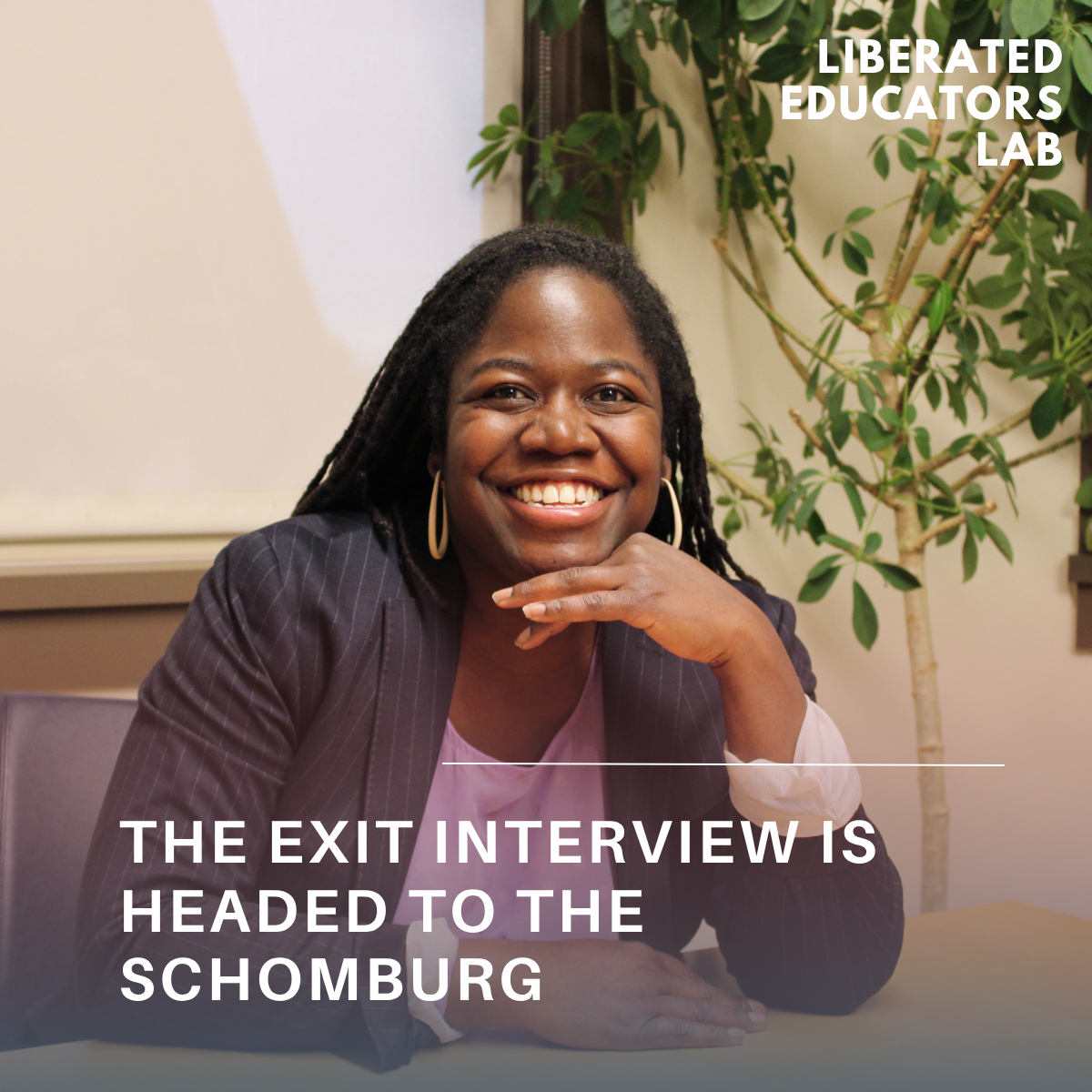
The Stories We Save: The Exit Interview at the Schomburg

In this special episode of The Exit Interview, Dr. Asia Lyons shares a milestone eight years in the making: the podcast's permanent archival at the Schomburg Center for Research in Black Culture, the first podcast ever accepted into its collection. She traces the story back to her own 2018 exit interview, the moment of relief that sparked the idea to give other Black educators a chance to tell their truth. Ninety-three episodes later, what began as a search for a simple narrative of racism and burnout revealed something far more layered: misogynoir, anti-Blackness, colorism, and the slow, hard-won return to joy and wellness after harm. Now, with the Schomburg preserving these testimonies as living historical record, Dr. Lyons introduces what's next: The Exit Interview Archive Project, an invitation to institutions and individuals to help carry Black educator stories further into the world. As she puts it, the stories we save, save us.

 RSS Feed
 Apple Podcasts
 Spotify
 Amazon Music
 iHeartRadio
 PlayerFM
 Deezer
 Key Takeaways
- Dr. Asia Lyons celebrates a monumental eight-year milestone as The Exit Interview becomes the first-ever podcast permanently archived at the Schomburg Center for Research in Black Culture.
- The podcast originated from Dr. Lyons' own 2018 exit interview and the profound relief she felt upon leaving the profession.
- Across ninety-three episodes, the podcast shifted from a simple narrative of burnout to a complex exploration of misogynoir, anti-Blackness, colorism, and the journey back to wellness.
- The Schomburg Center is now preserving these testimonies of Black educators as a living historical record.
- Dr. Lyons introduces The Exit Interview Archive Project to invite institutions and individuals to help sustain and amplify Black educator narratives.
In this special episode of The Exit Interview, Dr. Asia Lyons shares a milestone eight years in the making: the podcast's permanent archival at the Schomburg Center for Research in Black Culture, the first podcast ever accepted into its collection. She traces the story back to her own 2018 exit interview, the moment of relief that sparked the idea to give other Black educators a chance to tell their truth. Ninety-three episodes later, what began as a search for a simple narrative of racism and burnout revealed something far more layered: misogynoir, anti-Blackness, colorism, and the slow, hard-won return to joy and wellness after harm. Now, with the Schomburg preserving these testimonies as living historical record, Dr. Lyons introduces what's next: The Exit Interview Archive Project, an invitation to institutions and individuals to help carry Black educator stories further into the world. As she puts it, the stories we save, save us.
First of all.... have you signed up for our newsletter, Black Educators, Be Well? Why wait?
Amidst all the conversations about recruiting Black educators, where are the discussions about retention? The Exit Interview podcast was created to elevate the stories of Black educators who have been pushed out of the classroom and central office while experiencing racism-related stress and racial battle fatigue.
The Exit Interview Podcast is for current and former Black educators. It is also for school districts, teachers' unions, families, and others interested in better understanding the challenges of retaining Black people in education.
Please enjoy the episode.
Peace out,
Dr. Asia Lyons
Frequently Asked Questions
What is the significance of The Exit Interview podcast being archived at the Schomburg Center?
It marks the first time a podcast has ever been accepted into the permanent collection at the Schomburg Center for Research in Black Culture, cementing the lived experiences of Black educators as a living historical record.
Who is the host of The Exit Interview: A Podcast for Black Educators?
The podcast is hosted and produced by Dr. Asia Lyons, an educator and researcher dedicated to honoring the truths and wellness of Black educators.
What themes are explored in The Exit Interview podcast?
The podcast examines the reasons Black educators leave the profession, addressing systemic issues such as misogynoir, anti-Blackness, colorism, and racial battle fatigue, while prioritizing healing and joy.
What is The Exit Interview Archive Project?
Introduced by Dr. Asia Lyons, it is an initiative that invites individuals and institutions to support carrying the powerful stories of Black educators further into the world.
The Stories We Save: The Exit Interview at the Schomburg
Dr. Asia Lyons : Welcome to The Exit Interview, a podcast for Black educators. I'm your host, Dr. Asia Lyons, educator, researcher, story keeper, and founder of Liberated Educators Lab. This podcast is a space for Black educators to tell the truth about why we leave schools, districts, and institutions, and what we continue to build after we leave.
Here, we talk about racial battle fatigue, anti-Blackness, burnout, grief, joy, healing, liberation, and the complicated truth that leaving a system is not the same as leaving education. The Exit Interview is also a living archive of Black educator memory. The podcast has been accepted as a collection at the Schomburg Center for Research in Black Culture, making it the first podcast accepted as a collection there.
Every story shared here becomes a part of a larger record of Black educator testimony, wisdom, [00:01:00] refusal, and imagination. Because our stories matter, our experiences deserve to be preserved, and the stories that we save, save us. Now, let's get into the conversation.
Welcome back to The Exit Interview, a podcast for Black educators with me, your host, Dr. Asia. All right, folks. So normally I'm here with a guest and they're sharing their exit story, but today is a little bit different because I have a special announcement. The Exit Interview, a podcast for Black educators, is going to be permanently archived at the Schomburg Center for Research in Black Culture in the New York Public Library system.
This is a big deal for lots of reasons. It is also the first podcast to be part of their archive. It's big because it allows for Black educator stories to be a part of the historical record. So this special episode is going to be talking about the Schomburg and that collection and what it means. It's going to be talking about why our stories matter and [00:02:00] introducing something that I'm really excited about talking about with you all, which is the next steps after the archival project.
So just to get us kicked off, the first thing is like, how did we get here? I've told this story many different times, and I'm very proud to share that in two thousand eighteen I walked away from teaching after twelve years So at that time, I was teaching social justice to middle school students here in the Denver metro area in the Cherry Creek School District, and I had taught that class already for two years.
The first year it went really well. The second year it was extremely challenging, and that was because that was the year, that fall, that Trump was elected. And so all the folks who were not happy about social justice classes being taught to sixth graders in the first year bubbled up in that second year.
And so I experienced a lot of pushout from families, specifically white families and Brown families, [00:03:00] and then lack of support and pushout by my administration and my administration's boss. And we can go into great detail about what that looks like. But in the end, I decided in 2018 to leave education, traditional education spaces forever.
And so what I decided was that I was going to demand an exit interview from my superintendent before I left. So the summer that I left teaching, I emailed my superintendent and I requested an exit interview. Now, to be clear, that school district did not give exit interviews back in 2018, let alone with the superintendent.
But that made no difference to me. I wanted to make sure that he understood why I was leaving education and specifically his school district, and why lots of Black people at that time, at that same year, were also leaving education. And so I went up, I had my list of my experiences around racism, around pushout, about lack of support, the things that [00:04:00] happened with me in the union, all types of things.
And I started from the beginning of my list, and I moved all the way down. And I did that because I wanted to make sure that I left nothing on the table. I wanted my entire story to be shared, and it would be very clear. Now, to be clear, when I went into that space and when I left, I had zero expectation that my superintendent or the superintendent of that school district would ever change anything about the district.
The expectation wasn't that because I said something so special, that he would decide to change his district around. Of course not My expectation was I got to say what I have to say, and then there will be no doubt after that. Denial or not, I said what I had to say. So on the way out of that exit interview, I was walking back to my car, and I had felt this, like, rush of relief.
It was over. And then I thought, there are so many Black folks who leave traditional education spaces in early [00:05:00] childhood, K12, and higher ed who never have a chance to share their exit story about how they came into teaching, about why they chose to leave, what they're doing now. And so that's where the idea came for the exit interview.
At first, it was going to be a book, and I figured I'd interview some people or talk to some folks, write their stories, and put it in a book. But then I got to thinking about how when you write a book, the book has an end, right? And so there's only, you know, 20, 30 episodes or 30, 40 chapters or whatever that would come up in the book, and then that would be it, and then you had to, you know, publish subsequent books after that, and that just wasn't quite right.
Around, like, a year or so later, I was on a podcast, Two Dope Teachers and a Mic, so shout out to Kevin and Gerardo. I was on their episode, their podcast, and I said, "Hey, I got an idea. Can I put this podcast, the exit interview, on your show?" They said, "Yeah, sure." So for a while, [00:06:00] I was a special in their show, like, between their episodes.
So Kevin and I, we were co-hosts for a long time, and we would interview people about their exit stories, and eventually I decided to veer off and do this exit interview on my own. But that's how we got started. And so we are now, as of this taping, 92 episodes in of sharing the stories of Black folks who have been in traditional education spaces who have chosen to leave.
When I think about educators, I think about paraprofessionals. I think about our folks in our lunch systems, our food systems. I think about the teacher in the classroom, superintendents, deans. And so that's what I've been doing this time is interviewing people about their story. And what I've come to find out and what I see is that when I first started this podcast- I thought I would find something very simple, like a Black and white narrative where Black people were experiencing racism and then they chose to leave.
But [00:07:00] as time has gone on, more and more themes have become apparent. The original idea, the original theme that I was looking for, which was racial battle fatigue, which is a part of my dissertation research, did show up. And lots of people talked about having hives or panic attacks or having physical or mental illness or pushing away from their family and community.
So that was there. But then I also started to see that we have misogynoir in education, so Black women who experience misogynoir from their Black male counterparts. I started to see anti-Blackness show up. I started to see how people moved from one state to the next state and had the same experiences.
And then for some people, country to country had the same experiences around racism, sexism, homophobia. I've heard stories of colorism. So it's grown. And so this conversation about what does it mean to retain Black educators has become much more complex [00:08:00] in my mind because I'm hearing more and more stories that break up that narrative of it's racism or it's burnout or it's not enough pay.
It's much more complex than that. And so that's what I'm really loving. I'm also loving that people who've experienced harm in education find their way back to joy After grief. One of the questions that I ask on the podcast all the time is, for you, what does it mean to be well? And I ask that question because a lot of us in education do everything for the students and the family and the community, and we're always doing, doing, doing.
Staying late, spending all of our own money, getting up early, giving kids rides to school, showing up at kids' birthday parties, all these other activities, professional developments to be better at our job. But the idea of being well and wellness in our health is not a part of that conversation. And so when I ask that question of like what does it mean to be well, people a lot of times pause.
And sometimes they talk about [00:09:00] how they didn't understand what it meant to have wellness in their lives and healing and community care and self-care before leaving teaching. And then they talk about, these guests, all the ways that healing and wellness and love and joy show up for them now on the other side of education.
So yeah, that's what we've been up to. And all those stories and all that understanding, all that the podcast has revealed is going to be in the Schomburg. And so why the Schomburg? Why does that matter? Again, this podcast isn't gonna be forever. I'm not going to live forever. My plan always was to interview until I just was ready to retire from this or to step back from it.
And I needed to know that when this was over and I was done paying for the website, and I'd no longer maintain the YouTube channel, that there would be a place for our stories to live on. And for a long time I didn't know what that looked like. I just knew that they had to be somewhere. But [00:10:00] talking to s- one of my good friends, shout out to Blair, she suggested that I reach out to the Schomburg.
And understanding and always have known for a long time the history and the legacy and the importance of the Schomburg, not just to the New York Public Library system, but to the world, right, made me want to reach out even more. And so this gives a chance for our work, our stories, our lived experiences, our laughter, our joy, our grief to be part of something permanent.
To be a part of Black cultural memory and importantly, to be a part of future research. What I love about the Schomburg is that the stories of Black folks who share here on the podcast does not just sit on a shelf or the back of a website. The Schomburg has researchers, they have fellows that come in all the time, even youth, all the time who utilize the archives and the pieces and information within the archive, within [00:11:00] Schomburg, which means that it's living, that people will be using this information.
And so my hope is that We can have more and more folks who are interested in the lived experiences of Black educators listening to these stories beyond my website, beyond what we're doing here in Denver, but in New York, in Ghana, in South Carolina, in Florida, in Alaska, because our stories matter. And so I'm so excited about that.
And I'll say one more thing about the Schomburg specifically. The collection is there, and I've already submitted the first 83 episodes, so episode one all the way up. But because the interview has a collection there, I'm able to continue to add more podcast episodes to the collection, and this is really important.
That means that everyone's story on the podcast goes into a permanent archive, right? It's not just like, "Oh, you missed out on the opportunity, and now that's it." Everyone gets a [00:12:00] chance to have their story permanently archived at the Schomburg who fits within the qualifications. And what is that? A person who taught in education, who is Black, who wants to share their story and their truth.
So really excited about that, and I'm just so grateful for the curators over there and for my editor, for Kevin and Gerardo so for saying yes so long ago, for every single guest that showed up. The next thing after this is like, okay, so the podcast gets archived, and the Schomburg has things that they're doing to make sure that people are hearing our stories, then what's that next for Liberated Educators Lab and what's next for this work?
For me. And so what's coming next is The Exit Interview Archive Project, which is an archival project for liberated educators. And this is an opportunity for funders, for education institutions, for community groups and individuals to interact with these stories and with my [00:13:00] organization, Liberated Educators Lab, to help to bring the narratives of Black educators out into community even more.
And that can be through, uh, curation at other museums and library systems. That could look like partnerships. That can look like conversations about what it means to retain Black educators in this complex world. There's lots of opportunities for us to continue to have conversation, not just collecting the stories of Black educators, but what do we do with the information they've provided and trusted us with, right?
'Cause that's what it's about. They share the story, and then what do we do with those stories? A part of that is beyond story keeping is making sure that these stories make a difference in the lives of Black educators in our future, right? So I would love for you all to be a part of The Exit Interview Archive Project.
If you're interested, please reach out about how you can be a part of it, how your organization, your school, your institution can be a part of it. [00:14:00] And then for the rest of us who are just like, "I'm just in the vibe. I'm just excited. I just feel so happy for you," I would love for you to continue listening to the podcast.
I would love for you to share the podcast. I love to- for you to be a part of Podcast and Pause, an book club for Black educators that we have two times a year that listens to the stories of Black folks, and we listen to those stories and we heal. If you're a Black educator or a Black person in the education space, we'd love for you to be a part of that.
Invite others to come onto the podcast if you've been a guest before. And if you've been, like, teetering back and forth about whether you should be a guest, I'm inviting you to come on in. I'm inviting you to have a conversation to see if it fits for you, to listen to other episodes and see if it's a good fit.
And just continue to tell your story. If you're a Black person and you've left education, your story does matter. Continue to share that story. Continue to reach out. Continue to be a light for other people, and make sure to let people know, yeah, I left [00:15:00] education and this space and I'm still supporting youth.
I'm still taking care of myself. I'm on sabbatical. I'm helping community. I'm going back and, and helping in non-profit sector because people need to know that we are thriving beyond a traditional K12 or ECE or higher ed space. So that's the announcement. We're headed to the Schomburg. If you have any questions, please reach out to me at asia@liberatededucatorslab.com.
I love to have a conversation with you. And peace. Have a great rest of your day. All right, bye
Thank you for listening to The Exit Interview, a podcast for Black educators. If something in this conversation made you feel seen, affirmed, challenged, or less alone, I invite you to share this episode with another Black educator, former educator, school leader, researcher, or someone who needs to better understand what Black educators carry and what we continue to build.
You can learn more about the [00:16:00] podcast, explore past episodes, and follow the growing archive at exitinterviewpodcast.com. You can also learn more about my broader work through Liberated Educators Lab, where we create research, storytelling, and healing center spaces for Black educators and the communities who love us.
The Exit Interview is part of a living archive of Black educator memory, now accepted as a collection at the Schomburg Center for Research on Black Culture. So keep listening, keep telling the truth, keep building liberated futures, and remember, the stories we save, save us. Thank you

CEO and Principal Consultant
firm that supports foundations, schools, and other non-profits in creating culturally responsive programming and curriculum through equity-centered design thinking.
Before founding Lyons Educational Consulting, Dr. Lyons worked as a K-12 educator for over 10 years. She also served as the school-partner specialist. She worked with schools and other non-profits across the Denver Metro Area to provide communities with resources to help close the access gap for Black children and children of Color.
Dr. Lyons has her doctorate in Leadership for Educational Equity. Her research focuses on how racism-related stress and racial battle fatigue cross over from Black educators to their families.
In addition to her work in consulting, Dr. Lyons is the co-host of, The Exit Interview: A Podcast for Black Educators, a podcast focusing on the lived experience of former Black educators. Finally, she co-facilitates the Black Educator Wellness Cohort, a healing space created to support Black educators and their families with racial trauma.