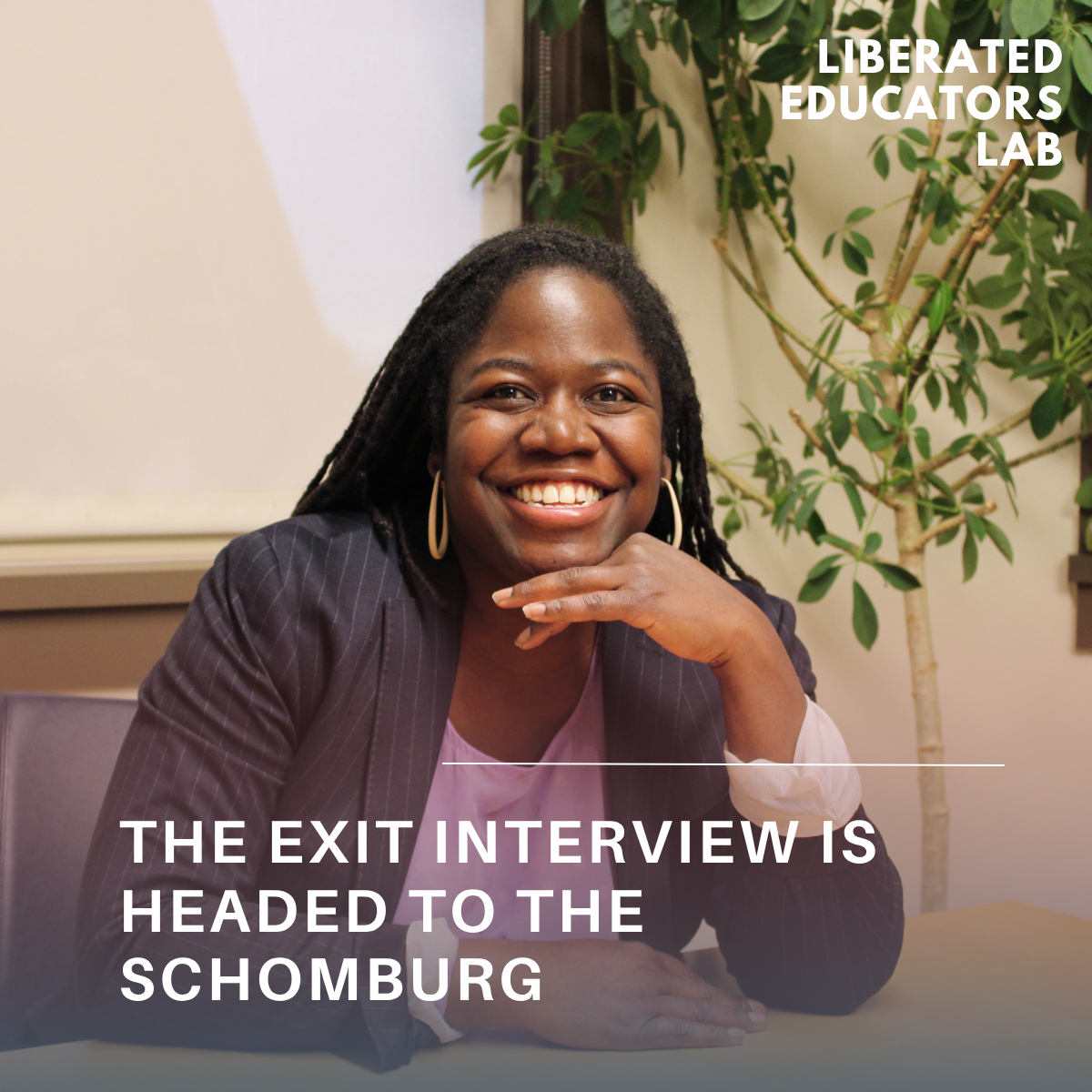
When The Harm Follows You: Black Educators, Nonprofits and Racial Battle Fatigue

From, Letters from the Lab
The morning before I was fired from my last job at a nonprofit organization, I stood in front of my bathroom mirror and asked myself a question:
Do you want to stay or do you want to go?
I remember looking at myself and answering honestly.
I want to leave.
At that point, I had already changed. I had become quieter. More detached. Less hopeful. I was spending more energy trying to survive the workplace than trying to help transform it.
What made that moment especially painful was that I had entered the nonprofit sector believing I was leaving harm behind.
After leaving teaching, nonprofit work felt like the natural next step. The organization I joined worked with youth. Its mission aligned with the same values that had drawn me into education in the first place. Like many Black educators, I still deeply wanted to serve community. I still wanted to support young people and families. I still wanted my work to matter.
And I think that is an important part of this conversation that often gets overlooked.
Many Black educators do not leave schools because they stop caring about community. In fact, many of us leave because we care so deeply that the harm becomes unbearable. So when we transition into nonprofit work, there is often hope attached to that decision. We believe we are moving toward something more aligned. More humane. More healing.
Listening to Kamye Hugley’s episode of The Exit Interview reminded me just how common that journey really is.
Black educators leave toxic school systems and move into nonprofit spaces, believing they will finally be able to continue mission-driven work without experiencing the same kind of racialized exhaustion they endured in education.
Only to discover the harm followed them there, too.
Different building. Different language. Different mission statement.
Same fatigue.
Kamye described what it felt like to slowly become detached at work after realizing leadership was going to do what they wanted anyway.
I knew exactly what she meant.
There comes a point in many harmful workplaces where Black women stop believing honesty will change anything. So we begin adapting ourselves to survive. We become quieter in meetings. We conserve energy. We stop volunteering certain truths. We do what needs to be done while privately planning our escape.
It's not due to weakness or disengagement; rather, survival demands careful calculation.
Bills still need to be paid. Families still rely on us. Children still need care. Health insurance still matters.
That tension is something my research continues to explore through the lens of racial battle fatigue and its spillover into family life. Racism-related stress does not simply stay at work. Over time, it spills into homes, relationships, parenting, emotional well-being, and physical health.
Kamye talked about discussing her decision to leave with her husband and having his support financially and emotionally. But many Black women do not have that kind of safety net. Some are supporting entire families. Some are staying because leaving feels financially impossible. Some are trying to survive workplaces that are harming them while simultaneously trying to protect the people they love from carrying the weight of that harm too.
And all the while, organizations continue expecting Black women to carry everything.
In our conversation, I said that Black women often become the emotional, operational, and racial infrastructure of organizations.
We are expected to fix things. Represent things. Absorb things. Carry things.
Our labor becomes infinite.
When Kamye shared that she was managing eleven priorities and was told that “everything is a priority,” I immediately recognized the assumption underneath that statement.
Figure it out. Work longer. Carry more. Stay later.
Because that is what Black women do.
Mission-driven organizations often publicly position themselves as progressive, community-centered, and equity-focused. But nonprofits are not exempt from white supremacy simply because they serve marginalized communities.
Over time, missions shift. Funding pressures grow. Leadership changes. Scope creep expands expectations. Organizations lose sight of the people doing the labor while continuing to demand more from them.
And eventually, something begins happening to the workers themselves.
The part of Kamye’s episode that stayed with me most was when she said:
“I was more afraid of who I would become working there than what would happen to me if I didn’t.”
I understood that immediately.
Because staying too long in harmful institutions can transform people.
You continue to compromise and look away from injustice. You act as if you don't notice. You keep accepting further harm and diminishing yourself just to get by..
And eventually, you look up and realize you are becoming someone you do not recognize.
I've observed this phenomenon in schools and nonprofits. I've seen Black individuals remain in organizations for so long that their survival gradually changed them into people they never originally aimed to become.
That is the part of racial battle fatigue we do not talk about enough.
Not just exhaustion. Transformation.
You just end up being a monster.
I did not mean that cruelly. I meant that prolonged harm changes people. Silence changes people. Constant compromise changes people. Existing inside systems that repeatedly ask you to betray yourself in order to survive changes people. I know for a fact if changed me.
And if we are honest, many of us have witnessed this transformation happen to people we once admired. Sometimes we have witnessed it happening in ourselves.
That is why this conversation matters.
Not because every Black educator or nonprofit worker should immediately quit their job. Survival is real. Financial obligations are real. Fear is real.
But because Black people deserve workplaces where surviving does not require disappearing.
If you left education and found yourself experiencing the same racialized exhaustion in nonprofit work, that does not mean you failed.
The education system includes the non-profit sector; it was designed that way.
And you deserve the opportunity to find work that allows you to remain whole. Not work that leaves you trying to gather the shreds of yourself after you finally leave.


CEO, Lyons Educational Consulting | Host & Producer, The Exit Interview: A Podcast for Black Educators
Dr. Asia Lyons is the founder and lead designer at Lyons Educational Consulting (LEC) LLC. In partnership with communities, organizations, and schools, Lyons Educational Consulting supports co-creating truly inclusive environments that assist Black educators toward self-actualization through wellness spaces.
Dr. Lyons brings a wealth of practical and academic knowledge to her role. She has served as a K-12 educator in the Denver Metro Area and an adjunct professor at the esteemed University of Colorado - Denver School of Education and Human Development. Additionally, she has worked as a school partner specialist, collaborating with schools and non-profits across the Denver Metro Area to provide communities with resources aimed at closing the access gap for Black children and children of Color.
Dr. Lyons' research is a testament to her unwavering commitment to addressing critical issues. Her doctoral studies in Leadership for Educational Equity, with a concentration in Urban and Diverse Communities, delve into the profound impact of racism-related stress and racial battle fatigue on Black educators and their families. As a reciprocal gesture to Black educators, she co-founded and co-facilitates the Black Educator Wellness Cohort, conducting free monthly wellness sessions in the Denver Metro Area as well as other support services for Black educators nationwide. Dr. Lyons has shared her insights at prestigious platforms such as SXSW EDU, Harvard Graduate School of Education, The State of Black Learning, and the National Board of Certified Counselors Symposi… Read More

Being Committed without Being Consumed


