Radical Self-Care Is A Part of Great Leadership
Radical Self-Care Is A Part of Great Leadership
By Dr. Asia Lyons, Host and Producer of The Exit Interview: A Podcast for Black Educators
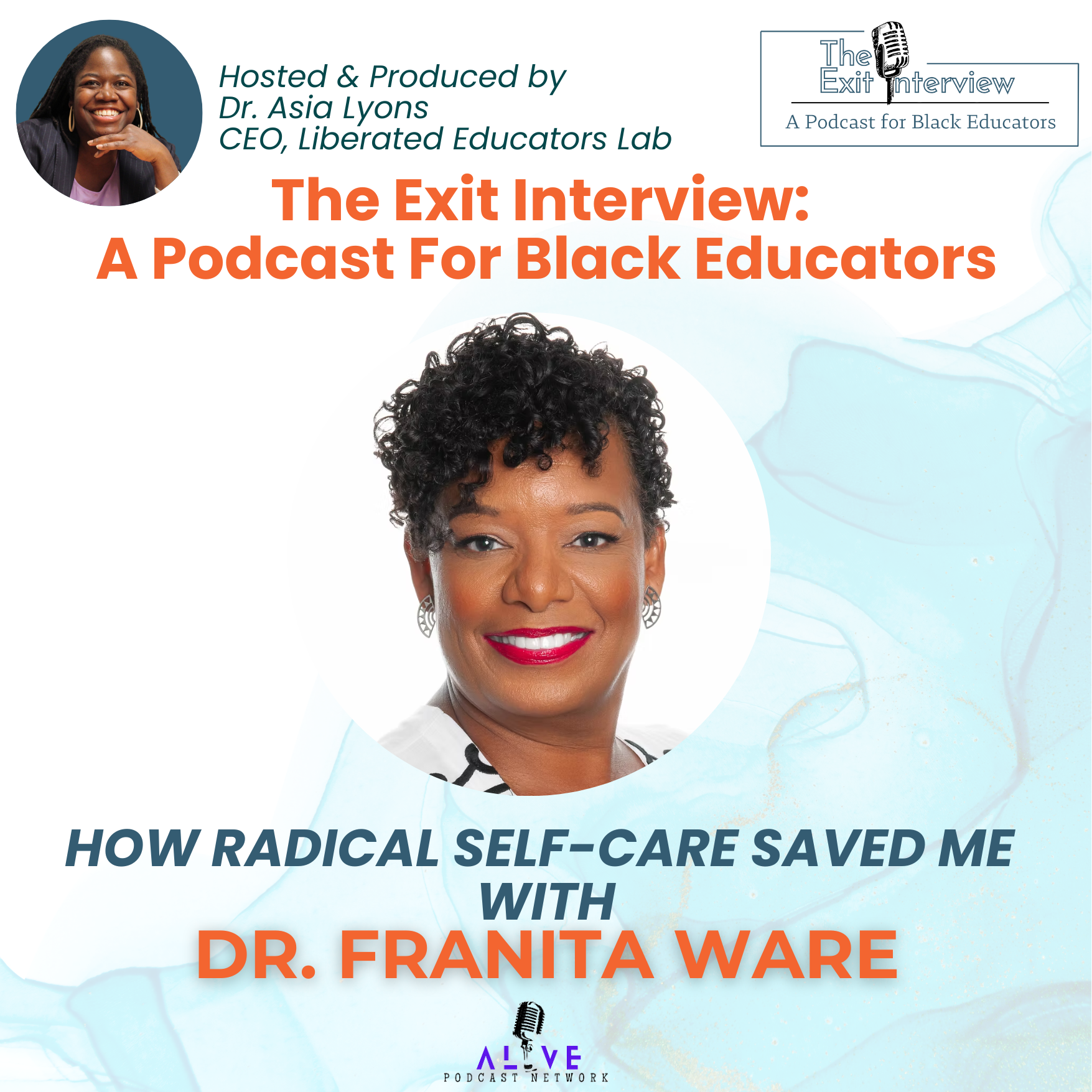
When I sat down with Dr. Franita Ware for The Exit Interview, I thought I knew where our conversation would go. I expected to talk about her book Warm Demander Teachers, her time at Spelman, and her brilliance as a researcher. But as she spoke, something else unfolded — something quieter, more urgent, and deeply familiar to many of us who lead and love our schools.
Dr. Ware told me about the moment she thought she was having a stroke.
She wasn’t, but her body finally reached its limit. After years of high-stakes leadership, late nights, and constant giving, exhaustion had taken over. The fatigue, mental fog, and difficulty recalling why she entered a room weren’t random; they were signals from her body, revealing the truth before she recognized it herself.
Rather than dismissing it as “just stress,” she took a brave step that few leaders are willing to take. She recognized it was time to prioritize her well-being, allowing her body the space and time needed to heal. This led her to write Radical Self-Care.
Healing as a Leadership Practice
In our conversation, Dr. Ware said something that my audience has heard me say for a long time on the podcasts, in workshops and community:
“Before teachers can be warm demanders for students, they have to be well themselves.”
So often, we ask educators and especially our Black women leaders to model resilience without modeling rest. We celebrate their ability to “push through,” but rarely their decision to pause. Why is that? Where did the celebration of working ourselves literally to death come from?
If you’ve had the time to listen to her episode, you would know and hopefully agree with Dr. Ware’s when she shares that radical self-care isn’t about scented candles or a spa day. It’s about re-training your nervous system to believe that rest is safe, that joy is allowed, and that care is not a reward — it’s preparation for the work ahead.
She calls it “rewiring the brain.” a revolutionary act purely because it bumps up against what is expected of educators. Rewiring the brain means:
- Drinking water throughout the day
- Taking days of work simply to rest, not run errands or complete appointments, just rest
- Not feeling guilty for not staying after school to finish one more thing
You get the picture.
When school leaders embrace radical self-care, it does something powerful to the culture of a building. It gives permission. It says to teachers, you don’t have to break yourself to belong here. It tells students that wellness is not weakness. And it reminds the system that sustainability, not martyrdom, is what keeps us in the work long enough to see change.
The Courage to Choose Yourself
Dr. Ware shared how, after being pushed out of a principalship, she felt disoriented. She had left a thriving career in Atlanta surrounded by Black educators who nurtured her and found herself in a city that didn’t quite know how to hold her brilliance. Have you been in a similar situation? I have.
She described the moment she decided to “bet on Black,” meaning, bet on herself, her own ideas, and a future she couldn’t see but was waiting for her to say yes to.
That leap of faith led her to build her consulting practice, finish her book, and begin teaching Radical Self-Care to others.
What I love about her story is that she didn’t heal after the work — she healed through the work. She let her pain become curriculum. And now she’s teaching leaders how to turn exhaustion into reflection, reflection into transformation, and transformation into school culture.
That’s what real leadership looks like.
What School Leaders Can Learn
If you’re a principal, a coach, or a district administrator reading this, I’ll say this gently: you cannot lead people toward wellness from a place of depletion.
Radical self-care doesn’t take you away from your leadership it makes your leadership sustainable. Imagine what would happen if every meeting began with a mindful breath, if hydration challenges came with coverage for restroom breaks, if you normalized mid-day walks instead of burnout bragging rights.
These are not small things. They are signals.
Signals that wellness is cultural, not optional.
Final Word
As Dr. Ware reminded me, “When you do self-care consistently, it stops being transactional, it becomes transformational.”
This is your invitation to choose transformation over survival. To bet on yourself the way Dr. Ware and many other administrators who have been on my podcast have done. To build communities that don’t just teach wellness but live it.
Because the work we do with Black educators and Black children is sacred. And sacred work deserves a well soul.
So…now what?
Listen to my full conversation with Dr. Franita Ware on The Exit Interview: A Podcast for Black Educators.
Then, take five minutes today, yes, today to pause, breathe, and ask yourself: You do have the time.
What would it look like to lead from wellness instead of exhaustion?
👉 Listen to the full episode here.
👉 Learn more about Dr. Ware’s book Warm Demander Teachers at warmdemanderteachers.com.

CEO, Lyons Educational Consulting | Host & Producer, The Exit Interview: A Podcast for Black Educators
Dr. Asia Lyons is the founder and lead designer at Lyons Educational Consulting (LEC) LLC. In partnership with communities, organizations, and schools, Lyons Educational Consulting supports co-creating truly inclusive environments that assist Black educators toward self-actualization through wellness spaces.
Dr. Lyons brings a wealth of practical and academic knowledge to her role. She has served as a K-12 educator in the Denver Metro Area and an adjunct professor at the esteemed University of Colorado - Denver School of Education and Human Development. Additionally, she has worked as a school partner specialist, collaborating with schools and non-profits across the Denver Metro Area to provide communities with resources aimed at closing the access gap for Black children and children of Color.
Dr. Lyons' research is a testament to her unwavering commitment to addressing critical issues. Her doctoral studies in Leadership for Educational Equity, with a concentration in Urban and Diverse Communities, delve into the profound impact of racism-related stress and racial battle fatigue on Black educators and their families. As a reciprocal gesture to Black educators, she co-founded and co-facilitates the Black Educator Wellness Cohort, conducting free monthly wellness sessions in the Denver Metro Area as well as other support services for Black educators nationwide. Dr. Lyons has shared her insights at prestigious platforms such as SXSW EDU, Harvard Graduate School of Education, The State of Black Learning, and the National Board of Certified Counselors Symposi… Read More

Being Committed without Being Consumed