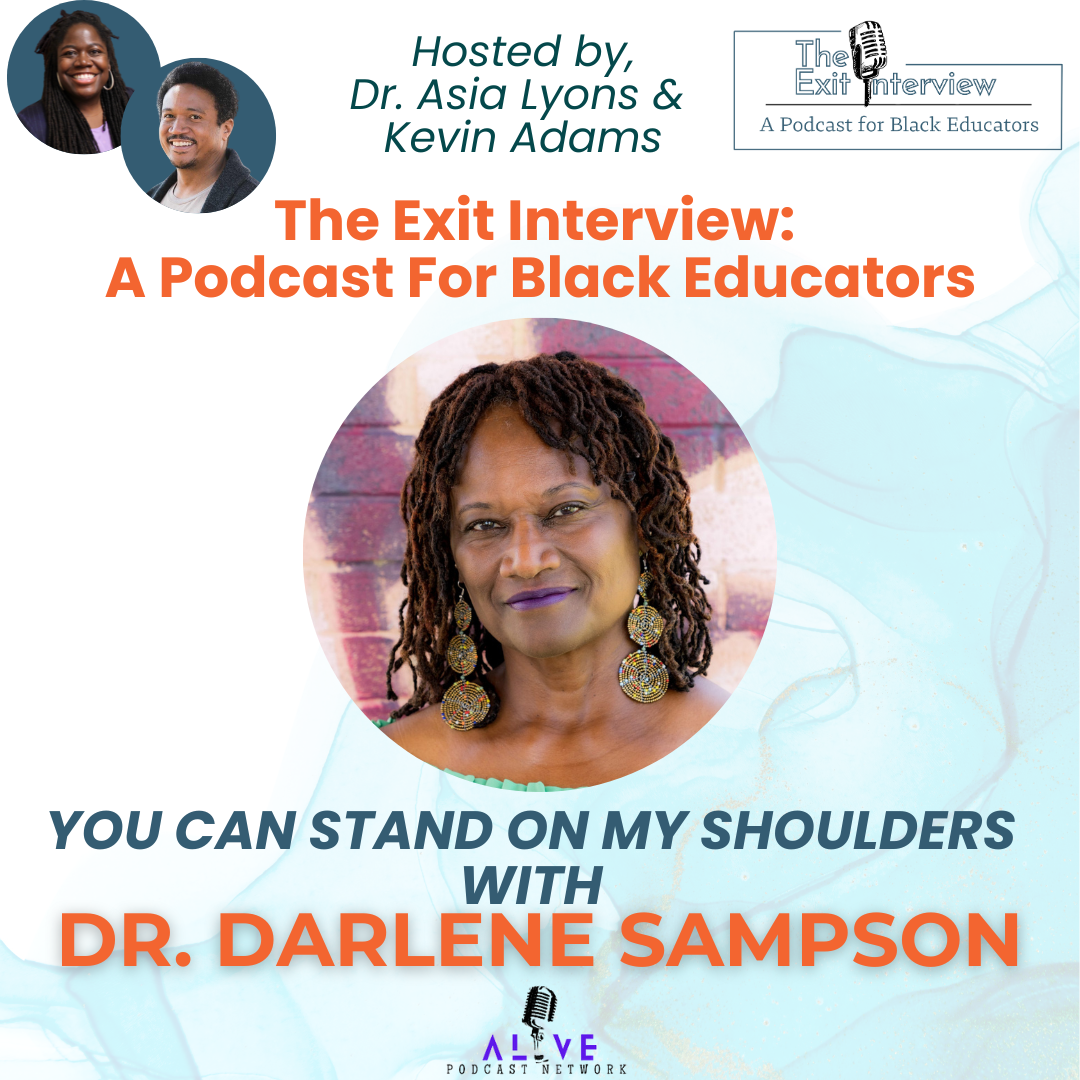
You Can Stand on My Shoulders with Dr. Darlene Sampson
Equity is the goal for nearly every diverse school district in the country. As the ripple effects of generational trauma and systemic oppression continue to be felt in communities of color, especially Black and Brown communities, districts like the Denver Public Schools have created positions and offices of equity, inclusion, or both.
Dr. Darlene Sampson, equity specialist coordinator at the Western Educational Equity Assistance Center and a clinical field faculty in the Department of Social Work at Metropolitan State University of Denver, was once the director of Culturally Responsive Education in Denver Public Schools, bringing with her three decades of experience to a vitally important office, especially as the district sought to end generational inequity and trauma within the school system. In 2006 she stepped into the position, confident and excited to begin the work that not only was she was she passionate about, she had lived it, growing up in Pueblo, Colorado where “there were not that many of us.”
Soon, she discovered that her employer was not prepared to do the work. They were not ready for her greatness, which is to say that they did not establish the conditions under which true Culturally Responsive Education could grow. Instead of building a space for liberation, she describes her daily work as a battle ground, and even finds the term “Racial Battle Fatigue” to fall short in describing what she experienced. It was a plantation experience.
Today, Dr. Sampson shares with us her experiences fighting the good fight, the correct fight, and the work in which she is currently engaged. She harbors no ill will; she simply realizes that her employers were simply not prepared for what Culturally Responsive work required.


Show Notes: You Can Stand on My Shoulders with Dr. Darlene Sampson
Episode 6 of The Exit Interview
Hosts:
- Dr. Asia Lyons
- Kevin Adams
Special Guest:
- Dr. Darlene Sampson, Licensed Clinical Social Worker, PhD in Culturally Responsive Pedagogy, Director of Cultural Responsive Instruction, and current leader at the Western Educational Equity Assistance Center.
Episode Overview
In this powerful episode, Dr. Asia Lyons and Kevin Adams welcome Dr. Darlene Sampson to discuss her journey as an educator, social worker, and advocate for equity in education. Dr. Sampson shares her personal story, the challenges and triumphs of her career, and offers invaluable advice for educators, administrators, and especially Black educators navigating the complexities of the education system.
Key Topics & Highlights
1. Dr. Sampson’s Background & Calling
- Raised in Pueblo, Colorado, in a close-knit church community.
- Service and leadership instilled from a young age by her parents.
- Early exposure to public speaking and community care.
- Dual career in social work and education, blending both fields to support students holistically.
2. The Power and Challenge of Representation
- The importance of Black educators and culturally responsive teaching.
- Dr. Sampson’s doctoral work on “Cultural Vibrancy” and how all students benefit from culturally relevant pedagogy.
- The emotional and professional toll of being a pioneer in diversity, equity, and inclusion work.
3. Racial Battle Fatigue & Systemic Barriers
- Dr. Sampson’s experience as Director of Cultural Responsive Instruction in Denver Public Schools.
- Facing resistance, microaggressions, and intersectional challenges (race, gender, colorism).
- The concept of “racial battle fatigue” and the need for support systems like her “Trainer of Trainers” (TOTS) team.
4. Centering Student and Educator Voices
- The necessity of listening to Black and Brown staff and students.
- The dangers of invisibility and tokenism in schools.
- The need for authentic community engagement and validation.
5. Advice for Leaders and Educators
- Administrators must create safe, validating environments for staff of color.
- Avoid performative equity—move beyond mission statements to real action.
- Build community, listen deeply, and support staff holistically.
6. Guidance for Black Educators Considering Leaving
- Recognize and value the breadth of your experience—brand yourself beyond “teacher.”
- Leverage community work, mentorship, and advocacy as professional assets.
- Prioritize your health and well-being; it’s okay to move on and let others carry the torch.
7. Dr. Sampson’s Current Work
- Leading equity initiatives across 13 states and 3 territories with the Western Educational Equity Assistance Center.
- Providing free support to K-12 schools on issues of race, national origin, trauma, and Title IX, funded by the U.S. Department of Education.
Notable Quotes
- “Service is what you do, girl. That’s what’s expected of you—to stand on those shoulders, to make our family proud, to represent Black folks.”
- “We are groomed to teach. That’s why we’re so resilient.”
- “If you’re not ready to talk about the metastasized cancer of inequities in our society, you’re not ready to do culturally responsive teaching.”
- “Sometimes you need to leave. You did what you could do in this space. Now let someone else carry that torch.”
First of all.... have you signed up for our newsletter, Black Educators, Be Well? Why wait?
Amidst all the conversations about recruiting Black educators, where are the discussions about retention? The Exit Interview podcast was created to elevate the stories of Black educators who have been pushed out of the classroom and central office while experiencing racism-related stress and racial battle fatigue.
The Exit Interview Podcast is for current and former Black educators. It is also for school districts, teachers' unions, families, and others interested in better understanding the challenges of retaining Black people in education.
Please enjoy the episode.
Peace out,
Dr. Asia Lyons
You Can Stand on My Shoulders with Dr. Darlene Sampson
Dr. Asia Lyons: [00:00:00] What's good Y'all
Dr. Darlene Sampson: welcome back episode six of the exit interview. So excited. Kevin, how you feeling? I'm
Kevin Adams: feeling good. Feeling great. Excited for this interview tonight, but overall excited 'cause we're getting. Closer to the end of the school year.
Dr. Darlene Sampson: Yeah. Well, who's counting?
Kevin Adams: Oh, I am,
Dr. Darlene Sampson: that's correct. Um, so we have Dr.
Darlene Sampson on tonight. So excited to hear her story, um, and just figure out like how her story can help, um, administrators, teachers, all of our, um, folks listening, um, support them in understanding the lived experiences of black educators. But before we get started, our intro as always, don't [00:01:00] forget. To follow us on at two Dope Teachers on Instagram and Twitter.
You can like us on facebook@facebook.com slash two Dope Teachers and a mic, our email address in case you wanna email us to be on the show, ask us questions or whatever. It's two dope teachers@gmail.com. That's TO obviously. You can listen to us on Apple and Spotify podcast or@mrmunoz.org. If you do listen to us on Apple, please leave us a five star rating and review.
It really does help others find us and get our content. Finally, if you want to support us financially, which we know you do, that's over to, that's right. Head over to patreon.com. Slash two dope teachers where you can become a PA patron for just $5 a month. And I just gotta put this out there, the two dope, uh, nation sticker.
When you get your $15 contribution, when you do [00:02:00] that, can't beat it.
Kevin Adams: You can't. You can't. Yes.
Dr. Darlene Sampson: Yes. Shout out to Sham
Kevin Adams: for the artwork.
Dr. Darlene Sampson: Yeah, it was super dope. So make sure you go over there and support, um, patron.com/two dope teachers and we'd depreciate it. Alright, let's go ahead and get started. Episode five.
So again, thank you so much Dr. Samson for joining us. Absolutely. Yeah. And we just like, as always, feel free. This is conversation start. First question we always start off with is like, what's your story? How'd you get into education? And then really like what led up to you leaving the K 12 space? Um, and feel free to tell us your story.
Hello everyone. Uh, get your phone, get your pencil and paper. We about to have a clinic. Okay? Let's go. Okay, so, um. I'm Dr. Darlene Sampson. And let me tell you about my story from the beginning because I didn't choose education and social work. It chose me.
Kevin Adams: Huh?
Dr. Darlene Sampson: And I [00:03:00] was one of those people that, um, I grew up with pastors.
My mother was a missionary, my father was a pastor. You know those Koic folks? Hallelujah. Yes. Mm-hmm. And, uh, I was raised in the church and I was one of those individuals who my parents were very clear. Service is what you do, girl. That's what you do. That's what's expected of you to stand on those shoulders, to make our family proud, uh, to represent black folks.
So very, very early on, growing up in the church, speaking in the church, talking in the church, um, you know, you had to get up there and they used to call that little piece that you had to say on. Easter and Christmas and Yes. Yes. Uh, so I learned how to talk. I was a public relations master when I was just 10, practically, because I learned how to speak to people and connect with people and to see what they needed.
And so early on, education. Social work were my pieces because my mother also [00:04:00] took in, um, individuals who were struggling with mental illnesses and she supported people with mental illnesses. And so at that time, way back when I was born, there was not a lot of support and particularly for black folks.
Mm-hmm. Support. And so the spirituality and the caring were all wrapped together. So it wrapped around me and it became ingrained in me. So that's kind of how I chose. Education and social work. I am a licensed clinical social worker by trade, but I also have a PhD in cultural responsive pedagogy, teaching educators how to connect instructionally, socially and emotionally with diverse, um, children, groups, kids who have, uh, special needs or differentiated learning needs.
So, mm-hmm. That's, um, what I've done and my work has. Really just mix both fields. I haven't divorced the two. Social work and education. I keep them together. One helps me understand human behavior and the other helps [00:05:00] me move change, um, and look at the, um, system of education. And so that's, that's kind of how I got to both of those areas.
Kevin Adams: Okay. Hmm. I love that idea of, uh, I can relate to it because I was thinking about my own family, um, because we have a lot of teachers in my family and I'm like, well, what, what is that? You know? But I think the commonality is. We come from a ra, a family that was raised in the church and this idea of service.
Mm-hmm. And, and that, that you give back. And so like, I'm, I, I start to think about us, my generation of the family, all of my cousins who went into education and, and, and that just really hits with me. You know, that idea of you learn it from a, a young age. Mm-hmm. That it's important what you do. Because it impacts the others who are gonna come after you.
Dr. Darlene Sampson: Yeah. But you know, black PE people, we teach all the time.
Kevin Adams: That's right. '
Dr. Darlene Sampson: cause in order for us to stay safe, in order for people to understand us [00:06:00] culturally, in order for us to, um, see the world in multiple ways, in order to be validated, we're always teaching. So we are groomed to teach. Um, and that's why we're so resilient, because we've learned how to teach in ways that engage others.
So, um, that's just who we are. We are teachers, we're educators, we're social workers. Um, we are spiritual folks. So it comes natural to us. It's ingrained in us. Yeah. I love that we are groomed to teach. I love that.
Kevin Adams: I love that. I love that. And when you say that, like I think about all the lessons I learned, WW uh, you know.
With my mom, my grandma, my dad, my grandpa. You know, always those lessons that were always coming through about everything, you know? Yes. In the world. And, and I just think about that, that powerful education, um, that I've gotten and it makes me think about this idea. You know, I think what, [00:07:00] what our podcast is about is, is why are black?
Why do black educators leave? Right? Because a lot of us, and I, I felt this way. A, um, like we, we teach for a different reason. Yes. There's a different reason why we go into it. It's not just to get a paycheck. It's not because summers, uh, we have summers off. Although all of those things are nice. Yeah. I, I, we, we come into it.
Most black educators that I meet say, you know, I wanted to impact kids who were like me. Yes. For sure. And help my people Sure. For
Dr. Darlene Sampson: absolutely. Mm-hmm.
Kevin Adams: So, and, and, and, uh, Dr. Sibson, where, where is it that you grew up? Where'd you grow up?
Dr. Darlene Sampson: Okay. That's a long story. Uh, okay. I grew up in Pueblo, Colorado. Okay.
There's not many of us there. It's, that's a whole podcast. Okay. That's a, that's another podcast because, um, but I had this large, not large, but a kind of a medium church family. Yes. So the people around me looked like me [00:08:00] and they cared for me and watched over me. Um, but in a town of a hundred thousand, there might be 2000 black folks in, uh, Pueblo, Colorado, but that's where I grew up.
Wow.
Kevin Adams: Wow. Even
Dr. Darlene Sampson: still now. Even still now, you think. And most of them have left actually. It's diminished, it's lower. Uh, even the numbers are lower from the a hundred thousand. Uh, a lot of people had to move out or find other jobs. The steel mill closed. That's where a lot of the black folks worked when I grew up.
Um, my parents weren't my. Mother was in health and my father was in the automotive business, but they were both, um, uh, they had the church as well, and we had this choir that sang all over and he'd come to Denver. And so I was exposed really early to, you know, just going places and doing different things.
But, uh, we stayed in our close knit area and across the street was someone black from me around the corner, someone's black from me. We stayed in a specific area in Pueblo. And everybody knew everybody and everybody knew everybody's [00:09:00] business.
Kevin Adams: Yep, of course. Yep, yep.
Dr. Darlene Sampson: So did you, I had about five mamas who watched over me.
Uhhuh told on me all the time. All the time. I believe that. So did you start your teaching career or your, um, you said, is it teaching social work? Thank you. Thank you. Did you start your social work career in Pueblo or were you moved to Denver or somewhere else? Well, I watched social work and watching my mother, uh, as a health provider and also caring for individuals with mental illnesses.
But, um, I didn't, when I first went to college, I left Pueblo and went to Greeley, Colorado, and that's where I received my first degree. I had a double major in rehabilitation and psychology, and from there I came back and start working in child welfare. And I worked in child protection probably 10 years, a long time, and, and went from child protective worker all the way up to a [00:10:00] supervisor in Adams County.
Kevin Adams: Oh, okay.
Dr. Darlene Sampson: So I worked there for a long time in social work and um, probably after working many, many years, I got my master's. Maybe five years after that. I got my master's degree in social work and I was teaching. Um, social work students. So I was doing education at higher ed, ed level Uhhuh, not K through 12.
So I was teaching for those who were seeking their masters in social work and, but they also were working with lots of diverse populations and we know who disproportionately comes into these agencies Yes. And need support and counseling and so I had to do a lot of work. So it was teaching and social work together.
And somet probably within 25 years of having my master's in social worker, I said, you know what? I'm in schools as a social worker. I want to have a greater, um, more information, um, more understanding of teaching. So I then went and move to, um, [00:11:00] pursue a doctoral degree. So it was a big leap from social work and so, and being in schools to being a doctoral student at the University of Colorado.
So that's what, um, how I got into education. And so all the, um, instructional pieces that teachers get, they collapse it into a doctoral program. And the first couple years is instruction and pedagogy. Writing plans and what do you do and how do you understand the field? What's the pacing of teaching and how do you look at formative assessments?
And all of those things are collapsed really quickly into a doctoral program, and then you start to write your data. But I knew that I wanted to impact black students that I had been teaching and supporting, I centered black students in my doctoral work. And it was focusing on the cultural responsive lessons that black children prefer.
That make them want to connect with school and their teacher. Uh, and you can look it up. It's called Cultural Vibrancy. It's published [00:12:00] and it's about the kinds of things that students of, uh, black students preferred. What ended up happening is all students wanted it.
Kevin Adams: Yes,
Dr. Asia Lyons (2): sure,
Dr. Darlene Sampson: sure. All students preferred the kinds of lessons that I came to teach them about.
All students wanted to hear about themselves. All students wanna talk from a social emotional level and to connect the old history with the new history. So they wanted to get outta the school. They wanted to see people who look like them. These things aren't new kids been telling you this. Uh, we know they wanna have validation on their history, and they want to be honored.
Uh, they want to be cared for. They wanna be loved in school. Nobody said like they wanna be loved like you love your child. Mm-hmm. And so all of this came out in my doctoral, uh, work and I published it way back in 2011, cultural vibrancy, the types of lessons that black children want in schools. And it ended up with all of the children in the classroom [00:13:00] wanting those lessons.
Huh.
Kevin Adams: That's, that's, uh, that's always, it doesn't surprise me, you know, because. Um, we, we've talked about before, you know that, that all kids learn better when they have black educators. All kids learn better when we use these culturally responsive methods. You know, and, and I've always, I teach middle school and I've always been convinced that, that kids like to learn about themselves, especially middle school students.
They, they wanna know, yes. Who they are, where they came from. Mm-hmm. Why are, why are they treated the way they are? Because they're starting to grow. To an age where they start to really, you know, notice their, how their identity impacts their lives.
Dr. Asia Lyons: Absolutely.
Kevin Adams: And so it just, it really is, you know, it, it's so obvious when you start to get into it.
What do these kids, yes. They always wanna know what will engage the kids. I'm like, ask them. They'll tell you.
Dr. Darlene Sampson: Yeah, sure will. It's not obvious to some people [00:14:00] though, you know. Yeah, people are challenged because, uh, you gotta look at yourself, you've gotta know your kids if you don't already know. Uh, the metastasized cancer of inequities in our society, it's everywhere up through curriculum.
Um, discipline, uh, every single area there is cancer of. In the school system. If you're not ready to talk about that, you really are not ready to do cultural responsive teaching. Yeah, that's so true. It's that, that history, the healing, all that is so important. Yes. Understanding all the systems and how they're intertwined.
You're absolutely right. Wow. Yeah. Um, that's awesome. I, we appreciate that. Um, so where, when you finished your doctoral program, were you working at the time or you were I worked up until I, I worked, I worked all the way through. Okay. But, um, I moved to [00:15:00] part-time as I wrote my dissertation and, uh, I continued to work in the school.
Um, shout out, Woohoo, Montbell High School is where I worked.
Dr. Asia Lyons: Okay. And it's coming back.
Dr. Darlene Sampson: And those are my kids. And this is my community. That is my hood. That's where I hang, that's where I continue to be. And, um, I wrote, uh, for almost three years to finish my doctor work while working at high school, um, working as a social worker, uh, support, um, I did.
Just about everything for the students. You can't just sit there and go, well, you know, I'm only gonna teach this. I'm only gonna look at 'em this way. I took them on trips, I made sure they got scholarships. I was the mama, the social worker, the mediator, um, all of the things that our kids need, which is called warm demander pedagogy.
Kevin Adams: Mm-hmm.
Dr. Darlene Sampson: We, I did those things. I had high warmth for them, but I wasn't taking on [00:16:00] stuff 'cause I know they were great. And so those are the things that, uh, I did during that time, uh, while I was preparing my doctoral work and, uh, doing my study.
Kevin Adams: Okay. Awesome,
Dr. Darlene Sampson: awesome. So we obviously, um, based on like just the topic of the podcast, know that you're no longer at the school and you're no longer necessarily doing.
K 12 work? Yes. Directly for direct as an employee Yes. Of school districts. So can you tell us kind of the, the, some of the situation that led to you going from being a mama doing the Yeah. Scholarship work and field trips to where it's like, I think it's time to consider leaving education. Mm-hmm. In, in the capacity that you were in it?
Yes. Okay. Well, I have to go backwards though, because after I got my doctoral degree. I then, um, the district decided that, that I was working in, decided that they were going to have a [00:17:00] coach, responsive director for the entire district.
Kevin Adams: Yes.
Dr. Darlene Sampson: They had not had that. Yes. They had not been exposed to that. Um, there was lots of inequities and challenges going on, particularly around disproportionality and discipline.
Kevin Adams: Yes.
Dr. Darlene Sampson: Uh, and instruction. And I had just earned my doctoral degree. I applied for the position as Director of Cultural responsive Instruction and got the position. So way back in 2006, I became the director of Cultural Responsive Teaching, and I stayed there about five years and it was a battle ground for the work battleground for our students.
Uh, a battleground for, uh, my emotional health. Yeah.
Kevin Adams: Um,
Dr. Darlene Sampson: so many things occurred during that time. Uh, people simply weren't ready for my greatness, and that is not to be arrogant. Yay. That is just to say that they were not ready for the [00:18:00] work. Diversity, equity, inclusion work, uh, simply couldn't even look at me and see me as a black woman.
I was invisible. So building an infrastructure for the work. At Denver Public Schools was very, very hard, very, very traumatic. Um, to the point that I left, uh, I, I can't even call it racial battle fatigue. I don't know what's worse than fatigue. What's the next? So it was greater than racial battle fatigue because while on the plantation.
I,
Kevin Adams: I
Dr. Darlene Sampson: use that term. Yes. Go. 'cause we had individuals who, um, struggled with who they wore as black folks too. And to this day, I don't fault them because I see we were, they were all falling, fighting for the same things. And some of the same black folks who fought against the work, the training, the instruction, looking at data, um, dissecting some of the challenges have also left.[00:19:00]
At the time though, they were scrounging and scratching to stay alive in a space in which you will drown if people are not ready to do the work. So I, I don't even begrudge people to this day. I say I totally know what happened. Uh, it was like a domestic violence relationship. Ah, we'll do better. We'll do better.
We'll change, we see these things and then knock you upside the head the next day. Hmm. So that was the challenge of being there as director. There were a lot of people like, embrace it, we want you to come, we want you to train the teachers. We're gonna onboard teachers. Let's look at data. Um, oh, somebody just made fun of this student, or.
Kids with special needs. Um, I wrote protocols, I did statements of faith, I did mission statements. I worked collectively with all kinds of different challenges. Um, and my role was to be in all places, communications and data [00:20:00] instructions and schools. Um, every single space, um, was a battleground, so the racial fatigue was very, very hard.
Um, it was racial, but it also was gendered as a woman. Mm-hmm. Mm-hmm. Uh, so it was intersectional.
Kevin Adams: Mm-hmm. Uh,
Dr. Darlene Sampson: there were so many things. I'm a dark brown-skinned woman. Mm-hmm. So colorism came up. Um, substantial size gender came up. The fact that I'm unapologetically black and speak to who I am. Mm-hmm. That was a challenge.
Uh, she's talking too loud. Uh, somebody said in a training one time, Dr. Samson moves her head too much when she talks. Huh. Oh, wow. This is, this is the kind of behavior that I endured. Uh, I can't hear what she said. 'cause she has dreadlocks. So when you start back in 2006, now everybody's woke.
Kevin Adams: Yes. Yes. [00:21:00] They
Dr. Darlene Sampson: love red locks.
They love brown skin. They wanna hear about the instruction, even if they're not gonna do it. Yeah, that's right. Uh, they want to be engaged, but in 2006 they're like, no, wait a minute. She going too far. Talking about, yeah. Our kids are brilliant and bright, resilient and they have a right to be an IB and gifted and have access to classes.
She had nerve to tell me I needed to teach all kids. That I have to have the capacity to do that. So while I push and push and pushed when I look this many years later, um, the emotional toll, um, was very, very great. But I then created what was called the Tots, the trainer of trainers, and these trainers helped me train and support teachers all over the district.
I had 17 of them. I was given a budget. By my director who was strong for my work and covered me many times. And that was the only way I survived with the Tots, who I could go in a room and say, can you [00:22:00] believe what you deserve? Can you believe what you just saw?
Kevin Adams: Mm-hmm. So the
Dr. Darlene Sampson: racial battle fatigue, I would say got better the more we pushed in to different spaces.
Yes,
Kevin Adams: yes. And I think that's so important, that idea of that team that you can talk about it, right? Yes. And, and you know, I know, uh, in my building I have, uh, my, our producer for this podcast, Gerardo, is like my go-to Yes guy, you know, or where you can talk and, and you have those con I can't believe so and so said this.
Yes. What are we gonna do? How can we push back against this? That's right. How can we organize to, to better meet the needs of kids? So, you know. It's, it's, and and what you're talking about is the work that, that, that, that we always talk about. You know, that, that you're always fighting a fight. Yes. It's every day it's gonna be a fight.
Mm-hmm. No matter what. Like, you, you, you can't even decide what we're going to [00:23:00] eat for lunch. You can't put your word in for lunch. Yes. Right. Without them fighting and arguing about it. Right? Yes. And, and you feel like, and again, to go back to what we talked about, this calling to serve. Right. And when it's that important, you, you can't let yourself be quiet.
You can't, you can't sit and watch the injustices happen. You can't. That's right. Not do all that you can for the kids every day. Yes. You know?
Dr. Darlene Sampson: Yes. And I centered their voices. I wanted people to hear what our kids said about their experiences. I did videos with them. They were published online. I sent them around to schools.
Let me tell you what the student said about you never speaking to them or correctly saying their name. Let me talk to you about the young lady who receives, um, a message from you that she's not going anywhere in life. Or let me tell you about the young lady who you told you're gonna be pregnant, you're not [00:24:00] going on to college, or you don't have the aspirations.
And so not only did I push systems, um, and the structures and that metastasize ine equity. Um, I also centered the voices of, um, all children, but particularly those children that were showing up in data disparities, black and brown, native American children. It was atrocious. Yeah. Uh, their care, the lack of curriculum, the tension, the invisibility.
So it wasn't just for black children, all that, that was my subject matter and what, um, I was unapologetically afraid to talk about. Uh, but they had, they had risen high in the data. In terms of, um, students who were feeling, um, very disconnected.
Kevin Adams: Yeah. And I, I feel like teachers never want to, you know, they, they never want to experience the cognitive dissonance.
They don't want to hear what they, if you let the kids tell you what they think, open it up because they're gonna be honest with you about how it feels, [00:25:00] how they, you know, feel about the school. Yes. They, they say it all the time. This place is a prison. Why are they saying that? Yes. It's how we're treating them.
It's how we're interacting with them. Mm-hmm. You know,
Dr. Darlene Sampson: you remind me, Kevin, of some of a, um, so parents would call me Dr. S Samson. Let me tell you what's happening. Yes. Can you help me? My son's getting pushed outta school. Dr. Samson, they took his paper and tore it up and threw in the trash doctor sent it would every week.
Every week. I can remember going to school where our kids were walking, like they were walking the line in prison. And the principal said, I have to do that for these children. So get out of control. Their cultural flavor, who they were, uh, they were young and already been adultified. And oversexualized. Yep.
Uh, so I had to talk about that. And many people were put in control of our kids who didn't really love them, who didn't care about them, or didn't understand their authentic [00:26:00] lives. And so, um. My role wasn't just this instructional social worker, educational, I had to like fight for the lives of our, our kids, the right to be who they are and the right to be validated in school.
So that was, to me, that was almost a greater. Um, tasks, uh, while I'm teaching you about what instruction looks like and what behavior looks like. So just thinking about what you're saying, it sounded like you ever played the game Whack-a-Mole at like a, you know, and it, it feels like it was, it was, there were systems that you were putting in place and you have your tots and there were things that you were doing.
Yes. And at the same time, this whack-a-mole of trying to, yes. Train over here and have a Yes. A parent meeting over here. And so when you talk about that exhaustion and how hard that was, yes. Yeah. Many days I went home and cried. Many days I was sad. Um, it was always the [00:27:00] kids and those educators were like, I'm going to get this.
I'm gonna understand this. I'm going to do this. That really shored me up, um, and wrapped around the work that I was trying to do. It was all worth it. All of the beat downs, uh, all of the, uh, challenges, uh, all the calling me out in meetings, all of it was worth it. Um, or I would write something someone else would take responsibility for.
Oh yes. Kind of stuff. That happens a lot. Yes. School classes and higher ed everywhere. Microaggressions all the time. Um, I think. One of the sadder things for me though, is that people learned to keep it in and be more quiet about it, but the behavior was still the same.
Kevin Adams: Hmm. Uh,
Dr. Darlene Sampson: but there were great people who, through the evaluations and documentations and the work we did with them made a lot of changes in who they were.
Um, and systems then called on me like. Uh, the teacher observation [00:28:00] system and the data system and the family engagement system to work with them closely. So there, it wasn't all bad, but I would say it, it, the challenges were greater than the people that, um, wanted to change.
Kevin Adams: Yeah. When it comes to that, and I, I love this idea about changing, right?
And, and I think that's the big question. Uh, for, for the trainers of educators, right? The people who are trying to push more culturally responsive practices, but, but do you feel like, is there a certain amount of learning or is it a certain amount of heart and attitude? Is it, is it more. Matter of the heart than the mind.
Is it, is it more, is it about learning or is it about like your intentions? Do you know what I'm saying? If that makes sense, Dr.
Dr. Darlene Sampson: Well, we have a lot of good white liberal intentions. Yeah. And look what happens with that.
Kevin Adams: Mm-hmm. So it's
Dr. Darlene Sampson: not, it's not so much the intention, it's the ability to change and transform over time and [00:29:00] to take it to different areas.
So. If I was to teach about what it looks like to incorporate a science lesson, uh, with instructional pieces or a math lesson, people think, um. Different content areas are culturally neutral. They're not Every single area has something that can be dismantled or looked at, or you can add to gender and race and size and color and differentiated learning.
But people don't get that. And so it's the person that has that opening that says, I wanna know more. Sure. I'm willing to learn. And that's called cultural humility.
Kevin Adams: Yes.
Dr. Darlene Sampson: And when people step into the space. They check their privilege and they say, I gotta understand what this means because you're not no savior.
The kids save us. They give us everything. That's
Kevin Adams: right. That's right. They teach us. Mm-hmm. Say that again. You know,
Dr. Darlene Sampson: and so we really want people who, when they come to teaching, you can already see that opening. And they may not be [00:30:00] there. They may say the wrong thing. Um, they may go run and get a lesson. I used to have this all the time.
We're gonna teach the N word. I'm like, wait, wait, wait. Ready? Slow. Yeah. You not ready yet? Okay. Yes. Um, no, no, no. You do not wear a Native American headdress to teach. Okay, come, let's talk about this. And so, but there's these people that are like, I must know more. Yeah. I have a yearning. I wanna love our kids and I wanna get them ready to be global citizens, but they're gonna teach me too.
Those are the people that I was really interested in working with because there's an opening there and there's a positive intention. And they, um, have an ability to put the privilege aside and to be taught. And that's gonna be important. Hmm. Wow. Can, we're gonna pause for a second just to go on break. Um, but when we get back, we wanna keep talking to you about this, these, all these gems you are dropping.
Um, just kind of [00:31:00] keep going on like what you're doing now and how your family community was supportive of your work and still, um, still are supportive. So. All right. We'll be back in a moment. Okay? Okay.
Gerardo: Hello listener. If you've made it this far into the episode, perhaps you are enjoying this remix conversation about power, culture, and education.
And if that's the case, please consider joining others like you, educators, community leaders, activists, scholars, artists, and youth. By supporting the two dope teachers in a MIC podcast and productions on Patreon for as little as $5 a month, you can get on Air shoutouts sneak previews in early released episodes.
Insider information on the happenings in two Dope Nations and many other small benefits. The greatest benefit though is you enable us to keep bringing the. Fire because of people like you. We have expanded to two podcasts with the exit interview, taking flight and forcing hard conversations about attacks on black educators.
[00:32:00] And we've added new features including episode transcripts and a revamped website, all because of listeners like you. But that's just the beginning. Your support will open up new possibilities for us and for the communities we represent and advocate for. And. At the $15 per month level, you receive a sticker.
Yes, folks, a sticker. To support the podcast, head over to patreon.com/two Dope teachers. That's patreon.com/two dope teachers,
Kevin Adams: and we are back with more of the exit interview and our wonderful, amazing guest. Dr. Darlene Sampson. Woo
Dr. Asia Lyons: woo,
Kevin Adams: woo woo. Doing the work about it, about it. So, Dr. Samson, you were telling us, you know, all, all that you were going through, all the experiences, you know, beyond racial battle fatigue, we still don't know what we're gonna call it, but just having to [00:33:00] fight that fight, you know?
Yes. And doing the work and, and, and, and I just thank you as a person who's been in the district for a minute. Thank you for the work that you did, because I think. While we are not near perfect people, your, your influence is still felt in the district and where we need to go and, and I'm hearing more and more of the right words now the question is, does that manifest in action?
But if I had to ask you. What, what things would you want administrators, district leaders to know? Uh, building leaders to know to, to help reduce racial battle fatigue, to, to make sure that we keep these black educators who have a deep desire to serve and a passion and a cultural knowledge of the community and, um, ability to connect with students.
What advice would you give these leaders to help reduce that racial battle? Tea?
Dr. Darlene Sampson: Yes. Well, one of the important things, just [00:34:00] like I center the voices of students, they need to do that for the. Black and brown and differentiated staff they have now.
Kevin Adams: Mm-hmm. So
Dr. Darlene Sampson: they always will say to me, we've gotta recruit and retain more.
Well, you can't even do that until you look at who you have and why they're there. And if they feel comfortable being there, how are you treating them? Do you ask them, are they invisible in your building? Mm-hmm. Do you call on 'em to be the black disciplinarian or are you engaged with them in ways that value who they are?
And we know that black folks like to be in a cohort. They have other people who look like them. It doesn't mean we won't connect with others, but we do have to have that space where we feel validated and it's safe enough for us to say what we want. And I can remember black educators walking in buildings, like whispering to me, pointing to me to come to them so they could tell me what was going on.
Mm. Not feeling comfortable enough. Um, they were being pitted against each other. Uh, they [00:35:00] were being pitted against, uh, teachers that were not black. Uh, they were being pitted against black parents and kids. Uh, they were asked to do all kinds of things that are totally inappropriate and cause severe racial battle fatigue and make them wanna leave the district or the school.
Um, if I'm the only one and there's only two, and you expect me to speak, uh, I'm the black consultant for the whole world. That used to happen to happen to me in buildings where I'm gonna speak for all black folks, like I am the person, but then I don't go and get people from my community that looks like my kids.
I, I don't, they don't have to necessarily be teachers, although we wanna groom people, but all kids, every kid, including black kids, need to see all kinds of people coming into the spaces. And there's this stuff in the literature about whiteness as property, so that you become property. Of, uh, our black kids become property of schools and school districts [00:36:00] and of a charter school or different whatever kind of school.
And they don't even reach out to the people who look like the kids. That's right. 'cause they're our kids. We gonna do what we wanna do with them, even if we don't treat them well. Even if they don't see cultural responsive teaching. Even if they don't see other people look like them, or their parents come to school and feel validated.
So they leaders have to go beyond what they just learn. In school. If you aren't gonna reach out to community, if you don't wanna know, you got to know where your kids are eating, what they're doing on the weekend, where are they at, how do they feel? What happens to them when they walk in their black and brown shoes?
If you're not ready to hear those things about your kids, you're not ready to lead in communities of color and you not ready to lead in white communities. 'cause white kids and other kids all need to know about other kids too, because we know that they have better empathy. Less bull, less bullying occurs.
When you know about other people, when you see them in the curriculum [00:37:00] and you know their value and their history, you are less likely to make fun of be disrespectful, uh, and denigrating. So if you are going to lead for equity, which is a training that I do now, if you're gonna lead for equity, it's not performative.
And all of a sudden you got a beautiful mission statement, but it doesn't mean anything. And the people are, the black folks are still whispering in your building. Yep. Because they scared, uh, well already there. You're not paying attention to what they need. And they have to be able to say what the truth is.
And when they do speak out, you don't squash 'em and beat them down. Uh, when they ask about how kids are being treated, that's something to say, wow, we gotta look at this. How can we do it? I wanna hear your voices, but you gotta learn too. Podcasts, reading, checking yourself. Uh, there's a book Coaching for equity.
Uh, you gotta do multiple things. Don't just go to your black folks and say, tell me everything I'm supposed to do. You ain't making the money, [00:38:00] but tell me everything I'm supposed to do. But then I'll shoot you down if I don't like it.
Kevin Adams: That's right.
Dr. Darlene Sampson: I think I'm, you know, when you're talking about going into schools and folks telling you to come on over and whispering to you.
Yes. It reminds me, and I have to just pause right here and say like, shout out to Stacy Brandon, who, uh, works in the of Office of Inclusive Excellence for Cherry Creek School District. She was my person. Okay. When I was teaching in Cherry Creek, she was my person and she was the one that I always call her and say like, I please come over here and be like a, like a cool glass of water for like 30 minutes.
Just, and when she was in our building for trainings or to meet with the administrators or whatever, she would always come up and see me. And it was like, I, she came every time I needed her. Right, right. Yes. Um, because I did have black educators in my building, but they very much so assimilated to whiteness and white supremacy culture.
Mm-hmm. And so it was more like denying like they just did not, not [00:39:00] not everyone, and not every year, but yes, the hardest part of my career, um, it was, it was that way that people just. Yeah, I was just rendered invisible. And so yeah, for to say, to think about now she's leaving the district Cherokee school district this year at the end, and if you have left, uh, your school district DPS, just to think like how many black educators no longer have that person and they may be replaced Sure.
But not have that, that relationship and that's so important. Yeah. But you know, I've maintained those relationships, which is interesting. Sure, sure, sure. A lot of them. Um, I don't think a week goes by that someone from DPS doesn't say, Dr. Samson, what should I do with this? Dr. Samson, let me tell you what happened.
Um, I hear the same things and I hear some progressive things and I hear some different things.
Dr. Asia Lyons: Yeah.
Dr. Darlene Sampson: Course, I, there's a lot that's going on, um, with pushing. Work, but it was, it was [00:40:00] similar to what was said 15 years ago.
Kevin Adams: Yes. That
Dr. Darlene Sampson: people weren't ready. So some of this work is developmental. I wanna say that, um, that, uh, people aren't ready till they're ready.
Uh, or they get a lawsuit. That's the other thing. That's right. That's the other thing. It's always the the money. It's always the money. Yes. Uhhuh we're, or we got a, uh, OCR complaint. Mm-hmm. Office of Civil Rights. Mm-hmm. Okay. Ooh, we better do something real quick here. Then we, then we act. Yes. And they divide the groups that are already minoritized and otherized.
So, uh, at the time that I was coming along in DPS, they went full force for English learners.
Kevin Adams: Yes.
Dr. Darlene Sampson: And put money everywhere in every crevice corner. The same thing I've been saying that helps all kids. And then push the English learners start rising above the black children in proficiency.
Kevin Adams: Yep.
Dr. Darlene Sampson: So then that pitted black parents and brown parents.
Oh, interest. [00:41:00] Interesting. So this is the kind of behavior that happens over and over in our schools and districts.
Kevin Adams: Sure.
Dr. Darlene Sampson: Wow.
Kevin Adams: And it really goes back to that point that if we do these culturally responsive practices, and this is the same thing I've heard in English language learner trainings, right? Yeah.
Is that these practices help all students. They do. And, and, and we resist it or we say, you know, you can, you have to do it this way, or it has to look that way. Or for these kids, there's funding for it and for these kids there's not. Yes. It's just let's, if we really want to. And, and again, you know, I, I have big questions about that achievement gap, right?
Yeah. That language of all of it. But if we wanna do something and create more equity, we know, we, we know, like you said, this stuff has been said for 15 years and probably even longer than that. Right. It starts to go back
Dr. Asia Lyons: 400 years, right? Yeah. Right. This is what
Kevin Adams: Carter g Woods said when he creates Negro History Week is thinking, he's like, they, we, we need to learn about ourselves.
Right? That's how we're gonna engage and, and [00:42:00] improve our lives.
Dr. Darlene Sampson: Yes, absolutely. So we got some serious work to do and, um. This new mo movement and moment, I don't even know 'cause I'm way older than all of you. And so what I will say is that, uh, I see some hopeful pieces. I see some performative pieces. Um, I see some rich pieces, uh, but.
We can't keep knocking statues down when there are systems of oppression, that means absolutely nothing. No. And, uh, education is one of the biggest systems of oppression. All the forms of oppression are engaged there and, um, this is the time to push. So that's what I do now. Um, I work for the Western Educational Equity Assistance Center and, um, I don't even know if, uh, not a lot of people know, some do.
That the United States is divided into four quadrants and the US uh, the [00:43:00] Federal Department of Education provides funds for K through 12 schools and K through 12 organizations free of charge to request services around race, national origin, English learners. Religion, uh, particularly Native American children.
We do a lot of work around trauma. Culturally responsive trauma, not culturally informed. I ain't informed. Culturally responsive. You're doing the work. Yes. And you know about how to do it. Uh, and we do, um, a lot of work around Title ix and this is under the 1964 Civil Rights Act. And I do the work in 13 states and three territories.
So I work for the rest Western region. Uh, and uh, we also have three territories, island of Mariana, Hawaii, and Guam, but it also could be, um, Arizona, Colorado, Nevada, Wyoming. So. All principals, school district leaders, superintendents, they send us a [00:44:00] email on the website. We need help around disproportionality in this.
We need help around culturally responsive instruction. Would you come and do an audit of our entire district? Would you evaluate our kids, uh, in terms of student engagement, how they feel about being in this district in terms of gender and sex equity, whatever it is that we're doing. And so, um, that's what I do now in the 13 states and three territories and we're travel, travel, traveling up until the pandemic.
Now everything's virtual, but we will start to travel again in the fall. I love that and I love that you said it was free. Yes, it is free paid for by the federal government and so glad for the new administration because the old administration. Was pushing back on critical race theory.
Dr. Asia Lyons: Yes. Yes. On privilege.
Dr. Darlene Sampson: Yes. These are some of the things we talk about when we go, um, we get practical, but we also have to have a framework to talk through some things. And, um, [00:45:00] we even thought that some of our work would be diluted or changed, but the 19 60 64 Civil Rights Act is anchored. You can't get rid of us, but you could defund us.
Kevin Adams: Yes,
Dr. Darlene Sampson: it would take a act of Congress. Mm-hmm. And so, um, I am so glad our new administration came in and said, uh, no, we gotta continue this trajectory of work. Uh, it is hard and toxic. It's still very difficult. Yes. Um, yes. People still call and they ask us for work and they have no intention of embedding it, but it's a checkoff.
Um, so that's the interesting, yeah. Still happening though. And there's some who just really are. Pushing in so many ways to change what's happening in their district. Wow. Interesting. That is fantastic.
Kevin Adams: And the work is so important, you know, given what we know about the demographics of the American educational system and where we are headed.
Yes. Um, I, and, but. But, and, [00:46:00] and, and when I think about the bigger picture, you know, and, and just the struggle for freedom and liberation, you know, it's long term, it's not gonna be easy. Yes. They're not gonna give it up, you know, because I feel like it's, it's the, and this is why I think there's always been this attack on education, whether it be attacking, um, higher education for being too liberal.
Or whether, uh, attacking, uh, K through 12 education for not being, you know, good enough and yes. And the solution, the cause of all of the problems in the world. Um, but it's because, you know, the educational system helps to maintain white supremacy Absolutely. At its root.
Dr. Darlene Sampson: Yes.
Kevin Adams: Had its
Dr. Darlene Sampson: root, it screwed it everywhere.
Budgeting. Uh, I was looking the other day. Could you, someone called me, could you help me write a grant? Um, for underserved students? I don't do all that coded language. Underserved means historically excluded. Yep. Let's stop playing games about, uh, coded [00:47:00] language and, uh, well, it is for minority kids. No, no.
They're minoritized.
Kevin Adams: Yep.
Dr. Darlene Sampson: Uh, but in the world they are a global majority. That's
Kevin Adams: right. That's right. Yeah,
Dr. Darlene Sampson: so called it language. I push back on it and translate it and help people to think correctly about it. And no, don't get money and start doing all kinds of things for our kids, but they don't get it and they don't receive the benefit of what's coming to them.
Yeah. I have, I have one more question. Okay. Um. And this kind of goes back to the question Kevin asked about advice, but more so towards black educators. Yes. So, you know, I recently, I feel like with the podcast coming out. I've had more black educators calling me or messaging me on Facebook and saying like, I think it's time to go.
I'm not sure what to do. Um, and just wondering and sharing story. Yes. And so my question is like, what do you tell an educator who, a black educator who's ready to [00:48:00] leave, but is afraid that like all their resume says is teacher? Right. And they, and for some, for. In their mind that's not enough, but they know it's time for them to go.
What, what advice would you give them? You know, I was coaching some, I coach a lot and mentor a lot of folks and, and because people have done that for me and continue to do that for me, uh, I was thinking about that last week because one, um, teacher was saying, I, it's really time to go. I've put in and done everything I can.
I'm exhausted emotionally. Um, now I'm starting. To feel angry and my health is being impacted, uh, emotional health. And I said to her, let's look at what you've been doing because you're not branding yourself correctly.
Kevin Adams: Hmm.
Dr. Darlene Sampson: And so she does community work, uh, with young ladies. Uh, this becomes on your vita.
Educational support and consultation on [00:49:00] behalf of marginalized students and populations. You, you gotta learn how to play that game like other folks do.
Kevin Adams: Yes, yes.
Dr. Darlene Sampson: They know how to change language and create stuff and haven't done half the work that we do. That's
Kevin Adams: right.
Dr. Darlene Sampson: When you're at your church, uh, that's anchoring spirituality and education.
Um, when you, um, uh, attend affairs or you have a booth, like she would have booths or different things, that's an educational practice. So. Shore up your community based experience, talk about it in a different way. Um, add to it, um, have people that can provide a, um, a plethora of information about you. Not just education, but all of us.
We do a lot of different things that we don't take responsibility for. 'cause it's part of our blackness. That's right. And we need to say that because other people don't do it. Uh, and they don't, uh, take responsibility for it. If you re, if you're reading, if you add to your knowledge, skill, if you go to workshop, all of those are things as well.
[00:50:00] And so I was talking to her about all the things I, I've witnessed that she's not, uh, said that she's done when she has been a, um, uh, she's been an instructional coach. Every time white folks come to you and ask you about blackness and black's instructional, no, coach. That's that's right. I love that. Yes.
That right. It's so true. That's so true. That's right. So we talked about that and the branding that has to go on, it's a part of the game. You know, it's a political game, uh, but it is the work that we do and we need to be able to say, yes, I did these things and it's okay, but also sometimes you need to leave.
You're still leaving your kids there. That's what makes you sad. Yeah.
Kevin Adams: Mm-hmm. And
Dr. Darlene Sampson: you know how they may be treated. They never will get that lesson like you gave them, or, um, I said, did you ever think about the fact that I've been gone 15, uh, you know, 10 years or so, and I'm [00:51:00] walking around Las Vegas and Dr.
Samson. I'm like, who is this? People remember what you embed in them when it validates and connects to them. So it's not for nothing when you leave, after you've done what you can do, and sometimes you need to do it and let the next group come on. Create that space. And that's how I left with a good head space was that it's just time I embedded what I could.
They can't get away from me. There's still things there today
Kevin Adams: That's right. That I
Dr. Darlene Sampson: created and as mad as they were about the change and how I pushed, I still embedded a lot of of information. Uh, I tell 'em, your health and your emotional health are pieces that are important and, and we weren't made to take responsibility for our whole, the whole social construct of race for black folks.
We're not responsible and people are made to make us feel that. And so that's some of the, uh, knowledge that I would drop on them is that you did what you [00:52:00] could do in this space. Now let someone else carry that torch to a different space. Now it's time for you to do something different for you. Wow. I love that.
I love that. Thank you. Well, um, what a beautiful place to end our podcast episode. Yes, yes. Episode six. Episode six. Um, thank you so much Dr. Dampson. Absolutely. Um, we'll definitely just take these pearls of wisdom and I've written down so many notes as always. Yes. Um, and just like, thank you so much for coming on and sharing this with, with our educators, with our audience, and hopefully this is really gonna be impactful for people who are listening to this and beyond.
Great young folks are stepping up. It's your time now. I'm I, you can stand on my shoulders and I stood on someone else's and we will all work together. So that's it. It's absolutely your time. I'm just watching all of you. I'm scared of y'all. You can Glad. Well, [00:53:00]
Kevin Adams: we're thankful. We've been thankful for what y'all, what you've done.
Yes, we're thankful.
Dr. Darlene Sampson: Alright, we'll talk. Well thank you for having me. No problem. We'll talk to you all later. Bye. Okay.
Gerardo: The two dope teachers in a Mike podcast is made possible by the people. This includes Martha Schwabe. Jesus Rodriguez, Sarah Ano, Von Toliver, Kate Berger, Jessica Robles, Nick Arnold, Kelsey Gray, Sarah Fitori, Jody Barker, Jill Boy, Meyers Les, Natalie Shafer, Jackie Parkin Angels, Brian Sullivan. Matt Bush, Aaron [00:54:00] Reed, Irwin Man Hillel, Marissa Mochi.
Patrick Kel, Olivia Mickel, Kelly Mullin, Connor Ser, Allie Cochran, Jennifer Graham, Hubble, Ella Paul, Michael Beya, Mia Kelly, Katie Johnson, Maria De Jesus. Aguilar other supporters include Serena Williams, Sophia Halman, Kate Holbeck, Alexis McClain, Nate Kay, Emily Santiago, Jen Tudor, Jennifer Torman, AKA Macho, Jonathan Alman, Esteban, Olivia Hida, Emily Fraser, Abel.
Leslie Hamilton, Kristen Edin, Patsy Everett, Vicky Ra, Anthony Bright, Braden, and Mary. Thank you for your support. If you'd like to join that list of supporters, head over to patreon.com/two Oak Teachers [00:55:00] and.

Diversity, Equity and Inclusion Consultant
Dr. Darlene Sampson lives by her late parent’s mantra: “Giving back to others is in your DNA-you must respect and honor the shoulders you have stood on.” With that thinking in mind, Dr. Sampson has maintained a space of social justice and cultural humility as she works across the education and social work fields as an administrator, leader, equity specialist, and counselor.
Dr. Sampson joined the Equity Assistance Centers after working as a Clinical Field Faculty in the Department of Social Work at Metropolitan State University of Denver. Her previous work in schools as a Director of Culturally Responsive Education, coupled with teaching and social work in schools rounds out her professional experiences.
Her lived experiences as a Black woman assist her in infusing empathy for others particularly around the intersectional spaces of gender and race. Dr. Sampson’s professional goals are to infuse culturally responsive consciousness, promote inclusive pedagogy, integrate equity infusions, and promote systemic change for all.
She has been a social worker, program manager, consultant, and educator for 30+ years. Her call to teaching, consulting, and community-based practice occurred as a result of the many mentors in her life who demonstrated excellence in regard to communities of color. In addition to many professional mentors, Dr. Sampson was influenced by her nine siblings, and the spiritual foundation instilled by her parents as a young child.
Dr. Sampson has a Bachelor’s Degree in Rehabilitation and Psychology from the University of No…Read More