The Origins of Racial Battle Fatigue with Dr. William Smith Part II
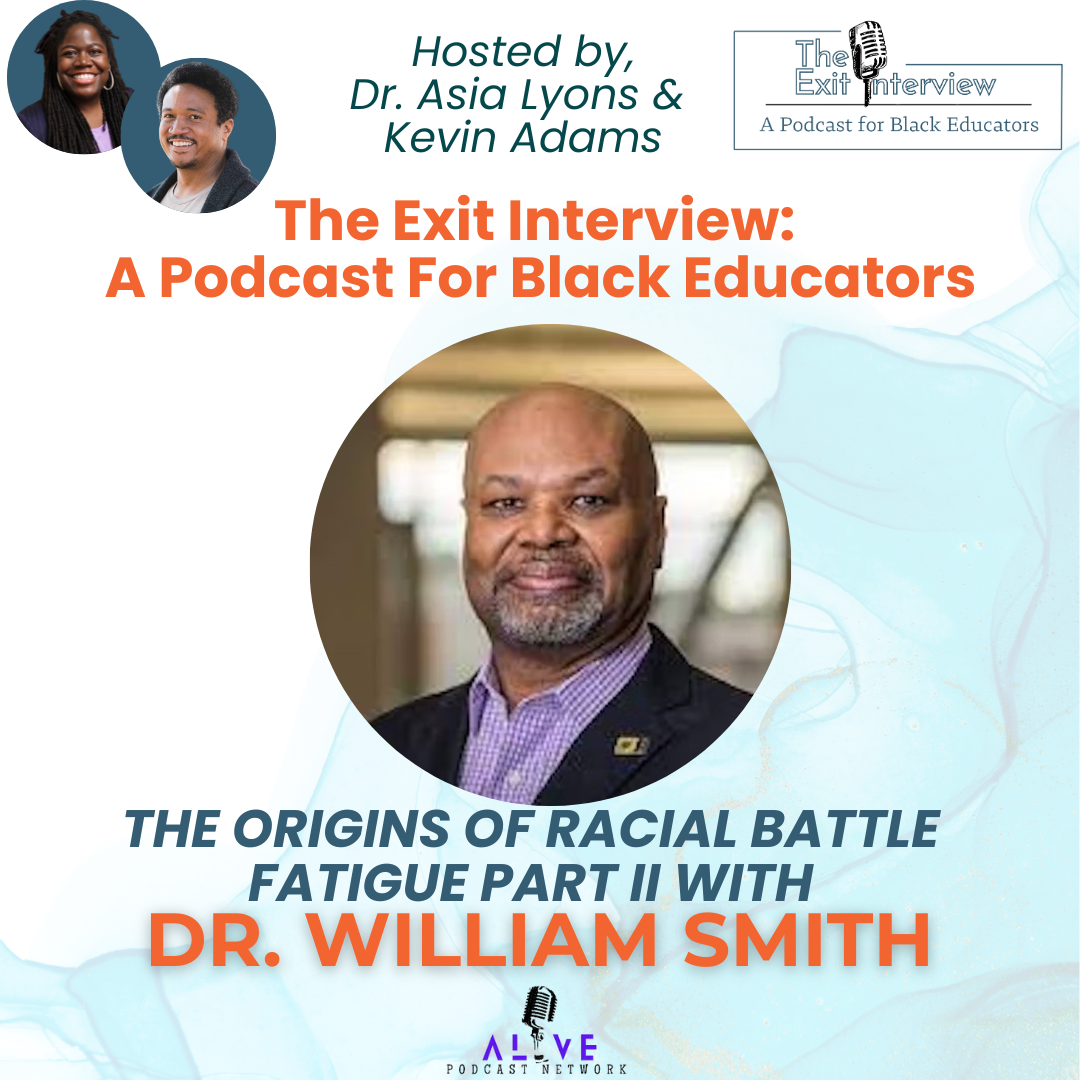
Asia and Kevin’s interview with Dr. William Smith of the University of Utah were so saturated with wisdom that we returned him for part II!
Dr. Smith shares his wisdom in this conversation, doing a deep dive into Racial Battle Fatigue. He discusses a litany of topics, including his rebuttal of the notion that Racial Battle Fatigue is analogous to post-traumatic stress disorder and the various manifestations of RBF, behavioral, psychological, and physiological. He reveals that addressing racism as Black educators and their communities experience it requires an honest look back over centuries, as opposed to reading a book or having a community circle in professional development.
Get out your notebooks; Dr. Smith is going to take you to school with this one


Episode Title
The Origins of Racial Battle Fatigue with Dr. William Smith Part II
Episode Summary
In this powerful continuation, hosts Kevin Adams and Dr. Asia Lyons welcome back Dr. William Smith for an in-depth discussion on racial battle fatigue, its impact on Black, Brown, and Indigenous educators, and the systemic challenges faced in predominantly white educational spaces. The conversation explores the psychological, physiological, and emotional toll of racism, the concept of "race lighting," and the importance of community, cultural rituals, and Black independent schools. The episode is rich with personal stories, research insights, and practical advice for educators and allies.
Guest Bio
Dr. William Smith is a renowned scholar and researcher specializing in racial battle fatigue, trauma, and the experiences of Black, Brown, and Indigenous educators. His work has been foundational in understanding the systemic and personal impacts of racism in educational settings.
Main Topics Discussed
1. Defining Racial Battle Fatigue
- Dr. Smith explains racial battle fatigue as a "systemic race-related repetitive stress injury," distinct from PTSD because racism is ongoing, not historical.
- The body codes racism as violence, leading to chronic stress and trauma.
2. Manifestations of Racial Battle Fatigue
- Psychological: self-doubt, imposter syndrome.
- Physiological: rashes, appetite changes, headaches, heart issues, increased risk of diabetes.
- Emotional/Behavioral: John Henryism, burnout, emotional exhaustion.
3. The Contagion Effect in Classrooms
- Teachers absorb the trauma of their students, especially in environments where students face racism and microaggressions.
- The stress is compounded for educators who are the only person of color in their school.
4. Race Lighting
- A form of gaslighting specific to race, where the experiences of racism are minimized or denied by others, leading to further self-doubt and stress for educators.
5. Systemic Barriers and Evaluations
- School evaluation systems and ratings often reinforce white supremacy and are used to shut down Black schools or push out Black educators.
- The importance of recognizing and challenging these systemic tools.
6. The Value of Black Independent Schools
- Dr. Smith and the hosts discuss the historical and current importance of Black-led educational spaces.
- Black students perform better academically in predominantly Black schools, and these environments foster community, love, and cultural pride.
7. Cultural Rituals and Healing
- Embracing cultural practices, rituals, and community as ways to mitigate the effects of racial battle fatigue.
- The importance of reconnecting with African self-consciousness and traditions.
8. The Dilemma of Staying or Leaving
- The tension between staying in challenging environments to support students and the personal cost to health and well-being.
- The need for collective action, building equity, and supporting each other.
9. Advice for Young Educators of Color
- Teaching is often a moral calling rather than a financial incentive.
- The importance of being a model, creating supportive classroom environments, and challenging the status quo.
Key Quotes
- "Racial battle fatigue is a systemic race-related repetitive stress injury."
- "The body codes racism as violence."
- "Race lighting is like gaslighting, but specific to race—minimizing or denying the reality of racism."
- "We have to believe in ourselves and build our own schools and communities."
- "Education doesn't just happen in a classroom."
Recommended Resources & Books Mentioned
- "Healing the Soul Wound: Trauma-Informed Counseling for Indigenous Communities" by Eduardo Duran
- "The Education of Blacks in the South, 1860-1935" by James D. Anderson
- "Yurugu: An African-Centered Critique of European Cultural Thought and Behavior" by Marimba Ani
- "Africana Womanism: Reclaiming Ourselves" by Clenora Hudson-Weems
- "Too Much Schooling, Too Little Education" by Mwalimu J. Shujaa
- Works by Joseph Baldwin, Naim Akbar, and Wade Boykin
First of all.... have you signed up for our newsletter, Black Educators, Be Well? Why wait?
Amidst all the conversations about recruiting Black educators, where are the discussions about retention? The Exit Interview podcast was created to elevate the stories of Black educators who have been pushed out of the classroom and central office while experiencing racism-related stress and racial battle fatigue.
The Exit Interview Podcast is for current and former Black educators. It is also for school districts, teachers' unions, families, and others interested in better understanding the challenges of retaining Black people in education.
Please enjoy the episode.
Peace out,
Dr. Asia Lyons
The Origins of Racial Battle Fatigue with Dr. William Smith Part II (2)
Kevin Adams: [00:00:00] And welcome back folks to the exit interview. I am Kevin Adams and I'm here with my wonderful oath,
Dr. Asia Lyons: Asian Lions. How everybody doing?
Kevin Adams: I hope everybody is great. We are here with part two of our interview. With Dr. William Smith. Uh, we had to keep this conversation going. We had to continue it so much that we didn't get to.
Um, so we are gonna jump right into this, uh, part two interview, uh, for y'all in a second. But just remember to follow us at two Dope [00:01:00] Teachers on Instagram and Twitter, and you can like us on Facebook, uh, dot com slash two Dope Teachers and a mic. Our email address is two dope teachers@gmail.com, and you can listen to us on Apple and Spotify podcast or@mrmunoz.org.
If you listen to us on Apple, please give us a five star review. It really does help others find us and get our content out to the people.
Gerardo: I'm sorry to crash in here as the Awkward Producer. Uh, if you go to the website and it's not working, it's because I'm learning how to be a webmaster, and it might be a little bit, but don't get mad at us.
Just go to the feed. It's all there. Yeah. Okay. Gerardo,
Kevin Adams: producer. Yes. Producer, voice
Gerardo: pro producer voice. Yes. The, the voice of the Gods coming down.
Kevin Adams: Go to the feed. Find it there. You will get it.
Gerardo: All right.
Kevin Adams: Uh, we're leaving that in by the way. Okay. That's it. [00:02:00] Finally, if you wanna support us financially, because you know it is all about the Benjamins.
Mm-hmm. Not really, but we need those to keep it moving. Podcasting ain't free. Head over to patreon.com/two Dope Teachers where you can become a patron for just $5 a month and you get a sticker, an amazing sticker by Sham if you become a patron and, uh, who knows what's to come. For the rest of you as you become patrons.
So, uh, yeah. Maybe a, a fire nickname. That's what? That's it? Mm-hmm. Oh, a Wu-Tang teacher name. Oh, nice, nice. A Wu-Tang teacher name, right? Right. Yes.
Dr. Asia Lyons: From the Wu.
Kevin Adams: We have to go back from the Wu. Oh, listen to Asia. Asia got bars. Yeah. Go in. All right. Well, speaking of bars, let's get back to these golden bars of [00:03:00] wisdom.
Dr. Asia Lyons: Mm-hmm.
Kevin Adams: Coming from Dr. William Smith.
Dr. Asia Lyons: So Dr. Smith, last time you were here, we talked about, um, educators and this need for us to heal specifically black educators and what we need to do to make sure that we're in the healing spaces in our homes, um, and that we are making sure that we're eating right and we're reading what we need to read and things like that.
And this time we want to kind of go back and talk to you about some of the, um, people we've had on our podcast we've interviewed and their experiences, and just really get your opinion about their experiences, what you're thinking, some of the folks that you've spoken to in your research. And it's kind of how a conversation about, um, like if what we are hearing about is common and which we believe it is, but just kind of have that conversation.
Dr. William Smith: Sounds good. I'm ready.
Dr. Asia Lyons: Okay. So like, one of the things a lot of times we talk about, and actually I think maybe it'd be good to, and I'm not sure if we're gonna [00:04:00] play this back to back, but I think it's really good that we talk about and define racial battle fatigue first. Maybe just in case people only get this part of the episode.
Um, so could, you could define it for us quickly. Just tell us the same things that, or more add on to it what you told us last time about exactly what is racial battle fatigue.
Dr. William Smith: Alright, so I, I'll give it in kind of scientific definition and then I'll break it down to the more kind of grassroots, uh, you know, elements of it.
So, racial battle fatigue is not a post-traumatic stress disorder, uh, because we do not live in a post racist society. Hmm. President Obama, uh, did not usher in a post-racial or post racist. Movement. So anything that happens to us is in the current, and we bring on to that, the historical trauma. All right, so what racial battle fatigue is, [00:05:00] is a systemic race related repetitive stress injury or stress syndrome.
Mm-hmm. Okay. So what that means really is, um, and I don't know if I said this last time, but there was, uh, and, and I think Geraldo will, um, like this, there was a hit by Grandma Flash and a furious flag with, um, Mely male. And you know, it said basically, don't push me because I'm close to the edge. Close
to the edge.
Yes.
Dr. William Smith: I'm about to lose my head. Right? Yes. It's like a jungle. Sometimes you make me wonder if I, you know, so you, you, you feel me? I think we on, yes. We're online now, right? Yes, yes. So what it means is that black, brown and indigenous people are always so close to the edge that they feel like they're going to be pushed over the edge at any moment.
And they're [00:06:00] fighting for their lives, their lives, in a way in which the body starts to code these environments in a very stressful and violent way. So the body codes racism, gendered racism as a violent act, thus racism is violence.
Dr. Asia Lyons: Hmm. Yeah. Wow. Wow. So, I mean, go ahead. Go ahead, Kevin. Okay. I, I was gonna say like, first of all, like all of that.
Yes. And you, you talked about like the three different ways that racial battle fatigue shows up in the body. Can you talk to us about that too?
Dr. William Smith: Yeah. So basically, and these are the main ways it shows up. It shows up at a psychological level, a physiological level and emotional behavioral level. So some of those psychological things will be, um, you might have [00:07:00] self-doubt, you might have, uh, imposter syndrome.
Um, you might, um, in physiologically you might have rashes, you might start to overeat, you might lose your appetite, um, headaches in emotional behavior, ways you might have John Henryism, imposter and all these different things. So it manifests itself because what happens is trauma is coded in the body.
Just like racism is a violent act and the body codes that, so what it does is it stagnates our growth. It stagnates our progress. Because what happens is we're carrying that load, that traumatic load with us. Yes. And since we are dealing with a repetitive stress injury, we start to pick up more and more and more weight.
Right. And so again, one of the things that we know, and this is pretty relevant for say teachers, is that, uh, [00:08:00] black and brown and indigenous teachers especially, is they are facing these kind of traumatic environments in the classroom, particularly when they are the only one in a historically a, in predominantly white space.
noice: Mm-hmm.
Dr. William Smith: And even if they're students, and when I say space, I mean the teacher, the other teachers and administrators might be white. Sure. The kids might be black, brown, or indigenous.
Yep. Yep.
Dr. William Smith: And so if those kids are dealing with trauma, trauma, I'm sorry, trauma from their environment based on the, um, white supremacy, guess what happens?
There is a, a racial battle fatigue contagion.
Yes.
Dr. William Smith: In that classroom. So those teachers are picking up that stress. So, you know, after having the 2020 and now 2021, most of us have become kind of, um, epidemiologists, uh, from this pandemic. We've heard words like are not Yeah, are not, is the [00:09:00] transmission rate.
Right. So if it's over one, which is, is really something that we always try to get it, uh, lower than that means that if it's say a four, you can contaminate four other people. Mm-hmm. So guess what happens when that teacher is in front of that room with these traumatized students? Because when they walk to school, the police are looking at them as little miniature terrorists.
noice: Yes.
Dr. William Smith: Mm-hmm. Right? And then they get into another classroom where the other teachers don't show love. Don't, so joy don't see you as a body that can inspire to do great things. Don't see you as, uh, a future heart surgeon. Doesn't see you as a future lawyer, doesn't see you as a future dancer. So they put you in your place by racial microaggression.
So these children are micro aggress, now they're in your classroom and you feel that because we are a collective [00:10:00] people and now you have racial battle fatigue contagion because it now that are not as high. You got 20, 25, 30 students in the classroom and there's one teacher.
noice: Sure.
Dr. William Smith: And she's overburdened because not only is she stressed because her babies are stressed in the classroom, but that white principal or that white teacher who doesn't understand, who does things like that, um, I think it was somewhere in the south where those teachers held up a noose and took a picture.
And the principal was the one who took the picture and they didn't, they didn't understand why the four white folks didn't understand why that was wrong. Mm-hmm. They knew why it was wrong. Mm-hmm.
Dr. Asia Lyons: Yeah.
Dr. William Smith: So that's traumatizing to those black babies', mamas and, and fathers having their children there. And then it's traumatizing the children.
And so if it's a lone black teacher or a lone brown teacher or a lone indigenous teacher in that classroom, she or he [00:11:00] feels that too. And the other thing that happens with that is those teachers, even if they are black, brown or indigenous in those spaces, and as white students and white, uh, um, colleagues, they might experience that environment as bullying.
And so what we know from the research is that right about, um, I think one point. Five, nine times, um, they're more likely to have heart related diseases. What that means, basically, basically is that they have a 59% increase on the ability, or not the really the ability, but the chances of having increased heart problems.
They also are roughly about 1.46 times more likely to get type two diabetes. Said differently, [00:12:00] 46% of a increase towards diabetes type two diabetes. Now, when we look at the black population in those studies, it's even higher. Now, what does that mean again, the body codes, racial body fatigue, the body experiences it.
And so those teachers start to say, my, I'm having heart problems. My, uh, I have rapid heart beating. I have a headache now. I got type two diabetes. I don't know how I, well, we know it's genetic, but genetic because of the stress.
Yep.
Dr. William Smith: So the environment becomes, um, an environment that they really don't feel safe.
And that's where the bullying comes from. So when you don't feel, when you feel fear, when you feel unsafe, when you feel, uh, um, a lack of security, when you feel hostility and you feel something like, um, [00:13:00] you know, just traumatic events, that's all coded as bullying.
Dr. Asia Lyons: Sure.
Dr. William Smith: And so I think that's what the teachers that you might have, um, spoken with, uh, are going through.
And many of the teachers that I've spoken with are dealing with.
Kevin Adams: Yeah. No, we've, we've had, we've, every, I think Asia, and correct me if I'm wrong, but I think every teacher that we have interviewed, or educator I should say, has always talked about health issues and challenges emerging. Yeah. Right? Yes, yes.
And then, and then, um, the interesting part is those health issues are then held against them. Right. And so it's like you have to take time off because you are going through, you know, these physical manifestations of white supremacy and racism and dealing with it every day. Um, and, and then it's being thrown back in your face, [00:14:00] right?
Mm-hmm. As you try to take advantage of the, of the time that you are allotted. Right? Right. And it's held against you. We've seen that happen over and over again. Right.
Dr. William Smith: And that's what, um, Luke Wood and Frank Harris calls race lighting.
Kevin Adams: Race lighting.
Dr. William Smith: So tell
Kevin Adams: us about it.
Dr. William Smith: So, you know, it's like gas lighting.
Yes. But it's race lighting. And they say, they argue that race lighting also leads to racial battle fatigue. So you might say, well, look, this classroom, this school environment, um, feels hostile to me.
noice: Mm-hmm.
Dr. William Smith: Doesn't like my presence. I'm experiencing these things as racial microaggressions. And then they say, ah, you sure?
It's, we all love each other around here. We all work. Um, together we all respect each other. You sure? It's, you're not just making this up. It's not just in your mind. Why don't you just focus on your pedagogy? Mm-hmm. Why don't you strengthen your, do you [00:15:00] need to go to a workshop? Mm. The thing is they're marginalizing your experience when you say, this is my reality.
And then sometimes part of the racial battle fatigue is that we start second guessing ourself.
noice: Mm. And that's where
Dr. William Smith: sometimes that, uh, imposter syndrome comes in. Like, well, is it me? And, you know, 'cause you oftentimes might be the only one, but if you're not the only one, then you might have other people who have different experiences that look like you or shared experiences.
And even if they're shared or different, they still are coded as hostile.
Kevin Adams: I mean, that I, it, it makes so much sense. You know, it, it's, it's, it's what we've heard and that idea of race lighting. Like that, that's, that's something new that I'm learning about right now. But, but when you explain it, it makes sense.
[00:16:00] Right? When you said that, I was like, oh, that is what they do. Right? And they're like, oh, calm down. You know? And it's the same thing. Oh, you're, you're too sensitive. It's not really about that. Oh, and, and you said it's, it is about the pedagogy, or if you did it this way, or if you handled it this way, or if you talked or acted this way, maybe it'd be different.
Right? And it's all put on the, uh, educators, black educators, uh, brown educators to kind of navigate their way through that and how that looks,
intro: right.
Kevin Adams: Um, so the other thing like that we've heard about like over and over is just like the constant having to fight, right? Like just the, you know, and it's, it's it, this isn't microaggression, it's just that every room that I enter into, uh, my position is treated as less.
I have to argue, I know that someone's gonna, you know, you know, well, I don't think these kids, you know, are meant for these classes or, you know, they really just don't really [00:17:00] wanna do the work or care about it, you know, or care about education. And, um, have you seen that as also a source of this racial battle fatigue?
Just having to like, constantly, uh, you know, fight the fight every day, every time you, any room you enter into, you're like, and I've had these days where I'm like, okay, take a deep breath. Here we go. Gotta, I know I'm gonna have to say this at least three or four times in this meeting.
Dr. William Smith: Oh, that's, I mean, that's classic.
I mean, it's a classic example because once again, you're being made to be put on the defensive. And so they'll say something like, um, well, if you weren't looking for racism, there wouldn't be any. Just Sure. You know, so it's, it's all about you again. So they're trying to turn the tables away from the systemic structure.
That's why I say it's a systemic race related, repetitive stress injury. [00:18:00] It's systemic. All those words mean something. So the system is really what we're fighting and it's those people in the system that reinforce it. And, um, they basically give fuel to the system to keep operating throughout, you know, our lives.
So, and we keep having to fight a iJust system. And again, it is one that really wasn't made for our presence. And then the education is wrong. So now you have to look at how students are being taught. And as Carter g Woodson said, the Miseducation of the Negro. And what I would do is expand that in the words of like Eduardo Bonilla Silva
noice: mm-hmm.
Dr. William Smith: To say this kind of collective blackness, so dark-skinned Puerto Ricans, dark-skinned Mexican, you know, uh, all these folks, um, who are part of this kind of [00:19:00] collective, um, bottom cast community.
Yes.
Dr. William Smith: And so you starting to say, wait, wait, this, this is just reinforcing whiteness. Mm-hmm. Mm-hmm. You know, and they try to argue.
So that's where the race lighting come in. No, this is just America. This is just human. We're all appreciating contributions. Then you say, well, the contributions of indigenous is missing. The contributions of Chicanos is missing. The contributions of black women are missing. Oh, well, you know, but it's such a larger piece.
So now you're on the defensive and anytime that you have to, um, always be on the defensive, you never get rest. You know, I don't know who your favorite football team is, is if, if it's the Denver Broncos or, you know, since y'all in college.
Kevin Adams: That's who, that's who I represent. That's who I represent.
Dr. William Smith: Well, if, if your defense was on the field for over 150 plays, that's a bad, [00:20:00] um, uh, defense.
That's right. And so what happens? Uh, they get tired. Mm-hmm. Right? And then the offense continues to run over them. Yep. The best defense is one that doesn't stay on the field long. That's right. And it can put the offense on the field. When have we been able to be o on the offensive side? And see that's what Dr.
Chester Pierce talked about, uh, when he said, uh, offensive mechanisms. And I, I recategorized it to say offensive racist mechanisms, but these offensive, racist mechanisms are the things that keep us on the defense, keep us in our place. And that's where racial microaggressions comes out of. So we're always being, um, um, defensive, defending our bodies, defending our minds, and that's the part of it that gets tiring.
Dr. Asia Lyons: So, can I ask a [00:21:00] question then? Just thinking about like, I, oh, first of all,
Kevin Adams: go ahead. Oh, well, I was just. Go ahead Asia, ask your question, but I'm gonna come back to this.
Dr. Asia Lyons: Uh, so I don't know anything about football, please know, but it, what I'm, what I wanna say is, you talked about like this, like being on the field for like 150 plays, and this makes me think about this idea of black educators like leaving the field and passing that baton on.
'cause last night we had on Dr. Um, Darlene Sampson, and she talked about when black educators are exhausted, it is okay for us to like walk, basically walk off the field. Mm-hmm. Right? And that let someone else, another black educator hopefully, but someone else to take on that work because we just can't keep, like, burning ourselves up.
Right. So would you say that that's the kind of thing that you would maybe suggest to educators And, um, I, we, I know that a lot of us talk about like not wanting to leave our children and like being the only [00:22:00] person of color, black person specifically in a space. Would you say like it? Yeah, like, let's try not to burn ourselves up in the name of all of our students, and then we end up getting, you know, basically like blowing away in the wind and sacrificing ourselves.
Dr. William Smith: Now there's, there's two ways to answer that. And one is, a, from a more radical tradition, it's a more liberatory, liberatory, um, tradition. So, which one do you want me to give you? You know, the one that's kind of where everybody will, you know, accept and understand, or you want to go in the radical you
Dr. Asia Lyons: already know?
Well, you know, you already, you know, you know, radical.
Dr. William Smith: I'll give you a little bit of both. One is we, we can't walk away. All right. And that's the hard things. But then we get burnt out and mm-hmm. We start carrying on that, uh, that allostatic load is off balance. So now, uh, our cortisol levels are [00:23:00] increase, uh, uh, we have teleric decay, uh, so it hurts us, but one of the things we do is we can't leave our babies, right?
Mm-hmm. And 'cause what happens to our babies. Um, so the thing about walking away is it's just like if you own a house, if you so-called live in a decent area, the longer you live in that house, your house gets equity.
noice: Mm-hmm.
Dr. William Smith: Right? And equity is essentially power. So when you have a black or brown or indigenous teacher.
The longer they stay, the more equity they should build.
noice: Mm-hmm. The more
Dr. William Smith: expertise they should have and, and the more influence and maybe some more of the favors. Like Don Corone said, I might have to come and ask you something. Hopefully not. Yeah. For one day you might [00:24:00] have to repay. That is what equity gets you.
Right. But if you move away, you never build equity.
intro: Mm-hmm. Mm-hmm. So
Dr. William Smith: you lose power. Alright. Now here's the other thing. Why can't the equity be in our own community? That's right. So what, why can't we have black independent schools like we used to have?
intro: Mm-hmm.
Dr. William Smith: Mm-hmm. The work of Vanessa c Walker, a great historian, you know, past a RA president.
Dr. Asia Lyons: Yeah. Um,
Dr. William Smith: and look at those schools that she talked about.
Dr. Asia Lyons: Yes. I have her book up here on my bookshelf somewhere.
Dr. William Smith: Yeah. Um, read the great work of, um, he was on my dissertation committee, Dr. Um, James D. Anderson, the Education of Blacks in the South, 1860 to 1935. So we can do it now. We knew there was threats then, and a lot of those things got, um, white [00:25:00] supremacy came in and they burned it down and lynched people.
But we are in a new era. White supremacy is still alive, but we gotta teach our babies because our babies souls are dying. Soul injuries, that's one of the things that the native people called, uh, uh, soul wounds.
Yes. Right.
Dr. William Smith: Um, and they have, um, a book, one brother has a book, Eduardo, um, it's called Healing the Soul Wounds.
Healing the soul wound. Trauma informed counseling for indigenous communities, Eduardo Duran. So, um, we need to be able to understand the, the soul wounds that these children are having in these schools, right? And, and that they're being injured. So indigenous kids are being injured, black kids are being injured, brown kids are being injured, [00:26:00] and they would be less likely to be injured if they were in loving hands and loving arms with teachers that looked like them, who were in control of their community with, or their school within their own community.
Kevin Adams: Very, I mean, I love this idea, you know, of black independent schools. Um, I'm, I'm a big fan of Bell Hooks. We're big fans, bell Hooks, and, and, and teaching the trans guests. She talks about the greatest education. I've ever had was in my all black school, my segregated school. She's like, we didn't have much, but we knew we were driven by a mission.
And, and, and that mission was guided by love. And it was people who knew us, who cared about us. They knew us out. Mess. Messianic Zeal. Yes. Uh, that knew us. They knew us in and outside. They knew us at church. They knew our aunts, they knew our uncles. They knew everybody. Right. Um, but, but, um, [00:27:00] so like, I, that just, that just hits, that just hits, right.
But I want to go back to this idea where you talked about, uh, offensive racial mechanisms. And one of the things that like has also been mentioned by teachers are like, uh, evaluations.
Gerardo: Mm-hmm.
Kevin Adams: Evaluations and, uh, school ratings. And I've come to the opinion, like all evaluation systems, um. I believe they are skewed towards whiteness.
And so they're always gonna prefer whiteness in the way that that expressed in whatever. And so I almost feel like it's just another tool of white supremacy mm-hmm. To come through and say, you're not good enough, you're not qualified, you still gotta do it better. Even if you were doing it, you know, the best.
And oftentimes it's people who aren't, who don't look like us, who are evaluating us mm-hmm. And deciding, you know, are we doing a good job or are we not doing a good job? But have you seen also like that role of the [00:28:00] evaluation and what are your thoughts about things like school rating systems, especially?
Um, in our city, they're used to, uh, shut down schools in our state. Right. And then, uh, reopen them and usually, uh, with what we call plans of innovation and usually nine times outta 10, what I've found is the plans of innovation. Black schools tend to be stricter, more rigorous. Yep. Takes away joy. Yep. Takes away freedom, opportunity, like the ability to talk.
Right. And, and, and express yourself always. And, and we've talked to other people and New York and they have debates about school uniforms, but that always is like part of the process. Um, but what are your thoughts about like all of those kind of, uh, tools that are used to kind of reinforce white supremacy, uh, run black teachers out, um, and, and really, you know, [00:29:00] um, I guess shut down black schools?
Mm-hmm.
Dr. William Smith: Oh, no, I, I think there, there're tools to, um, really raise the status of those who are more likely to benefit from whiteness and then keep the other groups. In their position. Right? So we have to use our own tools. We know, um, what's good. We know how to see and seek out brilliance. We know how to create brilliance.
And so that's why it would benefit us more in black independent schools, but we have to believe in ourself. See, I I come from, uh, a mother who was a teacher
Yes.
Dr. William Smith: In an all black school.
Yes.
Dr. William Smith: I went to all black schools until high school.
Yes.
Dr. William Smith: So I saw black, black brilliance. Yep. And I saw black struggle. Yep.
But I saw the whole continuum and that, see, that's the beauty of like a school, like, [00:30:00] uh, Spelman and Morehouse. Yes. Yeah. Yeah. So you could see the whole continuum instead of just one side. And that's just the deficiencies or the deficits. And then those deficits become the part of the culture of the race.
As an identity, because people say that blacks can't achieve, but if you go to Spelman, you go to Morehouse, you see success. Right. And that's how it was in my school. I saw, um, brilliance in the teachers and the thing that was really most effective, uh, for us because, you know, sometimes boys get black boys get a little rambunctious.
Yes. It just, it, it benefited me in Chicago when the, uh, there, there was a offshoot football league and I think the team was called the Chicago Fire. And then it went to funk, um, after a couple of years, uh, that lead. So we had this influx of big whole strong black [00:31:00] men. Who was substitute teachers and regular teachers come in the classroom.
The black teachers was all excited because they, that I'm gonna send you down to Mr. Holmes and his name was Larry Holmes. Yes. I'm gonna send you down to Mr. Holmes and see back then they was paddling. I think most of 'em was cues or something. Yes, they was swinging at wood, you know, but, uh, I, but they had these muscles and, and and they didn't play, right?
Yes, but they could teach too. That's right. So the thing was they commanded respect. Yes. They didn't demand it. They commanded respect. And so that changed the whole culture of the school. And, and so that benefited me, um, a lot. But here's the other thing, uh, some colleagues of mine and I, we did a, a study using national data.
And what we did was it was looking at some of the, uh, from K through, I think sixth grade [00:32:00] and some of these assessment tests like with math. And here's what we found in the data. The black of the school got, the better the math scores were. Huh? Not only for black students, but brown students and the few white students that was in it when it was fewer, um, black students in the predominantly white school.
The black students did poor and the brown students did. Poor Asians pretty much was not affected no matter what the school looked like, you know, in this national data.
Yeah.
Dr. William Smith: But the scores for black and brown children went up. As the school became black at every grade level.
noice: Mm. So
Dr. William Smith: the thing was, they, um, passed over the white norm when it was an all-white school.
[00:33:00] Right. Wow. So that's math. Those are, and and they, everybody in the country were taking them.
Kevin Adams: That's right. That's right. Right. So you
Dr. William Smith: can't say, you know, uh, you know, y'all just created some kind of new math test for black kids.
intro: Yeah.
Dr. William Smith: So what does that mean? That means that those black children were having a different experience when the school was predominantly white.
Those brown children were having a different and potentially more hostile experience. The whiter the school was, but the black. And remember the last time we talked about a different data set on. Children. Yes. Black teachers,
noice: yes. Mm-hmm. Teaching
Dr. William Smith: the white, black and black, uh, um, and brown, white right.
Effect. Yep. This, this is a study that we did and we show empirically that, um, black students can't achieve. [00:34:00] So that means that it's not just about the numbers, uh, in the classroom, but who's in front of them.
Kevin Adams: That's right. Interesting.
Dr. William Smith: And that's a quantitative study. Big data.
Kevin Adams: I mean, that's, that's why we have to deal with this.
If, if, if, unless, unless we and I, and I and I support, let us saying, let's, let's build the Black Independent School network across America. I'm, I'm down, I'm down to start working on it, trying to plan it, put it together, uh, um. We'll see if they let us have it. We get this, all this, uh, charter start. A new charter.
That's what I always have said with these charters. I was like, let let the, let the mosque wanna open up a charter. Let the, let them wanna open up their own religious charter and see what they, what they let them do. Right. You
Dr. William Smith: can, um, there's a few schools in Chicago, matter of fact, there's an all boys school in [00:35:00] Chicago, black Boys School, where they have some, like 90 something percent who go on to, um, college.
Dr. Asia Lyons: I read about it.
Dr. William Smith: Right. And then we had the sister, um, Marvel Collins years ago who had, uh, uh, independent black school. And they, and they, um, just excelled. So we could do it. We just have to believe in ourselves and we have to stop being scared of white people.
Kevin Adams: Mm-hmm. That's right. And
Dr. William Smith: white and white approval.
Kevin Adams: That's right. That's right. And,
Dr. William Smith: and then the other thing, what happens is one of the things that has been shown to mitigate the stress and the racial battle fatigue that we experience is falling back on our African self-consciousness, like Joseph Baldwin said,
Uhhuh.
Dr. William Smith: So one of the things that, um, Chicanos, Chicanos, Chicanex, Puerto Ricans, Afro Puerto Ricans, even indigenous [00:36:00] people, um, one of the ways in which they lower their, um, stress load from racism is the cultural practices that they perform.
Kevin Adams: That's right.
Dr. William Smith: And the rituals. That's right.
That
Dr. William Smith: they perform right now. I mean, we can talk about that Spanish stuff, that's a colonizer language, but, um, I'm supposed to be, uh, sitting here in Oslan, the capital of Oslan.
Yes.
Dr. William Smith: Right?
Mm-hmm.
Dr. William Smith: So, um, but what does that mean? And they wasn't speaking Spanish. Right.
Alright. So, so, but we went through that process too. And then, um, we started, um, looking at Swahili and, uh, speaking and, and then Kwanza and naming our children more, uh, really Afrocentric or mm-hmm. Really true African American names. Yep, yep, yep, yep. Right. So, um, I, uh, my point is this, [00:37:00] that we have to start looking at those rituals and those, um, cult deep cultural traditions and love those and embrace it and don't be ashamed of it.
Yes.
Dr. William Smith: We can start to reduce our stress load. And it, and I'm, I'm talking about things like our artistic expression. Right. I'm talking about dancing.
Kevin Adams: That's right.
Dr. William Smith: Yeah, that's right. All you gotta do, I could go right out here and there's some Navajos. Who will do a certain kind of dance, culturally specific, that brings community together and builds strength.
And that's what I tapped on the last time when I talked about that body of Christ thing coming together and the body of haru.
noice: Mm-hmm. Uh,
Dr. William Smith: and commit coming together. The pieces, the pieces coming together means power, unity, collective, uh, responsibility.[00:38:00]
Kevin Adams: I mean, that's it. A Asia, that's what we gotta do. We gotta, we gotta come together like Dr. William Smith is saying. And this is what I always think about is, you know, I'm, things fall apart is that story right. Of losing it. It's the African perspective, but it's like losing what holds your community together.
And, and we were robbed of it, you know, and, and, and we were sold. You know, or, or, or brainwash to think that there was something bad about it,
noice: right? Yeah. That there was
Kevin Adams: something that was negative that we had to distance ourselves away from or put away, you know, or be ashamed of. And, and, and part of that is Christianity.
And, and we, we know Christianity in some ways has been great for black people in some ways in this country. It has not, Christianity has been like the most harmful thing for black people. Yeah. But, but, but we do have to reconnect and, and, and that idea of just [00:39:00] celebrating, connecting back to the earth.
Asia, you're big on this. Asia Asia's a big camper, spending time outdoors. And I always say, you know, people are like, black people don't camp. I was like, what are you talking about? Yeah. We, we, we, we love being outside. You know, you go anywhere, barbecuing, you go anywhere in the world. Black folks is outside.
Everywhere in this country. They ain't in the house. They outside. You
Dr. William Smith: know what they said that, um, the porch, front porch was invented by a black man, um, who was a architect or, you know, early stages architect. So why do black people always sit out on the porch? You go through black communities, they're always out there.
That's what's happening
Dr. William Smith: right on the front porch, right? Waving and, you know,
Kevin Adams: talking and build, like you said, building community.
Dr. William Smith: Building
Kevin Adams: community.
Dr. William Smith: [00:40:00] Right. And so we have to go back to what we lost. I don't know if you all, uh, are familiar with the book Ugu? Mm-hmm. Oh my gosh. Y-U-R-U-G-U and Ugu, um, was written by Marimba Ani.
And in that she talks about the Great Mafa. And the great mafa is the disruption of the African body from the, um, translated Atlantic slave trade. So she doesn't use, um, Holocaust because that basically explains somebody else's
tradition. Yes.
Dr. William Smith: But she uses, uh, the as, uh, and the Mafa and ku. Now that's a book.
It's, it's real deep. So that's, that's a book club reading. You have to all, you gonna have to read it together. I don't know what this means. Let's break it down. Right. [00:41:00] But it's worth getting through to try to understand what we've been through. So KU is a, a excellent book. Now you all mentioned Bell Hooks.
Um, now Bell Hooks ain't got nothing on my sister. Um.
Dr. Asia Lyons: Can we just stop and take a, like a, a, a, like a praise, praise report on this library of books is in your mind and this stack of books behind you.
That's the up.
Dr. William Smith: I just wanna see the, yeah, I just
Dr. Asia Lyons: wanna see the library of books.
Dr. William Smith: You can't see my show. This just the home thing, but, uh, let's
Dr. Asia Lyons: just see.
Oh, there, it's at that. There it's folks you are missing out. Nice.
Dr. William Smith: So, uh, but I don't know if you, do you know c uh, Glenora Hudson Wings?
intro: Mm-hmm.
Dr. William Smith: Uhuh, have you heard of um, Africana Womanism?
intro: No.
Dr. William Smith: No. I should check. Look, look here. If you ain't heard of Africana [00:42:00] Womanist, this is a researcher. She used citations.
There we go.
Dr. William Smith: Look here. Bell Hooks can't hold nothing on this sister. Okay. If you ain't read this once you read this sister, you'd be like, well, why has she been missing in my life? Geraldo
Dr. Asia Lyons: Geraldo says he's heard of her.
Dr. William Smith: Yeah. So this sister will make you start to look at some of the contradictions of the academy.
Yes.
Dr. William Smith: Yes. So she believes in, in the African family, the African U in African unity. Right. And, and this is not a, um, a new book. I remember when she first, um, published it, I was sitting at, um, the table next to us and look girl, I'm on an autograph copy
Kevin Adams: Ah-huh.
Dr. William Smith: Back in the eighties. So, um, Reed Africano womanism reclaiming ourselves by Glenora Hudson Weems And [00:43:00] life will be changed.
You'll be like, let me put some of these other people who really I thought was important and put Queen Glenora up where she belong up there.
Kevin Adams: Right, right where she belongs. And I see it right here on Google Play People ebook. Oh good. Y'all can get it. You'll buy it as a gift. So let's go. Let's go. Yeah.
Sister Strong.
Dr. William Smith: She's, she's strong.
Dr. Asia Lyons: Can I, can I kind of thinking about this idea of like reclaiming ourselves and like you talked about this idea of like black folks, black educators having fear. One of the things that I hear commonly when people talk to us on the podcast or talk to me and Kevin, you, they have this experience too, is that people, they fear losing Para, which is our retirement system here.
Yes.
Yes.
Dr. Asia Lyons: Like if I leave teaching, I won't have my retirement, I won't have my para.
Yes.
Dr. Asia Lyons: [00:44:00] Right. And so. Like, I get really, like, I, I understand people's concerns about retirement, but I'm trying so hard to understand, especially if folks are 20 years out, 10 years out. Yes, yes, yes,
yes.
Dr. Asia Lyons: Like how much, how much?
And, and gerardo's in the background saying me though, it's him. He's like, I got eight years.
Kevin Adams: He's like, I'm counting down. Right.
Dr. Asia Lyons: But like how much
Dr. William Smith: he too, he too young to talk about eight years. Yeah.
Dr. Asia Lyons: Like how do we exchange, like how do we justify, maybe it's not a question to you, but like put out into the atmosphere.
Like how do we justify killing ourselves slowly knowing that we can, um, end up with diabetes, knowing that we can have heart disease, knowing that we are having strokes and, and, and, and, and justifying our mind, exchanging our livelihood for our retirement system.
Dr. William Smith: Right. Right. I mean, it's, it is a, it's a realistic fear.
Yeah, [00:45:00]
Dr. Asia Lyons: sure, sure.
Dr. William Smith: Black people have, brown people have, um, wanted to get to a point where they didn't have to stress. I mean, that's the dream of everybody, that when I retire, I'm not gonna be as strong as healthy as mobile as I used to be. And I don't want to be a dependent of the state or the, um, have to have someone else take care of me.
So it, it is a real fear of especially the older population, uh, uh, demographic of people because they've gone through depressions. But now we've gone through, uh, 2008 now we've gone through a pandemic.
noice: Yeah. So
Dr. William Smith: more people who are growing up now who are behind you all will start thinking about this, especially those who are in high school and, uh, junior high are gonna be like, I need safety.
That's [00:46:00] what happens when you go through traumatic events like depressions.
noice: Hmm.
Dr. William Smith: Um, and then remember when, when white folks catch a cold, we have the flu.
Yep.
Dr. William Smith: Right? So it hits us much more. Um, so I don't fault them, I understand them, but if we had the black independent schools, if we had the courage to say somebody put together a strong business plan, they set up the school, we is going to work, and we don't believe that white ice is coated in black ice, then we might be able to feel good about showing up.
Right. But don't start thinking like, I mean, schools here, even teachers be buying supplies outta their own pockets.
Kevin Adams: That's right.
Dr. William Smith: But if I do it in the black school, that you going to be complaining. Right. But you would do it over there in the white school. Yep.
Kevin Adams: Yep. That's right.
Dr. William Smith: So we have to [00:47:00] believe in ourselves.
But remember that fear of a lost job and then the abuse that they feel in that system is part of the bullying atmosphere.
noice: Sure.
Dr. William Smith: And so that becomes a threat. And sometimes, as Dr. King said, um, we become not only complicit, but um, he, he said it in a way like, um, we start to become acquiescent.
Mm.
Dr. William Smith: Right. So we acquiesce to oppression.
He called it a state of acquiescence.
Kevin Adams: Hmm. I that, I mean, it, it's just, it, it, it's, it's powerful. It's, it's. It's what happens though. I, I think that's, that's, that's, that's the balance, right? Is how do we make sure that we continue to fight [00:48:00] this. And I think the, the sphere of education has been so critical for black people's liberation in this country that like, we have to understand why black teachers are leaving, right?
Or why, why they acquiesce, right? Because that's the other side I'm gonna give in. I'm not gonna fight anymore. I'm not gonna resist, and I'm just gonna let it be. And, and maybe I feel a little be better. Maybe my conscience hurts, right? Because I feel like I turned my back on folks. Right? Or, or, I'm out. I'm out.
Um, or I'm sticking with it and I'm going through it. Um, or, or I find a balance, I find a way to ground and center myself.
intro: Mm-hmm. Which
Kevin Adams: I, I think is ideal. So one thing that I always think about, and I think we are, uh, we're getting close on an hour on this episode, but Dr. Smith as, as a teacher and as somebody who works with young people with the ultimate goal of [00:49:00] loving to see more people who look like me, go into education and, and, and, and see education as a career.
All too often I see kids who've gone through this system like you've said, and experienced this trauma, and, and it makes sense why you wouldn't wanna ever step back into school, what you actually get out of a school. Right. Well, how do we talk to young people and prepare them, especially young teachers of color?
I've, um. Had teach, worked with teacher candidates in my classroom, uh, teacher candidates of color, and, and, and, um, I've seen some of them really thrive. I've seen some of them leave, you know, after amount of time. But how do we talk to them and, and really let them know what it's gonna be like and how to best prepare for a career in education?
Dr. Asia Lyons: Good question, Kevin.
Dr. William Smith: You know, that's also a hard one because unfortunately, [00:50:00] um, there is no financial incentive. A teacher, it's like a moral obligation, which is pathetic, right? That yes, you have to tap into my morality and my concern, uh, and not pay me what I'm worth. Ooh, to, to build the future generation.
And then we miseducate people. That's right. Think about all these people out here killing us. Uh, what's his name? Derek Chauvin. He had a bachelor's degree. He was had a teacher. That's right. So educ. Uh, so teaching schooling is complicit in white supremacy, right? So it's a real hard sale. But if you can be a model, if you can find a way in which you can create a paradise within your classroom where you can use [00:51:00] different structures, challenge the orthodoxy to, um, you know, schooling folks.
And remember there's another book called Written by in wamu Soja called, uh, too much, uh, schooling Too Little Education. Yes. Too much schooling, too Little Education. So we are schooling these children. We are not educating them. Right. We have to be educators, not schoolers, not putting them in a system that's going to put them to, um, participate in the prison industrial complex or not be able to be effective.
Um, working citizens. We have to educate, educate. One of the root one, the root word of educate is to enlighten, to, to bring out. Yes. Right. So we have to be able, like that light behind a Asia, that to shine bright. [00:52:00] Right. There's a old passage, um, I think in the Old Testament that talks about you went and light candles and put a a, a a bushel over it, right?
Yes. So
Dr. William Smith: those children are like lit candles. But you're putting a a bushel, you're putting them in a box so the eventually the light goes out,
Dr. Asia Lyons: is out. Sure, sure. Right? '
Dr. William Smith: cause you, you're taking away the oxygen. And so that's what happens with our, our children, is that they can't see a future. So remember I said about those big football player, ex football players that came to my school?
Yes.
Kevin Adams: Yes.
Dr. William Smith: They shined a light, but my mother was a teacher. So the light was already
Kevin Adams: Yep,
Dr. William Smith: yep, yep, yep, yep. And this is her 81st birthday. So I'm celebrating it with, with you all.
Kevin Adams: Blessings,
Dr. William Smith: blessings, blessings.
Dr. Asia Lyons: Happy birthday. Happy birthday, mom. Happy
Dr. William Smith: birthday moms. So, um, we have to be the model that [00:53:00] we want others to see and be inspired by, and that's gonna be the children in the classroom because they going to say, you know, Ms.
Lyons, Mr. Adams, Mr. Munoz. Those are powerful people. And it might not be a formal classroom. You might be a coach, you might be at the Boys and Girls Club, you might be with Big Brothers, big Sisters, but those are educators.
noice: Mm-hmm.
Dr. William Smith: Education doesn't just happen in a classroom.
Kevin Adams: That's very true.
Hmm.
You know what they call that? Just letting it marinate. Just letting it marinate
Dr. Asia Lyons: Exactly
Kevin Adams: like 40 Water says.
Dr. William Smith: Yeah. Well, you know, I'm a, I'm a [00:54:00] definitely reiterate, a couple important people, Joseph Baldwin, African Self-Consciousness, and Naim Akbar. Um, the Mental Disorders of Blacks. And part of the problem as Abar talks about is that we oftentimes suffer from the alien self disorder, the anti self disorder, or the self-destructive disorder.
And so in order to not participate in that kind of self-destruction, we have to reignite the African self-consciousness. So re Baldwin's work, um, and get inspiration from that. And then read the work of a Wade Boykin. He was a psychologist at Howard [00:55:00] University, and he talks about ways in which we can teach, um, effectively the black and brown children, right?
So we have to look at. What comes out of our community and says, this is the way we teach. This is the way we learn. This is what's most effective. And not use a European paradigm that empowers them. It's just like, um, I think we talked about a little bit earlier, um, assessment.
Yes.
Dr. William Smith: And, um, I don't know if last time in part one we talked about Carl Campbell, um, Bingham.
We might not have, we, I don't think we did. Maybe we did. But he, he was the one that did the army beta test way back when. But he's also the so-called father of the SAT.
noice: Yes. And,
Dr. William Smith: and he's the one that, um, [00:56:00] created the SAT and it was opposed to really have a racial hierarchy to it and a certain, um, um. Ethnic kind of strata in it, white ethnic strata in it.
So the so-called Caucasian was supposed to be at the top and the Jews were at the bottom of the, um, strata. And then you had the racialized people. And so the test, when he first did it, white women actually did better than the white bed. So they had to recalculate it so that the white bed did better.
Kevin Adams: And they were like, oh no.
Dr. William Smith: Right. And then decades, decades later, there was a, a test, I'm not gonna say pronounce the word, but it was called the B-I-T-C-H test, the Black Intelligence Test of Cultural Homogeneity. Um, so you can, I know, I know
Dr. Asia Lyons: the look on Asia's face. Wow, okay. Alright. [00:57:00]
Dr. William Smith: But they were being. This was in the seventies so that, you know, these was some black, uh, psychologist said, look, we going to get you. We gonna get you. And so they asked you culturally appropriate questions. Yes. If you were able to ask tho answer those questions, you were connected to your culture.
So what they basically was saying is those at a CT tests, those SAT tests, those intelligence tests were culturally specific for a certain group of people. That's right. You give you this test and you perform well. You just as brilliant as somebody that comes outta your test.
Dr. Asia Lyons: I love that.
Dr. William Smith: So at the end of the day, what they're trying to say is, we have to be culturally appropriate for the people who we are teaching.
And that is where we'll see brilliance.
Kevin Adams: That makes sense. That makes sense. Don't force someone to play on a field they, they never [00:58:00] played on and, and don't know, don't know the game
Dr. Asia Lyons: or interest. They don't play the game. They don't exactly that. They care to play.
Kevin Adams: Right. That's right. That's right. Well, yeah.
Dr. Smith, you've given us books. I got books. My wife's gonna be mad. She'll be like, what? What is all this? Amazon, what, what? Actually I can't use Amazon no more, so I gotta, I gotta, I gotta go look out, find some other spots. What'd you say? Asia? Thrift books. Thrift books. I gotta, but see, it's hard. But I, I'll get out there.
We gonna do it right, but we gonna get these new books. And, uh, we, we have just, I mean, we could sit and talk to you I think for another hour.
intro: Yeah. Hours
Kevin Adams: on end. I think we would definitely be checking back in with you as the exit interview, uh, continues. Um, and, and just appreciate your time and, and just all of the wisdom and knowledge [00:59:00] and, and just, um, you know, as someone who teeters right.
And, and I'm, I'm, this is my year 15 and I teeter on it, you know, listening to these exit interviews, stories. Sometimes I'm like, may, maybe I should leave, but you, you just left me feeling like, nah, keep going. Mm-hmm. Center myself in my African consciousness. Right. Reaffirm that African consciousness mm-hmm.
Connect with those traditions that are there, um, that, that are dormant in my DNA. Mm-hmm. And, and, and, and that's gonna help us. Right. Which I think is really powerful and important.
intro: Right? Right.
Kevin Adams: Regardless of if we stay or leave, I, we gotta do it either way.
Dr. William Smith: Long as you way you work for your people, you gotta work for your people.
Kevin Adams: That's right. Yeah.
Well, well go ahead, Aisha, bring us home.
Dr. Asia Lyons: Well, this has been another wonderful episode of the exit interview. Once again, thank you so [01:00:00] much Dr. Smith for being with us, uh, and, and coming back and just filling us in with again, more books, more knowledge and audience. Uh, tune in. We'll have Dr. You all have a good night and we'll see.

Chief Executive Administrator at Huntsman Mental Health Institute (formerly University Neuropsychiatric Institute)
Dr. Smith is the Chief Executive Administrator for Justice, Equity, Diversity, & Inclusion (JEDI) in the Huntsman Mental Health Institute, Department of Psychiatry, in the School of Medicine. He is also a Full Professor & former Department Chair with a demonstrated history of working in the higher education, community-based, private, and professional industries. The developer of the biopsychosocial framework of Racial Battle Fatigue. He is skilled in Nonprofit Organizations, Sociology of Education, Critical Race Theory, Program Evaluation, and Academic Advising. Strong professional with a Doctor of Philosophy (Ph.D.) focused in Educational Policy, Social Psychology of Education, and Educational Sociology from the University of Illinois at Urbana-Champaign.