(Re)defining Me with Langston Jacobs
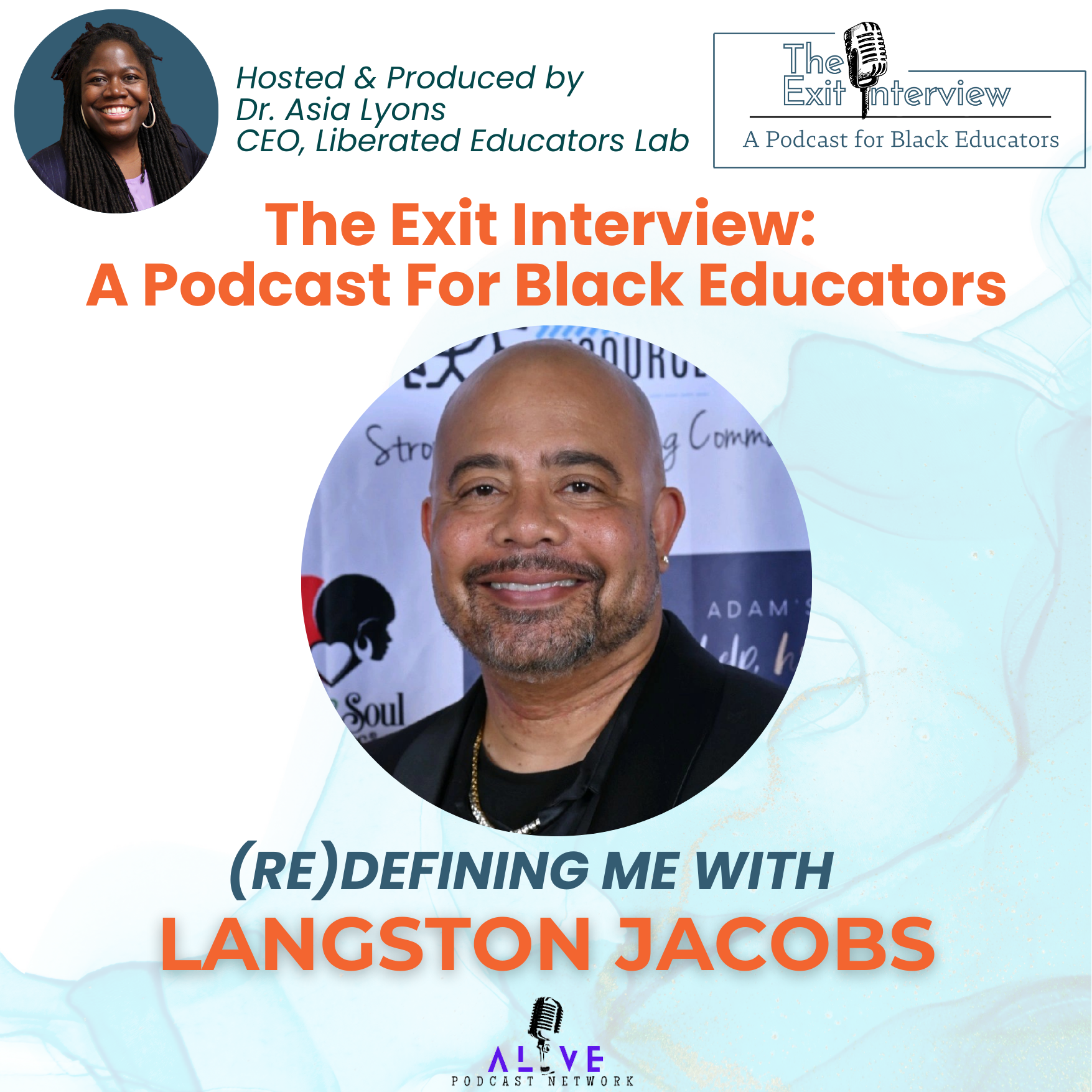
In this episode of The Exit Interview, host Dr. Asia Lyons sits down with Langston Jacobs to explore his journey through education, from substitute teaching to school leadership. Langston shares candid reflections on his early days as a guest teacher, the challenges and rewards of connecting with students—especially those often overlooked or labeled as “troublesome”—and his transition into special education and later, a dean of culture at charter schools.
The conversation delves into the systemic barriers Black educators face, including lack of mentorship, the emotional toll of disciplinary roles, and the impact of school culture on both educators and their families. Langston opens up about the personal cost of his work, describing how stress and the demands of leadership affected his health and family life, ultimately leading him to step away from traditional education.
Now, as co-founder and director of Men and Youth Programs at Adam’s Purpose, Langston focuses on healing and community support, especially around grief in the Black community. The episode highlights the importance of culturally relevant mentorship, the need for systemic change to retain Black educators, and the power of redefining one’s role to align with personal values and well-being.
Listeners are left with a message of hope, resilience, and the importance of community—both inside and outside the classroom.


Episode Title: (Re)defining Me with Langston Jacobs
Host: Dr. Asia Lyons
Guest: Langston Jacobs, Co-founder & Director of Men and Youth Programs, Adam’s Purpose
Episode Summary
In this powerful episode, Dr. Asia Lyons welcomes Langston Jacobs to share his journey through the education system, from substitute teaching to school leadership, and ultimately to community healing work. Langston’s story is one of resilience, self-discovery, and the ongoing challenge of navigating systemic barriers as a Black educator. The conversation explores the personal and professional costs of working in education, the importance of culturally relevant mentorship, and the need for systemic change to support and retain Black educators.
Key Topics & Timestamps
[00:00] Introduction & Welcome
- Dr. Asia introduces Langston Jacobs and sets the stage for a candid conversation about his path in education.
[02:00] Entering Education: Substitute Teaching
- Langston describes his unexpected entry into education as a substitute teacher in Indiana, the dynamic nature of the role, and his early experiences connecting with students.
[08:00] The School-to-Prison Pipeline
- Reflections on witnessing systemic racism and the impact of exclusionary discipline on Black students.
[12:00] Transition to Permanent Roles
- Moving to Colorado, Langston is encouraged to become a permanent guest teacher, eventually taking on a full-time position in a high-needs school.
[18:00] Building Connections with Students
- Langston shares his approach to reaching students who are often labeled as “troublesome,” and the importance of seeing their humanity and potential.
[22:00] Special Education & Curriculum Challenges
- Taking over a special education classroom, Langston questions the relevance and rigor of inherited curriculum and advocates for culturally responsive teaching.
[30:00] The Importance (and Absence) of Mentorship
- Both Langston and Dr. Asia discuss the lack of sustained mentorship for Black educators and the impact on professional growth and retention.
[36:00] Innovating in the Classroom
- Langston brings creativity and joy to his classroom, from Soul Train lines to integrating art and poetry, despite limited support.
[42:00] The Praxis Hurdle
- Langston’s struggle to pass the Praxis exam, the stress of certification requirements, and the emotional toll of feeling unsupported.
[48:00] Moving into School Leadership
- Transitioning to a dean of culture role, Langston confronts the realities of school discipline, the pressure to be a disciplinarian, and the impact on his own well-being.
[55:00] The Personal Cost of Leadership
- Langston opens up about the effects of stress on his health and family, and the difficult decision to step away from traditional education.
[1:02:00] Redefining the Dean Role
- Finding ways to bring his authentic self to leadership, Langston uses art and poetry to connect with students and foster a healthier environment.
[1:08:00] Family Dynamics & Community Impact
- The challenges of working in the same school as his children, the unintended consequences for his family, and the importance of community support.
[1:15:00] Why Black Educators Leave & What Schools Can Do
- A discussion on systemic changes needed to retain Black educators, including mentorship, leadership opportunities, and a focus on legacy and community.
[1:22:00] Shoutouts & Acknowledgments
- Langston honors fellow Black educators and mentors who have shaped his journey.
[1:25:00] Life After Education: Adam’s Purpose
- Langston shares his current work with Adam’s Purpose, supporting healing and grief in the Black community through therapy, art, and community events.
[1:30:00] What’s Bringing Joy
- Reflections on family, nature, and the simple pleasures that bring joy and balance.
[1:33:00] Closing Thoughts
- Dr. Asia wraps up the episode with a call to action for listeners to support Adam’s Purpose and to continue archiving the stories of Black educators.
Notable Quotes
- “Learning is really being challenged into differences of curriculum, something that meets the child where they’re at, something that’s culturally relevant, something that’s exciting.”
- “Being a good Dean was being an unhealthy Langston.”
- “We don’t get that many opportunities as Black educators to pass down that Black excellence.”
- “It’s okay to grieve. It’s actually healthy to grieve.”
Resources & Links
- Adam’s Purpose: www.adamspurpose.org
- Follow Adam’s Purpose on Instagram, Facebook, and LinkedIn for community events and support.
Connect with the Show
- Host: Dr. Asia Lyons
- Guest: Langston Jacobs
- Podcast: The Exit Interview: A Podcast for Black Educators
If you enjoyed this episode or know someone whose story should be featured, share the show and help us continue to uplift and archive the experiences of Black educators.
Thank you for listening!
First of all.... have you signed up for our newsletter, Black Educators, Be Well? Why wait?
Amidst all the conversations about recruiting Black educators, where are the discussions about retention? The Exit Interview podcast was created to elevate the stories of Black educators who have been pushed out of the classroom and central office while experiencing racism-related stress and racial battle fatigue.
The Exit Interview Podcast is for current and former Black educators. It is also for school districts, teachers' unions, families, and others interested in better understanding the challenges of retaining Black people in education.
Please enjoy the episode.
Peace out,
Dr. Asia Lyons
(Re)defining Me with Langston Jacobs - The Exit Interview: A Podcast for Black Educators
[00:00:00]
dr--asia-lyons--she-her-_1_08-06-2024_114111: Welcome back to another episode of The Exit Interview, a podcast for Black educators with me, your host, Dr. Asia. And we're back with Langston Jacobs. So folks, we have a good story. Langston and I were on a call for maybe a good hour just sharing this story. And I'm like, wait, wait until we get you recording and sharing your story.
Thank you so much for coming on our podcast, Langston. You're welcome.
squadcaster-07bg_1_08-06-2024_114111: Well, thank you. Um, welcome. I remember a part of that is I, I didn't necessarily think I was a good candidate and the more, you
dr--asia-lyons--she-her-_1_08-06-2024_114111: Yeah.
squadcaster-07bg_1_08-06-2024_114111: tapped and shared, you're like, you are a good candidate.
dr--asia-lyons--she-her-_1_08-06-2024_114111: Yeah. I think that people get into this place of, well, I wasn't a teacher or I didn't teach for a long enough. And, you know, on the exam interview, we say an educator is [00:01:00] someone who supports young people in an education setting. So that's peer professionals, family liaisons, admin, all kinds of folks. Our educator so i'm glad you did email me and i'm glad we had a chance to chat because you absolutely are The perfect candidate for our show, so i'm glad you took that risk
squadcaster-07bg_1_08-06-2024_114111: Well, thank you. And, um, you know, I'm, I'm glad that you've taken the risks and fall through with doing this show. Cause it's helping so many people Langston Jacobs included.
dr--asia-lyons--she-her-_1_08-06-2024_114111: Yeah, awesome And i'll say langston has told me that on his walks in the morning He listens to the podcast and I told him that it'll be a surreal feeling To see yourself up there as a thumbnail and to hear your own story. Uh, If you choose to hear it, uh, listen to your episode, but I guess we'll jump into it start us off.
What helped you decide that going into education was for you?
squadcaster-07bg_1_08-06-2024_114111: Well, I, I think for me, I think it was something that's always [00:02:00] available. And when I was going to grad school, um, many years ago, um, one of the, um, job search engines that would always come up, one of the things that would come up is substitute teacher. it was kind of like a grad school, grad student thing to do.
You substitute teach, you bring your books in and you, you know, um, you You just do your study and why you're supposed to be substitute teaching. Um, and so that was kind of like, you know, that's what you do. You get paid for just sitting there and studying, but I didn't do that. I, I came in and, um, this was in another state.
This was in a state of Indiana. And I came in and I just, I just really enjoyed the setting of kids, enjoyed the setting of, um, although it's a very, um, static environment. For me, it was very dynamic. Yeah. Meaning every change, every change, because sometimes you come in and you'd be a PE teacher. Sometimes you come in and you'd be an English teacher. And so it was, it was like exciting to me to see, you know, [00:03:00] what was, um, what I was going to do. And so I started off just, um, being a substitute teacher or now they would call it guest teacher.
dr--asia-lyons--she-her-_1_08-06-2024_114111: Okay, um, and how long did you do that for? Tell us more about that experience because a lot of folks, um, don't necessarily want to sub, right? They're like, oh no, I don't know if I can deal with all the, the guesswork of who the kids are and trying to figure out different schools. But for you, it sounds like you loved it.
So tell us more about that experience.
squadcaster-07bg_1_08-06-2024_114111: I think I liked it. Number one, cause it was a job and I needed the job. Number two, um, it was somewhere that I felt that I was accepted and needed. And I got some kind of immediate, um, Affirmation. I can remember one of my first, um, substitute teaching roles. There was a young man that was kicked young African American man.
Hence the young African American male. The theme, um, was, you know, kicked out of his class. He was [00:04:00] outside with, you know, like, uh, uh, individual table and books and just sitting there. And I walked up to him and I just started talking to him and I started asking him, what is he doing? And later on that afternoon, the, um. primary teacher said, how did you get him to do any work? We never get him to do any work. in my mind, you know, I have no formal training thing. I was like, I talked to him, asked him how he was doing. Does he need help with everything? And what I found out is that the work was easy for him. And so my first time, you know, kind of being thrown into the fire, I'm thrown into what, what is the, School to prison pipeline, which is systemic racism, which is a brilliant black young boy, young male who was separated from his peers who was outside and who was probably more intelligent than most of his peer group in there and for no reason outside, but I immediately connected to him and got work done.
And I was like, how come your primary teachers aren't doing this? How come they're not connecting and doing this? So [00:05:00] those were some of my experiences. And those were some of the experiences that, you know, kept me going back to substitute teaching.
dr--asia-lyons--she-her-_1_08-06-2024_114111: Yeah, makes sense. Um, and being at multiple schools, maybe in multiple districts, like you said, you're in Indiana. You probably did have a full bird's eye view of what the pipeline to prison looks like for our black boys and our black girls, especially. Um, you told me in our kind of pre interview that you ended up going and deciding like this is going to be a long term thing.
I think, um, Falling in love with the idea of being in education longterm. So what was that journey like?
Okay, so after you've been subbing for a while and seeing what it looks like to witness the pipeline to prison, and I'm sure you saw some harm done, not just to our, our black kids, but also to probably other educators. You've made a decision that you then wanted to go in to education more permanently. So tell us about that part of your journey.
squadcaster-07bg_1_08-06-2024_114111: Uh, once again, [00:06:00] I, I was, um, You know, in the state of Colorado and, um, going through the process of similar guest teacher, um, in the state of Colorado and I can remember being in a kind of like a big interview room with a bunch of potential guest teachers and, um, they started weeding out everyone and they said, um, and the HR lady, she, she said, Langston, she said, you really shine at this. in my mind, I'm just doing what I suppose, what I, what I, um, like to do. She said, why, why have you ever thought of being a permanent, you know, guest teacher? I'm like, what the heck is that? And, you know, she kind of said, well, this is where you'll be, you know, on, on site at, at, at some of our higher risk, uh, schools. And you'll be there to kind of fill in because sometimes it's hard to get. guest or substitute teachers for some of those, uh, quote unquote title one or high risk schools. And I thought about, I said, Wait a second, this is a full time position, you [00:07:00] know, being in a school, you know, being, you know, they're full time, not having to go ahead and click.
You know what school you're going to because then it was an online picking what days I said, that sounds good to me. And it also came with benefits. And so, um, came with health benefits because it was a full time position. So I chose to do that and similar Langston fashion. I think my first class was like an E.
- L. Class, and I'm and I'm not pro pro. Prolific in Spanish. once again, after that class, the, um, the assistant principal said, principal said, Langston, you really rocked in that class. And I'm like, what did I do? You know, and they just, cause I didn't know I was just being myself, but, you know, breaking it down, they said, you know, your command, you seem to have a love for the kids, the kids were, were, were listening to you.
And I, in my mind, I'm thinking, aren't they supposed to, you know, aren't they supposed to listen to
dr--asia-lyons--she-her-_1_08-06-2024_114111: Yeah, that part. [00:08:00] Yeah, that part.
squadcaster-07bg_1_08-06-2024_114111: And so, and so I did not know that I had a skillset. But I didn't know that I had a passion for this community of Denver. When I came back to to Denver, this this school was in what is known as Park Hill area. Um, you know, just community school. And and I did something really interesting when I got there.
I'm I'm a big soil person. I'm a big earthy person. I felt that soil on that school and, um, I felt like this is where I was supposed to be. And once again, I said, if anybody's driving by and sees this six foot one black man digging up some earth and running it through his fingers, what is he doing? But I would walk around the school and I would just, you know, just either pray or just, um.
Quite honestly, listen to Earth, Wind and Fire. This was before the Asia Lion podcast. So I was listening to Earth, Wind and Fire before that was my,
dr--asia-lyons--she-her-_1_08-06-2024_114111: You know what? [00:09:00] We all love,
squadcaster-07bg_1_08-06-2024_114111: podcast.
dr--asia-lyons--she-her-_1_08-06-2024_114111: we all love Earth, Wind, and Fire. That's all right. I support that a hundred percent. Oh
squadcaster-07bg_1_08-06-2024_114111: I would always be gravitated to the students that, that seem to be, to have that stamp of rejection on there. And, and because those were the students that were the most animated, in fact, they were the most funny, their, their, their behaviors, which may have seen troublesome, like blurting out in classroom or, or hanging out in the hallways.
Those never bothered me. I looked at that as opportunities to connect. I looked at that as our opportunities to hear their story. I looked at it as an opportunity, you know, to, um, to just share a quick, you know, um, laugh. And so I was never intimidated by those sorts of things. And I think that was the population that felt like this, that nobody else wanted to deal with, that [00:10:00] somehow my life had, um, perfectly suited for that. And so that's, what I would, you know, was enjoying that role of guest teacher. And the only thing would be in the guest teacher is I didn't have a space. I didn't have an office. I would come in and plot my backpack or or something like that, maybe in in the teacher's lounge. And sometimes the teacher's lounge is kind of territorial.
You know, they're in there, you know, studying there and they're, you know, eating their vegan burritos and um, and chocolate chip Cakes and all that other stuff. And, and they looking at me like, don't touch my vegan burrito special or whatever,
dr--asia-lyons--she-her-_1_08-06-2024_114111: yeah, yeah,
squadcaster-07bg_1_08-06-2024_114111: is it's kind of territorial and I kind of wanted a place of my own.
And cause I always felt like, excuse me, can I sit in these, um, you know, staff lounge
dr--asia-lyons--she-her-_1_08-06-2024_114111: yeah, yeah, yeah, yeah, yeah, yeah, yeah, yeah, [00:11:00] yeah, yeah, yeah, yeah,
squadcaster-07bg_1_08-06-2024_114111: And there's an opportunity that came up where there was a young man in a middle school who was transitioning out because his mother was had poor health care on the East Coast. And I have been putting my name out there as far as like, Hey, I want to teach full time. And I got called by the administrator of that school. And she said, Hey, there is a a spot for special education. would you be interested? And I'm like, heck yeah. And it would, it would start in October, means the school years already started. And so, you know, I talked to, you know, the school that I was at, um, being, you know, a guest teacher and they said, you know, sure, you know, try it out. And I went and I interviewed. And they asked during the interview for the um, special education teacher, they asked me about my day to day work. And I said, you know, I'll come in and, [00:12:00] talk to students who, you know, um, are nons speakers. They just may, you know, respond verbally or through sign language and I'll take them on breaks and I'll talk to them and, and I will, you know, kind of be a one-on-one support for them. And they just kept on looking at each other every time I answered. I didn't know if they were looking at each other because I was given the wrong answer, but apparently they were looking at each other because I was given the right answer. And they said, that's kind of like how it is dealing with a special education classroom. Special education sometimes seems like a bad word, but it's just basically the need for it individualized education plan. Um, and so that's all that means. And, and seemed like I had the skills for that. So I, um, I accepted the position of, um, being, you know, taking over a class, um, from of 6th through 8th graders, whose, um, [00:13:00] whose educational and IQ scores were anywhere from 38 to 68. And so I had a combination of genders, combinations of verbal. I had a, you know, down syndrome, um, you know, blessings of, of, of kids and, you know, um, some youth that had all sorts of things. And so it was kind of, and the classroom was kind of like in a corner. And I did. I was just so happy to have a classroom with my name on the top.
Got the little, you know, Olin Mills picture taken thing with the chalkboard behind me. Like not my I'm like, yes, it's my own space. And, and I was feeling really good about it. And the, um, was passed down to me from, you know, um, the, the previous teacher. not only was the curriculum passed down to me, but kind of like the schedule, kind of like everything. And I was just so excited to have my own class. But when I went to do some [00:14:00] of the assignments with the students in learning stations, um, the curriculum was very quote unquote vanilla, I mean by vanilla. I
dr--asia-lyons--she-her-_1_08-06-2024_114111: yeah,
squadcaster-07bg_1_08-06-2024_114111: mean, it was very. It wasn't very challenging. There were like note cards. And the note cards were actually, where is Billy hiding? I see Billy hiding over there. Oh, look, they're, and, and I would challenge, I said, why are they doing the same thing over and over again?
dr--asia-lyons--she-her-_1_08-06-2024_114111: Yeah, I'm sorry to cut you off. I just want to say that is this idea of passing down curriculum or doing the same thing year after year. I've, I remember my, before my first year of teaching, I was sitting in the main library here in Aurora. And I had out all my Houghton Mifflin notebook, I'm a first year teacher, I'm holding on to all my texts as hard as I can because I want to make sure I do right by my students.
And I had everything laid out, I had my planner out, my little blue [00:15:00] planner. And I remember a woman walking past me and she said, Are you a first year teacher? And I'm like, Yes. She said, This is what I think you should do. This is what I've done. Write your curriculum one time and do the same thing every year.
And I'm like I said, okay, thank you and I just felt so terrible for her students Because that was her mindset. She was an older woman I don't know how long she had been teaching because age has nothing to do with how long you were teaching But I just thought how terrible that is for their her students and for her own mind her own critical thinking That she didn't even pause and say let me mix this up.
Let me see what else is out there. Just You This is week one. This is week nine. This is week 14. This is and and when we get into that place of we're doing the same thing over and over it's time for us to leave. So I just wanted to interrupt you because I remembered that story that someone else had done this tried to do the same thing to me.
But of [00:16:00] course, I decided against that. But go ahead, continue.
squadcaster-07bg_1_08-06-2024_114111: well, thank you for that. And, and also what is the purpose of school? Purpose of school was learning. so, um, a lot of these students were being celebrated because they were able to. Repeat, Billy is hiding, but I challenged that. I said, that's just memory. That's not necessarily learning. I said, learning is really being challenged into, um, uh, differences of, um, curriculum, something that, you know, meets the child where they're at, something that's culturally relevant, something that's exciting.
That has colors. I mean, these note cards look like they were made in the seventies. It looked like they were hand drawn, you know, read alongs. And so I started to use the computer. I started to use stories about animals. I started using stories about, um, American history that had videos with them that had read alongs with them. And I took a risk, but the, but the students liked that a lot more [00:17:00] just the regular, you know, know, thing. And I remember this, um, book called the chocolate, called the, uh, the, um, the chocolate touch. It's kind of like a spin on the Midas touch, and it was our group reading, and I just love reading the kids.
I do. It's kind of like it's calming. They get to listen to your voice. And so, um, during a transition, I would always read from them the book that was passed on, you know, to me, the, Chocolate touch. And it was a kid who, you know, really craved chocolate. And, you know, every time, you know, he got the wish, like the, the Midas, everything he touched turned into chocolate. And, you know, it was like, no, I don't want this, but I noticed all the characters in the book were blonde hair. And they said, you know, her blonde hair and, you know, and so forth. And the, the, the chocolate got on her, her pretty pink dress and all these things. And, I [00:18:00] can remember right in the middle of that lesson. I closed the book and I apologized to the students. I said, I apologize because this book is not relevant or it doesn't have the same connection to you. And I looked around, I said, how many of us in this room have eyes? Nobody
dr--asia-lyons--she-her-_1_08-06-2024_114111: Mm
squadcaster-07bg_1_08-06-2024_114111: in here even
dr--asia-lyons--she-her-_1_08-06-2024_114111: hmm. Mm
squadcaster-07bg_1_08-06-2024_114111: I apologized. I closed the book. I said, let's find something that we can read for our, for our community reading that, that speaks to us. And they said, yes, once again, you know, taking a risk. And a lot of the reason why I was, uh, taking those risks is because the, the, um, supervisor who was going to be, um, mentoring me. on maternity leave, and so I did not have a supervisor at that time. Yeah, and so [00:19:00] my supervisor, who was very pregnant, God bless her, she went on maternity leave a little early and you know that happens. And so they had a backup person, um, who was, who was one of the, he was actually the dean of instruction, who was going to be my supervisor after she went on maternity leave. Unfortunately, the backup supervisor got terminated for, um, inappropriate, um, What do you call it? When, when you, um, take somebody down, say physical management, he got, he
dr--asia-lyons--she-her-_1_08-06-2024_114111: Mm.
squadcaster-07bg_1_08-06-2024_114111: for poor safe physical management, breaking up a fight. And so I, I didn't have a, a, a mentor and my backup mentor wasn't there. And so, although, there were others who, you know, would come by and try and help, I was basically on my own. In the corner. I realized that they liked me being in the corner because nobody wanted to deal with sped.
dr--asia-lyons--she-her-_1_08-06-2024_114111: Yeah, [00:20:00] this is really interesting that you're talking about supervising or our mentorship. And I feel like we've had so many folks come on the show who have been left without any support. Right? Whether they were guest teaching, whether they were long term, whatever the situation, we've had so many folks who said my principal left mid year and the assistant principal became the principal and they never came into my room.
No one ever checked in with me. They were just happy that I was in the school building and I filled in and didn't give me the support. And so I want the audience to know this is not a, um, a one off that if you listen to this show over time, you'll hear more and more people saying, I'm just, I want to always do best for my students.
And I didn't necessarily, I did what I did and I did a great job of my heart, but I know that there are supposed to be other people supporting me. And that just did not happen [00:21:00] either. It didn't happen the whole time they were teaching or just a small part of the time. But I think that, and we'll get to this in a moment, when I think about what we need for black educators to stay in education, some of that is probably, and people have talked about this, is mentorship and guidance, right?
Not just someone to come and evaluate with the rubric and the checklist and you meet, but someone to say, Hey, Let's pause for a minute. I love that you use this book. Have you considered doing this as well? I'd love that you take the kids out after lunch because it gets that energy out But did you think about X Y Z and we're just not getting the mentorship we need and if we are It's not for a sustained period of time, where maybe it's more than six months or a year, it's a couple years.
So I wanted to say that, um, while you were talking about not having that support you needed, not once, but twice, um, that it's not an uncommon occurrence for folks.
squadcaster-07bg_1_08-06-2024_114111: Well, thank you. And
dr--asia-lyons--she-her-_1_08-06-2024_114111: [00:22:00] Mm hmm.
squadcaster-07bg_1_08-06-2024_114111: classroom being mentioned, everybody avoiding that area. There was one time when the area of my classroom got a lot of attention. Um, after lunch, you know, students are usually kind of sleepy and I was passed along. In the curriculum for everyone to watch CNN and 10, which is 10 minutes of CNN, of, you know, what's going on and so forth.
And I just. You know, would line everybody up after lunch, press play it and half the class was sleep that. And so I was like, why am I doing this? So in typical Langston earth, wind and fire fashion, what did I start doing? To transition kids in from lunch. We did soul train line,
dr--asia-lyons--she-her-_1_08-06-2024_114111: Yeah.
squadcaster-07bg_1_08-06-2024_114111: and the kids were coming in.
Of course, they didn't want to dance and I would come in dancing like a soul train line and so forth. And then all of a sudden students and people started coming by and and and teacher starts come by like what is [00:23:00] going on in there. I hear music. I hear that and I was like, Oh, am I in trouble?
dr--asia-lyons--she-her-_1_08-06-2024_114111: Yeah, right, exactly, yes. Mm hmm.
squadcaster-07bg_1_08-06-2024_114111: this?
And I said, you know, what is going to be my story for this? My story is going to be, Hey, you know, the kids are bored. It's just 10 minutes of activity, 10 minutes of this and that. But what I found out was, was that they're looking in, was looking at admiration of like, is a good idea. But once again, You know, first time teacher, no mentor, no backup mentor. I'm just trying to work things through. And so no affirmation of Langston, that is a good job or even no affirmation of. You know, can you choose a different song or whatever, you know,
dr--asia-lyons--she-her-_1_08-06-2024_114111: Mm hmm.
squadcaster-07bg_1_08-06-2024_114111: liked it. The pair of professionals in there really liked it. Um, another loophole would be not having a mentor and that is in the program that I was in part of the process of being a first time teacher that doesn't have a [00:24:00] license that you have to go through an alternative licensing program, which
dr--asia-lyons--she-her-_1_08-06-2024_114111: Can you talk about that? Yeah, talk about that, please.
squadcaster-07bg_1_08-06-2024_114111: yeah, great.
And so it's one of the things where you, um, go through and in special education specific, you have to show that you are, you know, prolific in, you know, math, um, language, arts, science, and, um, I can't think of what the other one is, but it's the, it's the four major, you know, core areas of school.
dr--asia-lyons--she-her-_1_08-06-2024_114111: Mm hmm. Social studies. Is it social studies?
squadcaster-07bg_1_08-06-2024_114111: What's that?
dr--asia-lyons--she-her-_1_08-06-2024_114111: Is it social studies or no?
squadcaster-07bg_1_08-06-2024_114111: social studies. Thank you. Social studies. And so, and so I'm figuring, you know, I know how to take tests. You know, I've, you know, been in grad school. I know what I'm doing. And I took the test because I wanted to hurry up and get it over so I can get my license. So I can be this is my classroom, not. This is my classroom with no mentorship, with no supervision. This is Langston's classroom. And I remember I took [00:25:00] it and I failed the math portion horribly. I mean, I was like, how can I fail that bad? My score in the
dr--asia-lyons--she-her-_1_08-06-2024_114111: Mm hmm. Mm
squadcaster-07bg_1_08-06-2024_114111: was horrible. And, um, my score in, I think, the history section was pretty horrible too.
It wasn't as bad, but I knew, you know, And so I was like, wow. And so I remember talking to the school administrators. They said, Langston, you're doing a great job. We love having you here. We're getting good response from the parents, teachers, everything. You're doing a great job, but we need you to pass these, this math practice. was like, wow. So I need to lesson plan. I need to be on time like everybody else. I'm not getting paid. The I'm getting paid at a substitute hourly rate because that's how that was. And so when I didn't work, I didn't get paid. And so struggling through lesson plan, struggling through with how to do, you know, I P struggling with all these things.
Now I needed to pass this math class that was [00:26:00] very difficult in order for me to be a certified math teacher. Teacher, which means I would have the benefits. I would have the days off. I would have all things as a teacher. And I said, okay, I may have just had a bad day at this. So I
dr--asia-lyons--she-her-_1_08-06-2024_114111: hmm.
squadcaster-07bg_1_08-06-2024_114111: a second time. I think my score actually got worse. The second time I
dr--asia-lyons--she-her-_1_08-06-2024_114111: Oh, no.
squadcaster-07bg_1_08-06-2024_114111: How do you get worse? And so I'm feeling all this. You know, my dream is coming true. I'm a teacher. I have my own classroom. You know, kids and students are responding well to this, even though I don't have mentorship. Parents are responding me.
I felt really good, but I could not pass that practice. The math portion in particular.
dr--asia-lyons--she-her-_1_08-06-2024_114111: Mm hmm. Yeah. So, and I, I think again, this is something we've heard before from folks that mention the practice. Many don't, but. They talk about the difficulty in passing it, having to take it multiple times. [00:27:00] Um, did you ever end up passing it? If not, what happened? If so, we need to know.
squadcaster-07bg_1_08-06-2024_114111: Well, I, I, I wish this, um, part were, were, um, true that I pass it, but I never did pass it. And, and with that program that I was on, there's like. Like 13 months or something like that. You have to pass that. And so although I was, you know, ready to jump back in that second year, I had kind of timed out on the time of that program to pass it.
And so I was given the option, although they wanted me to stay in that teaching role that said, you know, we, I or according to the rules or whatever, we cannot put you back in as a teacher in this because you only had so much grace period to pass that. And so they offered me, um, a pair of professional role. And I had gotten used to not there's anything wrong with paraprofessional, but I had gotten used to having my own classroom, my own space, my own refrigerator, [00:28:00] my own, um, you know, um, soul train line space. I've gotten
dr--asia-lyons--she-her-_1_08-06-2024_114111: Right.
squadcaster-07bg_1_08-06-2024_114111: I'm like, you know, and so I, you know, continue to job hunt and, saw that there were some jobs open for, um, school leadership in the, um, charter schools. And so I applied and accepted a job as a, um, dean of culture in a, um, in a charter school. I said, you know, this is pretty cool. I don't have the lesson plan. I don't I don't have to be mentored. I'm still in educational, but now I'm in as I pound my chest. I'm in educational leadership.
dr--asia-lyons--she-her-_1_08-06-2024_114111: Yeah, sorry,
squadcaster-07bg_1_08-06-2024_114111: maybe I can get out of this guilt cycle. I'm not passing the practice. I can get out of this. I'm not thinking, you know, my dream is, you know, over being, you know, in a teacher. I said, you know, now I can be. dean and work, you know, side by side and assistant principal working in culture.
But, [00:29:00] as we know, those are some of the things on paper, what they want a dean to do. But what I learned a few weeks in Schools. A lot of school cultures want deans to do what the role of assistant principal was when I was a child. And that is to hand out suspensions and tell kids and parents that, you know, that, you know, you're suspended and they're the role of Not in the hallway and checking and seeing what our students.
Okay. But the idea of assigning consequences for kids not being in a classroom. Why they're not in the hallway. Why are they late? You know, why? Why did they stand up and square off against all that? And so me being authentically Langston in that role, I found that Me talking to the students and me telling them, Hey, this is, you know, things like that.
I started getting challenged. Well, why isn't this child suspended? Well, why, why, why are the, why is this that? And, and, you know, why are these kids still, you know, hanging out in the hallway? [00:30:00] so I, I went off script of being Langston and I'm blessed with a loud voice and so forth. And so I got to this point where I started becoming a different person.
I would go out into the hallways, kids were out there and I would just bark, you guys got five seconds to get in class, five, four, three, and they would just, just run. get into class, but I noticed, that was working, my level of connection with the students when they were sad in the lunchroom, when they were like hungry, when they were late and showing up, you know, to, to, to school, maybe smelling like, you know, um, like, like marijuana or, or showing up, you could tell they were hungry. really didn't want to explore any more of that. They were more just like, man, deuces, dude, I'll just go to class because I don't want to hear you. And so I had to start to, you know, um, just kind of, you know, compartmentalize that because I had become good being a tool for kids to go back to class. I had become [00:31:00] good at being Someone that once my shadow hit that hallways, the kids will run.
I become good at, at telling parents, you know, your kids are suspended, but it started to affect my social emotional health. I started to be stressed out being in that role. And so I try. Yes.
dr--asia-lyons--she-her-_1_08-06-2024_114111: I have to pause you here because when we talked about this previously and I, I was hoping that you would bring this up. And folks Langston is not a small man here, okay, so he yes, and I don't know he'd mentioned this but he's a Taller larger black guy, right and he talked about this checklist of how they this is a Dean role this is what it is and I I want to pause because I love that you said it was changing who you were and I feel like there's so many black men that I talked to who've been [00:32:00] in a Dean role who really had a lot of pride in that power dynamic of the barking and the yelling and the da da da da and this fear piece.
And I've never heard folks in this way say, and I'm probably sure they, they've thought about it, just didn't share with me, but say like, I didn't like who I had to become. And it wasn't about power. It was about relationships. And I wasn't experiencing and providing that relationship. That I typically would have in the beginning and I love that you said that because we in education or they in education love a black man in a dean role as if black men don't have this have heart.
Or, or, or desire belonging or desire care and are just really good at being the disciplinary and they just need to get, get in the class and yell and, and, and don't have a, a beautiful and soft and open spirit. And I think that's such a disservice to education when we [00:33:00] pigeonhole our black men in these types of positions and women too, but I see a lot more with black men.
So I just wanted to pause and say that.
squadcaster-07bg_1_08-06-2024_114111: Well, thank you for saying that. And that's affirming. That's something that I didn't hear because it's kind of like a good Dean blank students. The rates of this a good Dean this and that. But what I was finding out was being a good Dean was being an unhealthy Langston. Um, I found myself, you know, I'm forgetting things that I would normally do. One time I remember. I went to Walmart and, you know, you know, Walmart parking is everywhere and my parking beep beep didn't work. And, and I, I honestly forgot where I parked. Um, I can remember, you know, my not getting my cup refilled as I did when I first started education with that back and forth of, Hey, you know, student AB, I enjoyed seeing you today with the high five, with the love and, and, Come and get you.
I [00:34:00] wasn't getting filled at all. And and it was starting to affect my memory. It was starting to affect my countenance. My shoulders were starting to slump. Um, I was starting to be grumpier than normal at home. And I remember even going to my personal doctor and say, I'm very concerned because need to go.
Have my head examined, you know, no pun intended. And so, um, went through tests with memory, went through tests of all things, things, thank God, nothing was wrong. And the doctor just said, Langston, you're overwhelmed. That's why you cannot remember and
dr--asia-lyons--she-her-_1_08-06-2024_114111: Um, I need you to say that one more time, please.
squadcaster-07bg_1_08-06-2024_114111: all the tests that I had, um, blood tests, tests of my brain memory test. And, um, I wanted to rule out because I thought maybe something medically was wrong with me. And the doctor said, all the tests come back, Langston. Everything's normal. Actually, you have a very excellent memory. [00:35:00] You are just overwhelmed. the doctor gave me this, this illustration of a plate. Um, is if, if your plate is full, if something's added on it, it's going to either fall off or it's not going to make it on that plate. And she said, right now, Langston, this is the illustration. Your plate is full. And I started thinking about who is this person that's coming home where, you know, I was doing the things I was taking the long drive home.
I was counting the 10 before I get in the door and I noticed my family would kind of look at me and give me that look like, you know, version of you is going to come through this door and it started to become pretty hurtful. me, you know, is, is this the, the, um, is this the spouse? Is this the, the, the dad that I can come in and I can joke with and I can grab your leg and, and all that stuff?
And, or is this the one that, that I need to take a minute and chill and see what, [00:36:00] what, uh, what temperature you are before you going in and that started to affect my heart. Because I wasn't who I felt I was designed to be. you mentioned like a lot of the things that, you know, may look on the surface with me being over six feet over 250 pounds, all those things.
But I'm a poet, you know, I'm an empath. You know, I care, you know, I've, um, I care about not just the kids, but their parents who work 60 hour construction jobs or who work multiple jobs and really don't understand, you know, why their child is working. That's, you know, is, is having these behavior. I care because. I'm a working class man myself. And what I would always tell parents is, you know, Hey, we're going to end up shopping at the same King supers. We're going to end up shopping at the, um, same Walmart. We are a community, but what I felt was the role that I was doing was taking me out of that community and making me an enemy of the community. And so [00:37:00] I had to re tool how I did the role of Dean. And so, go ahead.
dr--asia-lyons--she-her-_1_08-06-2024_114111: so folks, this, the, you've said so much Langston in this small amount of time. Um, I want. to acknowledge that you have spoken about your family. One thing that I talk about in the work in community around racial battle fatigue, around the impacts of racism in education, and the impact of all these things on education, is that we're not having enough conversations.
about the impact of these things on the families of our black educators. That we hire folks, but we don't think I'm not hiring just that one employee. I'm hiring them and their grandmother and their aunt, the two cousins, the roommate, whoever, the children. And so when we're talking about hiring strategies and how many folks of color and things like that, we [00:38:00] have to be mindful that we go home to community.
And if we're not having the type of experience in schools, in whatever roles these are, that's going to bring us joy. It impacts family first, right? Um, and so I'm so glad that you, you acknowledged that and you said that out loud, because I really want the audience to hear more people talk about the ways that this, this work, whether you're working for folks of color or not, or white folks or whoever, you're working for.
It's impacting our relationships with our families and some of that is not reversible all the time just because we quit the job. So I appreciate that and I also appreciate that you said, hey, I'm a working class person too. You're going to see me at the King's Super, you're going to see me at the Walmart, you're going to see me back to school shopping with my, my children because that's important too to see that black educators, educators period, are having a human experience.
Thank you. [00:39:00] just like the rest of us, right? And that cannot be overstated. So I really appreciate you saying that. That's so important. Continue, please.
squadcaster-07bg_1_08-06-2024_114111: And so, how did that look, me redefining what a dean was? That same desk that I would stand out there and bark, um, at the students, I brought in my own watercolor set, I brought in my own art easel, and so I would be out there while kids are in class and I would be drawing. be exercising that artistic part. And before, you know, the same students that were coming out of class, they would walk up to me, what are you doing? I'm like, I'm, I'm, you know, painting. It's like, that's dope. I didn't know you could draw. I didn't know you could do this and that. And, and there was a connection there. And I, and, you know, as, as you know, kids started talking about what do they want to be?
What do they want to do? I started telling, I said, you know, was honest with them. They said, you know, why are you out here drawing? I said, you know what? calms me down and it's fun. Do you like what I'm doing? And and and [00:40:00] the first time they would like frown like what are you doing? But they would always come by and see what is Langston drawing? What is he painting? What is he working on? And you know and I would do you know, like poetry i'm i'm not I can't like rap, but rap is poetry. And I love doing poetry. And I love doing all these things. And I love going for walks and, you know, going back to, you know, taking, you know, kids and groups on walks just to get that temperature change and to get that breath of fresh air.
And so I, I redefined that, that role for me because it was, it was healthier. It was more of who I am.
dr--asia-lyons--she-her-_1_08-06-2024_114111: Yeah. I love that.
squadcaster-07bg_1_08-06-2024_114111: So,
dr--asia-lyons--she-her-_1_08-06-2024_114111: that. So go, uh, uh, uh, uh, you go, go ahead. Continue.
squadcaster-07bg_1_08-06-2024_114111: had started feeling good. There was still that, you know, back and forth with, you know, with, with, you know, a lot of the job duties, but I got a chance to, to do what I thought was [00:41:00] an amazing thing. I got a chance to be the dean of students at my own kids school. And I thought this was the best of every world.
I mean, I'm a community person. kids are there. I can look after my kids. Students can see me in the role as father. Students can see me in the role as, you know, a dean. My kids get to see me as that I can have my own. And so it was basically like all the. Intersectionality in a good way, I thought was really going to exist.
And it was so fun that first, you know, um, 30 or 60 days being a dean of students in my kid's school, you know, getting a chance to, to be a part of the, the leadership, getting a chance to, you know, enact, you know, policy. And this was another charter school. And so I was like, you know, get to, you know, take my kids to school, pick them up and.
You know, they felt like they were, um, [00:42:00] a little, maybe a little bit better cut than other kids because they could go into the staff lounge was always there and get leftover doughnuts. And so all those fun things that they had, but there was another part of it that was brewing underneath that. It took me about another year to figure out what effect that was happening on my own Children. Yeah. And so, you know, as a dean, of course, you know, you, you have to suspend students or give consequences. And, and I noticed that the more I got involved with the dean role, a lot of students, especially students that were having a lot of difficulty and behavior, they started becoming closer to me. Because I saw them because they weren't in class. And I noticed that the, the, the other part of that is my own student, my own children started to separate further from me instead of saying, you know, you guys meet me here, you know, right after the bell rings, this and that, it started to become more of a separation where I'll see [00:43:00] you 20 minutes after that, or, and there started to be more separation of it.
Like, I don't necessarily want to talk about school. And we kind of agreed. Sure. We're all in the same place. Let's agree on the ride home. We don't talk about school. We talk about something else. seemed very natural until the last day of school, the last day of school, I can remember going home and, you know, last day of school should be a very joyous, um, celebration.
We're thinking about what we're going to do in the summer. We're thinking about, you know, what pools are going to go to, what summer movies we're going to see. And my oldest son started to cry in the car on the way home. And I'm thinking myself, you are breaking down and crying on the last day of school. Did you have a rough day? Did you have this? And he said, I, I'm good dad. I just don't want to talk about it. Um, my wife ended up, um, talking to him about it cause he was actually, Very uncomfortable talking to me about how he was being [00:44:00] bullied as far as residual attack and crossfire for me, applying consequences to his peer group. And he was very,
dr--asia-lyons--she-her-_1_08-06-2024_114111: Mm.
squadcaster-07bg_1_08-06-2024_114111: tell me because he didn't want to be labeled as a snitch. He didn't want to be labeled that, but, but it came out, you know, um, about a month after school. let out that he finally felt that now that, you know, school wasn't in session in the summary said, you know, I don't necessarily feel safe there. Because student A, student B, student that I know that you, they, suspended you. But when they see me in the restroom, when they see me in the cafeteria, what they're saying to me is things that are things of aggression. Things are basically bullying. They're really calling me names and so forth. And I did not want to tell you that because I know you would go and you would hold them accountable for it.
But is that affecting me as a [00:45:00] person? And so once again, you know, um, the utopian fit that I thought I had of being in school leadership of being this and that and being a dean and and being one that looks at things outside the box, the effect that it was having on my own. And I've, you know, talked to other educators and some of them said, sometimes when you're in those roles, it's best not to have your kids in the same school as you. And so I ended up,
dr--asia-lyons--she-her-_1_08-06-2024_114111: Mm. Yeah.
squadcaster-07bg_1_08-06-2024_114111: yeah, I ended up taking my kids out of that school and still working in that school. Um, and I can remember bringing to my leadership team, and this is something that I still wrestle with. I brought up to my leadership team, but hey, my My kids don't necessarily feel safe in this school, and I think we need to look at some of our systems and the response that I got, [00:46:00] I can still feel it in my gut now.
The response was twofold. Number one, the response was, that's one opinion. And number two, the response was, you're dean, why can't you just fix it? And I was saying that's not the reason why I was bringing it up. I wasn't bringing, bringing it up to be, um, to, to have my kids to be shame. I was bringing up because we're community school in this community.
What we do is we bring up problems and we solve problems and we work together. And part of the beauty of this, of being a part of this school system is that get to show up as a community. We get to show up as family. You know, I wasn't the only, um, educator who had kids in that school. I said, it was amazing, you know, and we kind of developed like a, a, uh, kids, staff, kids culture. And what I found out is that staff kid culture, um, had a, had a lot of them kind of having their own therapy group amongst themselves about how it felt to [00:47:00] be, you know, um, students
dr--asia-lyons--she-her-_1_08-06-2024_114111: interesting.
squadcaster-07bg_1_08-06-2024_114111: And, but the parents didn't know because we're so busy with deadlines. We're so busy and this and that, but the kids kind of got together.
It's like, you know, this is how it feels to be, you know, You know, Langston's son here. This is how it feels to be, you know, teacher X, Y and Z something that they felt a certain amount of pressure that was an additional. And what they also shared is that they really didn't necessarily feel comfortable always talking about it. And not in those spaces.
dr--asia-lyons--she-her-_1_08-06-2024_114111: Yeah.
Yeah, I appreciate you sharing that. And I'm just thinking about the kids. And there are lots of folks who brought their kids to a school that they're working in. And I don't know how many folks have sat down with their kids to say, How's it going for real? Right and the fact that you said that there it was supposed it was supposed to be beautiful It was supposed to be this place where it must be a good [00:48:00] school because my kid because her kids are there, too That's a beacon and I know a lot of people who say that like oh the principal's son goes there So I know it's a good school and not understanding the consequences of those decisions on kids sometimes Right, maybe it's not always gonna be the way your son experienced it But it's, uh, there's probably more than we imagine that do experience backlash.
I also want to say the fact that you brought this to your administration and they decide to lobby it back to you, right? In this way of like, this is not our problem or we, whatever they, whatever way they try to move around or cower to or bend to that issue. It's not uncommon and you know that right? I'm sure like you it's shocking when you said it my my whole Chest like I just sunk, but we also know that's a part of the push out that's a part of the way we get rid of folks is we just kind of [00:49:00] Um, Gaslight them or we say like, Oh, this is not important or you'll be all right.
Or you're the Dean. Do some magical thing to make this stop happening. Um, as if we're not living a human experience, like we're not, uh, living. Um, the day to day with folks in our families who are experiencing these heavy things. So thank you. I want to ask you were a Dean for how long? And then like, what was the, the.
The last straw, I guess, that helped you decide it was time to leave education.
squadcaster-07bg_1_08-06-2024_114111: Well, I, I was a dean for little about two and a half years. And I think I was looking at my family and the fact that it was having on my family. And I remember I thought I was at the mountaintop with being a part of the executive leadership team. I thought I was at the mountaintop with having paid summers off. But after a couple of summers, because I just [00:50:00] thought that if after these three or 2. 5 months off, I'm gonna come back. Refresh. I'm going to come back strong. It's like everything's going to be erased. And when I found myself physically ill, um, I look back, you know, how those Google photos are. I look back through the years and I said, Wow.
I carried a cold, not a COVID cold, but a stress cold for like two and a half months of the school year. And it was just cause my body was so stressed. I, um, some of it I can own, although they say, you know, have a lunch. I would end up eating my lunch at about 10, 15 every day. Like about 10, 15 in the morning.
Cause that would be the only time that I will have before lunch hours would start and, and, and where free time would start. And so I said, if I can eat a good, healthy meal around 10, 15 in the morning and stretch [00:51:00] through that. So my, my nutrition was failing. Um, my, my health was, I carried a cold and I found myself not. coming to work could not wait for the, um, for each and every three day holiday could not wait for all those things. And that was the reason why I was showing up. And I said, every time the school calendar would come up, there would be more, you know, you know, professional development days. And I'd be like, yes, this is going to be, but. It
dr--asia-lyons--she-her-_1_08-06-2024_114111: Mmm.
squadcaster-07bg_1_08-06-2024_114111: me to return Monday. I felt terrible. Every Monday I showed up Friday. I felt terrible and I started feeling terrible even in the middle of that and I had to look at us, had to just kind of count the cost.
dr--asia-lyons--she-her-_1_08-06-2024_114111: Yeah.
squadcaster-07bg_1_08-06-2024_114111: that I'm becoming of, of, you know, how, how long my, my immunity didn't seem to be working, you know, I would be doing the chicken soup things.
I'd be doing the vitamin C things. And he'll be like, and once again, it's a story, Oh, you're just soft. [00:52:00] You're not a good teacher. Cause good teachers have like the most amazing. Immune systems in the world. What's wrong with you? And you know, even the things with the kids. Well, it goes back to, well, if you would be a yeller, if you would do this and that, you wouldn't be having these problems. The problem is, you know, you're, you're too easy on these kids. You're, you're suspension legs. And so it was all these things that I, that I started to have to say, you know, I can't do it anymore.
dr--asia-lyons--she-her-_1_08-06-2024_114111: Yeah.
squadcaster-07bg_1_08-06-2024_114111: check mark. Yeah. That is saying this is worth it. It wasn't the pay. It wasn't the summer's off and the coolest thing ever like fall break.
I thought fall break is awesome. They have fall break, they have spring break, all these things. My bucket never filled back up.
dr--asia-lyons--she-her-_1_08-06-2024_114111: Yeah. That's all I'm going to say. Yes. Yeah. So. Seeing that [00:53:00] you've had this experience, the next question we always ask is, What do you believe that schools, if you believe this, schools, districts, unions can do to keep black educators in school buildings based on your own experience? Is that something that you believe is possible?
Do you have ideas and tips? What do you think?
squadcaster-07bg_1_08-06-2024_114111: Well, I think it's, it's always possible if people need a job. So that's possible, but I think it's that retention and it's that ability to have a second generation of success, you know, here in Colorado, we, and this is not a plug for C university, we have, you know, Deion Sanders, who's primetime, that's one generation of football excellence. And he's had a chance to pass that down to his own natural children playing at excellent level at Colorado University. And we don't get that many that many opportunities as [00:54:00] black educators to pass down that black excellence. We don't get that that many chances. And so. You know, people can have a job.
McDonald's is going to hire you. Schools are going to hire you because it's a high turnover. But to be able to have that season educational professional that's able to help you finesse through, you know, angry parents that season black educational professional that that's able to help you through the racism that's That's in school that sees an educational, uh, professional that's in a leadership position, that it's not just a policy of, you know, equity and so forth.
It's, it's really knowing how to navigate that a seasoned black educational professional. who can help Langston pass the praxis. A seasoned black educational professional who can say, Langston, I, my kids were in school too. This is what we can do about it. Let's, we're going to bring everybody, your voice is [00:55:00] heard. So it's not just about the quantity, but it's something about having a quality. season, man or woman or somebody who, who, who embraces teaching, who loves it and who, and who has some authority in the school system and is able to not just hear, but take those messages of, of all the hurt and really turn it into policy.
That's advantageous for the black educator. And when you do that, you have a stage that's advantageous for all kids. For all kids, what mayor, what president, what politician regard who does not want a thriving school system? Who does not want a thriving school system where we're not only our, um, students excelling and getting state championships, but they're also, you know, getting high college admission rates.
They're, they're, they're, they're happy that they're doing community prod pro, um, You know, projects that they're [00:56:00] able to show up with pride on that first day of school in school, teachers be like, dang, another school year, you know, who doesn't want that? Everybody wins.
dr--asia-lyons--she-her-_1_08-06-2024_114111: Yeah, I love this. The idea of like the legacy.
squadcaster-07bg_1_08-06-2024_114111: Yes.
dr--asia-lyons--she-her-_1_08-06-2024_114111: who bring in teacher. Yeah, the legacy is so important. You're exactly right Um, all right folks, we're gonna go on a break when we get back. We'll continue our interview be back
All right, welcome back folks for my favorite part of the show So starting off first things first Langston is there a black educator or multiple that you would like to shout out on our show?
squadcaster-07bg_1_08-06-2024_114111: Well, I'm, I'm looking at you right now, dr a and I gotta shout you out because, because if your podcast, it has increased my, uh, my mental health. I actually listened to your podcast as I'm doing my self care walking, [00:57:00] um, in the morning. So I want to start off with you and everyone who's been on the show. I found a little piece of me and every single story. But, um, I have a, a brother in law who's in Minneapolis schools. Uh, public schools does the same thing. His name is Alex Leonard. And you know, Minneapolis schools have been through quite a bit with social justice and so forth. And he was my person that I would phone a friend when I was ever having a difficult time as a Dean and so forth, and checking the pulse of how they're dealing with the community, because they have real stuff that they're dealing with. And, um, you know, another, you know, um, fellow dean of mine, Webster Johnson, the second, um, he's, he's done some dean work in the schools and he's been kind of like a, a phone a friend as well. And the 3rd person I want to shout out. I can, well, the fourth, um, would be that there was a, um, assistant principal when I was in seventh grade.
I cannot remember his name, but he was a reverend. And, um, I remember [00:58:00] we were out in the field fighting or brawling, whatever, and each and every person, he would give them their suspension, send them off, give them their suspension, send them off. And last of all, it was Langston in the office and, um, he had on his, you know, preaching suit and he just. Said Langston. He said, you're different. He said, you have no business being out there fighting. I said, but he said, I don't want to hear that. said, I left you in here last on purpose because I want to tell you my story to you is different than them. is not you. The fighting out in the field, the, the foul language, that's not you.
And he saw that in me. And I tried to be that every single youth that I come across. I try and say, Hey, what you done or been a part of, or what you done. That's not you. And so those, those are my shout outs, Dr. A.
dr--asia-lyons--she-her-_1_08-06-2024_114111: Yeah, I love that. Your story about your 7th grade assistant [00:59:00] principal reminds me of my principal at Clark Elementary in Detroit. Um, I've never been in the principal's office. I am a nerd. I, I,
squadcaster-07bg_1_08-06-2024_114111: Ditto
dr--asia-lyons--she-her-_1_08-06-2024_114111: I will write a strong, I will write a strongly worded email before I, before I get into any kind of altercation with people.
And folks know that about me. Um, but I just remember. So many black male principals I've had over the years. Um, we can get into that a little bit some other time, but yeah, I appreciate you sharing that story. So then the next question is now that you're no longer in a traditional education space, what are you doing now?
squadcaster-07bg_1_08-06-2024_114111: right now. I'm, um, uh, co-founder and director of Men and Youth Programs for me and my wife's organization, Adam's Purpose. It's a, um, organization that was birthed out of our own pain and our lived experience that offers hope. and healing for, um, those [01:00:00] of us in the African American community who have experienced loss. And that comes with, um, you know, um, individual therapies for black moms and black moms of color group therapy. And we're introducing this fall circle healing groups. So I'm very excited about that. That's something that is not often talked about. enough in the African American community, and quite often we need to be comfortable enough to be able to grieve in safe places. Dr. Asia, I've heard you talk a lot about, you know, black grief and how that shows up in the education space and, and, you know, honestly, you know, how that, you know, does get intertwined in our own grief. When we, when we get to those certain ages, you know, like I am, when we start to lose our parents, when we get to those certain ages, when we start getting in pre grief where, where our parents are getting older and we have to, you know, take care of them.
And also, to be able to deal with the grief that we have at how it affects our families, how it affects, you know, our, our health, our mental [01:01:00] health, how it affects our diet. And so really looking to, um, offer some, the, the services, um, we do social outings, um, horse therapy, art therapy. Um, we, we, we've done the paint and sip.
Some of us paint, some of us sip, but it's all good. You know, some of us do a little bit of both, but it's, it's a way of normalizing grief. And that's one of the things that really drew me into on your podcast. You talk about black grief and black grief is different because it's systemic. things that we deal with every day.
But when we come, um, not only with that black grief that that comes with systemic racism, but when we lose those who are our loved ones, when the loss of a child, which me and my wife experienced, which I don't, Put that on anyone. Um, you know, when, when we see in this community, uh, those who are teenagers, schools are grieving, you know, you can walk into certain schools and you can feel that, like, is going on with this school?
And, and, [01:02:00] and, you know, I've come to, I could, I could probably do the research that that whole community is grieving. The staff members, the family members, they're grieving. Maybe it's a loss. You know, we're in the community of Elijah in peace. You know, we're in the community where there's been a lot of untimely death there.
There's, um, and some some things Hit the news. Some things don't, but to talk about it, a safe place to process that grief, a safe place to go through the stages of grief, a safe place for us. That's culturally relevant, connecting to therapists of color, connecting to peer advocates of color. And so that's how that's, that's what I'm doing these days.
Dr. A
dr--asia-lyons--she-her-_1_08-06-2024_114111: I love that Adam's purpose and just tell us the website and email so we can have people reach out if they'd love to learn more information, please.
squadcaster-07bg_1_08-06-2024_114111: www. adamspurpose. org. And we have website. We're on, um, Instagram. We're [01:03:00] on Facebook. We're on LinkedIn. And you can see, you know, pictures on there. You can sign up for community events. You can sign up for more information. There's a lot of personal stories on there that you may find yourself in of those who have, have, you know, impacted grief and loss. But basically there's a term that's, um, I've been rolling with. It's called Ujima. And it's one of the concepts of Kwanzaa, and I've been rolling in that for a couple years now. And that means a community that heals together. And so I want to be a part of that. I'm an introvert by nature, and so I can I can connect with the introvert.
I'm also a class clown by nature. How does that happen? And so I can I can connect with with you on that aspect. And so whichever it is, you know, we want to meet, you know, anybody where they're at. and we're a safe place. People that look like us, people that grieve differently, people who their two weeks of, um, a [01:04:00] bereavement off that, you know, they have to go back to work and if it's a, um, and if it's a different relationship, maybe you just have one day of bereavement and you better show that, um, that obituary to your boss.
And so we want to normalize that in a healthy way and say, it's okay to grieve. It's actually healthy to grieve.
dr--asia-lyons--she-her-_1_08-06-2024_114111: Absolutely love that and thank you for that work, beautiful. Um, last question. What's been bringing you joy these days?
squadcaster-07bg_1_08-06-2024_114111: As I smile, um, I enjoy spending time with my wonderful wife, Shaneika. I and my boys, Elijah, Josiah, and Seth. love to get outside and I love to walk. Um, I enjoy sunshine. One of the things that I've started to enjoy that's on TV is just a safari channel. And the safari channel is basically like the waterhole live in, um, in African safari where you just watch and, You just [01:05:00] hear the sounds of the birds and whatever animals come by, they just gradually get a drink of water.
They just, you know, stretch out and lay in. So those, that connection to nature, that walking, that sunshine, and of course, listening to the exit interview podcast gives a breath of joy.
dr--asia-lyons--she-her-_1_08-06-2024_114111: I love that. Well folks, this is it. Our time is up. We've had a great conversation. If you feel like Adam's Purpose is something that you need to be a part of, don't hesitate. Thank you all so much for being in the show. If you know someone who should be archiving their story on the exit interview, make sure that you send them this episode.
And I'll talk to you later. Peace!


