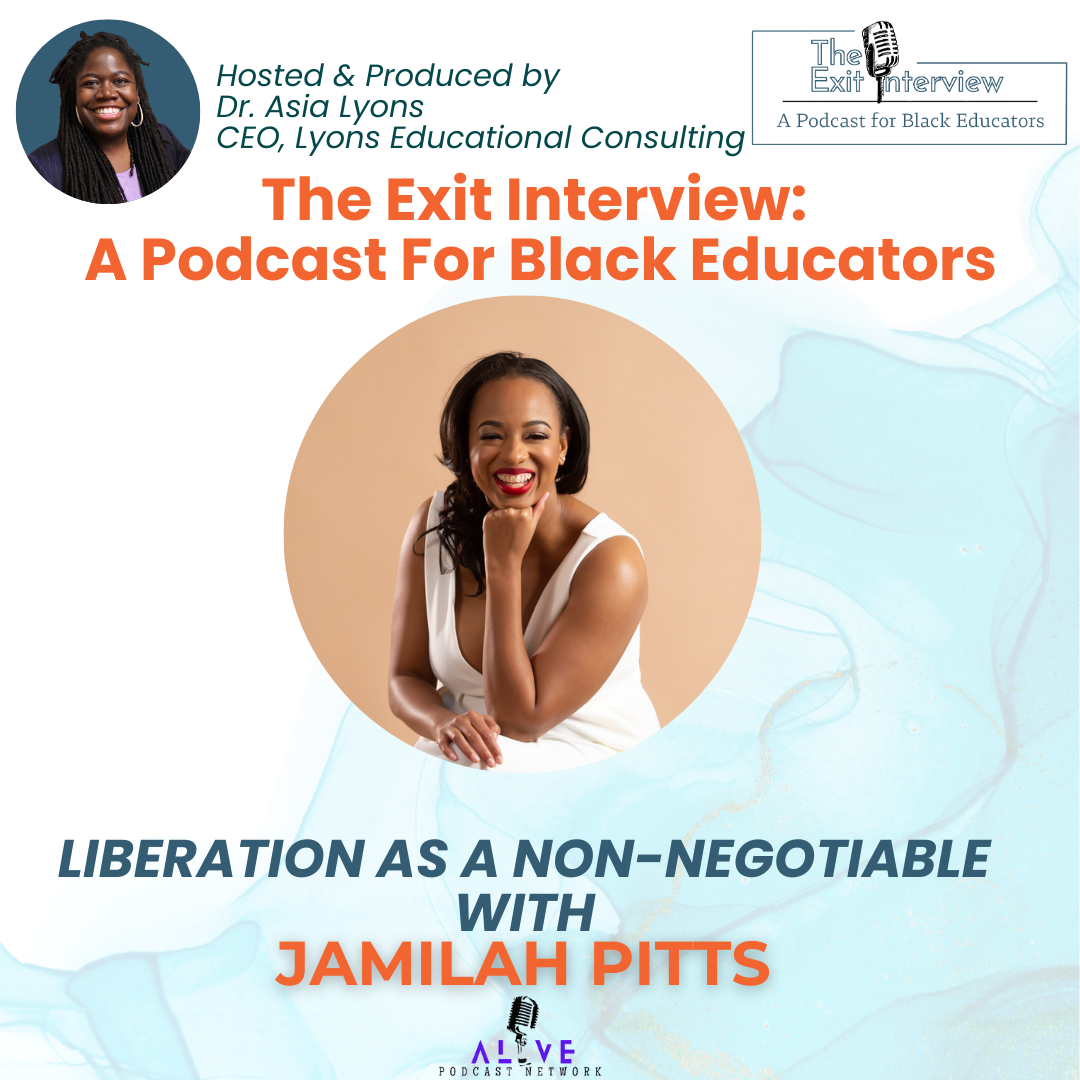
Liberation As A Non-Negotiable with Jamilah Pitts
What happens when an educator's deep love for liberation collides with the realities of traditional schooling?
In this episode of The Exit Interview: A Podcast for Black Educators, Dr. Asia Lyons sits down with Jamilah Pitts, educator, author, yoga teacher, and founder of She Imprint, to explore her journey through the education system and beyond. Jamilah shares how her childhood experiences with Black women teachers inspired her dream to teach, and how her international work, from Boston to the Dominican Republic to India, shaped her vision of education as a tool for healing and activism. She opens up about the emotional toll of navigating toxic school environments, the complexities of internalized racism among leadership, and the moment she chose her own wellness over a broken system. Throughout the conversation, Jamilah offers a deep call to center healing in our schools, reimagine leadership, and honor educators' full humanity.


Episode Overview:
In this powerful episode of The Exit Interview, Dr. Asia Lyons sits down with Jamilah Pitts—author, educator, yoga instructor, Spelman alum, entrepreneur, and advocate for healing and liberation in education. Jamilah shares her journey from a childhood inspired by Black women educators, through teaching in Boston and the Dominican Republic, to her leadership roles and eventual transition out of traditional school settings. The conversation explores the intersections of activism, healing, and education, and the importance of centering wellness for Black educators.
Key Topics & Highlights:
- Jamilah’s Early Inspiration:
Growing up in Columbus, Ohio, Jamilah was shaped by Black women teachers and a performing arts education. She knew from third grade she wanted to teach, write, and work with children. - Teaching as Activism:
Jamilah discusses her experiences teaching in Boston, the Dominican Republic, and New York, and how each setting shaped her understanding of education as a tool for liberation and activism. - International Perspective:
Her time teaching affluent students in the Dominican Republic challenged her to adapt her approach to social justice and critical consciousness in the classroom. - Leadership & Leaving Traditional Education:
Jamilah reflects on the challenges and violence she faced as a Black woman in school leadership, including internalized racism and the emotional toll of advocating for anti-racist, healing-centered practices. - The Importance of Healing & Wellness:
She emphasizes that healing and wellness must be central in education, not just for Black educators but for all. Jamilah shares how her own journey led her to prioritize self-care, yoga, and retreats. - Current Work:
Jamilah is now an author, speaker, and founder of She Imprints, an organization serving women and girls of the global majority at the intersection of wellness and justice. She leads programs for leaders and educators, and hosts international wellness retreats. - Advice for Schools & Leaders:
To retain Black educators, schools must center healing, pay educators fairly, and create supportive communities. Leaders should be the most well among us, modeling self-care and vulnerability. - Shout-Outs & Affirmations:
Jamilah uplifts all Black educators, especially those feeling defeated, and encourages them to remember their worth and the value of their work.
Resources & Contact Information:
- Jamilah’s Book:
Toward Liberation: Educational Practices Rooted in Activism, Healing and Love (available everywhere books are sold; support Black-owned bookstores!) - She Imprints:
sheimprints.org – Wellness and justice programs for women and girls of the global majority - Contact Jamilah:
- Email: hello@jamilahpitts.com
- Website: jamilahpitts.com
- Instagram: @missjamilahpitt
Memorable Quotes:
- “Healing and wellness has to be central in education, period.”
- “If I am silent about my pain, they will kill me and say that I enjoyed it.” — Zora Neale Hurston (quoted by Jamilah)
- “You cannot love yourself fully and look at another human being and act harm or violence upon them.”
Call to Action:
If you enjoyed this episode, please share it with someone who would benefit from Jamilah’s story and insights. Connect with Jamilah for speaking, retreats, or to bring her work to your school or organization.
First of all.... have you signed up for our newsletter, Black Educators, Be Well? Why wait?
Amidst all the conversations about recruiting Black educators, where are the discussions about retention? The Exit Interview podcast was created to elevate the stories of Black educators who have been pushed out of the classroom and central office while experiencing racism-related stress and racial battle fatigue.
The Exit Interview Podcast is for current and former Black educators. It is also for school districts, teachers' unions, families, and others interested in better understanding the challenges of retaining Black people in education.
Please enjoy the episode.
Peace out,
Dr. Asia Lyons
Liberation As a Non-negotiable with Jamilah Pitts
[00:00:00]
dr--asia-lyons--she-her-_1_02-26-2025_140701: All right folks. Welcome back to the exit interview, a podcast for black educators, and we are back with another fire episode. I'm so excited. we're talking to author educator, yoga instructor, Spelman alum, entrepreneur, foodie traveler, Pitts. Welcome to the show, Jamilah. How are you today?
jamilah-pitts_1_02-26-2025_160701: I love that. Thank you. I'm good. I'm good. I'm excited.
dr--asia-lyons--she-her-_1_02-26-2025_140701: Yeah, I'm excited too. This, I feel like this episode was fast and furious, right? Um, reached out to your people. Your people are like, I, we got somebody we know. We have a brilliant story. And so we had a chance to talk and I'm excited for you to share your story, an education and what you're doing now.
'cause obviously you got a lot going on. yeah. So, you know, as always, we're gonna jump in and start with the first question. So many people who come on the show have a journey into education. [00:01:00] That is, for some people very short. They knew in college, they started in college and then they figured it out.
Then some people are from families of educators. Other people come in through organizations like TFA. Uh, what was your journey into education?
jamilah-pitts_1_02-26-2025_160701: Yeah, my journey started in third grade. I had a really amazing teacher. Well, I like to share, and I, and I talk about this in my book. I did not have a white teacher until I was in fifth grade. So pre-K to fourth grade were all, all black women teachers actually. And so in third grade, I had an amazing teacher, Ms.
Jackson. Um, I think that the theme that year was Dreams and they were really focused on just really placing in front of us, like opportunities to be able to explore what we wanted to do and what we wanted to become
dr--asia-lyons--she-her-_1_02-26-2025_140701: Mm-hmm.
jamilah-pitts_1_02-26-2025_160701: we got older. And I remember at that time because I loved school, um, it really was like a safe haven for me.
I went [00:02:00] to a performing arts school. I grew up dancing, performing in shows. And so I really, really had a beautiful educational experience. I also knew as a child that I liked kids and that I wanted to work with kids. And so I remember saying in third grade that I wanted to be a teacher. I wanted to be an author.
And at the time I also wanted to be a pediatrician. And an O-B-G-Y-N, all those things.
dr--asia-lyons--she-her-_1_02-26-2025_140701: Okay.
jamilah-pitts_1_02-26-2025_160701: and so, yeah, I knew, I knew in th in third grade that I wanted to teach. And so that, that desire, that interest stayed with me for a really long time. But as I got older and I paid more attention to just my surroundings, so I grew up in Columbus, Ohio.
I went to, I'm the pro product of, um, public schools because that's what my mom could afford.
dr--asia-lyons--she-her-_1_02-26-2025_140701: Mm-hmm.
jamilah-pitts_1_02-26-2025_160701: and so she made sure that she was really intentional about making sure that we were in the best public [00:03:00] schools if that was the only option that we had. Um, but it became very clear to me as I got older, the, the way that schools seemed to free me and to offer opportunities for me to escape.
To explore, to dive more into myself. I noticed that it seemed to trap a lot of people that were around me. As I got older, I became more civic civically engaged. I became more politicized. And I had an understanding very early on on how education could either be tied to our oppression or it could be tied to our liberation.
And so I saw what was happening to a lot of my classmates between just early deaths, gang violence, incarceration. And so I remember the first time someone said to me that education was political. And I really, I didn't fully under understand what it meant at the time. But by the time I got to Spelman College, I [00:04:00] remember going through, uh, this program called Civic Engagement and just really being a student at Spelman and, and the ways that we are taught.
Um, to move through the world and to look at the world critically, I was able to tie that into education and that really just burped in me a fire to not just pursue education, but to pursue education as a pathway to liberation. And so I have on that path ever since.
dr--asia-lyons--she-her-_1_02-26-2025_140701: Yeah, I love that. So, hi, um, higher ed, K 12 Elementary. did you teach? Were you an educator in a traditional sense as a teacher? Or what did you do? What is that journey? What part of the journey, or what was that part of the journey like for you?
jamilah-pitts_1_02-26-2025_160701: Yeah, so I started right after college. I went to grad school, um, for education. I started teaching in Boston. I was a high school English teacher, so most of my years in education were spent in the classroom as a high school, [00:05:00] ELA teacher. And then I taught for some time in an international baccalaureate school in the Dominican Republic, which really.
Opened me up in terms of the disparities of education, but also really understanding how Bell Hooks talks about how the, the classroom is the most radical space. And so really being able to practice that, um, through my teaching, through fellowships and work that I did in, in India. And then I came back to the US um, after teaching and living in the Dominican Republic, and I taught in New York City.
dr--asia-lyons--she-her-_1_02-26-2025_140701: pause for a second? We can't skip, we got, we have to sit on that Dominican Republic for a minute.
jamilah-pitts_1_02-26-2025_160701: Yeah.
dr--asia-lyons--she-her-_1_02-26-2025_140701: 'cause you're saying it's like it's shifted the way that you thought about education. Can you talk to us about that? Because I know that many folks teaching here in the US in the, in the con continental US, want to teach
jamilah-pitts_1_02-26-2025_160701: Mm-hmm.
dr--asia-lyons--she-her-_1_02-26-2025_140701: elsewhere afraid to, not sure how to, things like that.
So can you tell us what that was like for you? Why you decided to, [00:06:00] to teach there? And then also what that experience has been was like for you?
jamilah-pitts_1_02-26-2025_160701: Sure. So, and thank you for asking because I, I don't often get to talk about it. Um, so my first year of teaching, I went to grad school and started teaching in the classroom in Boston. I started teaching in a charter school and while my first principal was a black woman in really a really incredible leader, still is and was at the time, I really started to lose my love of teaching.
And it was just the first year because I literally felt like at times I was teaching in a prison. I did not have autonomy over my curriculum. I very much. Still am and was at the time, saw teaching as an art form, saw it as something that is a tool of activism. And in order to engage in the praxis in that way, I need to be able to create, in order to, in order to be a culturally responsive educator, I need to be able [00:07:00] to create, um, in front of the, for the students who are in front of me.
And I, I was, I did not always have that opportunity, and it just felt bad. And I said to myself, you know, I have, I, I have known that this is the work that I've wanted to do since I was in third grade. I should try to explore another opportunity in a way to dive into teaching that does not. The other thing is that it was also completely exhausting.
And at the time I was 23, 24, and so I, I did not want to give up on teaching. I also, when I was in college, I'm a first generation college student. Um, I. Spelman really opened me up in a lot of ways. Um, but it, it opened me, opened me up as a global citizen. And so, um, I really had powerful and beautiful opportunities and experiences as a college student.
I was able to teach in Beijing, China. I was able to travel to the Middle East. I was able to do social justice work in [00:08:00] Cape Town. And so by the time I arrived to my first year of teaching, I also had this love of just the world and wanting to explore the world. And so I had, um, completed a, a summer fellowship where I was teaching and the manager of my program had actually taught abroad, I can't remember where he taught for a few years, but was just like, Hey, you should really look into this.
And for teachers who have studied this craft, um, and are certified, you can actually make good money and you can actually have. Uh, just a really beautiful opportunity and experience teaching abroad in international baccalaureate schools. And so that's what I started to apply to. These are the types of schools where like diplomats and ambassadors send their students.
I did not want to go super far away from home, but I did want to have an experience where I could learn and, [00:09:00] and immerse myself in another culture, especially if I was going to be teaching there, because I believe in that reciprocal nature of, of being teacher and student, especially when you are, um, teaching in a community or a culture that is different from your own.
Um, and so I chose the Dominican Republic after meeting with my principal at the time, who just really spoke life into me and we, we were able to forge this really beautiful relationship and that was it for me. So while I was teaching in Dr, I remember talking to other teachers. I had, again, I went to public schools.
K to 12. I grew up in an impoverished community and neighborhood. Um, I think Spelman was the first time that I was around black people who came from money. Not everybody came from money, but a lot, a lot of, um, people did. But I had never had a schooling experience like K to 12 and certainly as a teacher where I was teaching affluent students.[00:10:00]
And so in the Dominican Republic, like right off the back there was this contrast. Um, I was teaching affluent, mostly white Dominican students, and I just had no idea what activism work and what liberation work looked like in the classroom with this demographics of students. And then it. It became very clear to me, these are going to be the young people again, because I was teaching high school.
These are going to be the people who assume leadership roles within their country. These are going to be people who go on and study in the United States, either stay in the States and are able to just by the sheer amount of access that they have to opportunity right now, they're being set up to do very well.
And so what does my work look like in the classroom? Right? How do I, I'm [00:11:00] not going to teach them in the same way that I would teach my students in Boston, right? And, and urban schools, predominantly students of the global majority who were coming from impoverished backgrounds like I did. Um, and so it became very clear to me that.
They need to understand how oppression works. They need to understand how to think critically and how to be able to develop a reading of their own worlds so that they can do something about it, because they are being set up to be in the positions where they can really do something about it. And, and, and that's not to suggest that students who are coming from an impoverished communities and are relegated to the margins of society can't do anything about it.
It's that, that's, that's definitely not what I'm saying. But the way that you teach those demographics, it's, it's very, very different. And so I started to dive into teaching, um, as a tool of activism, as a tool [00:12:00] of advocacy really for students. And I really wanted. Did use the material as a way to support my students and really being able to deepen and develop a critical consciousness where they could not only look at the community around them, our school community, the country that they were living in, but the at at the world, and be able to name different types of oppression, be able to name different types of injustice, and be able to begin to, and be able to think about like, what do we do about that?
How do we position ourselves in the world now that we have this information so that we can do something about it? I wanted them to understand empathy. I used to say to them all the time, yes, I care about how you perform academically. Obviously like scholarship is important, but I actually care more about you being heart smart.
That is more difficult to teach. It is. It is more difficult to cultivate. But it's [00:13:00] something that I was able to do really beautifully, and not just because of me, but because of the willingness and the openness and the hearts of my students. And that was transformative for me. It affirmed for me that I can do this anywhere.
dr--asia-lyons--she-her-_1_02-26-2025_140701: Yeah. I'm curious to know what was the response of the families, of the students when you were teaching these things to the students? Because I, I, I think about the community in which I taught,
jamilah-pitts_1_02-26-2025_160701: Mm-hmm.
dr--asia-lyons--she-her-_1_02-26-2025_140701: wouldn't say they were affluent, but I would say that this was the ways in which I taught social justice
jamilah-pitts_1_02-26-2025_160701: Mm-hmm.
dr--asia-lyons--she-her-_1_02-26-2025_140701: definitely eye-opening for the families.
The students ate it up. The families were more hesitant. So I'm curious, was it well received by the families of your students?
jamilah-pitts_1_02-26-2025_160701: Mm-hmm. My students also ate it up. Um, I, I do not recall having any direct opposition to families and parents and caregivers. I think because students spoke so [00:14:00] highly of the learning experience that they were having, that caregivers, family members did arrive. There was a lot of respect. I will say, I think the only,
I think the only issues that maybe brought up a deeper conversation were when we tackled things like homophobia and, um, like corruption. And I think it's because of the climate in the state of the country, um, and what is, what was bred within the country and the climate. But aside from that, I mean, we were pretty bold and loud in terms of, in terms of the work.
My students were definitely co-conspirators alongside me. Um, so no, I actually didn't have a ton of resistance from, from families.
dr--asia-lyons--she-her-_1_02-26-2025_140701: That's amazing. And so I heard you say before I made you rewind, you went from there to India. Is that [00:15:00] correct?
jamilah-pitts_1_02-26-2025_160701: Yes. So I taught in Dr. Came back to the States and was while I was teaching in New York, and then I moved into school leadership when I was in New York. Um, I, I completed a fellowship and a part of the fellowship. I chose to go to India to study the impacts of human rights education because I wanted to, I wanted to open up the work that I was doing.
It was very much focused on the us It was very much focused on, um, communities of the global majority, particularly black and Latino communities. Um, and I want it to, this, this work to me is, is it's, it impacts humanity. It's something that I think is important to do across the globe. And I thought that India would be a really rich place.
To dive into how can we just given the number of human rights violations that exist in a lot of [00:16:00] places, um, but certainly in India, um, and in different types of violations, um, against women and girls. I mean, just, there's a wide range as there is in in many cultures, communities, countries. Um, but I chose, I was, I, I felt led to go to India to study that
dr--asia-lyons--she-her-_1_02-26-2025_140701: Yeah.
jamilah-pitts_1_02-26-2025_160701: and to.
dr--asia-lyons--she-her-_1_02-26-2025_140701: this. Thank you, and I love this, uh, this zoomed out, very intentional way that you chose to go about being in education, this traditional sense, right? Where it's like, I wanna learn more about this. I wanna teach this type of student, um, I wanna at my craft, understanding this part of the world, or the way that these particular folks in this particular area, um, are experiencing or not experiencing education or humanity. Um, sounds like you probably give a lot of that credit. Maybe, maybe not. I don't want to to speak for you too. Like you said, the [00:17:00] Spelman, right? Like, you could do all these things. You can be every, right. And so really interesting that, um, that college that you decide to go to shifted your worldview.
And I, I want, I wanna talk to folks, particularly folks who are in college for, um. Education. This is something, or thinking about going to school where you go to school matters.
jamilah-pitts_1_02-26-2025_160701: Yes.
dr--asia-lyons--she-her-_1_02-26-2025_140701: Where you go to college matters, right? And so I know I've heard so many people, myself included, like, oh, I wish I would've traveled abroad.
I didn't experience. It was not offered to me. And so when we think about for some people going back to school or people going to school for the first time, think about where you're going to school because it's gonna change how you are as an educator before you even start in the classroom or as a school psych or so on and so forth. So I just wanted to pause and say that, um, and so continue you, you or in New York and we're in leadership. And [00:18:00] then what about after that?
jamilah-pitts_1_02-26-2025_160701: The end of that story, no. So I, I, I taught in New York, um, moved into other positions as a dean, academic dean, dean of students, a coach, um, and. And, and then into administration as an assistant principal. And then where, where did the story go from there? Um, so the last position that I worked in was as a school administrator, as an assistant principal founding a school.
And it was the most toxic experience, the most violent experience that I had in education. And I had had other violent experiences, but I think that sometimes working in education, you may not realize something is, feels violent because it's so much a part of the norms and the, and the [00:19:00] customs and the culture and the practices.
Um, but I did realize that it was violent and that it was harmful. And so that was the end of my traditional work. In schools. I still work with schools as a consultant, but even now I'm finding that even that proximity sometimes is violent because you're, you're still in it and you're advising and people are bringing you in because of an expertise that you have.
Um, and sometimes they're looking at you to fix and to solve, um, you know, systems and issues that, that have existed for a really long time that are not going to be mitigated or undone overnight. And so, yeah, that is school leadership is, is where the, the traditional story ended for me.
dr--asia-lyons--she-her-_1_02-26-2025_140701: Yeah. I wanna ask the next question, and I think you're kind of get leaning into it a little bit, but what was the, what was the, it sounded [00:20:00] like a series of events. That caused you to decide, like, this is it, I'm not going beyond this. I mean, it sounds like you, you had lots of positions and assistant principal and the way that your story started, it sounds like you could have just kept on going to superintendent, right?
You had the passion for it and definitely, the will and the community support. So what was it that caused you to leave education in this way?
jamilah-pitts_1_02-26-2025_160701: So it's taken me years to even be able to fully answer that question because I have not been able to fully answer the question without continuing on my healing journey. There was so much that I was carrying so much that I was experiencing so much abuse, so much harm that was happening that I just, I didn't realize and I couldn't name at the time.
But it's over time since I have been out of the environment about almost five [00:21:00] years now. That I'm able to look back and say, wow, and put a name to some of the things that transpired. So in general, when I think about working in schools and how they are, are violent, you know, I had a, a, a really good friend say to me, we're black women.
And when we're working with black students who come from communities that are similar to the communities that we came from, it just hits us differently. It just impacts us differently
dr--asia-lyons--she-her-_1_02-26-2025_140701: Yeah.
jamilah-pitts_1_02-26-2025_160701: see what our students are holding, to see what they are carrying and to see what the system, the educational system, the systems and the world are doing to, to them, but also working within the system and knowing that we are trying our best to do our very best for students.
And so a part of it is the emotional labor that I carry, that I think many black women who are working with black students or students of the global majority that we're carrying. Whether we recognize it or [00:22:00] not, that that contributes to the, just the weightiness of the work.
dr--asia-lyons--she-her-_1_02-26-2025_140701: Mm-hmm.
jamilah-pitts_1_02-26-2025_160701: I think when you are engaging in the work and the way that I was as a form of activism, as a form of liberation, as a form of healing, there's this added layer layer.
Because I'm not here just to teach this lesson. I'm not here just to create this unit. I am thinking about the liberation of my people and, and just the, the fullness of that, that, that adds a weight. Um, I'm an empath. I'm energetically very, very sensitive. I would, I would argue that many of us who are called to this work and have the heart to do this work and to be sustained in this work, I would imagine that that many of us are, are built similarly in that way because you, you have to have a deep level of care to do this work and to stay in it.
Um. And so just feeling not only the, the weight of the world, but [00:23:00] feeling all of all of what schools house. Just a day to day experience, like standing on my feet all day as a classroom teacher. There was the emotional, the physical, the spiritual, the mental laboring that was happening. That comes at a cost.
It, it comes, it comes at a price. And I did not one personally, I did not, again, I started teaching right, right. After grad, grad school. I went to grad school right after college, so I wanna say my first year of teaching I was 23. I didn't have a lot of the tools that I have now in terms of being able to regulate my nervous system, understanding when my nervous system is dysregulated, understanding how to use food as medicine and how to.
Properly nourish my body. I wasn't a yoga teacher yet, so I may have been feeling different things, but I didn't have the tools for self care and self preservation that I needed. And so there was a wearing and a tearing that was happening on me. So that's, that's one aspect. Um, in terms of what I was [00:24:00] arriving to this position as a school leader with.
So by the time I arrived to the position as a school leader, I was really excited. I had a lot of beliefs around, um, just the importance of centering, healing in schools, liberation in schools, activism in schools, culturally responsive practices, and really making sure that we worked as hard as possible to do right, um, by our students.
I felt well prepared. To be a leader. I felt like I had the skillset to be a leader. I think a lot of people around me were clear that I, I had the expertise, I had the knowledge, I had the practice to be there, and I felt really clear about that. That also came to my detriment because I was working with people.
Unfortunately, we've gotten to a place in education where we don't always require skill and um, expertise [00:25:00] for educators to do the job that they're doing, and there are a lot of reasons why that might be happening. But what tends to happen, when I think about the interpersonal relationships and how I was showing up in this space, again, I went to Spelman College, so this whole imposter syndrome never had it.
Never walked into a room feeling like I didn't belong there. I knew from third grade that I wanted to be a teacher. And so I put in the work to read as much, to do as much of practice as much because I felt like that is what our young people deserve. They deserve really excellent, skillful educators. And so I made it a point to arrive that way.
Um, you know, Spelman, women, we're not taught to shrink. We are told we are taught to, to to speak truth to power, and we don't see other black women as a threat, right? When you
dr--asia-lyons--she-her-_1_02-26-2025_140701: Mm-hmm.
jamilah-pitts_1_02-26-2025_160701: have Allegate experience where even if you arrive there having had, you know, dramas and issues with, with, with other black women or girls, listen, it happens, right?
Um, and there are a lot of reasons [00:26:00] tied to oppression and patriarchy and racism, why that happens. But I, I. I had this experience where I learned to trust black women, to love black women, to support black women to believe in sisterhood. I'm also a sister. I have an older sister. I have a younger sister, so I was learned in that I was practicing that I believe in it.
A part of my mistake was not remembering that not all black women and women of color have a Spelman experience or having an experience where they are taught to love black women and to love other women as they love themselves or as a part of loving themselves. Some people, some women see a woman speaking truth to power, not shrinking, no matter who it is, showing up, doing her absolute best, whatever that looks like on [00:27:00] that day.
You have some women who see that as encouraging and who s who sees that that walking and liberation as an invitation to you also walk and your, and the birthright that you have to walk in your power to walk in your liberation. And then there are some women who see that as a threat. They see that as intimidating.
They see it as something that they need to attack because it is foreign. It creates fear. And even though I did not recognize that this is what was happening at the moment, because I just didn't believe it. Like I'm like, we are here to do what needs to be done. Who better than like black women? But that was a part of my ex experience and, and that was deeply toxic.
And so, you know, working alongside and with leaders who didn't always have integrity, um. What they said and what they did didn't always aligned or what they said and what they then, what they said didn't always [00:28:00] aligned. And I'm a true tell. So, so, you know, being a true teller in a space and, and encouraging people to operate with integrity, um, I be, I became a target.
Uh, I became the problematic one. Um, experiencing just people being jealous and people feeling intimidated. Um, having people lie about me, having people say things that weren't true. Um, sitting in the space of an advocate for other black women, women on my team who are not being treated fairly, but who were afraid to speak up, um, feeling the weight and the backlash of that.
Um, asking people to do things that were appropriate, both in terms of holding other adults accountable, because as leaders, that's a part of our job when other adults in the building are not doing what they're supposed to do and not being, not being a people pleaser because it's, how's, that's not helpful for the young people [00:29:00] that we are here to serve.
Being just very firm, very clear. Not everybody responds well to that, so that was a part of it. Um, but when you think about how that added on top of all of the other things that you have that you carry and that you do as an educator and the really long work days, um, for me, uh, I thought it was important as an assistant principal, I wanted to at least be teaching one class so that the teachers that I was coaching and leading professional development for, they could come into my classroom.
And, and also see like what was happening in practice, the days that
dr--asia-lyons--she-her-_1_02-26-2025_140701: love that.
jamilah-pitts_1_02-26-2025_160701: well, and also seeing the days when, like when I was struggling as well. Like, listen, this is a practice. We are living this. Um, and so there was the, the toll of um, just sometimes what, what comes from working with adults. I think that young people can be beautifully flexible and open and sometimes working with adults, um, that can [00:30:00] be really challenging.
But then there was also the added layer of really seeking to center anti-racism, not just in the curriculum, but in everything that we were doing. And so having to have conversations with our superintendent, our deputy superintendent, um, having conversation with white folks who are in leadership about how, what is, what exists and what you are trying to create and what you are trying to do is actually very harmful.
And so you are. I remember expressing to someone that I felt like I was just working against myself in so many ways. Here I am having an understanding of what, what liberation looks like, because I've studied it, right? Like I've, I've, I've researched it, I, and, and aspects of my life. I seek to live it. And trying to do that in my work, but meeting so much resistance.
I think about Toni Morrison where she says like, the very function of racism is to keep you from doing your work that also [00:31:00] exists in schools, right? I think about when Audre Lorde talks about like caring for ourselves is it's, it's a part of how we preserve ourselves. And so having, like literally working against a system as a person and, and trying to pull allies and co-conspirators alongside me, um, there was the just energetic drain and violence that came from.
Working in a space that was just toxic. Like sometimes schools are just really toxic. People talking about people behind their backs, people not working with integrity, people, um, not being kind people, not telling the truth, people not being honest. I think that sometimes we don't recognize what that does to our spirit.
Like we are also spiritual beings. And I think that education can be so disconnected from our humanity, which makes no sense because it is such a human field and profession. You know, that that energetic drain and [00:32:00] strain added a toll. Um, not having time to care for myself properly. And I was working under a black woman who said to me, um, because I would always say like, I put healing as a part of like the mantra and the model for our school.
One, because it's a part of liberation, but we have to center our healing and our wellness in order to do this work. And. Unfortunately, a lot of schools don't see the, the necessity and the importance of wellness and healing and self care for both young people and educators. So many schools are so married to grind culture and that toxicity.
And so here I am doing all the things that I'm doing right, probably just being a complete nuisance tell, telling people about themselves, you know, just all of these different things. Being confident, speaking up for myself, speaking up for other people, making meetings long because I want us [00:33:00] to think about how we can do this differently as opposed to doing always been done.
Because I want us to think about how we can do this in a way that is excellent because that is what our students deserve. So on top of all of that, you know, I'm also this person that's like, I. And I have to take care of myself. And the answer to that is no. And I'm going to set boundaries. And so we're having these conversations more now, like the importance of therapy and self care and boundaries.
Well, when I was having those conversations with like my principal in 20 19, 20 20, it was not well received. I was told that I was, I was told that I was not being a team player. I was told that, um, I was told that my wellness had to look different because I was a leader. Um, and so the, when I would have push back against things like that, all of that, even though I am a, a fighter and an advocate, I really love peace.
And I show up and I advocate and I fight because I, I believe in something, [00:34:00] but it takes a toll. And so to hear those types of things from a black woman to have my tone policed. By another black woman, um, to be told by another black woman, I need to fix my face. Um, just a lot of these really harmful, violent practices that we are able to name and identify when white folks do them.
Sometimes we do them to each other.
dr--asia-lyons--she-her-_1_02-26-2025_140701: Sure. Sure.
jamilah-pitts_1_02-26-2025_160701: And the, the toll of that, it just, it consumes you differently. It consumed me differently to the point where I was working with a therapist at the time. She recommended a medical leave. I took a medical leave. Actually, I had enough PTO because I was one of those educators.
I advocate now to people, [00:35:00] take all of your PTO, but I was not, like, I never missed a day. Um, I. So I actually had enough PTO where I didn't need to like file for an official medical leave. I had enough time to just take it. I went on a yoga retreat, um, after that time because we had a, we had a break. And while I was there in this space of just healing and wellness, I'm a huge advocate for, for retreats.
I know that some, like different wellness practice practitioners have different beliefs about retreats, um, and the investment around them, I believe in them because for me, the times that I have been able to really step away and like literally be in another part of the world, just things become less foggy and they become less cloudy for me and I'm able to see clearly.
And I decided while I was there, I called my principal and I said to her, I have given all that I can give. I don't have any [00:36:00] more. Fight and me, and before she blocked me, um, I sent a really lengthy email and I named everything that I could think of at the time to name as to why I was resigning, because I knew that that was going to be healing up part of my healing process to at least be able to begin to speak truth,
dr--asia-lyons--she-her-_1_02-26-2025_140701: Yes.
jamilah-pitts_1_02-26-2025_160701: to what I had experienced.
And, and people will gaslight you. They will say that you're making things up and that you were the problem, whatever, you know, I knew what my, my truth was and it was important for me to be able to speak that. Um, I, I sent, um, a letter to my entire staff. Um, essentially thanking them. I mean, the, the work was, was really, really valuable.
It was really important. I was very, very grateful to our team, to our staff, what we were able to build and do together. And I sent a letter to my students, um, really just thanking them and also apologizing. I had never resigned from a position I had never [00:37:00] intended to resign from a position, but it was, it got to be so ugly.
Um, I knew that if I did not make that decision, that my mind or my body would've made that decision for me. I had already started to see health issues. My mental health already just wasn't great. Just the sheer anxiety of what I had to show up each day and endure and move through. Like, what is this person going to say today?
What are they going to do today? How are they going to retaliate today? What lie are they going to tell on me today? In addition to all of the other work that I had to do? It just was too much and I was afraid. I was afraid of what would happen if I, if I didn't resign, if I didn't step away, and so I had to.
dr--asia-lyons--she-her-_1_02-26-2025_140701: let's take a breath folks.
jamilah-pitts_1_02-26-2025_160701: Mm-hmm.
dr--asia-lyons--she-her-_1_02-26-2025_140701: Thank you so much for that. There's so many [00:38:00] pieces. I think that what probably is most blaring for folks is that you are under the leadership of a black woman. And there's some assumption that like we all get along and we all have the same ethos and we all wanna see students succeed and we all wanna support each other. And like we were talking about before, um, the show started. And as many people in the audience probably understand, I hope they do. That is not the case.
jamilah-pitts_1_02-26-2025_160701: Mm-hmm.
dr--asia-lyons--she-her-_1_02-26-2025_140701: So when you talked about really the internalized racism
jamilah-pitts_1_02-26-2025_160701: Yeah.
dr--asia-lyons--she-her-_1_02-26-2025_140701: Yeah. That your principal was experiencing and lots of seems like multiple people, right?
The fact that because you choose to stand up straight and to, to, to come into a room as you belong there because you do, because your mindset is one of, not backbiting of not going behind people's back and lying. You become a target.
jamilah-pitts_1_02-26-2025_160701: Mm-hmm.
dr--asia-lyons--she-her-_1_02-26-2025_140701: Um, and I know that there's so many folks who also have that [00:39:00] experience,
jamilah-pitts_1_02-26-2025_160701: Mm-hmm.
dr--asia-lyons--she-her-_1_02-26-2025_140701: black woman to black woman, right? Um, and I, I thought about when you talked about teaching a class you wanting to teach a class so that students, so that people who were, um, needing support or needing coaching or required it could see this model classroom of what it could be and what it could look like. And I can only imagine
jamilah-pitts_1_02-26-2025_160701: Mm-hmm.
dr--asia-lyons--she-her-_1_02-26-2025_140701: shame,
jamilah-pitts_1_02-26-2025_160701: Mm-hmm.
dr--asia-lyons--she-her-_1_02-26-2025_140701: from, from your administrator thinking doing too much or whatever that situation is.
jamilah-pitts_1_02-26-2025_160701: Yeah.
dr--asia-lyons--she-her-_1_02-26-2025_140701: yeah, and I, yeah, I just, I wrote so many things down.
jamilah-pitts_1_02-26-2025_160701: Yeah.
dr--asia-lyons--she-her-_1_02-26-2025_140701: not,
jamilah-pitts_1_02-26-2025_160701: mm-hmm. I think you named something I that's important too though. Like, a part of why I, I have been really hesitant to share the fullness of my story is the shame and the guilt that comes from knowing that a, a large part of the violence that I experienced and the toxicity that really took it over the edge for [00:40:00] me was working under the leadership of a, of a black woman and working with other black women.
And just again, being a really felman alum, loving black women, being a sister, believing in sisterhood. I've built a whole organization around healing and wellness for, for women and girls of the global majority. And so it's not just something that I believe in, it's something that I live. And so even, you know, a part of.
A part of the hardship for me too is I was internalizing a lot because I excused a lot. There were a lot of things that I say, I, I didn't really want to rock the boat. And it, and it has been difficult at times to want to tell the story because I also, and you talked about how another guest felt this way, I did not want to be a part of carrying on this narrative that black women can't get along, that we can't love each, can't support each other.
And I think that you just [00:41:00] named something that's really important. So it's, it's the nuance of what happens. I am allowed to name the harm and the violence that I experienced at the hands of another black woman because I did. I did, I did. And I am also able to, with time and years in therapy. Really step back and look at the fullness of the, the nuances.
I'm sure that in some ways other black women felt offended by my presence or the way that I showed up in a space, and they are entitled to feel that way. You know, I am able to look at this now and, and be able to offer some compassion and some grace. You naming the internalized racism piece is really important.
Some of these things, when we talk about internal issues, um, when it, when it comes to like infighting and issues, um, within the black community and [00:42:00] among black women, they don't just arrive overnight. Some of this goes all the way back to the plantation and apart enslavement and racism and oppression and colonization is to, is to divide and conquer and to, to pist against, you know, one another.
And, and, and so I recognize that. I also recognize, like I said, not everyone. Got to attend Spelman College. I recognize that for a lot of black women, we move through the world with so many attacks coming at all parts of our being. It makes sense to me why the, why one black woman would feel intent. It doesn't make sense, but it does make sense considering what we experienced, why someone might feel insecure or why they might feel intimidated, or they might think this woman is just like strange.
Like, who is she to speak, to walk this way, to talk this way, to show up this way. Um, and it's, it's a part of why I, I do [00:43:00] my work, but I do also for the sake of my own healing, I have to name like, yo, like that wasn't right. And you, you, you will not do things to me. You will not intentionally cause me harm and violence.
Only one. Think I'm not going to say something about it. Um, Zora Nell Hurston writes about this, where she says that if I'm silent about my pain, they will kill me and say that I enjoyed it, that
dr--asia-lyons--she-her-_1_02-26-2025_140701: it.
jamilah-pitts_1_02-26-2025_160701: that was not going to be my story.
dr--asia-lyons--she-her-_1_02-26-2025_140701: Yeah. Pa, pause for one second. Say that again, please. Say it again. Quote
jamilah-pitts_1_02-26-2025_160701: Zo
dr--asia-lyons--she-her-_1_02-26-2025_140701: please.
jamilah-pitts_1_02-26-2025_160701: Nell Hurston says that if we are silent about our pain, they will kill me. They will kill you. And say that we enjoyed it. And so that was, that was not going to be my story. A part of my response and a part of protecting myself and a part of telling my story was going to be resigning from a position was going to be saying to you like, these are the reasons why.
It is not a, a part of how I [00:44:00] heal and how I tell my story and how I advocate for myself is having the nuanced conversation. It's writing about it, it's publishing about it. Um, is all of those things, not this black woman. Not, not with all that our ancestors have had to endure. Ab, absolutely not. Like, absolutely not so.
Absolutely not.
dr--asia-lyons--she-her-_1_02-26-2025_140701: Absolutely not. I thank you so much for sharing that so understanding. All the nuances, all the pieces, all the complexities that is the human spirit and education. Do you feel that school, well, let me ask a different question, ask the question a different way. What do you think, anything, at all, that schools and districts and unions can do retain black educators like yourself?
Like are there suggestions [00:45:00] that you have to make sure that we don't continue to lose educators who care deeply about the communities in which they serve?
jamilah-pitts_1_02-26-2025_160701: My overarching answer would be that healing and wellness has to be central in education, period. And I say that not only just for black educators, for us to be such a deeply human profession and to be missing the element of the work that FO focuses on our own healing and our ability to be well, you have so many people that are showing up to education to work out their childhood trauma.
dr--asia-lyons--she-her-_1_02-26-2025_140701: Mm-hmm.
jamilah-pitts_1_02-26-2025_160701: people's kids, right? You have, who are showing up in the education space because they don't love themselves and are seeking to validate themselves using other people's kids. And so [00:46:00] that, that's, that's, that's one element. But I also think the healing piece, and I talk about this in my book, it is really difficult to, in fact, I think it's impossible if you truly love yourself.
If you truly, truly, and for many of us, for many folks of the global majority, for for, for those of us that come from these generations where trauma has been imposed upon our bodies, our, our, our, our minds, our psyches, our spirits, we especially have this really long journey I believe back to, to self-love.
Um, I believe that we are whole. I believe that we are born whole, but I don't think that we always recognize that. And for many of us, we. Operate, operate in the world that's daily telling us that we're not. And so our self care, our ability to be whole, has to be top of mind. You cannot love yourself fully and look at another human being and act harm or violence upon them.
dr--asia-lyons--she-her-_1_02-26-2025_140701: Mm-hmm.
jamilah-pitts_1_02-26-2025_160701: not possible [00:47:00] because if you were truly in touch with your divinity, if you are truly in touch with your source, whatever you wanna call it, if you're truly in touch with your spirit, if you're in truly in touch with your being, and I believe that healing facilitates that, right? Like I I, when you are in that space or in the practice of that space, there's no way that you can harm another human being or do things that intentionally harm another being.
Because listen, we're human things happen.
dr--asia-lyons--she-her-_1_02-26-2025_140701: Yeah.
jamilah-pitts_1_02-26-2025_160701: But there's no way that you can intentionally do that because if I look at you and I love myself and I recognize the divinity within myself, I also see the divinity within you. I see the power within you. I see the beauty within you, and therefore, I'm not going to intentionally do something to harm you.
When we are not in a practice and in a space of healing, we are disembodied, we are disconnected. And I believe that is when a lot of the violence, a lot of the harm comes in. James Baldwin talks about this so beautifully when he talks [00:48:00] about why just the, in the foundation of this country, why it has, why this country is, has, was built on a, a racist foundation.
And a lot of it had to do with just this lack of, of self-love. You can't call me names and seek to strip away my humanity. You cannot do that. If in some way. You're disconnected from your humanity yourself. And so we are seeing that in education in a variety of ways. So healing has to be top of mind in order to retain folks.
Um, I believe that leaders,
I think that those who lead schools need to be the most well among us, we have too many leaders who just, and a part of it is a system like you don't have time. And it, and it hasn't been normalized that we prioritize things like healing [00:49:00] and wellness and care. And I think we're getting there. We're starting to have those conversations, but not at the rate that we need to for the, the, the levels of harm, um, and violence that are happening.
So healing has to be top of mind. I believe that black, black folks, we need our space. We need our spaces, we need our communities in order for black folks, for us to be in a, in spaces and in communities. We have to be able to have these real conversations with each other. We have to be able to be vulnerable.
We have to be able to take the mask off. We have to be able to remove the debris around our heart so that we can unify. I mean, again, a part of what happened during enslavement, a part of, um, you know, what happened during Jim Crow was this intentional destruction of our communities because there's power in our communities for folks who are the descendants of, of, of African people.
It's, it's a part of how, it's a part of our power source. It [00:50:00] just is. Um, I think that, I think we need to be paid more. I, I think that we just simply need to be paid more. Um, and I think that we need to be equipped for what we're, what we're walking into. And I, I share this.
dr--asia-lyons--she-her-_1_02-26-2025_140701: Yes, yes.
jamilah-pitts_1_02-26-2025_160701: Consultant as, um, as someone who trained and developed teachers working directly in schools.
And now outside of schools, too often we, we are thrown into schools or we're thrown into positions that we're not ready for simply because we, we, um, we resemble, um, the student body, um, or for some quota, um, or, you know, whatever, whatever their reasons are. But we really need armor to, to walk into, into schools, just given how schools are sites of violence.
We, we need that, [00:51:00] um, outside of school. We need to know that we are human beings outside of. The work that we do, we need to know that our worth is tied to so much more than just the work that we do. Our work is an extension of who we are. It's not who we are. And so we need that personal relationship with self and those communities.
We, we are caregivers. Um, we, we hold really powerful space. And so it's important for people who are caregivers and people who hold space in the way that educators do to also have a really beautiful, balanced life so that we are sustained in the work. Um, and so there are ways, I think, for school leaders and for systems to encourage that, to allow for that.
Um, we have to work against these destructive systems that are rooted in, and that's tied to capitalism and racism. Um, but we, we really have to do a better job at working against just these systems that are designed to destroy our spirits and our bodies, um, and [00:52:00] our, and our minds. And you can't do that as a leader.
You can't do that as a person. Making these decisions. If you haven't done that work yourself, you won't be able to see it.
dr--asia-lyons--she-her-_1_02-26-2025_140701: Yeah, is all beautiful. I, when you were talking, I thought about, we had Dr. Sean Genwright on the show beginning of the season, and he talked about how schools love professional development, but professional development develops our US in our profession, and that really we need human development
jamilah-pitts_1_02-26-2025_160701: Mm-hmm.
dr--asia-lyons--she-her-_1_02-26-2025_140701: development will grow us as humans, humans. Which in turn grows us as professionals.
jamilah-pitts_1_02-26-2025_160701: Mm-hmm.
dr--asia-lyons--she-her-_1_02-26-2025_140701: Right. And a part of that human development is wellness, is healing, is restoring ourselves to, and you, you're right, we are whole, we're born whole, but coming closer to who we were at birth.
jamilah-pitts_1_02-26-2025_160701: Right.
dr--asia-lyons--she-her-_1_02-26-2025_140701: Yeah. Yeah. I, this is just beautiful. And I think since you're, you're talking about a little bit, [00:53:00] us what you're doing now.
You, you've, we've heard yoga, we've heard, um, book, we've heard like lots of pieces, article, and you have, uh, a space of healing and wellness for the global majority for women and girls. So tell us all about, uh, what you're up to now. Mm-hmm.
jamilah-pitts_1_02-26-2025_160701: I am on this continuous journey of curating a life that I love and deserve and that I'm worthy of. Um, and so right now that looks like recognizing that I do not come from a family that is wealthy. And so work still is a part of my equation, but it is really thinking and getting in.
I get to, and it's a privilege. I get to be intentional about what my work looks like. So I am still available in the education space. More so as an author and a speaker. Um, my, so my book toward liberation educational practices rooted in [00:54:00] activism, healing and love is sold everywhere that that books are sold.
Though I recommend buying from our nd stores, our black, black owned stores, our black women owned stores. Um, and so doing work speaking engagements, that, that speaks to a lot of what we've talked about here that I also address in the book as, as one piece of the work. Um, the other part is I am, I started an organization in a couple years ago, like I can't remember what year we're in 2022 because I almost said 2011.
Uh, probably 'cause I started in November. So in two two she imprints and we serve at the intersection of wellness and justice for women and girls of the global majority. So I have recently launched two programs. One is a program for women, um, of the global majority who serve in leadership roles, executive leadership, nonprofit leadership to, um, [00:55:00] just receive educational programming development.
But that is focused specifically on our, our healing and wellness, because I know that we need it. I also believe that when we invest in women and women, when we invest in ourselves, it's just we are able to transform societies and community. The Emerge program, the second program, is designed, um, for educators, for community leaders, community advocates who are interested in working with girls, young girls, um, teenage girls.
Of the global majority, and it is a program that equips them to implement our curriculum that focuses on our pillars rooted in social justice, activism, leadership, wellness. Um, and so it is, it is a way to spread the work that I need, that I believe needs to be done on behalf of women and girls of the global majority, and equipping our leaders within, within communities to be [00:56:00] able to go and facilitate that work themselves.
Um, I also lead, um, international wellness retreats for, for black women and women of the global majority as well
dr--asia-lyons--she-her-_1_02-26-2025_140701: I, I, I love every time I, you and Octavia Raheem have to connect if you haven't already,
jamilah-pitts_1_02-26-2025_160701: Now.
dr--asia-lyons--she-her-_1_02-26-2025_140701: you all, you haven't connected. Yeah. You, you two do very similar work. Um, I love. When we are able to, when we have the heart to go back in and support in schools and educators and black women and black girls and girls and women of the world, majority, even after all that we've been through,
jamilah-pitts_1_02-26-2025_160701: Mm-hmm.
dr--asia-lyons--she-her-_1_02-26-2025_140701: are able to come back and to sow in, um, in this way of like reciprocity, right?
Because a lot of us are still in the classrooms. A lot of us are still fighting a good fight in these other ways beyond what we're doing, right? And so what does it mean for us to hold space for folks, right? Um, and prepare our [00:57:00] girls and, and give them the Spelman experience for what it sounds like, right? No matter where they are in the world.
jamilah-pitts_1_02-26-2025_160701: Yes.
dr--asia-lyons--she-her-_1_02-26-2025_140701: so I guess my next question is, is there a black educator that you would like to shout out?
jamilah-pitts_1_02-26-2025_160701: That's a beautiful question. I was thinking about that when I was reading through the questions. I would like to shout out every black educator that is, I mean like with their heart fully in it, showing up, doing this work. Um, up, this was just placed on my heart, so I'll, I'll go with that. And I want to speak and shout out to and speak life into black educators who are in a space that you're feeling defeated.
You feel like your work doesn't matter. You feel like you need to leave the profession. You feel like you're in this space of just why, like none of it even matters. Perhaps you're even getting into [00:58:00] this, this apathetic space. And I just want to reaffirm and I want to speak life back into you. I just wanna pour I.
Back into you in this moment. Yes. What you are doing comes at a cost. Comes at a price. It, it requires a sacrifice, um, at many times. But it is so worthy. And you are so worthy. And I am wishing you joy. I am wishing you peace. I am sending just positive energy and just speaking life back into you. 'cause I had so many educators do that to me on days, years before I made the decision to walk away, that I believe that I walked away at the time that I was supposed to walk away.
And that a time before that probably would've been premature.
dr--asia-lyons--she-her-_1_02-26-2025_140701: Mm-hmm.
jamilah-pitts_1_02-26-2025_160701: educators that spoke life back into me. And so those are the educators that I wanna uplift right now. There's a lot happening in our world. You are not, you are not misled. You are not disillusioned, [00:59:00] you are not wrong. Your work is valuable and you are needed and it matters.
dr--asia-lyons--she-her-_1_02-26-2025_140701: I was gonna say it matters. It does matter. Thank you. Um, my last question for you, what does it mean to be Well,
jamilah-pitts_1_02-26-2025_160701: Oh, I think the first word that came, so I think I'll do it, a series of words and phrases. First word that came to to mind was evolving, which you what, what I look like, what well looks like to me in one season, may look different in another season at ease. Just peace, joy, gratitude. Being well for me means that I'm caring for all parts of my being.
My mental self, my emotional self, my child self, my empathetic self, my introverted self, my physical body, my mental self, my emotional self, my spiritual self, my sensual self. Um, [01:00:00] the parts of me that needs different forms of pleasure at different times, it is the part of me that weeps and that cries. It's seeing all parts and honoring all parts.
It's the dark spaces, the spaces that need more compassion, more forgiveness, more tenderness. The parts of me that needs to apologize and recognize when I've done something wrong and repair, it's holding space and it's loving. All of that is what wellness or what it means for me to be. Well,
dr--asia-lyons--she-her-_1_02-26-2025_140701: Thank you so much and thank you so much for coming on the show. I really am excited to put this out to the community. I know that it will bless them. can they find you? People are looking for you, looking to work with you, be a part of your retreat space or bring you into your, their schools and organizations.
jamilah-pitts_1_02-26-2025_160701: yes. Thank you. Thank, thank you for this space. Thank you for. Giving us a, a platform and a space to tell our stories. I believe [01:01:00] that we, it is difficult to, to heal what we cannot speak. And so thank you for allowing this space to, for me to speak, for us to speak, to share, um, hello@jamilahpitts.com. My website jamilah pitts.com.
And for my wellness organization, it is she imprint, she SHE imprint, I-M-P-R-I-N ts.org and my Instagram at Miss Jamila Pitt.
dr--asia-lyons--she-her-_1_02-26-2025_140701: Fantastic. Alright folks, you got all the information. If you love this episode, share it with someone else, let it be a blessing to someone else, and we'll talk to you later. All right, peace.

Founder, CEO She Imprints
Jamilah Pitts is an educator, entrepreneur and the author of Toward Liberation: Educational Practices Rooted in Activism, Healing and Love, Jamilah's work centers the liberation, healing and holistic development of communities of the Global majority. Jamilah has worked and served in various roles and spaces to promote racial justice and healing. Jamilah has served as a teacher, coach, dean, and as an Assistant principal. She has worked in domestic and international educational spaces, including Massachusetts, New York, the Dominican Republic, China and in India.
As the Founder and CEO of Jamilah Pitts Consulting, Jamilah partners with schools, communities, universities and organizations to advance the work of racial, social and intersectional justice through training, coaching, strategic planning and curriculum design. Jamilah is also the Founder of She, Imprints, an organization serving at the intersection of wellness and justice for women and girls of the Global Majority.
Jamilah’s written work has appeared in the Huffington Post, Learning for Justice, and Edweek. She has presented to audiences of thousands of educators both within the United States and internationally. Jamilah threads her passion for human rights and social justice into her teaching, writing, scholarship and other artistic pursuits. She sees education and healing as her life’s work and calling, and truly believes that education should be an avenue through which empathy, healing and justice are promoted.
Jamilah is certified as a Yoga Teacher, Reiki Practitioner, Omnoir…Read More