Leaving With Your Head Held High with Nedra Hall
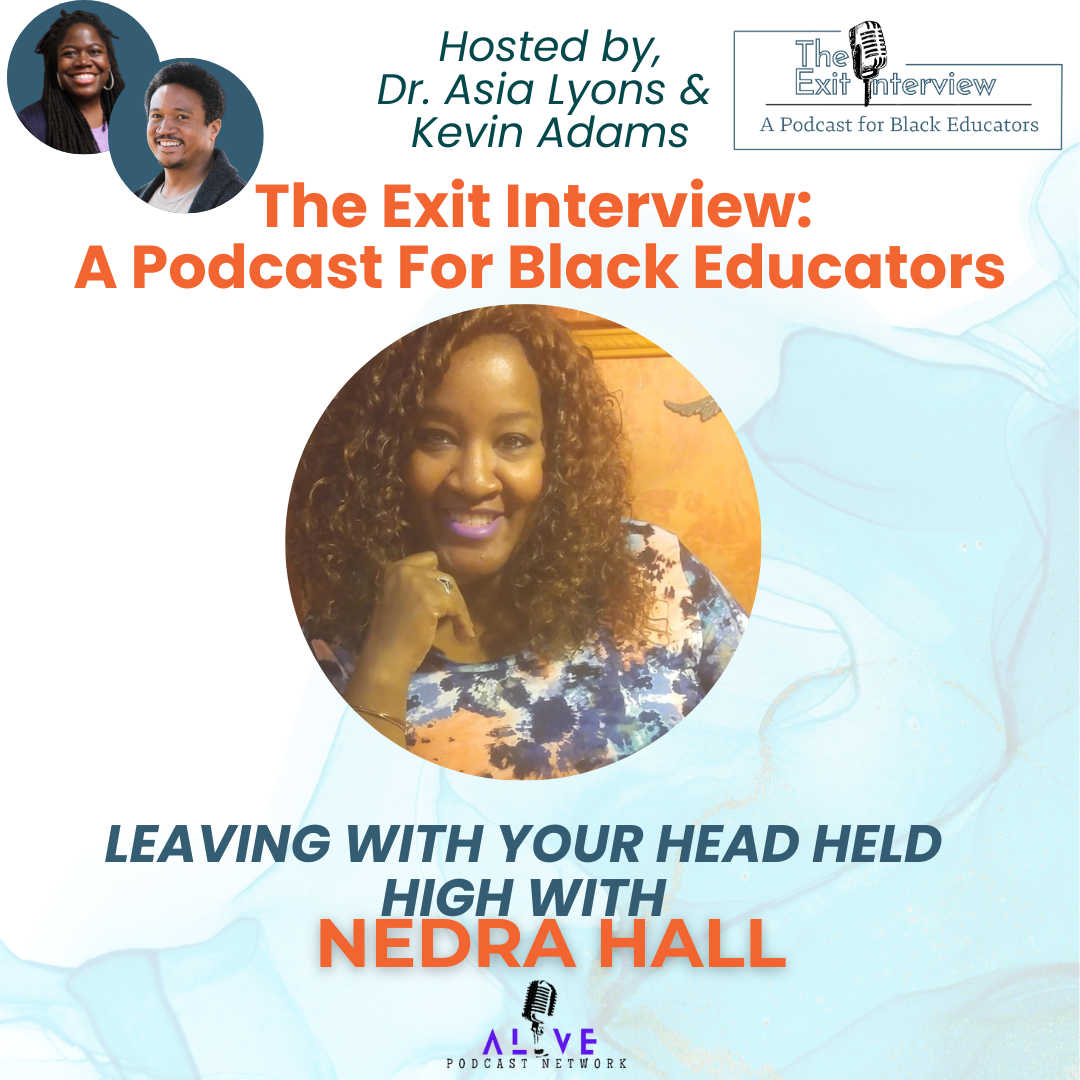
Nedra Rudolph is one of thousands of educational professionals that many of us see but never truly SEE. Having worked in Title 1 schools, as a Dean of Students, a paraprofessional, and a family liaison. These professionals are categorically invaluable, and grossly undercompensated.
She had a great situation, but like in so many situations, when leadership changes, so does culture. Never was the old saying "sometimes it's your own people" more true than in this situation, when a fellow person of color perpetrated White supremacy.
After a painful journey, Nedra was able to leave her position with her head held high. She still gets to work with children daily, and has found new joy in her work.


Show Notes: The Exit Interview – Season 3, Episode 1
Guest: Nedra Hall
Hosts: Dr. Asia Lyons, Kevin
Episode Summary
In this powerful season opener, Dr. Asia Lyons and Kevin sit down with Nedra Hall, a dedicated educator with over 26 years of experience in Aurora Public Schools, Colorado. Nedra shares her journey from her early days as a passionate “school kid” to her long tenure as a family liaison and dean. The conversation delves into the challenges, triumphs, and ultimately, the difficult decision to leave a beloved school community due to systemic issues and personal well-being.
Guest Bio: Nedra Hall
Nedra Hall is an education program coordinator at WINGS Over the Rockies Air and Space Museum. Previously, she spent 26 years in Aurora Public Schools, primarily at Mont View Elementary, serving in roles from paraprofessional to family liaison and dean. Nedra is known for her commitment to student and family advocacy, building sustainable community partnerships, and her resilience in the face of adversity.
Key Discussion Points
Nedra’s Path to Education:
Nedra reflects on her childhood love for “playing school” and her early ambitions to lead. She describes her move to Colorado and her start at Mont View Elementary, where she spent most of her career.Roles and Responsibilities:
Nedra explains the importance of the family liaison role—connecting families to resources, increasing parent engagement, and building community partnerships.Challenges and Turning Points:
The episode explores the impact of administrative changes, including the arrival of a new principal and team, which led to Nedra feeling undermined and marginalized. She shares the emotional toll, including anxiety and loss of professional dignity, that ultimately led to her decision to leave.Racial Battle Fatigue and Colorism:
The conversation addresses the concept of racial battle fatigue, the unique challenges faced by Black educators, and the complexities of colorism and intra-community dynamics within school leadership.The Last Straw:
Nedra recounts the moment she knew it was time to leave—being moved to a less private, less respected workspace, and feeling her role was being diminished.After Education:
Nedra discusses her transition to working at the WINGS Over the Rockies Air and Space Museum, where she continues to impact youth through educational programming.Advice for Retaining Black Educators:
Nedra and the hosts discuss the need for authentic support systems, safe spaces, and the limitations of institutional responses to the needs of educators of color.Finding Joy and Moving Forward:
Nedra shares what brings her joy now: working with kids, being recognized for her talents, and leaving her previous role with her head held high and no regrets.
Memorable Quotes
- “I always wanted to be the person in charge of the school. That’s where my interest in education started.”
- “I was going to work daily that last year, hyperventilating... it was just a really traumatic year for me.”
- “The fear of retaliation is so real, especially for educators of color.”
- “I was able to walk away with my head held high and I have no regrets.”
- “It has to be you first. We want to stick in there, but you have to advocate for your health and peace.”
Resources & Links
- WINGS Over the Rockies Air and Space Museum
- For educators seeking support: Big Brothers Big Sisters, YMCA, local DEI organizations
Thank you for listening to Season 3, Episode 1 of The Exit Interview! If you enjoyed this episode, please subscribe, rate, and share.
First of all.... have you signed up for our newsletter, Black Educators, Be Well? Why wait?
Amidst all the conversations about recruiting Black educators, where are the discussions about retention? The Exit Interview podcast was created to elevate the stories of Black educators who have been pushed out of the classroom and central office while experiencing racism-related stress and racial battle fatigue.
The Exit Interview Podcast is for current and former Black educators. It is also for school districts, teachers' unions, families, and others interested in better understanding the challenges of retaining Black people in education.
Please enjoy the episode.
Peace out,
Dr. Asia Lyons
Dr. Asia Lyons: We are in season three, episode one of the exit interview. Yay.
Kevin Adams: Yay, baby season three. That's right. That's right. This is wild. Big time. Big time.
Dr. Asia Lyons: Yeah, we might just stick around for all this work we're doing.
We might just make it out [00:01:00] here.
Kevin Adams: That's right. That's the goal.
Dr. Asia Lyons: Yeah, that is the goal. So tonight we want to welcome Nedra Hall. Nedra and I met each other in, 2018, but we were both doing two different, totally different things than we're doing right now. And she's here to here to tell us her story.
When I reached out to her, she said, oh yes, my story has to be told. So I am so excited to have you in the space. Welcome, Nedra.
Nedra Hall: Thank you. I'm glad to be here.
Kevin Adams: Yes. So, Nedra, tell us about your educational journey. You know, like how did you get to teaching, you know, what made you decide to become an educator?
How, how did you get here? And, and you could even go back reflecting on your own educational experiences growing up.
Nedra Hall: Yeah, for sure. I mean, I just remember that I always was one of those kids that wanted to play school and I always wanted to be the [00:02:00] person in charge of the school. So, you know, that's kind of where my interest in getting into education started. I found an interest in education here in Colorado, back in 1992 when I had, relocated from Colorado Springs here. My ex-husband was in the military and I came to Aurora Public Schools. I started at Montview Elementary, which is where I spent most of my career, pretty much all of my career except for two years. I was in Aurora for 26 years, so, 24 of those, like I said, they were spent at the same school.
Kevin Adams: That's some dedication.
Nedra Hall: Yes.
Kevin Adams: That's a long time.
Nedra Hall: I know, it is. And let me tell you though, when I, called the district to say that I was resigning, I was in tears and talking to the person on the other end, she said, well, that is unheard of nowadays. We don't have too many people that's been around as long as you have.
So [00:03:00] what's making you leave? And boy, that was the million dollar question for sure. And I'll get to that. But, again, I had a, I did several roles while I was there. I started out with Title One, title one paraprofessional. I was an educational, educational assistant. Did a lot of, programs for the schools and I ended my career in APS, carrying dual roles as a family liaison and a dean. So, that's kind of how my, that's kind of been my journey through Aurora Public Schools and in education here in Colorado.
Dr. Asia Lyons: Yeah, Nedra, when I met you, you were a family liaison.
Nedra Hall: Yeah, I was doing dual roles at that time.
Dr. Asia Lyons: Yeah.
Kevin Adams: Can you, for, folks who might not, understand the position, can you explain like what the family liaison is and some of your experiences in [00:04:00] that position?
Nedra Hall: Sure. So a big part of my role was to increase parent engagement, in the schools, help families advocate for their students in their learning processes, and, provide resources for our all of the community families, network with outside partners, and build partnerships for the school, that were hopefully sustainable relationships, a lot of them were, and some of them weren't, but that was a big, big part of what I did as a family liaison and I really enjoyed that role.
Kevin Adams: I think that's important work. I think at our school, right now, that's like one of the big things that we try to do is how, how are we connecting with families?
So that's, that's really important work. So, you said you were at Montview for 24 years. And then, and then you said in Aurora Public Schools for 26 [00:05:00] years. I'm not, I'm not a math teacher. I'm a social studies teacher. But, but, but based on what, what you're telling me is for 24 years at Montview was, pretty good.
Yeah. Tell us about what caused, you to leave Montview.
Nedra Hall: Well, you know, again, when I, always love working at Montview, but my last year at Montview, we did get, a new administrator, a new administrative team. , she kind of brought in her own team and one of the people that she brought in was basically to replace me and I got a phone call, over the summer from the principal to say, Hey, you know, I just wanna let you know I'm bringing in somebody else to do, you know, a similar role that you've been doing, but she's not gonna replace you.
But, you know, I'd love for you to support her and train her because she doesn't, you know, she hasn't done this work before and I know you have this experience. And, [00:06:00] you know, I just remember in my spirit feeling like that was just such a setup. Just, it just didn't feel right because. How in the world, you know, we're in elementary school, number one, so behaviors in elementary school are not behaviors in middle schools and high schools.
So there's no reason that you would need two deans in an elementary school. There's no reason. So, I remember, I went and met with them over the summer and I just remember there was a lot of eye contact between the ladies. And it wasn't like, oh, like this is a great idea that she has. It was more of, I don't know, kind of, just kind of really deceitful, I think, you know?
And so, you know, fast forward to the school year, they really started to. put me in positions that I had not been in. Not that I was above any of the work that they asked me to do, but it was how they did it. Because it was [00:07:00] almost like, I'm gonna put you in your place and let you know who you are and that I am in charge and this person's in charge now, and you are not this person anymore.
I'm gonna put you in your place, kind of thing. And , I just remember that parent, this is a totally true story. Parents were, they were coming up to me. You know, morning recess before school started or after school when they would see me and saying, at that time, last night was still Rudolph, and they said, miss Rudolph, what, what's happening?
What is going on? , or maybe I had changed my name, but anyway, what, what's happening? What? What's going on? You're doing jobs we've never seen you do before. Why are you outside? You know, in the mornings, and why are you doing this? And why aren't when I called to say, I have this problem, why aren't they people passing me along to you?
So parents started to notice this shift, you know, and for me that was really, that was hard because most of the times when those types of shifts happen in schools, parents aren't. Yeah. Yeah. [00:08:00] When, when it spills out into the community, the parents and kids and all of the staff, that they are aware that, hey, this person isn't being treated the same, that's a problem.
And, so really I was, I was going to work daily, that last year, hyperventilating, my husband would take me to work in the mornings and pull over because I couldn't go to school that that 10 minute drive would become a 20 minute drive because he'd have to pull over because I'm hyperventilating and crying and just, it, it was just a really traumatic year for me and just, you know, just lots of, negative experiences.
Relationships that I had established with kids. I felt like they were being undermined. It was, it was a lot. I experienced and saw a lot that last year and, , I never experienced because I mean, I've worked for several principles, as you can imagine, in 26 years. Yep. [00:09:00] So at Montview alone, I think I worked for five, six different principles.
So, yeah. To have an administrator. My office was across from this other woman that they brought in to replace me. My office was across from her. And to see these three administrators standing and gossiping and talking about colleagues that I had worked with for years. Was like, what is happening? It was, it was heartbreaking.
And I knew that if they were discussing other staff members like that, I could only imagine what they were saying about me because I was kind of like, really in your face and kind of really pushing back On a lot of things that they were, you know, doing and, and doing to the school. Cuz it wasn't just me, it really was a kind of an internal, kind of a upheaval.
We lost quite a few staff members after I left. So, just like I said, just those traumatic experiences really, really pushed me out the [00:10:00] door. That treatment I had never received before.
Dr. Asia Lyons: And that's a long time. I mean, you know, Kevin and I, we say this so much, right?
You talk about your husband driving you to work and that experience, and we name it, here on the podcast. You know, we didn't coin this, but we talk about racial battle fatigue and we talk about the ways that. Black folks are experiencing it just like you were saying. Yeah. Right? Just hyperventilation, questioning everything that we do.
Just kind of feeling like we just cannot get grounded. Trying to figure out like how we can navigate this. Can we leave, can we not leave, not wanting to go to work, but needing to pay bills or whatever the situation. Or not want to leave because you have these relationships.
Nedra Hall: Relationships with the kids.
Dr. Asia Lyons: Yeah, so please, I mean, we kind of hinted, hinted to it at the beginning of the podcast, but can [00:11:00] you tell us about that conversation, that last straw where it you knew like it's time to call down to central office or whoever and say like, it's time for me to go.
Kevin Adams: Yeah, but what you said, you said, and again, I'm not a math teacher, Asian, forgive me you 24 years, but 26 years. So there were you, you left Montview, right?
Nedra Hall:, One of the assistant principals that I had worked for previously at Montview had become a principal at another school, and she called and asked me if I would come over and run a program at her school. And so I was there for two years.
She left, she retired. and when she retired I went back to Montview. Yeah, yeah. But, Asia, back to your question about when I knew when it was the last straw for me, so, In 2019, that [00:12:00] summer of 2019 Montview had gone through a remodel and in, in that process, a remodeling Montview. Yeah , I got a new office.
You know, it was much smaller than the space that I had been used to work in as a family liaison. You know, I would keep clothes and supplies, school supplies, you name it, for families to come in and access coats. And when I got to smaller space, I didn't have that luxury of having the things available to families.
So they found another place for me to put those things and that was fine. , It was no longer something that I was kinda in charge of. The other lady kind of took over that, and I was like, okay, fine. As long as I know parents are still getting those resources, I'm okay with that. So one day the principal comes to me and she says, Hey, are you gonna be really mad at me?
She says, but I'm gonna have to move you out of this office. I'm gonna put you in a space. It's, you know, [00:13:00] down on a primary wing, you're gonna share this space with another person. And by the time I moved into the space, the other person had been there, so she her space was established, you know?
And so when they moved me into the office, they put me against this wall that was, that backed up to a restroom. And the vent was kind of over where I sat and I could hear everything. I could smell everything. And all of my things were in boxes. And I remember when I got to that place when they moved me and I was sitting there at my desk and I said, you know what?
This is my last move. I won't unpack these boxes. I said, I'm outta here. I just knew then, because at that point that told me that. My position, I wasn't important enough to be given this brand new office with new furniture, that kind of thing. I didn't deserve that. So instead, I'm gonna put you in a place where this is what you have all day.
[00:14:00] People coming in and out. There was no privacy. So if I needed to work with a parent and have some privacy, I no longer have that. And I just knew, then I said, I'm outta here cuz I can't serve families, if I'm, if I don't have a private space to honor their privacy and their respect, you know, respect them and their stories, what they're coming in with me to, you know, they're coming in to say, Hey, I need help with this.
I need help. And they don't want everybody in the school to know that. But in the office that I was in, there was no door. It was just kind of open space. And again, as I said, there was a bathroom here, and I, I just knew that was it for me. That was it.
Dr. Asia Lyons: Wow. And, so you're calling down to hr, you're letting them know you're leaving.
Nedra Hall: They say, we’ve never heard of this. Why are you leaving? And so, what did you say? I could, I could hardly even talk at that moment. I was so upset and I just said, it's obvious my time here is done. [00:15:00] You know, APS is changing and I don't think I fit in this shift any longer. And she, you know, and the lady didn't ask, well, is there something else going?
But I, I felt so powerless. I didn't feel that I could be 100% transparent without it, without there being consequences for me, some type of long-term, you know, consequences. Especially if I had ever considered going back to APS. And I did try to go back to Aurora Public Schools but of course it was the toughest thing in the world to get back into the district because of the principal that, I left under.
Let's be honest. Like she was the golden girl in APS. Interesting. And, we didn't actually get to elect her as our principal. She was supposed to be an interim principal and they just placed her in the position for the year. And, you know, it was just kind of a ripple effect. Once I left other people start to leave, so, [00:16:00] But I felt powerless in really saying to her what was happening to me.
Because even if I had shared everything that had happened to me, cuz I'm probably giving you guys the most condensed version because, you know, our time restraints. But, did I even have somebody that could be my advocate, somebody that was my ally in the district? And at that moment, you know, after 26 years and feeling like I'm being pushed out, I didn't feel like I had that support, you know?
Dr. Asia Lyons: Wow. Yeah, that fear of retaliation is so real.
Nedra Hall: Yeah. It's very real. Yeah. And I think especially for educators of color especially, I feel like it's really a thing for us because, you know, like I said, we don't always know who [00:17:00] our allies are and if we even have true allies because That's right.
Let's be honest, like the, the new principal that they put into place at Montview was. Woman of color, African American woman, but she was also a biracial woman. And so I feel like she could easily, because you know, she had to look right. She had to, she had to look. So she could easily assimilate and do whatever she needed to do to fit and she could code switch and it would be okay.
You know what I mean? Like I don't have that flexibility of code switch and I can take this wig off. I'm gonna still be a black girl. You know it is what it is. I don't have that where I can go back and forth and people are gonna look at me differently because this is how I look.
You know, I have this nose, like there's, I don't have those. Alliances in APS. Like she really had some strong alliances. Yeah. And I knew that trying to get back into APS was probably gonna be [00:18:00] tough for me because she was probably angry in the way that I left also, you know? So, yeah.
Dr. Asia Lyons: Can yu tell us about how you left? Did you not wait till the end of the year?
Nedra Hall: I did not. I was out of there at the end of January because I could not, I could not see myself staying an entire year. I couldn't imagine what was going to happen to me. What more would I happen withstand if I stayed the remainder of the year, you know?
Basically I think I mentioned this earlier, I felt like relationships that I had established with kids, because remember I had also, I had been doing the work of the dean for some years before they came in and brought this, you know, white woman in to do the work of the dean, who of course, Really didn't do much because, you know, she had that white saviorism going.
So discipline became, you know, let's kids come in my office and play in a big box and feed 'em cookies and candy. So, [00:19:00] I felt like I would see kids in her office, in her space, and I would say something to them and basically get the door closed in my face. So they couldn't directly tell me, don't talk to this kid.
Yeah. But they would do other things to keep me from talking to kids and to keep me from doing the things that I had done, using the strategies that I had used forever to get those kids back to a place where they could go and work in the classroom. They didn't want me to do that at all. And so it was craziness.
Craziness.
Kevin Adams: IYou know, we, we'd like to say it surprises us, but it doesn't. We've heard, you know, it fits a pattern that we've seen over and over again. , and so, we, we just are so happy you're here to share your story and we're gonna take a break here and [00:20:00] then we will come back and hear the rest of your story.
Dr. Asia Lyons: All right so, we're back. And, at the break, I brought up something that I think I wanna talk about more and is that's the conversation of colorism, and the conversation of what happens when we put black folks in positions of power, in school districts, and administration roles, and how they are capable of still harm.
Black folks, right? I say this all the time, and if you've listened to this podcast, if you know me in the streets, I've said this to you, every black person in Selma didn't march, right? Every black person, some black folks said, you know, I got a good job. I gotta do my thing. I'm just gonna keep my head down and continue to harm. Black folks, right?
And [00:21:00] in order for white supremacy culture in education and in general to exist and around this strong train that's running on, it needs black people to keep being silent or oppressing other black people. So when you said Nedra, like this person, they brought in that she is a biracial woman, that she has her, white counterparts talking about you in these ways and other people in these ways. It’s not surprising.
Nedra Hall: No. Not at all. No. And like I said, the, the team that she brought in, you know, they were two white women and, you know, it was, she, I felt like she fit in with them a lot more than she did with me and the other, few black educators that were in that school at that time, you know? Our relationship with her was very different than what it had been with our previous principal, you know, [00:22:00] Mia.
And, it was very different and I knew that Mia was my ally. I knew that I could go to Mia if I had concerns if I was being mistreated or anything like that, but I no longer had that when I got the new principal, so, yeah.
Dr. Asia Lyons: Yeah. That's super hard. And it's so unfair, and I just, I mean, I'm looking at you, I can see your face. I can see like you sometimes you're like right there, right? I'm, I'm so glad you're sharing this and I feel like, you know, this has been years now since you've left the school district and the pain is still there, but I really appreciate you sharing your story.
Plenty of times people say, well, what if it's this person went to a different place or a different school district they wouldn’t have that problem. And the truth is that we're talking to people all over the country who have similar experiences. Kevin always it's the same story.
Yeah. Right. Yeah. It's the same story. Yeah. And so if, I mean, I'm gonna ask the question and I have to ask it every time, is just thinking about your lived experience working in Aurora public schools, thinking about working with children and families and other educators for 26 years and like all the things you've seen, the people that have come and.
What do you think administrators, districts, unions can do to keep black folks in education spaces if you think that there's a strategy?
Nedra Hall: That's a tough question. It's a good question, and I'm not sure that I [00:24:00] know the answer to that. I mean, because as people of we are constantly dealing with, you know, the microaggressions and the other direct blatant, forms of bias on a daily basis. I think, I don't know if it's the district that can offer it, to put together support groups for us and have safe spaces to come together and talk about it.
I don't know if that's the district or if that's just as teachers, as educators, as paras, all those folks that are involved in a daily, operation of a school. I think it's just, it, it really kind of falls on us to. Develop those safe spaces, create those opportunities for us to come together and, , kind of reflect on what's happening to us, , what's being directed towards us, those types of things.
[00:25:00] I don't know that the districts could actually offer what we need. I really don't because the people that in most states, you know, they aren’t. They don't look like us, you know? And so I don't know that they can actually give us what we need, or if they're gonna fully give us what we need.
You know, I think a lot of times, and you know, not just in schools, but in any place that, you know, people of color are often offered, just kind of a little bit. You know, I'll give you a little bit on the spoon, but I'm not gonna give you everything that you need. I'm just gonna give you a little bit to somewhat appease you, but I'm not gonna give you really what you need to allow you to move forward, to grow, to, you know, have opportunities.
I'm just not gonna give you everything that you need. Mm-hmm. Thank you. Thank you. Yeah.
Dr. Asia Lyons: That's so real. [00:26:00], I don't know who said this, and Kevin, you might know. You're so well-read. It is. What is it? No one is going to give you the education you need to overthrow them. Something like that. And I, you know what I'm talking about here.
Kevin Adams: I know the quote. I can't remember who said it, but Yeah. I get I know what you're talking about.
Dr. Asia Lyons: Basically like why would a school district give us a space to empower ourselves to leave? Right. Or to have voice?
Nedra Hall: I just don’t see it happening.
Kevin Adams: And, the fact that they don't, I mean, they don't understand what we need. And sometimes it's just to be allowed to, to be treated with respect and dignity, as in your case, you know,[00:27:00]
It sounds like you have moved on and, you know, you've made that difficult decision. We know how hard it can be. But now that you left the classroom, what are you doing?
Nedra Hall: So I am working at WINGS over the Rockies Air and Space Muse. I work in their education department. I am the, education program coordinator there.
It allows me to still stay close to education because we do have a small, like, it's an enrichment program, but it operates just like a school. So it's for kids who are interested in, aviation and careers in aviation and aerospace. I still get to be close to kids. , and I still get to be close to education because we still work with some schools.
We partner with some schools and bring in programs. [00:28:00] But, yeah, so that's, that's where I am now. So, like I said, it keeps me close to kids in education.
Kevin Adams: Oh, wow. That's great. I always, often when I, when I fantasize. , leaving the classroom. Sometimes I'm like, you know, it'd be kind of cool because I'm always like, I'm, good at kind of teaching and I love being involved with education, but I always fantasize about working, like in the educational wing of a muse because I know there's always tours coming in, you know, and, and, and there's, you know, field trips, which are the best things Yeah.
Dr. Asia Lyons: Go where the kids are. People are finding me and saying like, can I just talk to you like I'm ready to leave? What, can I do? For me, entrepreneurship was the thing that I chose, but for other people it is they still wanna be working for others or in some capacity, which is totally fine, that's awesome.
And always say, go where the kids. Yeah. Big Brothers, big Sisters, Y M C A, like you're saying, there are so many places. Where youth are showing up and they need folks who've been in education to be a part of that conversation. Right. And you can still do that work. I know a lot of folks say, I wanna DEI work, go where the children are.
There's so many orgs here that need us in those spaces and specifically Black educators.
Nedra Hall: Yeah. In those spaces.
Dr. Asia Lyons: One last question, my favorite question, Kevin, I want you to ask it today.
Kevin Adams: The greatest question. What is bringing you joy?
Nedra Hall: I think what brings me joy is that I still, like I said, I still get to work with kids every day. I still am able to be in a place that actually recognizes my talent and allows me to, you know, use those talents and skills in a way that's beneficial to the students that we serve every day. I still get to see those school kids come in.
That brings me joy. You know, when you talk about the field trips and I see teachers and I see teachers with that one struggling kid and I can go over and offer a little bit of support in that moment. Like those things still bring me joy. And, and it brings me joy that I was [00:31:00] able to walk away with my head held high and, I have no regrets.
Yeah. Yeah.
Kevin Adams: Yes. I love that last part, that walk the joy of that feeling, right? The joy, the joy of having your dignity and, and knowing where you set the line. And what you said you wouldn't not stand for. And I think that's important for us as black people and black educators, you know? Asia, your thoughts?
Dr. Asia Lyons: Yeah, I was just gonna say that was a perfect way to end it. Like that, with your head held high.
I think that I've been hearing more and more folks are wanting to leave education, but they're afraid that people are gonna talk about them negatively if they leave.
Nedra Hall: You know how it is though. It's like when you leave a job or any place, you feel like an outsider, like your friends who were your friends at work, they no longer want to talk with you or anything. Like you've done something so terrible and so wrong for advocating for your health and for your peace.
And, for me, I'm sorry I'm tearing up, but it really was about advocating for my health and peace, you know?
Dr. Asia Lyons: Yeah, that matters, right? It has to be you first. Yeah, for sure. It has to be you first. A lot of us. We wanna stick in there. We wanna do the thing. The principal needs me.
Yeah. Such and such needs me. And they'll go, yeah, they'll leave. They'll retire. And you’re still there.
Nedra Hall: Yep. I mean, because when I really reflect on my career, when I really think about it, there are probably times when I should have gone a long time ago. [00:33:00] Because remember, you don't just get those microaggressions from the administrators, you also get 'em from your colleagues.
So, you know, when I think about all of the things that I endured throughout those 26 years, I probably should have gone a long time ago. But your commitment, like you said, to your principal, to the school, to the kids, and to the families, those things really kept me because I loved Montview Elementary School.
I loved the demographics that I worked with. I loved everything about the families. So for me, it was like the kids and the families, like they really kept me going, you know, I felt like I was with my family when I was with those families, right? So, but when I think about, like, when I really reflect over my career and think about some of the things that I endured during that time, Dang it.
I was I stayed, I put up with that. I allowed that to happen, you know, and I, for, you know, [00:34:00] what I forgot to mention was one of the things that happened to me that last year, they did a survey, with the staff. And of course, I, I didn't get to be a part of it. I didn't get to participate in it, it was just for everybody else.
And the things that, the things that were said on the survey. From people that I've, as I said, been colleagues with forever in the day, and people that I thought were my friends. Yep. It was, and they let me see the results, of course, of the, you know, very divisive, right? They let me see the results. The staff did not know that I would see the results, and I did see the results and, that was another thing that kind of broke me.
And I, and I knew then, and I was like, it's time to go. You know, because people won't say those things to you directly. They don't share those things like, Hey, I don't like the way you did this or that. They don't share their concerns, but you get them the [00:35:00] opportunity to hide behind a survey. And it's like you, you see things that you would not believe.
And so that was the other thing that, that really broke me.
Yeah, it was, that survey was rough reading the results and to sit across from these three people, because they read them to me in that meeting I told you about that I had with them. And they were looking at my face like, do you see what they're saying about you? And they had said things about, the former, the previous principal, Mia also.
And I was just like, what is happening? Who, who is this? And you know, some of the answers that you read, you knew right away who it was. Yeah. You knew right away. Like you could almost say, oh, this is that person, that person. And, some of them I was kind of like, who wrote that? So that, that made it hard for me to continue to [00:36:00] face those people every day because I was literally, I felt like I was walking through the hall. I would think I bet she's the one that put that answer. Yeah, I bet she's the one. It drove me crazy.
Kevin Adams: Yep. Well, people talk about gaslighting these days, you know? Yeah. And I think, you know, as black folks, we know this all the time because we're told things that it's just us. We're taking it too seriously.
Yeah. You know, I feel like that's that intentional stuff that they do to try to, push us out. Yeah. Right. When they, don't have any use for us anymore. Don't like the things that we have to say, that's the type of things that happen.
Yeah. And I've seen it happen. I've seen it happen in my buildings, that I've worked in, and I've heard about it. I've heard about it from other folks.
Dr. Asia Lyons: Yep. They're so real. [00:37:00] Yeah. Thank you so much for sharing your story.
Nedra Hall: Thank you. Thank you both.
Dr. Asia Lyons: Yeah. And we appreciate it. I really pray that you're like on the way to healing in your space. And I know this was really tough, but know that other educators who come and give us feedback always say like, oh, I heard that episode and this was so good and this is what I'm going through.
So know that it doesn't just fall on to ears that cannot hear your story. We call out and talk to black educators all the time and I hope that this was in some way, it was like a healing for you too.
Nedra Hall: It was. For sure.
Dr. Asia Lyons: Awesome. All right. This concludes our, first episode of season three of The Exit Interview: A Podcast for Black Educators.
Thank you all for joining us.