I Am Still an Educator with Shalelia Dillard
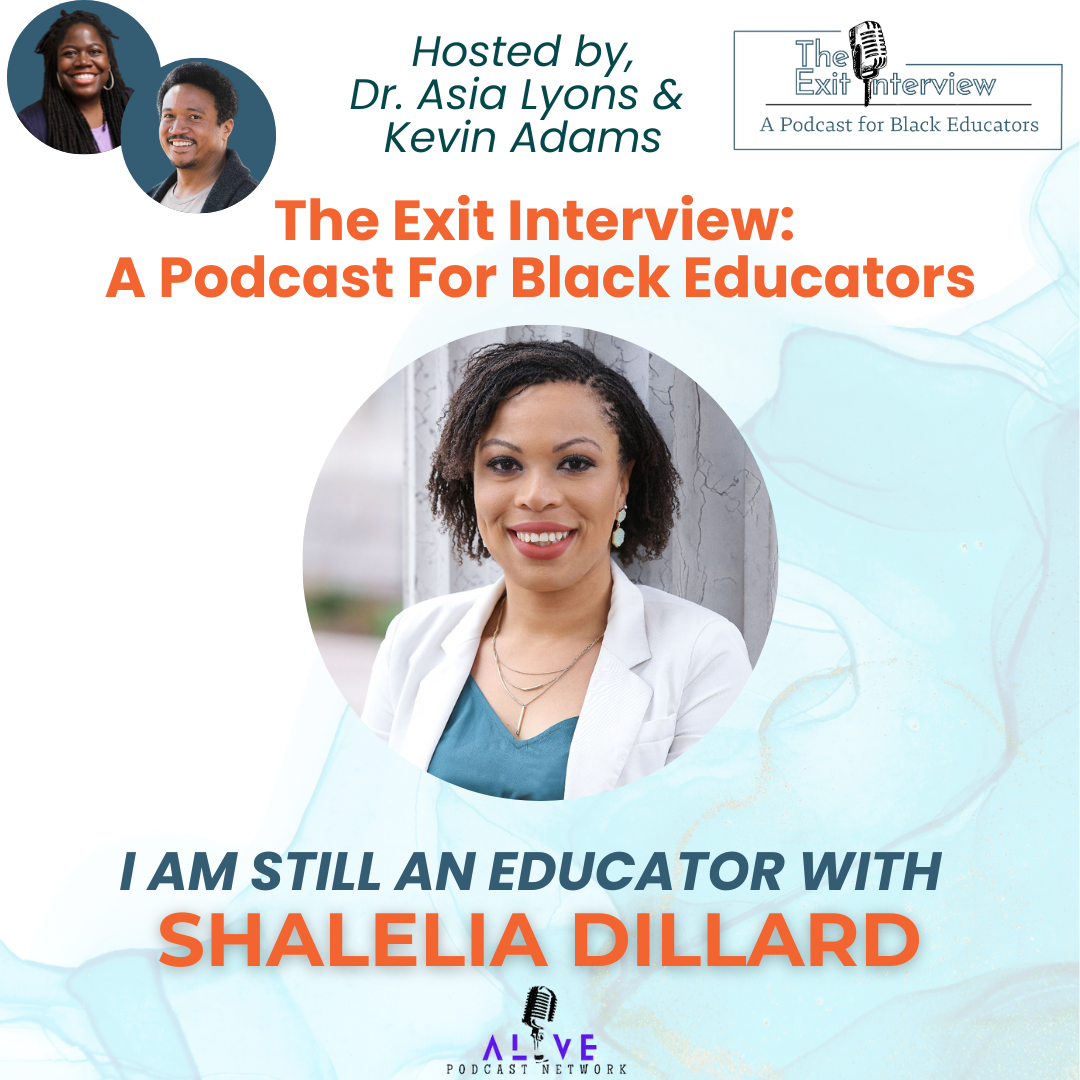
Welcome to Episode 4 of the Exit Interview with Asia Lyons and Kevin Adams!
This week we hear Shalelia Dillard share her story. It is a similar refrain for Black educators who have experienced institutional alienation and rejection within the education system. We invite you to listen and take in her story of optimism, belief in schooling as an equalizer and in her own brilliance and talents to provide a quality education for children generally, only to see her confidence and professionalism come under attack by the same forces that permeate our system.
But, as we have seen during the life of this podcast, the process has been liberatory while still painful. Shalelia has discovered that most dangerous of discoveries: that it is possible to continue to be an educator without teaching in a school. She shares her inspirational path and reminds us of what it means to be not an industry artist, but an artist in the industry.


Show Notes: "I Am Still an Educator" with Shalelia Dillard
Episode 4, Season 1 – The Exit Interview Podcast
Episode Overview
In this episode, hosts Aja Lyons and Kevin Adams sit down with Shalelia Dillard, an educator and founder of the SCD Enrichment Program. Shalelia shares her powerful story of navigating the education system as a Black woman, the challenges she faced in both public and private schools, and her journey to founding a nonprofit dedicated to supporting students of color in gifted and advanced programs.
Guest Bio: Shalelia Dillard
- Former teacher in Texas and Denver, with experience in early childhood and middle school education.
- Founder of SCD Enrichment Program (Scholars Cultivating Dignity), a nonprofit focused on recruiting and supporting students of color in gifted education and advanced coursework.
- Passionate about ethnic history, critical thinking, and community-based education.
Key Takeaways
- Leaving the Classroom: Shalelia discusses the personal and systemic factors that led her to leave teaching, including rigid curricula, lack of support, and the toll on her family life.
- Identity and Representation: Her experiences at Hampton University and as a teacher of color shaped her understanding of identity, belonging, and the importance of diverse representation in education.
- Challenges in Education: The episode highlights issues such as standardized testing, unrealistic expectations, and the need for culturally relevant pedagogy.
- Nonprofit Journey: Shalelia describes the vision and mission behind SCD Enrichment, emphasizing ethnic history, college readiness, and mentorship for students of color.
- Family and Community Support: The critical role of family, especially her husband and mother, in supporting her transition from teaching to nonprofit leadership.
Memorable Quotes
- “You will not thrive, and you will not be the best person that you can possibly be, which will harm your students at the end of the day.”
- “I am still an educator, just in my own way.”
- “Black equals intelligence, just so you know. And it always has.”
Resources & Links
- SCD Enrichment Program: scdenrichment.org
- Instagram & Facebook: @SCDEnrichment
First of all.... have you signed up for our newsletter, Black Educators, Be Well? Why wait?
Amidst all the conversations about recruiting Black educators, where are the discussions about retention? The Exit Interview podcast was created to elevate the stories of Black educators who have been pushed out of the classroom and central office while experiencing racism-related stress and racial battle fatigue.
The Exit Interview Podcast is for current and former Black educators. It is also for school districts, teachers' unions, families, and others interested in better understanding the challenges of retaining Black people in education.
Please enjoy the episode.
Peace out,
Dr. Asia Lyons
I Am Still an Educator with Shalelia Dillard
talking: [00:00:00] Alright, welcome to episode four, season one of the Ex Exit Interview. Um, I'm Aja Lyons. I'm here with my co-host Kevin Adams.
Kevin Adams: How y'all doing?
talking: And today we have Shaila Dillard sharing her story. But before we start a little intro, don't forget to follow us, um, at two Dope Teachers on Instagram and Twitter.
And you can like us on facebook@facebook.com slash two Dope teachers and a mic. Our email address is two Dope teacher at Gmail. You can listen to us on Apple and Spotify podcast [00:01:00] or@mrmunoz.org. By the way, please make sure that you, um, give us five star ratings and reviews. It really does help others to find our content.
Finally, if you want support us financially because podcasting isn't free, y'all head over to patreon.com/to dope teachers where you can become a PA patron for just $5 a month. The next five $15 patrons will receive a copy of Cornelius Minor's incredible book. We got this. That's it. Let's get started.
All right. Um, Shaila, so glad you're here with us to share your story on the as of interview. Um, I feel like we've been like planning this out for a couple weeks now, so it's good to have you on the podcast. And as always, we just want you to share your story. And we're here just to listen and just starting off, like what was the point where you decided that it was time to leave the classroom?
And if that was something that built up or there was one particular in incident, tell us all
Shalelia Dillard: about it. [00:02:00] Okay. Yeah. Thank you so much for allowing me to share my story and, um, thank you for even having this podcast because this is so powerful. Uh, I would say that it really was a, um, I, it was like, hmm. I had a vision of creating a nonprofit when I was 19.
I remember coming home from college my summer, like a summer, um, like during the summer. And I, like, my brother was in college as well and he had this like, anthropology book and I was just like, oh my gosh, this would be so cool. I would just listen, like, uh, reading the anthropology book and was like, man, it would be amazing if there was like something for kids like me, um, where we just struggled a lot and didn't have a lot of support and, but I didn't really quite know what it was gonna be about.
Um, [00:03:00] so then, uh, my major, I went to Hampton University, uh, that honestly, um. Really impacted my life significantly because I, there I learned like my history and who I was and, and like I had some extremely extensive identity, um, analysis going on.
Kevin Adams: Yes.
Shalelia Dillard: Uh, being from Denver. Yes.
Kevin Adams: Not har now was was real.
Shalelia Dillard: Tell our audience, where is Hampton University?
So Hampton University is A-H-B-C-U-A historically black college, or in uni, or It's a historically black university. Yeah. And it's in Hampton, Virginia, which is like the Hampton Roads. Uh, yes. Like 30 minutes from Virginia Beach.
Dr. Asia Lyons: Mm-hmm.
Shalelia Dillard: Um, yeah. But it's on the East Coast, so there's that, uh, there's definitely a lot more black people there.
Mm-hmm. And it's a lot more diverse black people there.
Kevin Adams: Definitely, definitely. My cousin, my cousin graduated from Hampton and I remember [00:04:00] going, I got to stay in his frat house. I was probably like, uh, maybe 15 one night. Yeah. And I was like, oh, wow. Wow. This is, this is it. I, I, I'm like, I gotta get to college.
Unfortunately I didn't make it to an HBCU, but I know, I know Hampton well.
Shalelia Dillard: Yeah, it, it is. You won't wanna leave, I'll tell you that much. Um, you, you find your people. Uh, I, I just had a really hard time, and this gets into like why I left, uh, education, but I really had a hard time, um, finding black people that were like me that didn't, uh, subscribe to like the mainstream definition of what a black person is.
Yep. So like slang, gang fighting, um, you know, like all, all the unfortunate negative stereotypes that we have.
Dr. Asia Lyons: Yes. Yes. Um.
Shalelia Dillard: I, I just, I'm like an introvert and I just, I couldn't, I just couldn't do it. I don't know. It just wasn't me. Um, and so when I went to [00:05:00] Hampton, I had the opportunity to be, um, just like inspired by so many different types of black people Yeah.
From all over the world. Yeah. So like from Van Ma, from Africa, from, uh, England, from like, you name it, there were black people from literally everywhere. Yeah. There were. And it was just so beautiful. Um, and I really got to like, not only was I academically, um. And enriched. But I was culturally enriched too to see that man, it, it wasn't just me.
Denver's tripping. Mm-hmm. Mm-hmm. Mm-hmm. Um, uh, because, because if you didn't subscribe to that mainstream for, for us Yes. For black people. If you did not subscribe to that
Kevin Adams: Yes.
Shalelia Dillard: And you were made fun of like, I was bullied, made fun of and all that.
Kevin Adams: And, and, and Shalia, [00:06:00] uh, what, what, what, what uh, years are we talking about?
Shalelia Dillard: Oh, so I graduated high school in 2003. Um, okay. Alright. Yeah. So, you know.
Kevin Adams: Yep.
Shalelia Dillard: Not because I feel like there's a different, I
Kevin Adams: feel like today there's a little different wave going, whether it's a little more acceptable in the black community to be a little more, um, you know, eccentric or a little, you know.
Shalelia Dillard: Yeah. More
Kevin Adams: different. But I, but I can relate in a lot of ways to what you are describing. I can relate.
Shalelia Dillard: Yeah. Same. The struggle's real. So going to Hampton, I was like, I, I found my people, like I found, I found my people. Um, and so I studied psychology and, um, but I wanted to be like a social psy psychologist.
So I, I already was really interested in, in people and how they navigated the world and how, you know, it influenced, um, society. Like, that was like really a, a huge thing for me. And so, um, [00:07:00] anyway, I, I did like, it was my junior year summer. I was like, I'm not going back home. I'm, I'm gonna stay here.
Um, and so I went and was a dorm director for Upward Bound, and I was able to like. Impact and, and just actually the students were able to impact me, to be honest. Uh, they were eighth graders and I was like, I had never once thought to be a teacher, did not, it, it did not even cross my mind. But running into our babies like it, during the Upward Bound, my Upward Bound experience, um, was like so influential to me.
And I was like, well, I can't switch majors now, so let me, uh, you know, look into alternative certification [00:08:00] programs, which were fairly new, um, you know, in 2006 and 2007. And so I, uh, searched for them and, uh, Austin, Texas had a really good one. Texas Teaching Fellows. And so I got my alternative certification there and went, um, two weeks after graduating Hampton, moved to Texas.
Did not really know, barely anyone. And, um. I began my teaching career and, um, I actually is really interesting because, because of my Hampton experience, I specifically chose environments that were people of color. Like I on work in No, you know, a school that had like a large, uh, population of white students.
Um, and, and my, my circle of people were all people of color. So I was really fortunate that I really was [00:09:00] never in an environment that was on, like I was one of the only black teachers. Um, and so anyway, I taught there for, uh, how many years? Seven years, uh, four years in preschool. And I don't know if you all know this, but you know, teaching in early childhood you'll see more, um.
Teachers of color Yes. That are there, you know, especially female teachers of color. Mm-hmm.
Dr. Asia Lyons: Mm-hmm.
Shalelia Dillard: So, uh, I, you know, found my tribe there as, as well. And, um, but went on to teach middle school and went, went to a school that had a, uh, Latino principal, uh, a black female vice principal,
Dr. Asia Lyons: Uhhuh,
Shalelia Dillard: uh, my, uh, what's it called?
My, um. Instructional coach was actually from, he, he [00:10:00] went to Hampton as well. Mm-hmm. Um, and, uh, yeah, I, I had a great experience my first year of teaching middle school. And so, um, my teaching experience in Texas was beautiful. Um, that's what I'll, I'll just end with, I, I had a great time there. Um, I actually, uh, my husband's from Denver too.
So we, I, I got pregnant and we wanted to, uh, raise our son here. Um, and so we were like, let's go back to Denver. I think that will be good there. Uh, and then we did, and we we're here. Yes. But yes, yes. But I will say that the school that I was hired at, which, which, which is Dr. Martin Luther King early junior college.
Yes. Dr. Grayson was my principal. Yes, she was. So, yes. Shout out to her because
Kevin Adams: amazing stuff.
Shalelia Dillard: She. Yeah. Okay. I was set to have my son [00:11:00] in early August and I was like, what am I gonna do? Because I gotta teach in like late August. So this brilliant woman put all of my PDs together or, uh, my, uh, my p uh, planning periods together.
My prep periods together. Yes, yes. With my lunch. And I was able to go and like, uh, breastfeed my son and spend some quality time with him in the middle of the day. Yes. She was like, you gotta be with your child. So, yes. Oh, wow.
talking: Wow. Can we just pause for a second and say like. That is phenomenal. Yeah. How like I've never, I've never even heard of anything like that.
That's awesome. That's dope.
Kevin Adams: That's dope. Like, so your son was at the
talking: school, 'cause I don't know much
Shalelia Dillard: about the school. He was there or close to there? No, he was close to there. So my brother happened to have a, um, he had bought a.[00:12:00]
Five minutes away, you know, during the day, and they're like, absolutely. So, um, it was such a blessing for me to be able to do that, but I realize now talking to a lot of mothers that, that, that was very rare. So I applaud, um, Ms. Grayson for doing that because that, that just doesn't happen. And, um, she really was, when I tell you she was there for her teachers of color, she, like, she was not playing games.
Um, and so, uh, funny thing happened at DPS. So I, so I, um, you know, coming from Texas, I had my Texas certification. Yes. And so when I interviewed with them, I went through all the process and talked to HR and all those things, and they're like, yeah, you're good to go. You just need to pass the Denver, uh, like [00:13:00] Denver's, uh, teacher certification, uh, within the year.
I'm like, okay, perfect. Uh, December happens and um, I am, I get a letter in the mail saying You can't come back to the school, uh, because you have not passed your test yet. And, um, until you pass your test, you can't come back.
So I don't feel like I've
talking: heard that, that before, but keep going. Keep going.
Shalelia Dillard: Okay. Yeah.
So, um, yeah, that happened and I was like, okay, what am I going to do? I still have pregnant brain. Yes. Because, and I literally took that test like three times and could for the life of me, could not pass it. But Ms. Grayson was like, you know what, um, that's okay. We'll just, uh, bring you on as like a long-term sub and it'll be [00:14:00] like the same, kind of the same amount like that you were making.
And I was like, okay, I could do that. Um, and I came back. I think that's what happened. Yeah. Um, so I came back as a eighth grade science teacher instead of a sixth grade science teacher. Um, and finished out honestly the year. Um, and so my time was good there, but um, then. The mo something, I don't know, something happened with the money 'cause it was like an innovation school or whatever.
Yeah. And uh,
and so I wasn't able to get that long-term sub funding anymore. And I got, uh, short-term sub funding, which was $900 a month. And who can, yeah. Who can provide for a family like that, [00:15:00] not my family. And so I was like, well I gotta find something else because, you know, I have this brand new baby. Um, yeah, my husband was working and all that, but um, that's just not how our role, so.
I, um, went on. Actually, that's, that's really the reason why. 'cause DPS, uh, uh, they, they said something and wa it was completely different. But I didn't give up on teaching just yet. I went and taught at a private school, um, here in Denver. Mm-hmm. And it's actually like a all black private school, a Christian private school had like 50 students there.
Kevin Adams: Yes.
Shalelia Dillard: And Uh huh.
Kevin Adams: Oh, I was just saying. Yes, yes.
Shalelia Dillard: Oh yeah. Yeah. And I taught, uh, fifth grade and sixth grade all subjects. And that was the, the straw that broke the crown's back to me because, uh, we had to go [00:16:00] by a specific, we had to go by a Becca curriculum, which was super specific.
Dr. Asia Lyons: Mm-hmm. And you
Shalelia Dillard: had to, you couldn't deviate from there at all.
And you, I was like, up. Hours upon hours at night, like getting my lesson plans and, and all that done and grading. And I was like, I don't have time for my family. So I went to the principal and you know, was like, Hey, like this is, you know, 'cause she was like, I'm concerned because I don't see like some of your grades in.
And I'm like, yeah, 'cause I'm literally struggling here. Like, how did you do it? Do you have any recommendations for me? Because I still need to spend time with my family. And she's like, um, okay. She said in so many words that this was the sacrifice that you needed to, to have, like, that your time with your family was gonna be limited and that was to be expected.
And I'm like, not, not my babies, not my husband. Yep. Yeah. [00:17:00] Um, and something in me realized, helped me realize that dream that I had when I was 19 and I was like, you know what? Because grading is for the birds and tight. Say that again? Yeah, it's true.
Kevin Adams: Say that again.
Shalelia Dillard: Yeah. It's, it is like, you gotta do what the, the, the school tells you what to do and if you try to deviate from there because your passion is really an inspiring student.
Yes, yes. Um, and that's not heard or seen by the ad admin, then it is just like not worth it. And I'd rather not be in education anymore if that's the case. If I have to sacrifice impacting the students stopping curriculum to talk about really serious things that they're going, that's going on in their lives.
And I can't do that because I have to stick by a strict schedule. Um, [00:18:00] no thanks. Uh, I'll, I'll hang it up. And really, ultimately that's what happened. Um, I was like, you know what? I think that I want to start my own nonprofit, like how I envisioned when I was 19. And I can inspire and uplift students just like how I am in my classroom, um, every day that I'm in there, but have a deeper impact.
So that was kind of my journey really. Yes. How
talking: did the, how did the principal, when you kind of made that decision, was this like the first year, first semester? What, like what was the principal after you, you made this decision? Did you go to her or him and say like, this is what I'm deciding to do? How did
Shalelia Dillard: that go?
I'm glad you asked that because there was some, uh, major controversy because I didn't go to her the way that she wanted me to go to her. And so, but you, um, you
Kevin Adams: didn't, you didn't resign the way I [00:19:00] You didn't make the announcement the way I wanted it to be.
Shalelia Dillard: Mm-hmm. Yes, exactly. So I, I didn't know that I was gonna leave yet.
I, it was like in my head, I was like, I'm not sure. So I was talking to one of the teachers about it. Now, mind you, there's only five teachers in the school, so. There's that. Um, I was like, yeah, I don't know. This might be my last year here. 'cause you know it, in March, April you start making your decisions. So it was around that time and I was like, ah, I'm not sure.
And um, so he went back and told her. So there, yeah. And then she started to like be a, she started treating me very differently. Let's just say that. Um, I went to my friend's wedding. Uh, actually I was supposed to go to my friend's wedding in, in May, and I put in like two, two weeks prior. Like I usually did all the time.
Sometimes I would even put in like a couple of days before and she would say yes, yes or so. I didn't even think anything of it. I put it in two weeks before. Okay. [00:20:00] Keep that in mind. So I'm not hearing anything back. I'm like, this is weird. I usually, like, she usually, you know, puts it in my mailbox to say approved.
So I go to her and she's like. Yeah. No, you're not approved. I'm like, why? She's like, because um, this is like the end of the school year. You shouldn't be traveling like that. I'm like, uh, okay, but I already bought my plane ticket.
Kevin Adams: Wait, wait. This is the industry. You shouldn't be traveling. Like, I like,
Shalelia Dillard: yeah.
Kevin Adams: Oh, I'm sorry. You're making up rules. Yeah, I'm sorry.
Shalelia Dillard: Yeah. So then she proceeds to say, I, I'll put it like this. You, you take that trip for all the days that you want and that this would be your last day here. That's what she said to me.
talking: Wow. Oh, wow. And so before this, I wanna hear the rest of the story, but before that, this, okay.
She was a, the, the relationship was [00:21:00] okay until she found out.
Shalelia Dillard: Okay. It, it's, it's layers upon this because my, my son went to the school, my, my nieces went to the school and I, you know, was a teacher at the school. And so I always felt like she had like extremely high expectations for me to be perfect.
Kevin Adams: Yeah.
Shalelia Dillard: Um, because, and, and my son had to be perfect and my nieces had to be perfect. And, you know, we're all human beings and that just wasn't gonna happen. And so I, I kind of al already felt like she felt some type of way about me, but she still was very loving. So I was like, okay. But once she found out that I wasn't coming back, then it was like, yes.
You know, now, you know, now the, and I had a ex interview with her and she literally said like, yeah, well the reason why I did that was because I was hurt. Because you didn't say that you weren't coming back. And, um, I had another situation happen [00:22:00] where my son, so I told you my son was in the classroom, uh, my, there, there are either two kids, there's two types of kids that you have there, there, your, your mother or your father as a teacher, there's a kid that will listen and do everything that you're supposed to.
And then there's the kid that is like, I'm my own person. I'm a still, I'm gonna still act out as much as I can without her seeing. That's right.
Kevin Adams: Uh, that's right.
Shalelia Dillard: And no. And so my, yeah, so my son was the latter and um, he was accused of like hitting someone and they were like saying that I was allowing for that to happen.
In class. And so, and so, the person in the school was like, told my students, you should tell your parents about this 'cause this is not right. So, so then there's that and then, um, you know, I, so I had a confrontation with that person. Like, look, this is not okay. Like [00:23:00] if you, if you feel like something, first of all, I would never let that happen.
Second, I'm harder on my son in class and all the students know
Dr. Asia Lyons: yes
Shalelia Dillard: because he's my son and I expect more from him. Mm-hmm. Second, um. I, uh, if you have a problem with anything that I'm doing in my classroom, you need to come to me first. Yes. You don't go behind my back and tell the, uh, parents to say something.
I'm like, what is wrong? Um, so it was that situation and then her basically saying I was gonna be fired if I didn't. So I had to cut my trip short when I went, uh, to my friend's wedding and come back literally the day that I, uh, came back to Denver on the plane I had, I made sure that I packed cl uh, like, you know, professional clothes to go back and teach.
And I was like a couple of hours late, but I made it that same day, uh, so that I wouldn't lose my Wow. Honestly, I, I didn't wanna hurt the students. Yeah. Because I would've just been like, all right, [00:24:00] peace. But I loved those students. Yes.
talking: So your, the principal at this school was a black woman? Mm-hmm. Right.
Yeah. No one is exempt. Right.
Kevin Adams: Ev vi own kind one. Exempt. Yeah, it does.
Shalelia Dillard: Yeah. Yeah. Uh, yeah, so that was like my last teaching as a, uh, as a professional teacher. That was my last experience. And I was like, yeah, that was a confirmation for me. Like, no, Sheila, this is not how, like, you don't have to put up with stuff like this to impact your students.
You don't.
talking: Can we like, back up just a second. I, I, I, this is part of sticking in my mind when you had the exit interview with her and she was like, yeah, I did that, but it's because you hurt my feelings. Mm-hmm. Okay. Like, what were you thinking
Shalelia Dillard: at that point when
Dr. Asia Lyons: she said that to you?
Shalelia Dillard: Uh, that's not professional.
That is very high school. Like, and I, in high [00:25:00] school, I didn't even play the high school game, so I don't have experience with that. So when people come at me with playing those high high school games, I'm just like, sorry, have no experience, so I can't, I can't play at that level. Um, so I was like a, a bit taken away, uh, that she would say something like that.
And then, um, you know, I, I just, yeah, that, like I said, that was confirmation for me that I didn't need to be at that school anymore and I honestly didn't need to be a teacher anymore. Yes. So. Yeah, it, it's situations like that where you're like, nah, I'm good. Yeah, I'm good.
talking: Especially to go from having such an amazing principal administrator.
Right. And having that great, well, first being in Texas, having that great experience, then being at this other school and having this fantastic experience and me feeling supported, and then to come here with another black woman and then having something totally different on top [00:26:00] of all the things that were happening.
This idea of perfection with your, mm-hmm. With
Shalelia Dillard: your
talking: family being there and you being like, all this was, that seems like a
Shalelia Dillard: bit much. It was, and I couldn't do it, um, because I was just always going to fall short of her expectations. And when you're in a workplace where you know that you're gonna fall short of the expectations, whether you're a teacher or not, you just, like, you will not thrive.
You will not grow, and you will not be the best person that you can possibly be, which will harm your students at the end of the day. So, um, yeah, that, that's for me. I was like, I'm just gonna go and do my, create my own nonprofit because I had this vision. It, it had been like simmering in my mind. Um, ever since being at MLK, but I did, I didn't, I wasn't confident at all, so.
Mm. So when
talking: [00:27:00] we get back from break, I would love to talk about like, when you were going through this with your, with the, with last school, how your family was supporting you and things like that. What your husband was saying, a family and friends, and what you're doing now. 'cause it sounds like the nonprofit is happening 'cause you're in it right now.
So we'd love to hear about that after our break.
Shalelia Dillard: Okay. Sounds good.
Gerardo: We are deeply grateful for all your support these last few years. Your engagement on social media, your downloads and your enthusiasm have kept us going since we started this two dope adventure nearly five years ago. Right, kid?
Kevin Adams: Yes. Thank you. From the bottom of our hearts for your ongoing support of the content that remixes the conversation about race, power, and education.
We have big hopes and dreams that you have [00:28:00] inspired. And with your support, those dreams begin to take shape. In reality, in the coming weeks, you will learn about projects that we can now go forward with because you stepped
Gerardo: up. Yeah, we're so happy. Of course, we still have numerous projects filed away that are awaiting your support.
You can support these projects by visiting patreon.com/two dope teachers, patrons who join at the two dope level, get a two Dope Nation sticker. And what's better than stickers? Um, it's designed by local, uh, artist sham. And for a limited time, limited time, the next five, two dope patrons will get a copy of Cornelius Minor's book.
We. Got this. What? What a deal. Hey,
Kevin Adams: that is, and it's signed. And it's signed. That's right. And it's signed. Patrons will enjoy special access to us in the form of Ask me Anything threads, throw back old [00:29:00] episodes, occasional Zoom meetings, and sneak previews to upcoming work and public appearances. Our upcoming podcast series, the Exit Interview, featuring the brilliant Asian Lions, which highlights the stories of black teachers who are forced out of teaching is only possible because of our patrons.
Gerardo: All right. And I can't wait. I can't wait. It's gonna be so dope. So we asked and you responded. We look forward to growing and learning with you. Let's remix this conversation on race, power, and education.
Kevin Adams: Welcome back folks. We are here with the next part of our interview with Shale, Shaila Dillard, um, Shaila. Let's, uh, so you, before you were talking about like that breaking [00:30:00] point, um, but again, um, you know, going through all of this, you know, and I think what we, we think about is these decisions, uh, for black teachers to leave, you know, first to go into education, right.
Given our experiences and are, and I find that, um, you mentioned something that I think a lot of black teachers go into being teachers, thinking about that. I don't know if white teachers always go in and that's to help and serve, uh, black kids or kids of color, you know? Mm-hmm. To meet those needs specifically.
You know? So, um, just thinking about all of your experiences, um, you know, and, and like. I think part of our goal is to help people understand what are the things that push people out. And it sounds like, you know, at DMLK you had a great experience, right? Yes. You had all the pieces in Austin, it sounds like you had those pieces, you know, and, um, I, what, what, what would you have liked to have seen [00:31:00] change that might have made you say, I'm willing to stay and, and do this, and be able to implement your passion for education in a way that you've described, that you went into it for,
Shalelia Dillard: uh, for the system to not be what it is.
Close the show up folks. We're done. That's it. That's it.
talking: That's it. That's the end of the end of the interview folks.
Kevin Adams: Change the system.
Shalelia Dillard: Yes. Change the system. You know, it's so much. Uh. Emphasis put on standardized testing. Yes. And, you know, expectations of, of grades, grades, grades, grades, grades. And it's like, okay, but it's a student being impacted because yes, there's, I mean, there's research to freaking show that if you are able to, I impact the student, um, through, uh, you know, teacher student positive, student teacher relationships, that that student will be, uh, more [00:32:00] successful academically.
There's several studies that show that. And so I, I just feel like there is a, um, emphasis put on so much of the, you know, uh, those structural system stuff that really is not like, our kids are not here for all that. They, they don't Say
Kevin Adams: that again, because I don't think people hear that. Our kids,
Shalelia Dillard: they're not here for it.
And you know, I, I talked to my, actually my son is in ninth grader right now, and he's like, I, I can't, we have to bring him back to school. Um, he was completely remote. Yes. And we brought him back because he's like, I can't learn unless I have relationships with my teachers. That's it. And it's really hard to do that, you know, when you're remote, but also really hard to do that when you don't know the experiences of your students and all those things.
And so I would change all of that. I mean, there's a lot of research that shows that, uh, the way that we're doing the grading [00:33:00] system, which has been the same since the beginning of education is not even ideal and it doesn't even work. So there's that too.
Kevin Adams: I mean, that's the real, that, that's a real one. I think there is this emphasis.
On grades and, and, and this idea that every student is proficient at these same times throughout their lives and that you don't have time to grow. You know, and I could speak for myself, I was a student that, like you said, I was there for, to be social. I was about relationships and I was coming. And the teachers that I loved, I wasn't getting good grades in their class, but they showed up and they, they, they recognized me, they talked to me, they were into the stuff, acknowledged my interest, you know, and tried to make connections for me.
And so I feel like you, that's that, like when you say the system, I got exactly what you meant,
Dr. Asia Lyons: the whole system.
Kevin Adams: That's what I find myself thinking about is like, are we really, like, we have these conversations and in our school right now, we have a lot of conversations about On Track to graduate for our seniors.
And I'm like, [00:34:00] are we really looking at the right parts of this? And why are the kids failing Right at high numbers? And I always think of this idea, I'm like, we. The kid has six F's, so, so clearly more F's aren't gonna really like get, he's got all the F's, right? I did it. I
Intro: got 'em. All
Kevin Adams: right. We don't try to do anything different.
We don't just keep doing the same stuff. Test keep blame the
talking: kid, keep blaming the kid, keep blaming the parents and the families,
Shalelia Dillard: right? Yeah. Yeah. That, that's a whole nother thing. I, I mean, I, I talk a lot about, um, like in all of my stuff that I do for my program and even like talking on panels and things like that, I always say, I.
People of color are communal. We need connections with our community. Yeah. If we don't feel connections with our community, then we feel we we're not our whole selves and we're not gonna show up as our whole selves. That's right. So if you don't include that in education and there's not a space for [00:35:00] that, a big space for that in education, then our kids are always going to be, um, left out of the, the, the conversation that, that's just my beliefs.
And so,
Dr. Asia Lyons: mm-hmm.
Shalelia Dillard: Yeah. When I, when I think about like, um, what would've allowed me to stay in education, it's definitely that. Um, although I am still an educator, just in my own way. Yes. You know? Yes. Yes. So, yes. Um, there was gonna be something else that I wanted to say, but I think it'll come up as I am talking later.
So, yes.
Dr. Asia Lyons: Yes, yes.
talking: We always ask the question about like, family, friends, and community, right? It was perfect transition. Yeah. You were going through all these things. Thinking about leaving in that last year, um, how was, how were you supported or not supported when you started having those conversations out loud of like, I think it's time for me to go, so let me tell
Shalelia Dillard: you, uh, last year of teaching I [00:36:00] was having, I had my mom, my husband, um, my mom and my husband helped me grading for hours at a time.
So they were, they were now teachers for free in my house.
Dr. Asia Lyons: Yes.
Shalelia Dillard: I would come home like exhausted. Literally would have my dinner like dang near head in my dinner plate. You know, just tired and, and it wasn't just like my body was tired, my soul was just like evaporated at that point. It, it, there was just no water at whatsoever.
Yeah. Um, and he, my husband was just like, look babe, you cannot do this. You can't keep on doing this. So it was actually his support and. You know, love that allowed me to see, like, this was not normal and I thought this was normal. Because then you get into like what the [00:37:00] society's expectations of teachers are.
Mm-hmm. Like, yeah. You know, long hours. Yep. That's the, yep, yep,
Kevin Adams: yep.
Shalelia Dillard: That's the name of the game. Yep. You have to be a martyr. Yeah. You gotta be a martyr. And my husband was like, uh, not on my watch, uh, not my wife. And, you know, he, he saw, um, the amount of, of suffering, I'm gonna say suffering.
Dr. Asia Lyons: Yes. Especially that last
Shalelia Dillard: year.
'cause there was times where I was like, f these grades, I ain't doing them. Mm-hmm. And then I was like, okay, okay. And then the last minute I would do the grades and I'm like, I,
talking: I'm throwing a couple pages, I'm throwing a couple sets of papers in the fireplace. I'm not gonna lie. Yeah. Even
Kevin Adams: fifth
talking: graders.
Kevin Adams: One day I'll be able to tell y'all where the bodies are hidden.
I ha I have a very deep process that I, after 15 years, I have perfected, I've heard from veteran teachers that have given me strategies of how to get around it. Yeah. My favorite is from one of our colleagues from Japan, who I think [00:38:00] he told us that you, you, you pull out one of the papers from the stack.
You grade that one. That's everybody's grade. Not that you still use this practice.
Intro: Oh, I heard
Kevin Adams: that. Good one. I'm like,
Shalelia Dillard: you gotta find a way.
Intro: I gotta find a way.
Shalelia Dillard: Oh. But it was, so at my last school, you had to turn every single paper back to the students.
Kevin Adams: Good. So there is that one. That's the worst. And so what do the students do?
Hold on, hold on. Let me go through the, what do the students do when you give 'em back those papers?
Shalelia Dillard: They are supposed to use them to study the quizzes and tests.
Kevin Adams: Yeah. This was fifth and sixth grade too, you said, right? This was
Shalelia Dillard: fifth and sixth. Yeah, but I, yeah, so I, you know what, one, I won't throw the, the one part of the shade that I won't throw is that Yes, yes. Those students at that school. Yes. When I tell you she had super high expectations for them. Yes,
Dr. Asia Lyons: yes.
Shalelia Dillard: Um, I mean, the bar was super, extremely high.
Uh, so much to the [00:39:00] point to where they, the way that I had them doing notes, which was not a part of the curriculum by the way. I, I put that in there. But, um, the way that I had them doing notes, the, the, the rigor that they, those students experience, and these are kids on the east side of Denver, you know?
Yes,
Dr. Asia Lyons: yes.
Shalelia Dillard: Um, they could literally take those skills and go to college and succeed. So. That's one thing about that. Um, but seeing every, every single paper, like, look, that, that's, that's, that's a bit much. Um, so I, yeah. So my husband and my, uh, mom were helping me grade and they, yeah, he, my husband was just like, Joe, um, he was like, yeah, nah, um, you, you know, I, I've heard all these things that you wanna do, like, why don't you do those things?
And I was just like, are you sure? Because I like, if I'm gonna do it, I'm gonna do it. Like, I'm gonna do a full-time. [00:40:00] Yep. I, I don't have the, like, my, um, desires to start this nonprofit are, is not part-time desires. It's full-time. Like my whole heart and soul is into, into this. And he was like, please, like, actually, I'll tell you what he said.
He said, if you don't go and follow your dreams, I'm gonna divorce you. That's what he said. Whoa.
talking: He put it like that. He was tired of grading papers. Like, I'm
Kevin Adams: done. We got, we got, I'm done, we done. No, I feel like my wife is gonna get that way. Like one day she's like, I'm tired of hearing it. No, you got it.
Just quick because she's always like, just don't go in. Don't do it. I'm like, I got to, you know, he would say that
Shalelia Dillard: same thing like, how many hours you got this house don't go in. I'm like, she gotta, no, there's five teachers in the, the school you would notice. Yeah, she noticed I'm right by the office anyway.[00:41:00]
Yeah. So I, I was extremely blessed to have, you know, him be there and be like, I will pick up as many jobs as I need to. Um, we will make this work. Uh, you go and follow your dreams. And I, I did and I haven't looked back. So, yeah. I'm thankful for him.
Kevin Adams: Well, let's hear about that dream that you, because like, this is, this is my favorite part of the podcast.
I, I've found it's the dream. Like I, I should the possibility, but could be.
Gerardo: Yeah. Right. Because
Kevin Adams: everybody's doing something amazing. So tell us a little bit about, um, your nonprofit and, and what you're doing now.
Shalelia Dillard: Well, I want to, before I talk about my nonprofit, I kind of wanted to tell you all why it took me so long.
Um, I, I literally still have my book that I wrote. My dream at when I was 19, I still have it. Yes. So it was [00:42:00] always there, but I wasn't confident enough to go after those dreams because I was complacent with a salary of teachers I was complacent with. Yep. Um, you know. Honestly getting them breaks in the summer, Christmas spring with, with my kids, you know?
Kevin Adams: Yes, yes. Yeah. And then
Shalelia Dillard: I, I didn't think that I could do it. Like, um, imposter syndrome was real. And I think that yes, every teacher that exits education goes through that imposter syndrome, um, at some capacity, whether it's really high or really low. And mine was really high. So I feel like that's why it took me a while, because remember after MLKI, um, actually I stayed home for, with my baby for like eight months.
Dr. Asia Lyons: Yes.
Shalelia Dillard: And was like, I don't know what to do. Like, so I had a, a, a moment where I was like between jobs and was like, I don't know what to do. Um, maybe I can [00:43:00] go and. Use my psychology degree and go back to, uh, like those roots. Or maybe I could, like, I was a family engagement, um, like specialist for like a couple of months, uh, for like a head start, uh, in between that time.
And, and so none of that like really ignited the fire within me. Mm-hmm. Until I found that book and I saw that dream and I could literally, that's wild. Visualize it. It was wild. I could literally visualize me speaking in front of people with like a really nice professional dress on. Like, I, I knew exactly how I looked and I like literally dreamed about it for, for months.
And, um, you know, with, like I said, the stuff happening at, at my school, uh, my husband being like, look, I can't grade these papers.[00:44:00]
Or like I, the, the things happening, the, the dream is really what reminded me, like where I needed to be. So, um, it was in August actually. I sat, sat down. Okay. I sat down, had paper in front of me and wrote for hours what my dream of my program would look like. Yes. I even broke out the dang calculator, you know, brought back my math teacher, uh, situations.
Yes. Mm-hmm. And was like, okay, how much is it gonna cost for this? How much is it gonna cost for that? How much are field trips? All these things. And, um, because my mom would say by you, were
Kevin Adams: in the serious head works.
Shalelia Dillard: Yeah, I, I was in the, the weeds of, of my dreams and it was, that's it. It was so, it was so great.
I
Dr. Asia Lyons: love that. And
Shalelia Dillard: I was like, yeah, no. Turning back now. So the next day, um, actually no, I told my husband, I was like, Hey, I know that, uh, I just quit my job, but I, I need, I need [00:45:00] money for this, uh, 5 0 1 C3. Mm-hmm. So, yeah. Um, so this is what this man did. He took out some of his 401k so that I can get the money for me to have my 5 0 1 C3 and, um, awesome.
Talk about, I, I need to rewind because this was my best friend in the eighth grade. Yes. Oh wow. Um, yeah. So like, he's not just my husband, he's my best friend and yeah. Like my, like, yeah, he's just so great. And um, so when he did that, I was like, yep. I applied for my 5 0 1 C3 articles of incorporation, all those things.
And, um, was like, yeah, I'm, I'm just gonna do this. Uh, so my nonprofit, my dream that became alive and that, I like when people say that. If you, if you find what you want, and I'm horrible at saying [00:46:00] so bear with me here. Yes. But when you find what you wanna do, you're, you won't work another day in your life.
Yes. Like that is real. Um, this is like great. I, I feel fulfilled every day. Um, and so my nonprofit is, um, honestly a dedication to baby Shaila.
Dr. Asia Lyons: Little,
Shalelia Dillard: uh, little middle school and high school shaila. That's right, that's right. Um, and it is a nonprofit, a school-based in school nonprofit. And our mission is to recruit and support students of color in gifted education or advanced coursework.
So that includes gifted and talented programming, um, honors courses, uh, advanced placement, um, ib, concurrent enrollment, dual enrollment, all those like high level courses. Yes. Yes. And honestly, I, I was in, um, I was identified as gifted and talented in the first grade. Went all the way through, uh, gt
Kevin Adams: Yeah.
Shalelia Dillard: Programming. [00:47:00] Um, high school, I was in honors courses, ap I did concurrent enrollment, and I was the only black female. And my high school courses. Sure.
Kevin Adams: I believe that.
Shalelia Dillard: Sure. Yeah, me too. And when I tell you I had, yeah, I had like, I had identity situations anyway because, you know, um, in Denver, I guess I, I, I think Denver had a, I, this is my hypothesis anyway, I believe that Denver had a real struggle with colorism.
Yep. And, um, I, as I was growing up, I got the, the, you know, bad end of the stick of that. And so I was made fun of, I was called a little white girl. Mm-hmm. Um, I, I remember, I'll never forget I was in preschool. I went up to this beautiful girl and was like, Hey, can you be my friend? You know? Yeah. So cute.
Dr. Asia Lyons: Yep.
And
Shalelia Dillard: she was like, my mom told me not to hang out with white people. And I was like, I'm not white. I had on a white shirt. [00:48:00] I was like, this is white. I'm not white, I'm black. Yep.
Kevin Adams: Yep, yep,
Shalelia Dillard: yep. And she wasn't having it. She was like, nah, not with that color hair and that color skin, and. Um, I honestly, and I was quiet and so, yeah.
What is one of the stereotypes of a light-skinned girl? Yep. Oh, she stuck up. Yep. She has an attitude
talking: problem. She
Shalelia Dillard: got an attitude problem. I was a introvert and I, I had confidence problems my whole life, and so it, it was the complete opposite of that. I was just trying to navigate my world and I was a gifted student.
Yeah. And so I, I had a lot, a lot of things going on, and so. For me, um, it, I did not know my identity until I went to Hampton. Mm-hmm. Which, this is a full circle. Yep. Um, I realized how beautiful my culture was and how amazing it was. And so part of my program is teaching our students ethnic history. Yes. Um, so, so black African, [00:49:00] indigenous Pacific Islander and Latinx, um, history.
Yes. And I put an emphasis on African history because you gonna learn about civil rights and Rosa Parks all day. That's right. But you not gonna learn about, you know, all the monumental contributions that we gave, the entire world that, you know, and we are a, a people of community and we, we allow them to take it from us.
Um, you know, I like, I have extensive like lessons and curriculum that goes deep. Deep into this. Um, and you know, it also incorporates in like Afro-Latino history because, you know, we don't tell people that 95% of the slave ships went to South. That's right. Central America and the Caribbean. We, we are like, man, I tell you, we are only 5% of the situation here and we feel like we're 100% of the situation, you know?
Dr. Asia Lyons: Sure, [00:50:00] sure. And,
Shalelia Dillard: and so, um, with that ethnic history, I teach critical thinking skills in order to prepare them for those advanced, uh, advanced courses and gifted and talented. You, you can, you'll take a test that's a requirement, but there's also a part of it called the body of evidence. Yes. And within that body of evidence, you have like, um.
If you've won awards or championships for like sports and you're like number two in the nation or number two in state, um, that is part of a body of evidence for gifted and talented. Um. Like speaking engagements or cultural, um, like appreciation dances and things like that within your community that could be part of your body of evidence.
They don't teach you any of this in teacher training. Um, and so I go and I help. Like, there's two parts of my program. There's the ethnic history critical thinking skills, uh, program, which I'll get [00:51:00] back to in a little bit. And then there's the other part, which is educational consulting. Um, where I go in and help teachers and in schools realize a lot of what I'm saying right here.
And, uh, we dig into like e equity audits and, um, equity consulting and, um, gifted and talented program development, uh, to be more culturally inclusive and, um, making sure that the curriculum, uh, is uh, similar to the students that represent in the school. And even if not, they still need to learn about other, other cultures because that makes you a, a well-rounded individual.
Mm-hmm. And it gives you multiple perspectives instead of just one.
Dr. Asia Lyons: Mm-hmm.
Shalelia Dillard: Um, and so, yeah, so there's that, the, the. Then back to the school programming. We also have a college student of color mentor program, which is really cool. And we've partnered with, uh, Metro State University, uh, here in Denver, their Africana studies and [00:52:00] their Chicano studies departments, um, to try to recruit more, uh, mentors to come in and help our students.
And really they are there to like, okay. This, these are my experiences as an actual college student and college. Please listen to me right now. Because, you know, when adults speak to kids, they don't listen. Yeah. And so near peers, they listen to, you know, and, and so the students are like, my mentors are coming in once or twice a week in encouraging our students, um, talking about like their experiences in college.
And we even do like a mock college day where we like, uh, present like a lecture to the students and they have to take notes. They have to study those notes and, and things like that. Actual, tangible, real college readiness skills. Not the, you know, advertised watered down college readiness skills that every school says that they do, um, that are [00:53:00] really not gonna help our kids at the end of the day.
Um, and so can you give
Kevin Adams: us some examples of like some of those real college skills? 'cause I think this is important.
Shalelia Dillard: Mm-hmm. Yes. How to take notes from a lecture. How to study those notes, how to take notes from a textbook, whether it's a physical textbook or a digital textbook. How to make no cards from those.
Yes. How to, um, navigate your identity. That's huge. No one talks about that. No, no one talks about mm-hmm. The transition from high school to college, that identity, you know, um, crisis that happens there where you're like a, a little baby and then now you're a grown adult and gotta like, pay your bills and all that.
Mm-hmm. Um, not very many. People talk about that. Financial literacy skills. We actually partner with Canvas Credit Union. They come in for free and teach our students about financial literacy. Um, awesome. Oh, those, yeah. And [00:54:00] when I talk to my college mentors, they're like, my number one, um, stress right now is finances.
That's right.
Dr. Asia Lyons: So that's right.
Shalelia Dillard: And then I could worry about, uh, you know, my, my courses and what I need to do there, but I'm really struggling with my finances right now. Should I get a credit card? Should I, um, you know, get a, a secure credit card? What should I do? I'm having to pay my rent. How do I budget?
All types of things. We also go over and in our program, and I ask the students in the beginning of the program, um, because it's usually like an elective class during the day for, uh, my program is. And so we ask them like, Hey, what, um, what do you wanna learn in this program? This is what we provide ethnic history.
You have, uh, critical thinking skills. You have your mentors of color, we have leadership development, but what do you wanna learn? And nine times outta 10, it has [00:55:00] everything to do with finances. Sure. And being ready for college. They're, they're afraid. They're afraid They don't know what's on the other side.
talking: Yeah. It's always this conversation of when we become, when in the real world, or, yep. You're gonna have to pay the bills when you get to the real world. And it's like, well, teach me about the real world now instead of trying to punish me by, like, giving me this vague blanket statement about the real world.
It is important that students know that information really before high school, but as soon as they possibly can. If not, not sooner than like, you know, elementary, middle, whatever. So I'm glad you're doing that. What you did, you, I don't think you mentioned this, but what's the name of your organization?
Shalelia Dillard: Oh SCD enrichment program.
Yes. Um, and so the SCD, uh, is scholars cultivating Dignity? Yes. Um, that's what it stands for. Yeah. Love it. And you know, dignity means a lot. You have to have [00:56:00] self-efficacy. To have dignity, you have to have confidence in, in yourself. In order to succeed, you have to truly know where you come from and in order to know where you're going.
So, um, really, I, I did this and I, I referred, let me go back to when I was talking about like, colorism in Denver. I didn't feel like I was black enough. Yes, I was raised by my black mother. I have my. Two brothers who are black men. Yes. At the end of the day, I didn't feel black enough because I didn't have the complexion to match the culture that I was raised with.
And that didn't make any sense to me. And so I also had a, a, a like major emphasis to put ethnic history in there so that we can know our, if I am a true believer in this, know where you come from and then you can undo all the, you know, colonialism and all those, [00:57:00] um, things that have taken us away from our true beauty.
Dr. Asia Lyons: Mm-hmm. Yes. Um,
Shalelia Dillard: to, to truly know like who we are. And also the other thing is that black. Doesn't equal education for some re weird reason in, in our culture. Yes. But we are the, but we are, what do you mean? Okay. So, um, like when I was in my advanced courses, when my brothers were in our advanced courses, uh, you know, we would always get from our black peers, like, why you in them white classes?
Yep. Or. Up you, uh, you, you sold out. Now you're a white person because you're in those like smart classes. Yep. Um, and so I was like, what? That doesn't make any sense. Like all people are smart and all people are dumb, you know? Mm-hmm. Yep. And you're one of them dumb ones if you think that. And, and so, um, and it's because we don't know our history because That's right.
That's right. Our culture and everything was ripped away [00:58:00] from us. And so it's really my way to impact us on those like intercultural levels Yes. Uh, with our students. Like, uh, black equals intelligence, just so you know. That's right. Yeah. That's right. And it always has. And that's why they came to our, our, our land.
That's right. And was, and was biting off of us.
Kevin Adams: That's right. Hey, we, we wouldn't have invented mostly everything in this country that exists as it does today.
Dr. Asia Lyons: Mm-hmm. Right?
Kevin Adams: Because they weren't teaching us anything. We just had to figure it out.
Dr. Asia Lyons: Mm-hmm. Yeah. Out of our own
Kevin Adams: ingenuity. Yep. Fighters. I love that.
Yep. I love that. I love that. So, Shaila, how if people wanna, um, support you, get involved, uh, use your nonprofit set up programs because we know we got some administrators out there looking and what I just would say as a teacher in Denver Public Schools, they're working on this black excellence plan and I could go into mm-hmm.
How [00:59:00] that's going. Mm-hmm. But, but you seem like the type of person they should have reached out to to help come up. Yeah. With something a little more solid. So I don't know if there's any of these building leaders who are looking for somebody. Tell us how, tell the people how they can get in touch with you and get some real understanding.
'cause what you were describing was black excellence. Yeah. It was all those pieces that, you know, like, I'm like, yeah, y'all don't have to explain this to me. I know what black, like, I'm. Yeah, I was raised by Yuli, Janet Adams, so I know what black excellence is.
Shalelia Dillard: Mm-hmm.
Kevin Adams: I didn't have the choice. Yeah,
Shalelia Dillard: exactly.
Um, and, and yet, and still we, we rise, right? Yeah. We rise beyond anybody's expectations and we are, yeah. We're just great. Uh, we are black excellence. Uh, so you could get involved by going to my website, www.se enrichment.org. Um, we're on Twitter, we are on, um, Facebook, we're on Instagram, and our handles on, [01:00:00] um, Instagram and Facebook are, uh, at SCD Enrichment.
So please look
talking: us up. S-C-D-S-C-D Got it. Enrichment, yes. Mm-hmm.
Shalelia Dillard: Yeah.
Kevin Adams: Very good. Well, well, we hope that, that you are very busy because I think there's a need for this. This is what we're talking about and, and it's amazing. We had teacher at the Denver Public School. Who came up with all this. Right. And if they had just let you follow your dreams.
Mm-hmm. And, and, and, and gotten more of the kind of things that prevent us from really engaging our kids in a way that we know is meaningful and best. You know, I, so I'm, I'm fully supporting it. I'm, I'm fully, I'm gonna be advocating it, um, to the best of my ability as a part of our school's leader instructional leadership team, so.
Shalelia Dillard: Well, thank you Kevin. I appreciate that. Yeah. You know, we're only three years in existence, so, uh, but we are making leeway. We had, um, some really great partners pre [01:01:00] COVI, and we have some really cool, amazing partners now, uh, during COVID and we're definitely looking to expand to like Aurora Public Schools, uh, more schools in Denver public schools, and honestly out of the state as well with my other connections.
And so, um, yeah, please, uh, hit us up if you are interested in getting our kids back to the roots so they can realize that we are black excellence and that black does equal int intelligence.
Kevin Adams: That's right. That's right. Brilliance.
Shalelia Dillard: Yes.
talking: All right. So that, thank you so much for coming on. We appreciate it. And that ends our episode number four, four already. Kevin, can you believe it?
Kevin Adams: Or if we move, we, we move and, and it is great. And I, I, I just, I'm so, like I said, inspired by all of these stories. You know, I, I don't know, and maybe some people might say, oh, wait, I'm, I'm, I'm inspired to quit.
You [01:02:00] know, uh, uh, maybe, maybe real talking, maybe
talking: there's more out there. For us. There is more. More. And I think it's important to know, you know, that
Kevin Adams: we can do, we have these ideas and, and I, I question whether, you know, as we, to kind of circle back that as black teachers, we go into this. With a social justice lens most of the time I would argue, you know?
Yeah. And, and I think the more and more experiences we hear is a lot of times is, is we aren't able to implement that social justice lens in a way that we, we feel is authentic or what our kids need. Mm-hmm. A variety of the challenges that you outlined today.
Shalelia Dillard: Yeah. I mean, you can, you can impact in schools and out.
Gerardo: Yep. That's, but.
Shalelia Dillard: You know I now, so,
talking: amen. Well, all right, we'll see you all later. Thank you all for listening. Have a great [01:03:00] rest of your week. And remember, there's more in this life than being in the classroom. There's plenty of opportunities. Stay open. See you all later. Bye.

Founder/ Executive Director at SCD Enrichment Program | Consultant
I have a definite grasp of child development and a wide range of knowledge and abilities to ensure that each student has the tools available for success. I have experience in teaching one year of high school and two and a half years of 6th-grade science. My graduate school education ranges from early childhood to high school. With my diverse background in teaching, I have mastered creating and implementing hands-on and effective lesson plans that increase student success. I also have experience in teaching students from special education to Pre-AP.
In my wide array of teaching experience, I have learned that a stimulating learning environment, the desire to uplift children, and successful research-based strategies can ensure that all children can reach their highest potential. I have also discovered a passion for academic and personal counseling for students of all ages.