I Am Complicit in This with Stacey Brandon
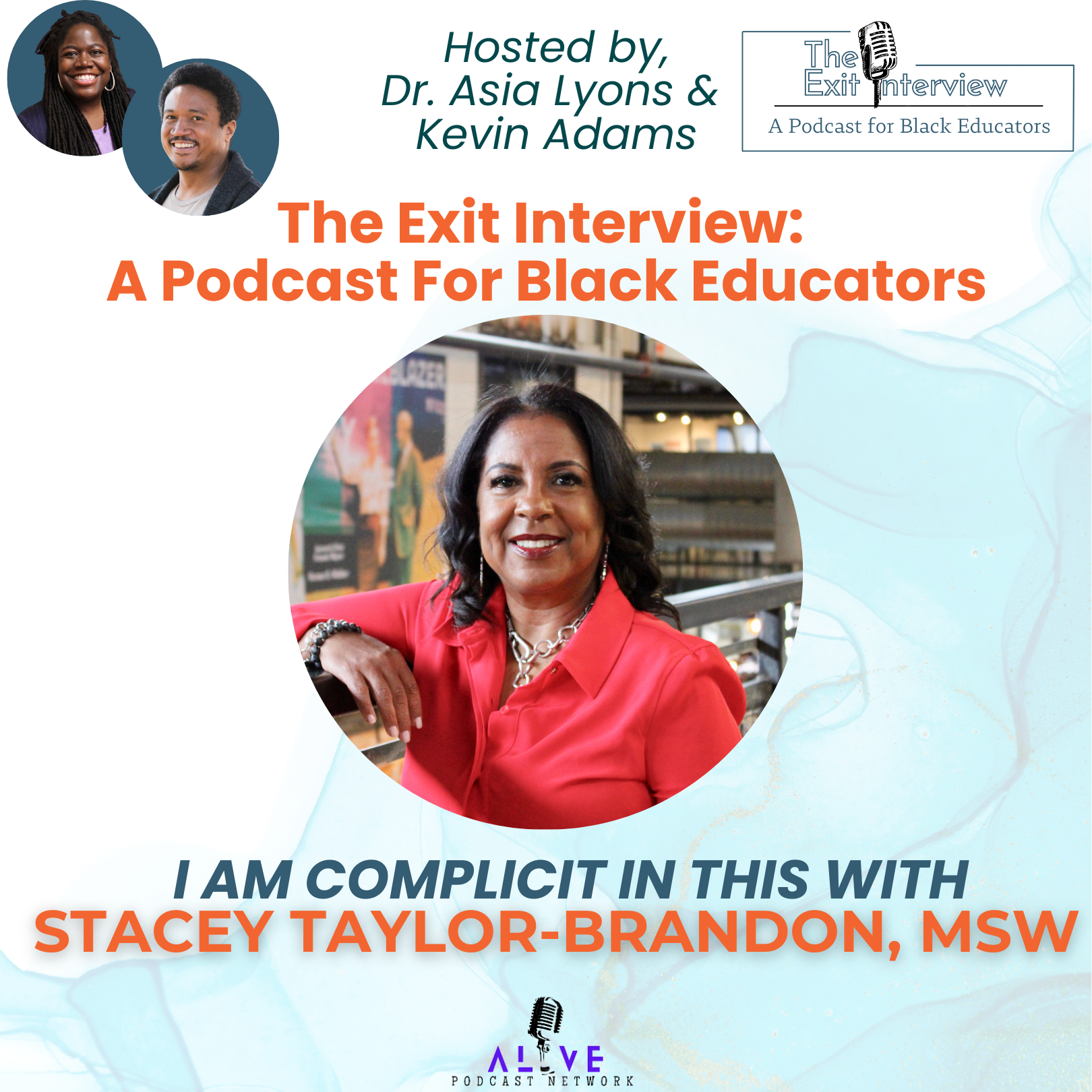
When a former director of equity in a school district joins our podcast you know it’s gonna be good. Stacey Brandon shares what led her to become a social worker in a Denver Metro school district, her journey to becoming director of their equity department, and consequently the decision she had to make realizing that it was time to move on. Enjoy another great episode!


Episode Title: I Am Complicit in This with Stacey Brandon
Show Notes:
Introduction In this powerful episode of The Exit Interview, Dr. Asia Lyons sits down with her longtime friend and colleague, Stacey Brandon, to discuss Stacey’s remarkable 28-year journey in education, her experiences as a Black woman in school systems, and her decision to step away from a system that often perpetuates harm. This candid conversation explores themes of racial equity, burnout, healing, and the importance of collective care among educators of color.
About the Guest: Stacey Brandon Stacey Brandon is a veteran educator, school social worker, and former Director of Inclusive Excellence. With nearly three decades of experience in a single school district, Stacey has served in multiple roles, including social worker, PBIS coach, and equity leader. Her story is one of resilience, advocacy, and a deep commitment to supporting Black, Brown, and Indigenous students and educators.
Episode Highlights
Stacey’s Path into Education:
Stacey shares how her faith and a series of serendipitous events led her to a long career in one school district, working across elementary and high schools. She reflects on the importance of representation and the changing demographics in her schools.The Role of a School Social Worker:
Stacey describes her early years conducting home visits, supporting families, and going above and beyond to help students access education. She discusses the unique challenges and rewards of being a social worker in schools, especially for communities of color.Transition to Equity Leadership:
After nearly two decades as a social worker, Stacey moved into the district’s equity office, eventually becoming Director of Inclusive Excellence. She talks about the challenges of navigating administrative roles, the need for multiple pathways to leadership, and the limitations of traditional principal licensure.Racial Battle Fatigue and Burnout:
Stacey and Asia delve into the emotional and physical toll of working in education as Black women, especially in leadership. Stacey recounts her experiences with burnout, health issues, and the realization that she was complicit in a system causing harm to students and educators of color.The Last Straw:
Stacey candidly shares the moment she knew it was time to leave: declining health, emotional exhaustion, and the offer of early retirement. She emphasizes the importance of putting faith over fear and choosing healing.Collective Care and Retention:
The conversation shifts to what school districts and unions can do to retain Black educators. Stacey advocates for strong sisterhood bonds, collective healing practices, and the need for educators of color to support one another. She challenges the notion of “retention” and stresses the importance of liberation and authenticity.Life After the District:
Stacey discusses her current work in educational consulting and her passion for creating healing spaces for Black women educators. She highlights the importance of joy, family, and community in her ongoing journey.What Brings Stacey Joy:
Stacey reflects on the joy she finds in healing, her relationships, her family, and the legacy of her parents. She shares the importance of repairing relationships, embracing joy practices, and supporting others through collective care.
Notable Quotes
- “I am complicit in a system that is meant to do harm to our children.”
- “You do not have to stay in a place that is harmful to you.”
- “We need each other. If you’re going to survive in a school district, go seek out those people you can trust.”
- “Healing has been bringing me joy. Breathing has been bringing me joy. Not having heart palpitations and feeling like I was going to die is bringing me joy.”
Resources & Mentions
- Gatz All Education Consulting – Anti-racist consulting and abolitionist teaching workshops.
- Dr. Bettina Love, Dr. Goldie Muhammad – Influential voices in educational justice and joy practices.
Connect with the Show If you’d like to be a guest on The Exit Interview, email twodopeteachers@gmail.com.
Thank You Special thanks to Stacey Brandon for her vulnerability, wisdom, and commitment to collective healing. And thank you to our listeners for joining us on this journey.
First of all.... have you signed up for our newsletter, Black Educators, Be Well? Why wait?
Amidst all the conversations about recruiting Black educators, where are the discussions about retention? The Exit Interview podcast was created to elevate the stories of Black educators who have been pushed out of the classroom and central office while experiencing racism-related stress and racial battle fatigue.
The Exit Interview Podcast is for current and former Black educators. It is also for school districts, teachers' unions, families, and others interested in better understanding the challenges of retaining Black people in education.
Please enjoy the episode.
Peace out,
Dr. Asia Lyons
Stacey Taylor-Brandon: [00:00:00] I want to tell you about one of our partners, Quetzal Education Consulting. Quetzal Education Consulting is a queer, black, and indigenous women owned firm offering anti racist consulting, PD, coaching, keynotes, workshops, and more. Their newly released abolitionist teaching workshop series coaches and prepares teachers.
To further develop abolitionist practices in the classroom, find out why they have been called the future of educational justice by Dr. Bettina Love. You can book a free consultation with Quetzal by calling 510 397 8011 or visiting Quetzalec. com. That is Q U E T Z A L E C dot com. And if you mention you heard about them through Two Dope Teachers, you.
will receive a 5 percent discount on their Abolitionist Teaching PD series. Once again, you can book them by visiting Quetzaleezy. [00:01:00] com on their Connect With Us page.
Dr. Asia Lyons: Hi everyone and welcome back to my channel.
Welcome to dolo as Kevin is helping out someone with a broken dishwasher. So if you haven't if you forgot, my name is Dr. Asia Lyons. Newly Dr. Asia Lyons. And I am here with a special guest. Dr. Ooh, almost said, maybe I'm manifesting it. I'm saying Dr. Stacey Brandon. Hey, maybe maybe so I'm here with Stacey Brandon.
Good, good friend of mine. A part of my education journey. Definitely someone I've probably spoken about on this podcast several times. And she's just here to share her exit interview [00:02:00] story. So glad to have you on our podcast today. Stacey, how are you today?
Stacey Taylor-Brandon: I am great. Asia, it's been a long time coming to get to this point, to have this conversation with you.
So excited about it.
Dr. Asia Lyons: So you were in the same school district your entire career, one school district, multiple schools.
Stacey Taylor-Brandon: Tell us about that. Yes. Yes. So the school district that I went into it was one of those things. And I believe, me, Asia, I believe everything is for a reason. I have a deep faith in God.
I the things that lined up in my life, even in that district. because I was supposed to have all of those experiences. So the reason that how I got my job totally crazy be it, and I wouldn't say crazy is all God. And so I was getting ready to graduate at graduate. And like I said, I was I actually was doing my internship in another district.
And knew I wanted to be a school social worker. I happened [00:03:00] to call the district that I spent 28 years in. I called the director of mental health at that time. And you can't get through to people like that ever. And I did. I had a conversation with him. And he said, why don't you come in and meet me?
Now I probably think back on it and I'm like, he heard that I was black. They probably were looking for black educators. I'm like,
Dr. Asia Lyons: I was, I got hired the same day. I'm so special. No money.
Stacey Taylor-Brandon: And then then of course you probably say, I thought she was black and then found out I was black. And then I was hired. I wasn't hired. I was sent over to another school. To a school to meet the principal and but I knew I would have to interview. So I interviewed there and wound up getting as school, as social workers and school psychologists, what happens is in a lot of districts you get a certain amount of FTE, you're not full time.
So I was hired like three and a half days. And by the end of the summer, I had a full time [00:04:00] position in two different schools at an elementary and high school. And I spent like four years at the high school and then at the elementary school, I spent 12 years, but it was just what I wanted.
And it was so interesting at that time, so many people said to me you should be working in, DPS. And because that's where Black and Browns and Indigenous students are. And and I would always say we've got kids that look like me where I'm at and they need us also. So it is.
Yeah. And what was wonderful about the school that I was in was that they were The quote unquote demographics were changing. Which is coded language for more black and brown students were moving in and at that time. So one of the first years are one of my first internship because At in social work school, you do to practicum in internships.
My [00:05:00] first one was at where I was working at the time. I was working at a program called family futures, which was really about helping young moms and women to Further their education and they gave him all kind of monetary support and support around their parenting and things like that. And so I was a child development specialists, whatever.
And I'm going to homes, I do. I was a home visitor. So I would go and talk about age appropriate child development activities. So what's funny Asia was, so one of the things when I became a social worker in this district, one of the first things, they, I was hired to do also as a part, a little part of my my job was working with headstart because headstart was just coming to that district.
And so home visiting if anybody has been in headstart knows home visiting is a huge. part of their programming. And actually how they mandated it for Head Start was a lot of in [00:06:00] person home visits, things like that. So I would be, I would home visit in that elementary school, not only with the Head Start preschool families, but also with just this families and people were like, are you crazy or whatever?
And I was like I was a home visitor in Northeast Denver. You talking about Aurora. Yeah. And that's how I met so many families. I I re I remember, now this, this would never happen. I would have families in my car. I had a, I had a car seat cause I had Yeah, because while I'm in the first few years I had two more kids, but I'd have a built in, car seat and I'd be taking families over to admissions to get them into to school, almost because it was crazy.
It was just. Like where the admissions buildings were compared to where our neighborhood was most families were prohibited. They would have to use transfer, what do I want to [00:07:00] say, public transportation. Yeah. There, or if they had to take. This was before, we did a lot of work with faxing and scanning and emailing and all of that.
And people didn't have computers in their homes. And so it was literally go pick up families, take them to get enrolled. I remember even taking them down to get birth certificates at and the first place or the licensing place was in Glendale at that time. Just Can just look back on so many things that I did that probably you can't put families in cars in anymore or kid transport kids or transport children.
It was to me, a true social worker position, not just a. School social worker. It was to me like what was happening in as a case worker for social services sometimes.
Dr. Asia Lyons: Yeah, I have a good friend Rekisha Groves and shout out to Rekisha if you're listening. She's a social worker, and she just transferred over to working at the state level [00:08:00] but she talks about when she was living in back in Michigan.
Putting kids in the cars and driving families over to different places. And, like doing home visits and things like that. I remember when I left student teaching, when I went to the, into the district, I was like, Oh, I'm going to get to do home visits and no one did them. And I was like, what I thought we, and then,
so thinking about it, how long were you a social worker? And then yeah, how long was
Stacey Taylor-Brandon: that? And so it's interesting, I think social work is still in my blood, I still believe I'm a school social worker. I was thinking about that the other night I was like, so I'm still a social worker, or am I a racial equity leader or am I a combination of both but Technically, I was a social worker throughout my 28 years.
However I wasn't working in schools any longer in that social worker, quote unquote social worker role. So I did that for 17 [00:09:00] years, and then almost 18 years and then went into first I became a. PBIS coach, public, what is it? PBI? public broadcasters. No, it's behavior interventions or which I don't
Dr. Asia Lyons: know
Stacey Taylor-Brandon: anymore.
And I don't agree with that philosophy anymore. So if anybody's listening and you're like, how could you have done that as a black school social worker? You're right. And I don't. necessarily go by that philosophy anymore. And so I did that for about three years, four years. And then was lucky enough, fortunate, or maybe it's just my purpose.
I say again, God opens these doors for you. And I became I went into the equity office. And was a coordinator at first, or yes. And then moved into when I left, I was the director of equity cult. It's the name of it changed, but while I was there, it was, I was the director of inclusive excellence.
So yeah. Yeah. Which is a whole nother story because [00:10:00] I had to get my principal license during that time. And I swore I would never be a principal. I did not want to say that. Yes. And that was all. All because of a woman named that, her name is Keisha Hill, and she's a black teacher. She is she actually still in education.
She's one of my good friends. And she talked me into going and getting my administrative principal license. And she and I did it together. Yeah, that's awesome.
Dr. Asia Lyons: And just think about, just thinking about the need to get a principal licensure and like It's it seems like that's the hill.
That's the access point. And I thought that working the same district for a long time. That was what you had to do. Yeah. And then I hear the stories and lived experiences of other educators, social workers, counselors, folks like that in other districts. And they're like, no. No, we didn't have to do it this way we did this way or I came in from the business sector or whatever.
And so I think about that now and I'm grateful I don't have my principal [00:11:00] licensure I do have my master's, but I think, like, how much better would it have been if we gave folks. Not we, they gave folks multiple pathways into leadership.
Stacey Taylor-Brandon: Yeah, because one of the things you're right is because one of the things about what's what's what I and I use the word crazy a lot but I won't, it's not the right word.
But it's almost ludicrous about the pathway of principles. Usually you have to be a teacher for a certain amount of time. Not even a certain amount of time, right? It just depends. And then you go and get your Type D or whatever it's called. I can't even think of type D, type D. And you go to get, and that's a two year program or some people, fast track it.
And then you become an AP, assistant principal, and then you become a principal. But it's almost backwards because you don't really have to spend a lot of time in the [00:12:00] classroom teaching before you become a principal. And you want to do it at the right way at the, at, because you. If you're out there and you're, you know what I'm talking about as an educator.
So if you spend 12, 13 years in the classroom and decide, Oh, I want to be a principal. Now you take a pay cut when you go, sure. Do principal, right? Yes. Specifically
Dr. Asia Lyons: in the district that we were in. That's how it works.
Stacey Taylor-Brandon: Yeah. And a lot of districts and then you become a principal, right? There's so many things wrong with educational system, just so many things wrong.
And that's one of them, because I really believe that you should spend more time as. An educator and not just in your own grade, but all the grades maybe in your if you decide to be an elementary principal and then you move up and then the other thing is, and this is coming from somebody who has a principal like principal license that never was a principal let me make that clear right, but I also spent.
Before I got my principal license, 14 [00:13:00] years in education in schools, right? And knew SPED really well because you have to, as school social worker, you SPED, knew how to work with families. Who do they call first when there's conflictual or parents who are, breaking down or students who are breaking down?
They call The mental health in, right? You have to, I had to deal with discipline. That's part of the reason I became a principal because I was in I was left in school as. De facto principle most of the time, because principals were out of the buildings, and at that time they didn't have a lot of assistant principals in the schools that I was in, so I was handling behavioral kinds of things, which I didn't necessarily agree with because I think a social worker operates differently from a principal in a disciplinary matter.
And you can't do both of those positions. Anyway, I could go on and on about that. But what we're what I [00:14:00] find what I found when I went to get my license licensure that, and I'm not trying to. Push state shade on teachers at all. Teachers have the hardest job in the world. But when I was getting my principal license, I realized that if you are just having one kind of view of the class, you only know your classroom, right?
At that time. that I was getting my principal license, they, people don't encourage you to look at other classrooms. You go in your classroom, you close the door and you take care of your kids. So that's something that's wrong too with the teacher licensure programs too. They should give opportunities to look at other ways of teaching.
And I would be in class and folks wouldn't know special ed. Procedures, which goes into law. Like you have to know the law. You have to know due process in disciplinary things. You have to know all of that. And I felt like I knew a [00:15:00] lot of things about how to compare and study knew about culture and climate of a building.
I knew about culture and climate of classrooms because I could walk in classrooms and see right away if this was a teacher that was engaging kids or this was a teacher that was losing kids. And especially black and brown kids, right? That I think that was one of the things that I felt like those are the kids I would always have to come get, hallway, there's a prick to disability to that.
And I thought these folks are going to be principals and. Still are missing the importance of culture climate of building relationships with kids about building school climate and a school that recognizes all children, that is not based on. Your limited view of because let's be real, most folks who go into education going to education because education has been good to them.
That is true replicate what they see. [00:16:00] So if you're a white teacher, and you had an amazing experience in school. It. There's a reason why we have white females that are predominant in the teaching field. They have had, for the most part, and I know people will be like, you can just generalize that no. I grew up with white girls who had excellent experiences in schools.
I went to graduate school with white girls who had excellent experiences in schools, and I actually was an educator with white women who perpetuated the same experience that they had, which was excellent with their kids, and anybody that falls outside of that, they don't do as well. Yeah, I
Dr. Asia Lyons: teach, the audience I think knows this, I teach at CU Denver, and I teach a course for first year, typically freshmen, some sophomores, pre service educators, always white girls.
This semester, I had a mix of Latine, [00:17:00] And white girls and one black girl I have, I've taught their six semesters, no black men, no brown men, two white men. And it is the same when you ask them why education, why teaching? My family is full of teachers. I, something traumatic happened and now they want to change the system because their brother was bullied or something.
Or they love kids. That's just, it's just like over and over again. And I have a few that will say things like I already changed my. major ones and I can't change it again or my parents will be mad at me. But you're right. It's the same, it's exact same white woman's story over and over again.
Yep. Just constantly. And which is why this is my last semester teaching. My work is on black educator wellness. It's not here to like, Continue to [00:18:00] push white women and their agendas through education system. Yes. Yes. So let me ask you a question because we can be here all day, just like you said, right?
We're at this place where you're saying like now I'm doing different work. And so the question we always ask on our show is, so what was like the last straw? How did you know it was time to leave the particular district you're working in and do something else? Yes.
Stacey Taylor-Brandon: Oh, that would be a whole nother story too, but I'll try to be brief around that.
So you've known me for a while, and I was burnt out a long time ago. I was burnt out a long time ago. I just didn't know it. And. And maybe I knew it, but I was just fearful of it. I hadn't faced it. And when I went into the district equity office, I found a new purpose. I had been doing the work of racial equity for a while in my specific schools.
And but I don't feel that I was as bold in my [00:19:00] purpose. During my early years. I look back on those early years and I think that I was one and I think I know I was palatable. I was the black woman who would talk about her black experiences, and, make sure that I was. I always had affinity for black kids and Latin a, I like kids and just kids of color.
I would always gravitate to them and have an affinity for spaces and in parents. But I didn't think that in, in meetings and thing, I, things like. I spoke up enough and I remember one of my first time speaking up was when Trump was elected. No, not when Trump was elected when Obama was elected, and I was a little bit.
No, I went to, I was in a space, and The white educators. We, the day that Obama will won, it was a beautiful day for black. No. [00:20:00] Despite what you feel about Obama now, at that time it was like wow. We have actually a black man who has been elected president. We see a black family, right?
. So people were black folks were rejoiced. Even all of my family, the folks that I know were all rejoicing and I went into this, so this is probably the first straw that I was like, yeah, this is not for me anymore. And I went into the it was staff meeting and the white folks, not all of them, but some of the white people in there were, visibly mad, visibly upset and everything.
And I remember standing up, I don't know what was said, but I remember standing up and saying, you, I just, I don't care what your political. Affinity is I'm paraphrasing this, and I don't care that you may be upset, but I will tell you that 99 percent of black folks. That means most of your children in your classrooms, and my son my youngest son was going to school with there at the school.
I was at that time, will. [00:21:00] This is an extraordinary day. This is a history making this is a historic day, and they are celebrating today. So whatever your feeling is, you've got black kids sitting in your classrooms that are excited and we're cheering last night. So how dare you take away their joy. I remember that was the first time I was like, No, Stacy, you went there out loud.
And I was like, yeah. And then that same year is remember when Obama went to speak to all the educators. Went to speak to all the nation's school kids. And we had folks opting out from the president speaking. And we got, we have folks in my school. Teachers that were saying, I'm not going to play that, play him.
And I was like, yeah, this is not for me. This is not for me. Cause my son was in one of the classrooms that they were thinking about opting out. And I was like Nope. So I was like, okay, so that was the start. That was before that was when I [00:22:00] was a social worker. And then when I went to the equity department, I was really excited to be doing the work of racial equity to centering race.
But I got to tell you, and you know this, Asia, the more you go up in administration, the more you raise yourself, not raise yourself, but the more that you enter into those sacred, quote unquote, sacred places of higher administration, you see some mess. I'm gonna say you meet you see some mess, and you truly realize this system wasn't built for us.
In no way, no shape, no form at all. So those things started to just eat away at me. And then my last year and a half when I was, or two years when I was a director, I thought, wow, Stacey, You not even, you made it, you didn't even, you weren't even an AP, you weren't even a principal, but you, I always believe God gave, God [00:23:00] allowed me to get my my principal license for a reason because everyone asked me, my husband would say too, are you serious?
We just spent all this money in loans and you are not going in to be a I'm going to lose too much money. And my my I had two sons in college at that time. It makes no sense to go back. And I'm like, no, not for more days working. No. Yeah. Yeah. So I was excited about becoming a director.
And I got to tell you, it was the hardest two years of my entire life. My health started. I was telling you, I'm having health issues, emotional issues. I thought I was having a heart attack on several occasions. I started having panic attacks. My health just deteriorated. My emotional health was was just, was not good.
And so I think the last straw for me really was just not being healthy, just not being physically healthy, not [00:24:00] being emotionally healthy. And I knew it was time to go and I was. Scared. 'cause that's all I knew for 28 years. And you and I had talks with quite a number of black women who are my mentors and friends.
And I finally said, this is it. . I can't, I put faith over fear and I decided, and then it was early retirement was offered in the district I was in and I was like, yep, this is it. This is my, this is time.
Dr. Asia Lyons: Yeah, I think about in the audience. We talk about this all the time. So the audience knows.
We talk about racial battle fatigue in this podcast so much, right? And the ways that it shows up in your story, this is not any different from every single person comes on here. The panic attacks, the crying, the, just all the things, increased blood pressure and fill all, fill in the things, fill in the blank.
And there are so many folks who are like, if I'm in the [00:25:00] equity department in the school district and I'll really be able to do something, if I become a principal, I'm going to really be able to change things around. All I have to do is get just one more license, just one more certification, and they're going to really listen to me.
And audience, she's telling you as someone who ran an equity department for a school district. It was the worst two years of her life. Yes.
Stacey Taylor-Brandon: Yes. Yes. I did. I would say I did a lot of good, but I, and I planted a lot of seeds and I made a lot of relationships. That is the thing that I think I miss the most is the relationships that I made.
I still have I get at least two calls a week from particularly black women who are just suffering to. Be a black woman. I believe in education and upper leadership is very it's difficult. It is downright brutal because how you are treated as a black woman, right? How you are questioned, how you are made to feel that you have no right to be angry.
I have every right to be angry. [00:26:00] Because this system is failing kids. This system is not made for children. It's not made for us as educators. And you, and I'm watching harm and I'm complicit in harm. I think that's the hardest thing is that you may, once I began to really take a look at myself in the mirror and realize that I'm complicit in this.
And then I am swallowing this every single day, doesn't matter if I'm speaking out, I'm still complicit in a system that is meant to do harm to our children. And then the secrets you have to hold and the things that you know that other people. Yeah, that eats away at you, that is truly racial battle fatigue.
And it can kill you and I finally decided I can't die like this I've got my own four children, three grandchildren that I want to live for. And I don't know did I tell you this that. So when you were defending your dissertation and you're talking about racial battle fatigue, and its impact on the family.
And the [00:27:00] night before I was going to your dissertation defense, I asked my husband, I was telling him about your defense and I said and this first time I ever asked him this and I said, did you feel the impact? Did I tell you this? And he told me, Oh yeah, I did. And he told me he's yeah, I felt like you weren't available.
And I'm like, what? He's never said that. And I was not available to him. I was not available at all. So tired. So just mentally, it's been a whole year of healing and I'm still working on the healing.
Dr. Asia Lyons: I'm going to pause right there. It's a lot and we're going to take a break. And we'll be back in a moment, but yeah, no, I'm with you.
I hear you audience will be back.
All right, folks, we [00:28:00] are back from our break. And we're here with Stacey Brandon again, telling her story. And so Stacey, we left off with you basically deciding it was time to go. Yeah. It wasn't worth your health. Yes. Your husband saying that you weren't available. And so then the question we ask next typically is if school districts, if unions, if places where educators gather want to hold on to retain black folks in education.
What do you think in your opinion? They can do to make that happen, not necessarily recruiting people right but holding on to folks who are already in the space.
Stacey Taylor-Brandon: Yeah, recruit recruiting seems to me to be the easiest thing. And I just want to first say that a lot of black folks don't have the, I had the opportunity to leave and I should have left long time ago and I was fearful.[00:29:00]
And then I had the means to be able to leave financially. And everybody doesn't. And I recognize that. And I just want to say that and there were times in my life that I could not have left. We were raising four children, all of those things. And I think, I know that God sustained me to be able to leave.
He was also preparing me for this. But You also don't want to die too, right? While you're, you don't want to die while you're trying to make your, pay the bills. You just can't. So to answer your question, I, I have thought a lot about that around retention. Somebody told me the other day that retention isn't even the word that we should be using.
Yeah. Yeah. You're right. It has some connotation. I don't know what the word is. Around ownership. Oh, yeah. Were we talking about that? Somebody was talking about ownership. No. Some, I'm
Dr. Asia Lyons: glad you mentioned that. So a good friend of mine, Dr. Trinidad, actually told me that and I was like, Oh yes. And then I'm glad I'm going to change my [00:30:00] question in my interviews from now on.
Yeah.
Stacey Taylor-Brandon: Cause that does, it's like the connotation of ownership. Yeah. And I think that really is a piece of what it's going to take is for one, you're not owned by a school district. You're not, they don't own you, they have no rights to, and as long as we have that mentality, like they can tell me what to do and how to do it and when to do it.
And I'm just going to show up and do what they say. I think once you realize that you, Okay. Are free that you want liberation. That is the goal. You're no longer scared to speak your truth and be authentic to yourself. I realized that people have to stay. For whatever reasons. And so if that is your, what you have to do in the meantime I'm really big on strong sisterhood bonds of being able to get with your sisters in a space.
And [00:31:00] not just focus on, Oh, this is what's hard. And this is what's challenging, but really start to bring some joy practices, some healing practices, some breathing practices together, and you can't do it alone. We as black folks, weren't meant to do this alone. We, we need to get back to our original.
Ways of being because they stripped that from us at such a young age from kindergarten on, we're told that you are an individual and you don't need anybody else. No, we need each other. So if you're going to survive in a school district, go seek out those people that you can trust for one, because that's one of the things that we, I know that happened to me is that I can't trust nobody up in here for one.
I, there, my white colleagues are having, what are those Friday night FACs, they're going to each other's houses. And, I never did that stuff. Cause I'm not, my mom taught me like our personal business days, our personal business, I'm not [00:32:00] coming in here Monday, telling you all about what happened to me over the weekend.
No. And that is harmful to us or to me, but I, if I had a network of sister. And I developed that right to I can call them and say, Hey, this is what's happening to me. Can we talk, can we have a drink, can we have some coffee. That is one of the things going to sustain you, but also.
Just making sure that for me, meditation started happening a lot more regularly so I could spend time with God and I could spend time with myself. And, I think the other thing is when you have a family you believe you have to give everything to your family. So this you're giving to work, you're giving a family and I lost myself in that.
And so I would advise you. Advice, especially black women, is that we need that space as sacred place for ourselves too, because we give so much away and we're told that's how you have to be as a strong black woman. And it's not true. You [00:33:00] can ask for help. You can tell people I'm suffering. You can ask for, I just need to just two minutes of your time where I'm just need you to breathe with me.
Those things. I don't think the system can do it. I don't think you can look. To HR department or the equity office. Or you can't, they cannot do that. They can't do that for you. So you're going to have to take care of yourself. And that means partnering with other folks in your school district, and not just black people I'm big on black folks and I know it but we've got to have some Interracial kinds of what do I want to say?
What's the word I'm looking for? We got to stop fighting within the people of color. Yeah. Like we
need to, to yeah. Black, Brown, Indigenous Asian American, Pacific Islander. You know [00:34:00] what? We got power. As a collective, we got more power together to go after systems that are doing, that are harmful to our kids because our Asian kids are being harmed. . Let's just, , our Latina, Latinx kids are being harmed.
We can go to our Pacific Islander. Kids are being harmed. Our indigenous kids are being harmed. . Our kids, our black kids are being harmed. They are all being harmed. Now we know black kids. On a whole, that disproportionality is huge. But if you go into the numbers, you will see that all of our kids are being harmed.
So yeah, we have to come together on some things in the school districts too. I
Dr. Asia Lyons: want to say, I told the audience when we first started this and this spot this particular taping is going much longer, which I'm totally okay with. So I hope folks are still listening. Like you talk about coming together as a collective.
And I will say that. Stacey, this is from our audience, Stacey literally got me through my [00:35:00] last year in teaching. Thank you. I was calling, texting, crying, snotting, she's coming to my classroom and supporting me. And she was just like, maybe it's time for you to go. And I was like, yeah, I have to get out of here.
I have to get out of here. And so it was a supportive Stacey. Being there for me to say this is not going to change and she at this point she's in the equity department so she understands if I'm telling you it's not changing. It's not changing so I love that like this idea of collective care, right and care, and
it is sometimes it is us telling each other like it's time to go. Yeah. It's time to go, we've breathed enough, we've hummed enough, we've journaled enough, we've been we've looked for the miracles, we've made the altar to the ancestors, it's just time to go. Yeah. Okay, so the next question then is, you've made that decision, you left, what are you doing now?[00:36:00]
Stacey Taylor-Brandon: Yeah. Thank you Asian. I'm sorry, this is going long. I get long winded about, this is great.
Dr. Asia Lyons: No, this is great.
Stacey Taylor-Brandon: Keep going And thank you for . Thank you for saying that. I think if there's collective care, I wish somebody would've told me a long time ago, Stacy, it's time for you to go. Because then you feel guilty that you're leaving people and kids.
But I think I have said that more more often than not these days, like there is these millennials. No, you don't have to stay in a place. You do not have to stay in a place that is harmful to you. Don't. Let me say that to you out there. You do not have to, right? But what I'm doing now, I'm working for a educational consulting company.
Just doing some work around racial equity work. Asia has me doing, hopefully doing some things to for sure. And, one of the things I really want to do that's that is going to come to fruition is really have a space for [00:37:00] black women educators specifically just to heal.
I'm really big on healing and joy now love Dr. Padina love and Goldie Muhammad that really embrace this joy because I can sit here and tell you all the harm that has been done to me. But I also know that there has been so much joy in my path that I don't want to let go of so I want to some joy practices too.
So I think that's in my future and then Asia just called out. Maybe I'll get my doctorate. Okay. I keep reading it.
Dr. Asia Lyons: Hey, listen, I don't put anything past anyone these days. Yeah. Yeah. So last question, what's bringing you joy these days?
Stacey Taylor-Brandon: Oh, what's bringing me joy. Joy for me has been leaving a district that I thought I would be there forever.
That is joyful. It's joyful to look back and And [00:38:00] the relationships that I have bring me joy healing has been bringing me joy. Breathing has been bringing me joy, not having heart palpitations and feeling like I was gonna die is bringing me joy. My husband and I you know empty nesters that brings me joy, seeing my four grown children.
Them make their own pathways and embrace life. They bring me so much joy. My family, my extended family brings me joy. Being able to think about my ancestors. My, my parents passed away too. That was another straw though, too. My parents, both my parents died in the same year in 2014.
And my, losing my mom and dad. Worst worst thing that could ever happen. But just being joyful that I had that I have two parents that just loved me very much. Like I said, my dad was out of my life for about 10 years, but, I knew him at the end at the last 30 years of my life and of his life.
So [00:39:00] he brings me joy. Knowing him, that you can get, you can repair broken relationship. That brings me joy. Watching, having, you remember my mom is a single mom. She, I have joy in thinking about what she left in me, her late, my legacy. One of the last things she told me was to do She was really big on me finishing getting my administrators license.
And the year that I went into the equity department was the year that she passed away. And she would be so proud. So that gives me joy. So lots of things bring me joy now. Lots of things. How can to you brings me joy. I know we get on the phone. And we could just go watch your intern brings me Joy .
Dr. Asia Lyons: Yeah.
Shout out to the intern Zoe. Yes. Which now I have a lock on my office door, but she's already jiggled it two times, so I know that she would've been in here if she could have been. Yes.
Stacey Taylor-Brandon: Yes. Thank you. My, I have a lot of sisterhood networks too, and they bring me joy too. I have a black book club that I'm in.[00:40:00]
I've got another group called Moms in Touch that used to help us out where we write kids in college and encourage them in their walk with God. And just, it's hard to be a teen, a college student now. So that brings me joy. So my, I have my Spelman sisterhood brings me joy. So yes. Yeah. Yeah.
Dr. Asia Lyons: All right, beautiful folks. Thank you so much, Stacey, for coming on.
Stacey Taylor-Brandon: Thank you for having me. This was a party. I'm going to tell you all, come on, exit interviews.
Dr. Asia Lyons: Yeah, we're always looking for guests to come on. So definitely email us at 2DopeTeachers at gbell. com if you'd like to be a guest on our show, but thank you so much Stacey for sharing your time with us.
Thank you for your story. We
Stacey Taylor-Brandon: appreciate you. Oh, thank you. I appreciate you. If you are not in a relationship with Dr. Asia Lyons, you need to get in a relationship with her. [00:41:00] I appreciate that. You're missing out.
Dr. Asia Lyons: I appreciate that. Thank you. Alright, audience, we'll talk to you on the next episode of Pians of Anarchy.
Bye. Bye.
Thank you so much.

Diversity, Equity and Inclusion Consultant
Stacey Taylor Brandon has over 30 years of experience in the field of education serving in the capacity of school social worker, PBIS Coordinator, Educational Equity Coordinator and Director of Inclusive Excellence.. Stacey holds a Bachelor of Arts in Child Development from Spelman College and a Master of Social Work from University of Denver. She also holds a K-12 Principal License. Stacey is the mother of four grown children and grandmother of three. Stacey is passionate about racial equity and racial healing. As a proud Black woman, Stacey is committed to honoring the humanity of all people, by acknowledging, understanding, and interrupting predictable patterns of racialized inequities and hierarchies.