Finding Identity and Building Community with Jenna Greenwood
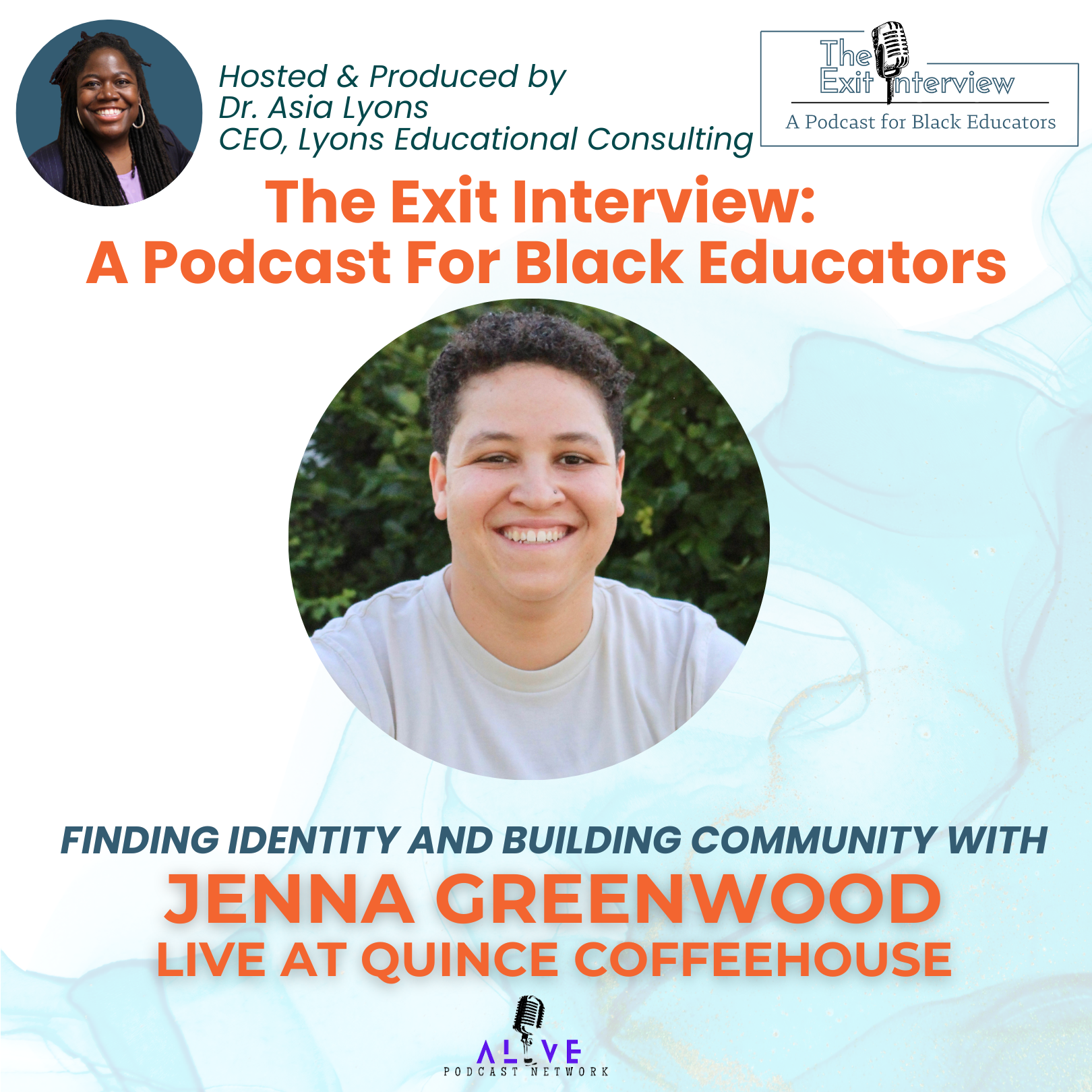
In this special episode recorded live at Quince Coffee House, Dr. Asia Lyons interviews Jenna Greenwood about her inspiring journey of self-discovery, family legacy, and finding community outside traditional educational settings. Jenna recounts stories of her upbringing, influenced by her grandmother, Marie Greenwood, Denver's first Black tenured teacher, and her experiences navigating her complex identity within predominantly white institutions. She also offers valuable insights into college affordability and scholarships, using her financial aid expertise to support students and families. Lastly, Jenna emphasizes the importance of wellness, mindfulness, and creating inclusive spaces like Quince Coffee House, which she co-owns and serves as a lively community hub.


First of all.... have you signed up for our newsletter, Black Educators, Be Well? Why wait?
Amidst all the conversations about recruiting Black educators, where are the discussions about retention? The Exit Interview podcast was created to elevate the stories of Black educators who have been pushed out of the classroom and central office while experiencing racism-related stress and racial battle fatigue.
The Exit Interview Podcast is for current and former Black educators. It is also for school districts, teachers' unions, families, and others interested in better understanding the challenges of retaining Black people in education.
Please enjoy the episode.
Peace out,
Dr. Asia Lyons
Finding Identity & Building Community with Jenna Greenwood
Jenna Greenwood: [00:00:00] I realized that the expertise that I was able to learn at that school would really, really benefit students in a way that not a lot of students were able to get support. And when I came back home, I started doing that in the student center that I was working in, which is like a diversity center in the College of Engineering at cu.
I just started helping students navigate financially, telling 'em tips and strategies and a way that. Was less transactional than they might experience working in the financial aid office. Mm-hmm. 'cause I was working in student programming
Dr. Asia Lyons: in a world where the recruitment of black educators dominate headlines.
One question remains, where are other conversations with folks who are leaving education? Introducing the exit interview, a podcast dedicated to archiving the untold stories of black folks who have departed from traditional education spaces. I'm Dr. Asia Lyons, and I'm embarking on a mission alongside my.
Themed guests. Together we shed light on the challenges, triumphs, and experiences of black educators aiming to inform and empower communities. Invest in understanding the [00:01:00] crucial issue of retention education. Welcome to the Exit interview a podcast for black educators.
Audience: Welcome back to another em. Of the exit interview, a podcast for black educators that we are live at Queen Coffee House.
Dr. Asia Lyons: I am so excited to be here. Jenna and I had a conversation day one and Jenna said. My grandma was the first black educator in Colorado. Right. That's what I said. I was like, oh really? So this exit interview is gonna be a little bit different in that Jenna is still in higher education, but I wanted to capture the story of Jenna's grandmother, capture the story of what it means to be in higher ed and stay in higher ed, and Jenna's also co-owner of Queen's Coffee House.
So we wanna talk about like what it needs to be, well, what you're doing now when you're still working in higher ed or K 12, but still have other things that you love and want to do. So, so excited. Thank you so much for agreeing to come on, Jenna. Yes, of course. Give it up a minute please. [00:02:00] And so, Jenna, I said go ahead and write a bio and send a bio in to me so I could read it to the audience before we got started.
Read the bio this morning. I'm like, if I read this bio, the podcast episode's over, because I just told everybody everything. So we won't read the bio today right now, but you'll hear through the stories and questions that we ask of the story of Janice experiencing and all the things as far as Marie Greenwood and Clance Coffee House and all the other things.
So let's go here and get started. So if you know anything about the podcast, I ask the same questions to every. Yes, and I'll start off with the first one. Tell me your journey into education. How did you know that education was for you?
Jenna Greenwood: Sure. This question is the one that's been the hardest for me. I've split it into like three specific phases of life.
So childhood. Yeah. I grew up with a lot of educators, a lot of public servants. So my grandma, she was the first black. Tenured teacher in Denver. So she started in the 1930s at Whittier Elementary. She only [00:03:00] taught elementary school. She wanted to only teach first graders, no one over the age of eight. 'cause she wanted to help students get a really strong foundation.
So I think that that shaped a lot of my childhood and entry into education. There was a lot that I was doing. As a kid related to uh, ways in which we were celebrating and honoring her life is at the point that I was sort of woken up to what, in all that she was. We were just doing a lot of celebrating and she was doing a lot of volunteering.
So really big, well small, she used to fill, 'cause she was only five foot tall. Um, where she was a mighty Sagittarius woman with a big personality. My most significant memory with her is just, she would help me read so. After school a couple times a week we would go to the library and then she would read clip with the big red dog.
She had the puppets. So she would do that for both of us. When we were kids, we would read with her. And so just like getting that basic literacy skill started while she was doing her laundry at my parents' house growing up. So I think education, it was definitely instilled that it was [00:04:00] important. She was one of the many educators that I was raised around.
I like to say that I was raised definitely in a village, a community of black women, black working adults. Both my parents had to work full time and all their friends had to work full time, and so they kind of all worked together to support us children in the community to make sure that we could get the opportunities that we needed to be successful.
And so I feel lucky enough that both my mom's best friends were also teachers and they taught a lot about education to us and just the importance of doing the best that we can in our community. And so. That was something that was just very matter of fact to me Academically, I struggled a lot. I've got a lot of learning things that made it really challenging.
In school, I went to Stanley British Primary School, which is a private school here. My aunt was on administrator there for years and years, and so we had the opportunity to go to private school, which was great. And also I didn't have letter grades and I called my teacher by their first name and so. I think I wasn't as aware of the ways in which my brain worked differently than other students.
So it was a rude awakening when I went to high school and had letter grades and wasn't performing the [00:05:00] best that I wanted to. I think one of the things that I definitely learned from my grandma and she helped reinforce is that learning happens outside of the classroom the most when that's where the continued education will happen, is when we're teaching and learning each other, and also the importance of like extracurriculars.
And so that's kind of how I survived most of my schooling is through. The stuff that is on the side, really involved in student government, really involved in sports, really involved in just community efforts to be able to support the people around me. I mean, I was able to make it with the people that I knew.
I had a lot of help from friends and community, which is the same now.
Dr. Asia Lyons: So it's interesting that you're saying survived. Mm-hmm. Right. And make it as far as you're talking about
Jenna Greenwood: the. High school portion? Yeah, or the whole thing through. I would say I struggled academically like pretty significantly through college.
I think I had it in my head that I was an academic person, but I just liked a bunch of like fundamental skills. So math, reading, it was just confusing. I didn't have the support that I needed, and so it did feel like that because I felt other for a lot of other reasons too, identity [00:06:00] based stuff that was going on that I was starting to figure out about myself.
But yeah, it did definitely feel like. A survival sort of thing, just because I didn't really like it that much, and I also felt really isolated in the experience I was having.
Dr. Asia Lyons: I wanna point out that I know that my daughter also goes to private school, and I think that a lot of folks make assumptions about if you pay for schooling, then certainly your kid's gonna come out X, Y, and Z.
Or if you don't pay for schooling, your kid's gonna come out. I think as I'm talking to folks who have been on a podcast, who've taught in places like juvenile justice systems, who've taught in K 12 and public and private sector who come through TFA, all these different ways. When it comes down to it, it is a lot different factors that cause our students to be successful.
Mm-hmm. And how we define success too. Right. Some people think it has to be straight A's, and that's just what success is versus like you're saying, extracurriculars and community is so important. Mm-hmm. So I just wanted to pause and point that out to you or to the audience that that's really important because I talk about my daughter often.
Many folks know that [00:07:00] she loves sewing club at her school and it is working on a quilt and sewing club, and that's bringing her joy to be able to do that after school, right? Where maybe it's on a particular day that's tough in math or language arts or whatever. That being able to be in those extracurriculars is really important.
So when we talk about taking those away from our students mm-hmm. Mm-hmm. And like, you gotta go to math club because you behind, where is the joy in the learning? I just wanted to pause you for
Jenna Greenwood: that, but go ahead. Thank you. I appreciate you saying that. Yeah. Extracurricular saved me. Sports saved me, music gave me, that was it.
I had my team, uh, I stuck with for a good portion of my youth. And then music is just something that's important in my family. I'm a drummer mostly, but also did a lot of other forms of music. That just helped me be able to continue to have the joy while also getting so many messages of failure on a constant basis.
Again, it was super isolating to be going through that, and then I. It's also confusing because I have proximity to whiteness. So because I went to private school and then I went to east, which depending on what version of east you get, like it can be a different experience. So I think that the ways [00:08:00] in which other students were getting access to resources was not, I just wasn't having that same experience and I didn't have the awareness that it was different for me.
And so when it came to applying for college, it was. Just me in the basement by myself just trying to figuring out like what exactly I was supposed to do. I mean, they ultimately only got into two schools, so CU and CSU, and my brother was at cu so I decided to go there and felt pretty disappointed in myself.
But I do think that when I got to higher education, that's kind of where I started to get some footing and a lot more self-confidence because I was involved in more substantial. Ways of engagement. So like student government, I was an orientation leader. I was super duper involved at CU and I think that that then helped me with my identity.
'cause I was studying sociology and so I started to get some language around like social constructionism and that like as a society, we socially construct everything that we exist in and all the media and how we reinforce those things interpersonally. And so I felt a lot more comfortable in my own skin.
Also learned about student affairs as a profession where I could work in college working with students similar to [00:09:00] me as they navigate the different challenges that come with existing at a predominantly white institution.
Dr. Asia Lyons: Let me ask you a question. It's interesting because you talked about the early years with your grandmother and her supporting your reading, and then we fast forward to you going into school and filling out applications by yourself, right?
And then you go into school, it sounds like you find your way to being again successful. What was the conversation with your family when you decided that college was for you and that you were gonna pursue it and not only pursue college, but then go into higher education as a career?
Jenna Greenwood: Yeah, I mean, I think the thing that's hard is that I had a lot of educators around my parents themselves.
They're not that academically minded. Both of them have degrees in higher education. My mom has a master's degree, but she's a physical therapist and my dad. Is when like a business owner. And so there just wasn't a lot of concrete structure they could provide and we weren't in a position to be able to like pay for a college counselor.
I think in different parts of my life, they definitely wanted to help me. But like at a certain point they couldn't really help with my math homework anymore. They couldn't really help with these things. And so I was kind of [00:10:00] alone. And so it was more of like a moral support thing. Mm-hmm. But going to college was just like, period.
You have to do that. And I think that that was something that I embodied and I knew that, that this was what I needed to do, but it was getting from point A to point B starting east was like a big blow to my confidence. 'cause I got letter grades and they weren't great. Then started, you know, going into college was like another, like, wow, this is a rude awakening of the things that I know that I'm missing.
But I just had to get through it. I have realized that like wherever I'm gonna end up, I can make the best of the situation, and so I. 'cause I'm not gonna get the same opportunities as folks based on academics. But the realization that I had, look, I just decided to make the best of it after crying on the phone during my first semester freshman year, to like everyone in my family, like, I can't do this.
I'm not cut out for this. And then just kind of started to figure it out.
Dr. Asia Lyons: Yeah, it's real. That's so real. I think I had the same experience. I'm like, what am I doing here? I went to school, I went to engineering school for two years now. My father wanted me to be a chemical engineer. I said chemical engineering people.
Oh. And I went for that. And then that second year I got a letter [00:11:00] in the mail in the summer like So about you not coming back next semester. Right. And having to find my way. But yeah, like figuring out ultimately. So you were finishing college and I read in your bio that you did some other work before coming to see you Boulder.
So tell me about that or tell me about that work. Yeah,
Jenna Greenwood: so I feel like that was then like the beginning of the stage that I'm in now where. I learned that higher education was a profession that you could pursue. I ended up doing AmeriCorps right after graduation. I knew that I wanted to do a term of service.
So I worked in a college access nonprofit where I learned without a lot of training just about some of the barriers that students face, specifically the population. I worked with students in community college in St. Paul. I think just learning how complex the system was, it was really frustrating. I felt like I wasn't able to be supportive, and so I decided to.
Eventually pursuing my Master's degree in student affairs. I actually took a job at the University of Oregon after that. 'cause I was moving there and it was between housing and financial aid, and I just picked financial aid. So it's like a similar thing. I usually have two [00:12:00] choices, which apparently is like a psychology hack.
If you give yourself two choices, then it makes me easier when you're like trying to make a decision. Okay. So I think, I guess I've just been doing it the right way. Yeah. If it works. If it ain't broke, yeah. Yeah. So I didn't wanna live in housing because I'm a cancer and I like my home, and so I. I didn't wanna live in the residential house, and so I chose to work in financially, and it was brutal.
It was like a similar, very math focused, detail oriented work that I just wasn't finding a lot of success in. I quickly decided to start my master's degree, so when I was in Oregon, I was mostly working full time. Then pursuing my graduate degree full-time. 'cause I didn't really want to be doing the work that I was doing, but financially it essentially changed my life because while I hated it, like every single minute of it for the three years, I learned so, so, so much information that not a lot of people know and not a lot of people like me know.
I realized that the expertise that I was able to learn at that school would really, really benefit students. In a way that not a lot of students were able to get support. And when I came back home, I started doing that in [00:13:00] the student center that I was working in, which is like a diversity center in the College of Engineering at cu.
I just started helping students navigate financially, telling 'em tips and strategies in a way that. Was less transactional than they might experience working in the financial aid office. Mm-hmm. 'cause I was working in student programming.
Dr. Asia Lyons: Yeah. I think this is one of the reasons why we talked about you coming on the podcast was yes to share your story, but also the financial aid part, right?
So if it's so many people, they're trying to fill out the form for their child or fill out the form for themselves. And there's obviously hacks and things that we should know. And I do wanna ask you that question a little bit later on. About like what's some things right away? Because you're still doing that work.
Yeah, yeah, yeah. What can people take away and tell their nieces, nephews, whatever, so that, especially in these times when we talk about financial aid and is it going to exist and what's happening? How they can continue to make sure that the children that they're supporting or the teens that they're supporting are able to get a chance at college when most of us need loans.
Mm-hmm. So since we're talking about it, tell
Jenna Greenwood: [00:14:00] us what you're doing now. Sure. So my role right now, I'm assistant director for scholarships and college affordability. So it's something that I created. I was able to take on the responsibilities of awarding scholarships in the College of Engineering. So that's added some.
Big amount of, which has been good for the legitimacy of it. But where my heart is and the work that I've developed a philosophy around is college affordability advising, which is essentially to help give students tools, tips, and resources to be able to make informed decisions about paying for college.
And so I work in the College of Engineering specifically focusing on supporting that population of students. So I'll explain how different processes work. I'll help coach them if they're gonna go meet with the financial aid office. I'll explain how scholarships financially works just in general. So I really try to break down the sort of the hidden curriculum that comes with higher education, financial aid being one of them.
Be able to help equip them with the knowledge so they can walk into that find they usually, the office know exactly what they're talking about. 'cause a lot of the time it is gonna be more transactional and less. [00:15:00] Developmental for students, and so I wanna make sure that they have a grasp, like an empowered grasp understanding about how it all works.
I also co-managed the Lattice First Generation Scholarship program, which is a full ride for First Gen Colorado residents in the College of Engineering. Just a cool program to be able to work through the cohort of students because it's so heavily financial based. We work individually to make sure the parent work packages are in work, they have everything that they need so they can just focus on the school.
And the way that we're structuring the model is kind of a brainchild and the fact that we're using the aid that they're already gonna be eligible for from the state and the federal government, and we're just layering on top to fill the gap, and so we're able to give it to a lot more students because we're mm-hmm.
Targeting students that are already gonna get opportunities based on their eligibility criteria to be able to give them this. That doesn't require like a massively large endowment to pay for a bunch of students, and that just feels really inaccessible.
Dr. Asia Lyons: Can I ask you a question? Sure. So first things first, y'all heard engineering degree for Rods, right?
Like I'm not going back in engineering school wasn't for me, right? I failed [00:16:00] horribly, but. So you talked about, and I wanna come back to this, you talked about hidden curriculum. Mm-hmm. And this need to help students. Now we had a conversation and teach them the hidden curriculum. If you could give us three things, or three tips, or three ideas that you give your students before they go and have that conversation.
Jenna Greenwood: So I think I really focus on them building a strategy. I tell students that applying for scholarships doesn't end in high school. It's a continuous process because you gotta treat it like a part-time job and keep doing it. There's students that I've worked with that by the time that they're graduating, they've got their full year paid for, which.
With how expensive education is in inflation, that's, I mean, like a car or something. Nice. So I tell students to continue to integrate it into their lives and treat it like a part-time job, but building their college affordability strategy, which also includes thinking about how they can reduce costs. So before they're going to look for scholarships, like what are the ways that I can think to reduce my costs as far as like in my default into a housing [00:17:00] situation or you know, a more expensive housing option in, do I have the health insurance that's gonna be a lot more expensive.
Are there things that I can do to just, you know, if it's around getting the textbooks or taking summer classes or taking some of their base level classes at like a community college. So like getting really creative about ways that they can lower the overall cost. I think it's something that I'm also saying, I tell students to prioritize applying for anything and everything within the institution first 'cause it's just gonna be the best bang for their buck.
Even if it doesn't seem like a scholarship. So looking at like alumni associations or affinity based centers or leadership programs, stuff like that, and the institution and keeping your eyes and ears open for like stuff that could be a possibility. Research becoming a resident hall advisor, like stuff like that.
Getting creative because. You gotta look at the full. No. You good? No, you're good. Are you fine? You're fine.
Dr. Asia Lyons: Are you okay? We'll just put a little break. So while that's happening, how's everybody going anyway? It's spicy [00:18:00] season and my
Audience: season in the house.
Dr. Asia Lyons: We're living in a world where our children and their lived experiences are being erased. And I think that it's really important that as parents, as folks who are taking care of children, think deeply about where we send our children to school. If you have a child who is entering kindergarten through eighth grade next year, you need to check out St.
Elizabeth Episcopal School on the old Johnson and Wells campus in Denver. It's an intentionally inclusive school. They have social justice as a class starting in fourth grade mandatory. My daughter's been going there since fourth grade. She's a sixth grader now and loves it. She loves her friend groups, her afterschool programs.
She loves that her teachers and the faculty at St. E's are diverse and it's a great place to belong. So if you are in a Denver metro area, you're thinking [00:19:00] about moving your child to a different school and you want something. That really amplifies justice, that amplifies seeing the whole child into the diverse school.
You need to check out ese. Tell 'em Dr. Asia sent you. I.
All right, so we were talking about, and I definitely wanna keep some of that action in the, in the vibe, right? We are talking about hidden curriculum. Yes. So you said reduce your costs, so your housing costs, your health insurance costs if you can take classes at the community college or some other ways to reduce those costs.
Yeah. You also talked about applying for scholarships, like it's your part-time job, and I love that because. We do see a lot of high school students, especially around this time for, to get the scholarships, right, our seniors, and they say, you get this much, this much. And I don't see too many folks in higher education saying, I'm a freshman and I just got another $30,000 scholarship.
So I'm glad that you're saying that. And you said, applying for money to your alumni association. [00:20:00] Think about being a resident hall assistant, which my sister did. And that was live because. She had no roommate, so I used to come up there and hang out with her all the time. She also, if you know anybody knows my sister, she also had a giant, nevermind.
I'll tell that story later, my kids in the room. But, and then also thinking about research grants. I love that. So anything else you wanna share?
Jenna Greenwood: No, I think that's pretty much it. When I tell students to create a strategy, I tell them to understand their true costs, actually understand how it works, prioritize institutional scholarships first, and then.
Local scholarships next. So that's the order of operations. And I think there's just a lot of, oh my God, oh my God, oh my god, college is so expensive. But not actually understanding like the sticker price, but also understanding like what it's gonna mean for you before making that decision. And there's also websites out there that will break down the cost for you.
And so I recommend putting it on a spreadsheet so you can see like school to school and actually just make an informed decision. So. Not promising that you're gonna get everything under the sun, but knowing that if you're intentional about it and you're strategic about it, you can make an informed decision and make one that has all the elements that you want, but it's [00:21:00] also at the right price and has everything.
But I, for some reason, I think that we don't really spend that much time being intentional about it. And then for students that don't know, I think, you know, obviously it's not their fault.
Dr. Asia Lyons: Yeah. I think we had a conversation on Monday and you were saying that you all just had. Like a retreat. The support your students, right?
Mm-hmm. What's going on with their mental health and all these things? Can you see how you support students in this capacity with their wellness? What are you noticing or what are some of the things that you're hearing from students in college that are, we need support on this. I'm really feeling alone on these things.
Like what are you hearing from them when they're to talk to you?
Jenna Greenwood: Yeah, that's a good question. I mean, I think that it's a little bit skewed 'cause engineers are like already so stressed. Like, it's such a stressful career. I particularly love working with engineers because of how quickly it can create upward mobility.
Um, you can graduate making six figures. That's pretty common to do, and so with just a bachelor's degree, and so it just feels really meaningful. But students are scared. They are worried about family getting deported. They're worried about politics getting in their [00:22:00] way of. Their ability to complete their degree programs.
And also it's really, really expensive. And so students are working like 2, 3, 4 jobs to be able to make it work. And yeah, I think that there's not a lot of buy-in for like, what's the point? Especially when the population of students that are in school right now, like. In high school during the pandemic.
And so I think it was a little bit of confusing as to what exactly the point is. And so I think that that piece on mental health and wellness is more important than ever because there isn't a lot that they're looking forward to. And there's also a major disconnect within each other because of the ways in which they were completing the high school by themselves and at home.
And so there's just like a sadness around that. Something that we focus on and prioritize in the program is mindfulness. So. That's something that me and the cohort program manager have infused and has been around the nervous system and students having language to be able to understand what's going on inside of them on, and to be able to attend because [00:23:00] they're in situations a lot where they're really, really, really dysregulated because of everything that's going on.
And so. We really focused on giving them tools and language around nervous system and mindfulness and being grounded in their own experience to be able to come back to, 'cause that feels like a big part of how they're gonna continue to exist and how challenging things are.
Dr. Asia Lyons: Thank you. And that same vein, typically what we talk about is I.
Now that you've left education, what are you doing now? But you're obviously still supporting students, so I'll ask a different question and then shift the other one. What do you feel that schools, school districts, unions, higher education can do to retain black educators? I think I've said this so many times in K 12, at least, and CDE can verify the Chicago Department of Education.
We have less than a thousand black teachers in the state of Colorado. That does not count for higher ed. I don't think they count higher ed education, but. It's scarce. Right? So thinking that really we need to be focused on obviously recruitment, but retention of our black educators. [00:24:00] What do you feel like seeing how you've been in your school for eight years, you said?
Yeah. What have you noticed is a theme? What do you think keeps people there? Is it money? Is it community? What's some ideas that you have for retention?
Jenna Greenwood: Yeah, so this was the other question of the five questions that I felt so stumped by because I feel like I hear this question and literally my mind goes blank because I've been in so many different, I.
Settings where they're asking me that question and then it's just like, can I cuss full of shit?
Go
Jenna Greenwood: for it. Go for it.
Yeah.
Jenna Greenwood: But it's like I'm not bought in into the way in which the institution is created that's actually gonna be able to support me. I really want to just be able to get paid what I deserve.
I really wanna be able to have the space to be able to not be in. The whiteness all the time. Like I want to be able to just have space to exist as a human. I want to be able to have balance and focus on me as a human. And I feel like that's the thing that, unless these institutions drastically shift, I just don't know how it's actually feasible.
And this is where I would talk [00:25:00] about the shop, if that's a big part of where I was when I bought the coffee shop, was about to leave. I was on leave trying to figure out where I was gonna go from education just because I. Was feeling tired, hopeless, burnt out, and then also like compassion fatigue for the students that I was wanting to support.
I just couldn't see the forest of the trees, and so the shop presented as an opportunity actually while I was on leave. Even just like being able to wash dishes was felt so real and tangible.
And
Jenna Greenwood: so it was something that I didn't really know that my body needed, and as it's sort of progressed into what it is now as an experience that's super duper liberating, but doesn't have the resources that I have.
I decided that both is the balance that I wanted. At least now in this point in life where I'm still learning about business ownership, I'm still learning about community organizing. This way I'm still learning about existing outside of an institution. And what that means for me and the folks that I'm working in collaboration with to create this space that is intended to be more liberating and less rooted in [00:26:00] white supremacy and less rooted in capitalism.
But that takes time to figure out what that looks like in practice. Having this as a creative outlet and like a space to hold me has helped me be able to reengage in the institution. And I guess just going back to your question around retention, it's everything that I have just stopped. I've stopped pushing, I've stopped speaking up.
I mean, obviously when it comes to students, that's the hard line. Like, I'm going to continue to advocate for students, but I have this internal check that I do every time stuff happens all the time of like, is this worth it?
Dr. Asia Lyons: Mm-hmm. Is this
Jenna Greenwood: not? It's not. I mean, it's not because I just truly don't know that the institution is shaped in a way that's going to be able to hold my full experience as a human, and so I have to protect my peace and make that conscious decision whether or not I'm gonna engage and then.
Reinforce and fuel that energy into whatever additional thing I'm doing outside. That feels more liberating and freeing for me as a human.
Dr. Asia Lyons: Say that. So I always ask that question, but I often say when I'm having that conversation with people, I don't [00:27:00] believe that systems want to change, and I don't believe that there is a strategy to retain, but I always wanna leave it up to the guest to say like, this is what I believe.
What's interesting is I think we're on episode 61. The theme across the board is never money. A lot of it is listen. Mm-hmm. And then move to action. Mm-hmm. Right. And that's the main thing. And if you're going to give me more responsibility, give me more money. Mm-hmm. Right? But saying, I really like the way you show up for students, so here's some more responsibility.
It's not the badge of honor that people think it is, right? Mm-hmm. So I'm glad you were honest, right? Because many a times I'm out in community or doing different things and workshops and folks come up who say like, I'm an ally. I wanna know what we can do. And it solely are not the university. You solely are not Cherokee School District, A-P-S-D-P-S, whatever district.
So I think it is hard to say what they can do. And it's interesting that you talk about, basically what you just said was pick your battles.
Mm-hmm.
Dr. Asia Lyons: And many of us spend our time like Dr. Racist such, such, such, [00:28:00] right. And on that whack-a-mole movement of constantly trying to fix systems and comb through policies and burn ourselves up and we go on leave or whatever the situation and the system continues to do what it does.
Right. And so it's hard for some folks to step back from every battle. But for the longevity of our mental health, our spiritual health, our emotional everything, there has to be that. Dr. William Smith came on the podcast, season one. He coined racial battle fatigue, which is part of my research. And he said that, he said, pick your battles.
Create a home that's centered in black excellence. Get out into nature, eat well. Mm-hmm. And if you've gotta leave, get the hell on. Mm-hmm. Right? Mm-hmm. Mm-hmm. And people don't wanna hear number five, they're like, this gonna keep a good fight. And I'm like, bro, I'll see you on the side. Right. Yeah. No, thank
Jenna Greenwood: you for sharing that.
So yeah, I think, I guess just one thing that I do that when I was thinking about this question, I like had a list of things, but also like my white counterparts that are touting themselves as allies, like also learn how to be an accomplice. Also learn how to actually [00:29:00] build relationship in a way that we can drop our ego and want to actually learn about our experiences.
Yeah. Because I do think that while they're not the institution, they are the people that we're working with every single day and there's some white allies that wanna support us and I think that. A big part of that. And then also I feel like the greater position that we're in in society right now is relationship building.
Mm-hmm.
Jenna Greenwood: And like getting beyond the pseudo connection and superficial interactions to actually being able to connect as on a human level and hear what that experience is and honor and hold that person as a whole human. And so I think that, I do feel like for folks that are trying to be an allyship.
Really learning how to be an accomplice and really learning how to build relationship that is sustaining and generative, I think is important.
Dr. Asia Lyons: Yeah, I agree. What I struggle with is the what can I do as if books don't exist. Yeah, that's a good point too. Yes, agree. Like the same TED talk that I watched, the same training that I was in that Stacey, did this district like the same things.
I'm not doing anything magical that you can't find out. Right. We're past white fragility [00:30:00] being like the only book that people understand. And so when people ask that like, what can I do? You know what you can do. Right, right, right. Like stop wasting time. Right. Yeah. So you talked about Quin being this place and I heard people with the washing dishes like, yes.
I feel like every educator has like that fuck it job, where it's like, mine is thrift store, putting things back on the hanger and hey, get it up. That's it. Like when I was in the depths of teaching sixth grade and figuring it all out, it was that are relle and books at the library. Mm-hmm. I didn't wanna think, I just wanted to just put my headphones on and push your car or put things back on the hanger, or everybody knows that their stories.
Toy section is always a mess. Right. I just wanna to do that. Right. But you found Quince. I did. I need you to talk about how it came to be the vibe in this place. This is my second home. Yes, Zoe. Yeah. Has what? She knows her famous Order Haven Cheese Trant and a Leo Dream. Leo. Right. With whipped cream. With the whi cream.
With the whi cream. Hurry up. [00:31:00] So like, why quit? Obviously everybody can't own a coffee shop, but why is this for you?
Jenna Greenwood: Yeah, I mean, so the opportunity really just serendipitously happened. So Kate, Catherine br, who is one of the black educators that I'll definitely call out, she bought this coffee shop and sent me casual texts like, Hey, I bought this shop 'cause she left the university.
So we met at CU Boulder. Doing diversity work together, scholarships and diversity work together. But she left the university and decided to buy a coffee shop, and she was like, it's five minutes from your house, which this is okay. Yeah. And so I just started coming and there was something about this place and I.
I was like, I don't know anything about business and I would love to help you with this. So like let's do it. And so we really decided to take what we'd learned from being in diversity spaces in higher education and have infused that into this space. So it was like, we don't have a lot of affinity based spaces for adults.
Once you get past. [00:32:00] The educational experience, and so we just wanted this place to exist and an extension of the love and support that we want to give out to people and be a space that can feel, uh. Affirming and liberating and supportive and restorative and connective as much as possible. And it's hard, but I think the thing that both of us are realizing is that working in education sets you up to be able to do a lot of different things.
How
Dr. Asia Lyons: so?
Jenna Greenwood: Just because of the number of different things that you have to balance as an educator. I mean, you are just already equipped to like think on your feet. Move fast, think strategically, do a lot with very little resources,
right?
Jenna Greenwood: And then also connect with people. Obviously I think teachers are like the model, if they can be the model for connecting with humans.
And so I think that people like the fact that we're able to, we're authentic humans that are genuinely checking in with how they're doing feels really good when they're walking in the door. And so, yeah, it's just opened my brain in a way I didn't know. Uh, it could, and it's very complimentary to [00:33:00] being able to work in education.
'cause I just. I don't know what my journey education will be after this, but it's just so embedded in me to like be in education, supporting my community, supporting my city, whatever that looks like. Going quote item, I'm not sure.
Dr. Asia Lyons: Yeah. I feel like when I come to Quince, it very much reminds me of the folks I.
Who had that classroom. Mm-hmm. Right. Or the counselor's office that had the lamps and the thing, all the bubbler was going right. Yeah. And it so was like, can I hang out? What you missed? I wanna be here all night, go to class. Right. And then he's created this so beautifully for the community and I actually love it here.
I know quite a few people, like I didn't know this place existed and I was introduced like, if you don't have a sun, yeah. I mean you right now. Shout out to Miguel Lovato at Donelle Kay, who introduced us, and this is five minutes from Zoe's school, so I've been able to hang out here. Many, many a times and so much so this things like this, small businesses, consulting coffee shops are what I feel like for a lot of people, they feel like they can [00:34:00] control, right?
Like I can't control systems, I can't be, but I know that I can come in here and I can turn the lights on and I can make coffee for people and I can, that's exactly what, yeah, yeah. I can be in community in these ways. Where it's just us and you can have a flag for Palestina and not have like, well, I don't know if I should have that in there because what I think of, right?
Mm-hmm. We could just kind of be in such a beautiful way. Right, right, right. And the community really, I feel like it's shown up in these really great ways for Quince. Mm-hmm. Yeah.
Jenna Greenwood: Yeah. I think the energy is definitely flowing, and I think even like within the context of business, like the way in which we're trying to organize ourselves in a whole human again, like non-capitalist way, I think is a continued learning.
I think I just really feel like the importance of being able to be in relationship and have that be generative and create things. I think that there could be a whole line of, you know, former educators that are owned like coffee shops and laundromats, and there's just something to that that I think that provides creativity.
It's connection to community. It is [00:35:00] just a very tangible way, and I just feel like to have more business owners that are former educators, I think would be cool.
Dr. Asia Lyons: Yeah. Yeah. And it feels like that, that's where it's going. I. The question I always ask folks is, what are you doing now? And quite a few people, some folks are still in the youth serving organizations like A Girls Inc.
Or YMCA, but quite a few folks, specifically black women are like, nah, I'm doing consulting, I'm selling fee picks. I'm not.
But there is this like, I can't go back especially, 'cause if you think about it, no matter what industry, if you look across the board at Jobs that people like, for myself, I look across the themes and I'm like, oh, it's not me. Yeah. Right, right. And so then we have to figure out like, okay, if it's not me, and if I go and apply somewhere else, it's, I know it's gonna happen either month one or month 17 or week two.
[00:36:00] Yeah. Right. Then it's like this. Okay. Let me get real about what I need to do to take care of myself. Mm-hmm. Right? Mm-hmm. Next question. So you talk about being from a family educators shout out to Marie Greenwood. Are there black educators that you would like to shout out on the show?
Jenna Greenwood: Yeah, so Marie l Greenwood, first black tenure teacher in Denver.
There's a school named after Montbello, Marie Greenwood Elementary. So she's obviously icon that is. I have a lot. Yeah, so my cousins, Morgan and Lisa, my aunt was an admin. Ida Kate. She's a amazing educator. Juanita and Victoria, my mom's beauty best friends. I think that they were all very inspiring, just very matter of fact that education is it, and kinda knew our best for our city, for our community, and.
The fact that I grew up in East Denver and the fact that the coffee shop is here also feels like on purpose. Sure.
Dr. Asia Lyons: So we're gonna have a q and a with the audience, but I have one more question to ask you. Yeah. For you, what does it mean to be Well,
Jenna Greenwood: yeah, so I had mentioned [00:37:00] before nervous system work, somatics mindfulness is all really, really important to me.
Early 2020, I went on a 10 day silent meditation retreat, and it totally changed my whole orientation to existing I. At a certain point, your thoughts just stop. They just stop. And so it kind of put things into perspective for me, and I feel like I try to move at that pace as much as I can, where whatever's happening right now in my immediate experience is what is the most important I.
I try to just make adjustments throughout the day to support that experience. So wearing comfortable clothes or making sure that I'm drinking water, having a warm drink, you know, stretching, it feels like, you know, when there's pent up emotion in your body, it feels like plaque in your body and taking a gentle stretch or being in good company.
And I think that those ways in which I'm constantly just trying to make these adjustments to just make a little bit more space in my body so I can do what I have to do today is I think what being well means to me in an embodied way.
Dr. Asia Lyons: Thank you, Dr. Sean Genwright was on the show for season five, episode one, and I'm pointing because Stacey Taylor, [00:38:00] Brandon was my co-host on that episode.
And we asked that same question and Dr. Genwright talked about the micro diet of wellness. Just how you describe it, is the 10 day silent retreat. But it also is stretching. Mm-hmm. Two minutes here. Mm-hmm. Instead of pulling up in front of your home, jumping out the car and running. Right. That's us. Getting hurry up, grab the keys and running.
And jumping is chewing our food. It is taking time. It's drinking our water. These are all the ways that we can. Resist white supremacy culture and its urgency. Totally. Right, and he definitely outlined that, and I love that he said this micro diet of wellness, because we have to be taking that every chance we get, right?
Mm-hmm. I've texted and called many of folks and asked like, what you up to today? Laying in my bed, taking my time being with my pets. Mm-hmm. You know, just. Enjoying myself because that's what we need. We need to be taking every minute that we can. Totally. Yeah. Yeah,
Jenna Greenwood: and I think everyone has a nervous system.
Like literally everyone has a nervous system, which also [00:39:00] means that we vacillate from regulation dysregulation. And if we can start to also realize what dysregulation feels like in our body, there's a lot of power in that because there are moments that create a flooded sensation in. Your body. And if you can learn how to bring yourself back, that's where that peace exists, and that's where you can come back to a state where you can make informed decisions.
And your brain is not in this hyper aroused lizard mind. And so I. Really, really getting familiar with your nervous system I think is power that we all can have to be able to navigate all the different moments that we have to experience.
Dr. Asia Lyons: Yeah. Thank you. Before we move to questions, can we give it up for Jenna, please?
You have like two questions. If we have folks have questions about Jenna's journey. So Jenna,
Stacey Taylor-Brandon: I love that story you tell about your grandmother. We know that she was educated at a time where not any black folks were educated, expressed to black women. Yes. So what do [00:40:00] you pull from her as some of the legacy I.
Kind of traits that are in your DNA Yeah, right? That are indebted in you that you have used for your
Jenna Greenwood: Yeah, so I just reread for the first time her autobiography, so I learned a lot about sports and music were really important to her. She liked to be outside and so honestly the ways in which she presented her gender was like really affirming to me.
That she was very unapologetic about the fact that she wanted to do stuff that the boys would do. One thing that was interesting, so they wouldn't not let her graduate from East High School, but at a certain point she was at the top 10 percentage of her class at East, and the guidance counselor pulled her to the office and said, what are your plans?
But then they saw that she had Negro written on her form and they're like, oh, well you're wasting your time anyway. You're gonna be cleaning people's houses. So. Don't even bother. We're not even gonna have this conversation. And she decided that she wanted to take her education into her own hands and she [00:41:00] transferred to West High School, which honestly goes to show you that while schools were integrated, how they were living it out, like depended from school to school.
And so West High School, my guess was they were just a lot more evolved and how they were doing their integration process. Whereas at East, students could only go to school. They couldn't do extracurricular activities when they weren't going to encourage them or help them get into college. And so. She transferred to West for sophomore year and had a much better experience, but she just showed those examples of, this is mine, I'm gonna do it.
Mm-hmm. Like, you're not gonna tell me what to do. And then she ended up going to what's now UNC, Colorado Teacher's College. And then, yeah, I mean, she just dealt with it. I think my grandma just had a very detached orientation to life. So again, I talk about how she's a Sagittarius. It's like this is her party.
We're just here as guests. So
Dr. Asia Lyons: that
Jenna Greenwood: looks
Dr. Asia Lyons: like my grandma thing. Yeah. So I think that like the,
Jenna Greenwood: like the amount of exuberance that she had when she told stories about such like mundane things like playing a sports game or like playing in the mud or what she said, [00:42:00] prejudice in her book, a lot prejudice that she was experiencing.
I think she just had like a good, spacious, detached way of things, which I think helped her in her resilience and attaining her education and getting to where she was because I. She was kind of having fun along the way.
Dr. Asia Lyons: Mm-hmm. So, thank you. Yeah.
Jenna Greenwood: You
Dr. Asia Lyons: have spoken brilliantly
Stacey Taylor-Brandon: to the many iterations
Jenna Greenwood: of you.
What would you tell your younger self?
Audience: Man? Wow. Wow. Joy just came to hear this. I know.
Thanks.
Jenna Greenwood: I would say the most challenging part of my experience growing up was just isolation. I felt different for so many reasons, and I think. I feel really, really happy and affirmed in my blackness because I was raised by black women. There's a term in teaching that I learned that's the warm demander. Yes.
And I feel like black women just embody that so much that it's like, I'm gonna hold high expectations for you, but I'm gonna hold you so gently. And so I truly owe everything to the black women that raised me that I feel so [00:43:00] loved and important. And also there's just stuff around my gender expression and my sexuality that I just needed additional language to be able to figure out.
So I had a lot of time where I just felt really, really alone. Again, like my proximity to whiteness, like I had a lot of friends, but also they didn't look like me. And so I think I would just tell my younger self that you're gonna have community that can see you and hold you in your full self, and your definition of success is not measured by anything around you.
Dr. Asia Lyons: Thank you. Alright folks, this concludes our episode of the X Interview, a podcast for black educators. One more time for Jenna, please.
Um, I need you all to come back and support the coffee shop, or you get a tea Go drink, get a to go drink, get something. Make sure that you're supporting them. You tell people about Quance, they're doing great things here. We wanna make sure that we drive by and it's going to be here, right? So enjoy yourself.
Thank you all for coming and tune in this episode. We'll [00:44:00] drop on our podcast on Spotify, um, early April. So if you're signed up for the newsletter, you'll see that it'll drop in April. If you follow me, those of us who know I live on LinkedIn and on LinkedIn, I'll put that on LinkedIn. I'll put that out in Instagram, but make sure to follow the newsletter.
And so yeah, that's it. Have a great rest of your day. Thank you.
Thanks for tuning into the X Interview, a podcast for black educators. If today's conversation resonated with you, know that you're not alone. Through Alliance Educational Consulting, we work to support black educators in navigating racial battle fatigue, reclaiming their wellness and building community center solutions.
That sustain us in and beyond the classroom. If you're looking for workshops, wellness cohorts, or strategic support for retaining black educators, let's connect. Visit Lyons educational consulting.com or follow me on LinkedIn, Dr. Asia Lyons, or Instagram. Hello Dr. Asia to learn more. Until next time, take care and keep [00:45:00] thriving.

Assistant Director for Scholarships and College Affordability/Co-owner of Quince Coffee House
Jenna Greenwood is from Denver, Colorado and is a proud graduate of Denver East High School. They earned a B.A. in Sociology from the University of Colorado Boulder and went on to complete an M.S. in Higher Education Leadership and Policy with an emphasis in Student Affairs from Portland State University.
With over a decade of experience in higher education, Jenna has dedicated their career to guiding students through the complexities of the higher education system, specifically focusing on financial aid and college affordability. Their professional journey began with a term of service through AmeriCorps at a college access and retention nonprofit in Minnesota. It was there that Jenna developed a passion for supporting students.
They later served as a Financial Aid Counselor at the University of Oregon, where they gained an in-depth understanding of the financial aid system. In this role, Jenna advised and managed financial aid awards for hundreds of students and launched a successful student-run financial literacy program.
Currently, Jenna is the Assistant Director for Scholarships and College Affordability at the University of Colorado Boulder’s College of Engineering and Applied Science, where they have worked for the past eight years. In this leadership role, Jenna oversees scholarships and college affordability initiatives and co-leads the Lattice First Generation Scholars Program. Their expertise has led to presenting and publishing work on financial aid practices, including sessions such as “Eliminating Barriers in Financial Aid for Mar…Read More