Saying Yes Despite the Odds with Dr. Adrienne Smith
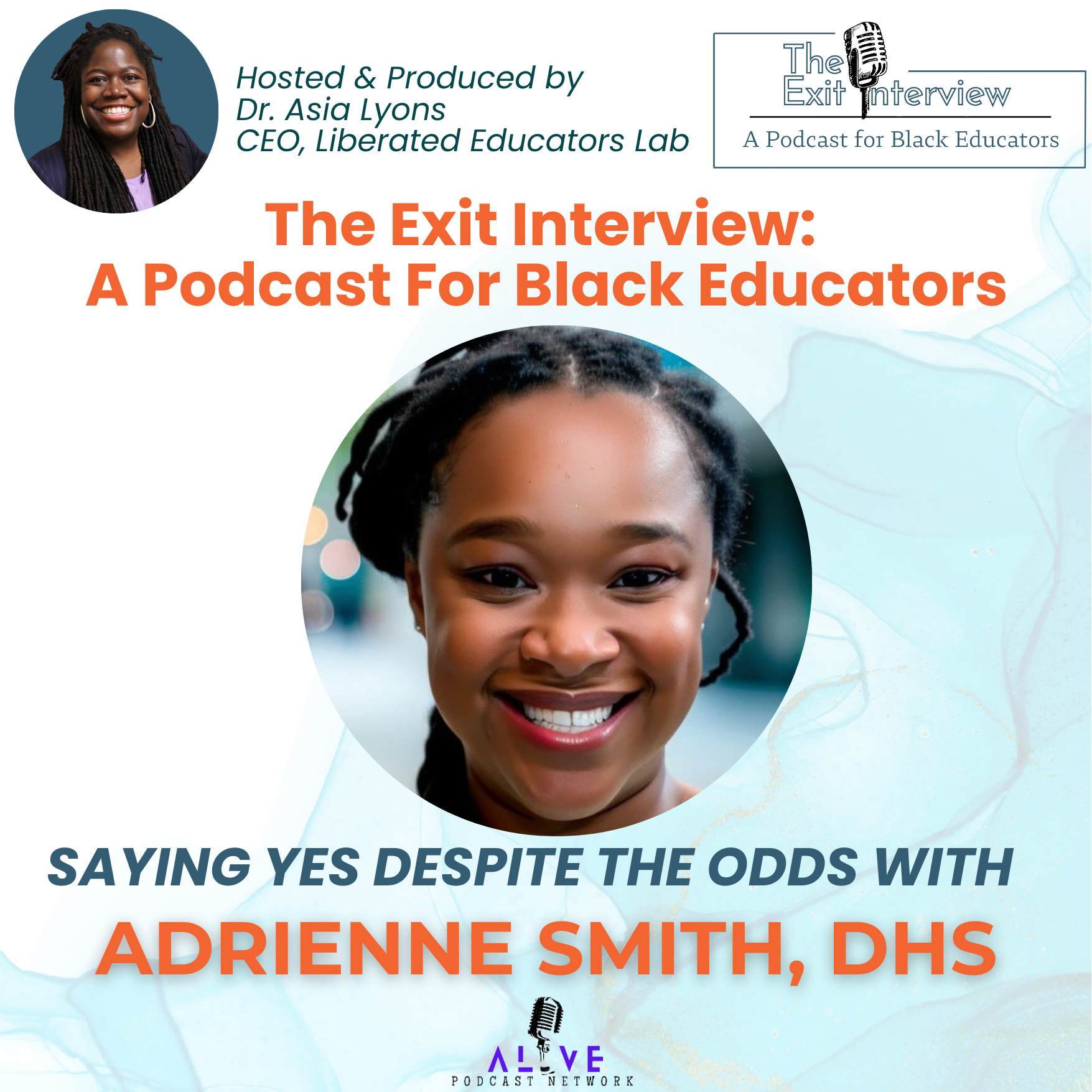
In this episode of "The Exit Interview," host Dr. Asia welcomes Dr. Adrienne Smith, an educator whose journey spans from humble beginnings in Virginia to teaching in Alaska and beyond. Dr. Smith shares her early dreams of teaching, the challenges she faced as a first-generation college student, and the pivotal moments that shaped her career—including working in fast food, becoming a substitute teacher, and navigating multiple college transfers due to accreditation issues.
The conversation delves into Dr. Smith’s bold decision to move to Alaska, a choice made with her partner after a literal coin toss. She recounts her experiences as a special education teacher, the hurdles of certification, and the life skills she gained while living in a remote community. Dr. Smith also discusses the complexities of code-switching, the impact of family support (or lack thereof), and the realities of being a Black educator in predominantly white and Black spaces.
After returning to the East Coast, Dr. Smith describes her roles as a special education teacher and school counselor, the mental health challenges she faced in toxic work environments, and how the COVID-19 pandemic provided a much-needed pause for self-care. She candidly addresses issues of racial battle fatigue, self-harm, and the importance of mental health for educators.
The episode concludes with Dr. Smith’s transition into entrepreneurship, founding her own educational consulting firm focused on trauma-informed practices and professional development for teachers. She offers advice for retaining Black educators, emphasizing the need for ongoing cultural competency, respect, and genuine inclusion in school communities. Dr. Smith also shares the joy she finds in her family and friends, underscoring the importance of finding joy amidst adversity.


Host:
Dr. Asia Lyons
Guest:
Dr. Adrienne Smith, Educator, School Counselor, and Founder of Adrienne’s Educational Consulting Firm
Episode Overview
In this powerful episode, Dr. Asia sits down with Dr. Adrienne Smith to explore her remarkable journey from growing up in a low-income community in Virginia to teaching in Alaska and eventually launching her own educational consulting business. Dr. Smith shares candid stories about overcoming barriers as a first-generation college student, navigating professional and personal transitions, and prioritizing mental health as a Black educator.
Timestamps & Segments
00:00 – Introduction
- Dr. Asia welcomes listeners and introduces Dr. Adrienne Smith.
- Teaser: Teaching in Alaska as a Black woman.
02:00 – Early Inspirations & Barriers
- Dr. Smith’s childhood dream of teaching.
- Challenges of being a first-generation college student from a low-income background.
- The impact of family expectations and support.
08:00 – The College Journey
- Working in fast food and as a substitute teacher.
- Navigating college transfers due to accreditation issues.
- The importance of mentors and advisors.
15:00 – Taking Risks: The Move to Alaska
- The story behind the coin toss that led to moving to Alaska.
- Preparing for the move: selling belongings, road trip, ferry ride, and camping with dogs.
- Reflections on courage and seizing opportunities.
22:00 – Teaching & Living in Alaska
- Roles as a special education teacher and paraprofessional.
- Certification hurdles and professional growth.
- Learning life skills: deep-sea fishing, kayaking, camping.
- Experiences with code-switching and community acceptance.
30:00 – Family, Community, and Identity
- Family reactions to moving to Alaska.
- Navigating being “the only” in a new environment.
- The importance of support systems and partnership.
35:00 – Returning East: New Roles and Challenges
- Transitioning back to Maryland and Washington, DC.
- Working as a special education teacher and school counselor.
- Facing toxic work environments and the impact on mental health.
- The blessing of remote work during COVID-19.
45:00 – Racial Battle Fatigue & Mental Health
- The toll of workplace racism and lack of support.
- Dr. Smith’s candid discussion of self-harm and recovery.
- The importance of mental health resources for Black educators.
52:00 – Advice for Schools & Districts
- What schools can do to retain Black educators:
- Ongoing cultural competency training (not just in February)
- Listening to and valuing Black and Brown voices
- Respecting professional expertise and lived experience
- Fair compensation and workload balance
58:00 – Shoutouts & Mentors
- Dr. Smith honors influential Black educators in her life, including Ms. Wayne, Ms. Emma Staples, Camille Hill, and Cheryl Anderson.
1:02:00 – Building a Consulting Business
- Founding Adrienne’s Educational Consulting Firm.
- Turning lived experience into trauma-informed professional development courses.
- How educators can access her resources and connect online.
1:08:00 – Finding Joy
- Dr. Smith shares what brings her joy: family, friends, and community.
1:10:00 – Closing Thoughts
- Dr. Asia reflects on the importance of joy, resilience, and honoring Black educators.
- Where to find Dr. Smith’s courses and connect with her online.
Memorable Quotes
- “Sometimes when the opportunity is there, you have to move quickly.”
- “We learned life skills in Alaska—if something happened, we’d know how to survive.”
- “COVID was a blessing for me because I could focus on my mental health.”
- “We need to provide cultural competency more than once a year. Listen to Black and Brown voices.”
Resources & Links
Adrienne’s Educational Consulting Firm:
adrianseducationalconsultingfirm.com
(Also on Instagram, LinkedIn, and Facebook)TED Talk Mentioned:
Dr. Quel Martin on cultural competency (search for her TED Talk for more insights)
Key Takeaways
- The journey of a Black educator is often filled with both obstacles and opportunities for growth.
- Support systems, mentorship, and the willingness to take risks are crucial for personal and professional development.
- Mental health and self-care are essential, especially in the face of workplace adversity.
- Schools and districts must do more to honor, support, and retain Black educators—not just during Black History Month, but year-round.
- Lived experience can be transformed into impactful professional development and consulting work.
Connect with Dr. Adrienne Smith:
Website: adrianseducationalconsultingfirm.com
Instagram, LinkedIn, Facebook: Adrienne’s Educational Consulting Firm
First of all.... have you signed up for our newsletter, Black Educators, Be Well? Why wait?
Amidst all the conversations about recruiting Black educators, where are the discussions about retention? The Exit Interview podcast was created to elevate the stories of Black educators who have been pushed out of the classroom and central office while experiencing racism-related stress and racial battle fatigue.
The Exit Interview Podcast is for current and former Black educators. It is also for school districts, teachers' unions, families, and others interested in better understanding the challenges of retaining Black people in education.
Please enjoy the episode.
Peace out,
Dr. Asia Lyons
Saying Yes Despite the Odds with Dr. Adrienne Smith
[00:00:00]
dr--asia-lyons--she-her-_1_07-07-2024_100950: Welcome back to another episode of the Exit Interview, a podcast for black educators with me, your host, Dr. Asia. And you know, folks, I mean, we've been doing this straight for since 2021, something like that. And we're onto our 40th something episode and it just get better and better and better. And today I'm super excited for our next guest, Dr.
Adrian Smith. We had a chance to talk before the episode been all over the place. When we talk about teaching Alaska as a black woman. Hold on to your pants folks, because this is gonna be a really good one. Uh, Dr. Smith, thank you so much for coming on our show.
dr--adrienne-smith-_1_07-07-2024_120950: Thank you so much for having me. I greatly appreciate it.
dr--asia-lyons--she-her-_1_07-07-2024_100950: [00:01:00] Yeah, of course, of course. So. Like I already told them, you've been all over the place. And so we'll start off with, share with us your, your story, your educational story. How did you decide that teaching, being, education, the field of education in general, was something that you wanted to do? How did it all start?
dr--adrienne-smith-_1_07-07-2024_120950: Um, so it actually started when I was extremely young. was in third grade and I used to daydream. Um, I would go inside my head and be like, if this was my classroom, I would have it this way, and I would go about teaching us this way. Um, but you know, as you get older and you become a teen, your dreams sometimes go away, especially if you don't have the right people in place to filter, to help you, know?
Um. Develop those dreams. So I just [00:02:00] let it go off the back of my head. 'cause I was thinking, you know, I'm never gonna go to college. Um, college isn't a place for a person like me. And when I say a person like me, a black person who comes from a low social socioeconomic community and who just can't afford college and I've never seen anyone, um, in my family, um, go to college. Um, 'cause I grew up on my mom's side and no one I knew went to college. So I just. wasn't the place that I was gonna go. Um, so fast forward to becoming in my early twenties, um, late teens, early twenties. I was working at fast food restaurants and I was just like, again, daydreaming always do.
Say, you know what, uh, just, I just want something more. But then I, Facebook became so like, prevalent at that time. I would see my, um. White [00:03:00] counterparts, they would be posting pictures of themselves at college, having a great time.
dr--asia-lyons--she-her-_1_07-07-2024_100950: Hmm.
dr--adrienne-smith-_1_07-07-2024_120950: I would again go back to daydreaming and my, I was hanging out with my dad one day and we were at his next door, neighbor's house, and she was saying how there's a position as a substitute teacher at a head start.
She said, you should go apply. So the next day I went and applied and I got hired to be a substitute teacher. Um. Where I drove all over the Tri city area of Virginia being a substitute teacher at a local Head start. Um, and one particular Head Start was a night school Head Start, and I was a substitute teacher there every Tuesday.
And I really just enjoyed what I was doing. and like I said, Facebook was, um, so prevalent at that time that I, a old friend back from high school had sent me a message [00:04:00] and he was like, what are you doing these days? And I'm like, nothing, just hanging out, you know, what are you doing? He's like, I'm gonna college. Oh, all right. know, way to throw it in my face. Whatever. He didn't
dr--asia-lyons--she-her-_1_07-07-2024_100950: Yeah.
dr--adrienne-smith-_1_07-07-2024_120950: and he was saying how much he didn't like the college experience, so I was like, well, lemme Google. You know, when people tell me they don't like something, well let me do my research based off of what it is. So I researched the college he was at and I applied and I got in and, um. I got in, I was like, I wanna be a counselor. I went to school, I want to do a, um, what is it called? Where you tour the college. I wanted to like, I wanna be a counselor, but the advisor there was like, in order to be a counselor, you have to be a teacher first. And I was like, okay. You know, like that used to be a thought.
And I enjoyed working as a substitute teacher. So I'll go to school to be a teacher I loved it. I loved everything that I was [00:05:00] doing. Um. So I enrolled in the pre-K through sixth grade elementary program at, um, when I was there. And that summer I did not wanna go back home just because, you know, the life experience at home was, I was like, I can't, I don't want to, I don't want, that's not me.
I don't wanna do that. So I applied to be a camp counselor at a, it's called, um, camp Easter Seals, UCP, in Virginia. And they accept everyone who has a disability, um, cognitive, physical, emotional, whatever that looks like. They accept people who have disabilities and it was a residential camp where they will come and just get away from their norm and just have a great time. So I applied there,
dr--asia-lyons--she-her-_1_07-07-2024_100950: Okay.
dr--adrienne-smith-_1_07-07-2024_120950: and I stayed there the whole summer. Like, um, I would go home maybe once or twice that whole summer. Um, but I just worked the entire summer and I went back. I went back [00:06:00] and I was like, you know what? I'm apply to be a SPED teacher, so I told my advisor I wanna be a SPED teacher.
So that's how I started.
dr--asia-lyons--she-her-_1_07-07-2024_100950: Okay, this is making a lot of sense. So I wanna back up a little bit and talk to you about this experience of you working in fast food and then working at a nighttime childcare center, which we talked about you and I a while back about this like second shift childcare center and you, that experience that you, that you love that, and I had not heard of it, but it makes so much sense once you applied to go to college and a family who folks had not historically been going to college.
What was that experience like? Did you share that with your family? Did you decide to keep it to yourself? People celebrated you. Did you feel like you got some hate for that? What was that like?
dr--adrienne-smith-_1_07-07-2024_120950: Ooh. That was, that's, that was an interesting time. Um, [00:07:00] I kept it to myself in a sense. However, my, I think my family was really happy for me. They were proud of me. However, I will say my mom at the time, her of her emotional state, that, again, she was happy, but she was going through her own trauma as a black woman, you know, still learning about what trauma is, probably not even knowing what trauma was back then. So she, she, I, she was happy, but. It, it's difficult to answer that question because it did not display its happiness. Like it displayed as aggression in some, in some formats. But my uncle, he dropped me off at college the first day because, um, my mom couldn't, she had to work and my mom was mad at me 'cause I decided to hang out and party all night before my uncle would take me to college. [00:08:00] And I was super tired. Um, but he was happy and he was explaining to me, um, how he went away for a semester. But he was really sad, missing home. He missed his mom, so he went back home and never did anything. So he was like, you have to finish this out. And I'm like, okay, I'll, so that whole time I changed my whole lifestyle just at, I partied literally from like eight o'clock to three in the morning and came home packed. Um, packed everything in my mom's car. She took me to my uncle's house. My uncle and his girlfriend dropped me off at Co. Like they drove me all the way there, dropped me off and that was it, a wrap.
dr--asia-lyons--she-her-_1_07-07-2024_100950: Yeah, I love that.
dr--adrienne-smith-_1_07-07-2024_120950: yeah, my, they were happy, but at the same time it just didn't really show. But my, I think my dad's side, again, they were happy, but it just was like, well, this ain't the college that we wanted you to go to.
Like this type of, you know, so, yeah.
dr--asia-lyons--she-her-_1_07-07-2024_100950: Yeah, never, never good [00:09:00] enough kind of situation.
dr--adrienne-smith-_1_07-07-2024_120950: Mm-hmm.
dr--asia-lyons--she-her-_1_07-07-2024_100950: Yeah. Yeah. I love to ask that question, um, because I think that people, folks in our audience need to understand that everyone is not necessarily bring it out. The welcome wagon and balloons are pop, all the things when we make the decision to couple things.
One, go to college if that's not been the, the historical context of our families, but also to go away from the family, right. To drive hours, even an hour when everyone usually is on the same block or the same neighborhood, and it's like you're trying to do something different. And I'm, again, not trying to paint your family as trying to be against you, but I, I just think it's really important that we talk about that, that particular piece of.
Folks are making these decisions to be the first or the only, or it's been a while since someone's gone and they may not always get, um, all of the support that they want, at least not in the very beginning. So thank you for sharing that.
dr--adrienne-smith-_1_07-07-2024_120950: Yeah,
dr--asia-lyons--she-her-_1_07-07-2024_100950: now
dr--adrienne-smith-_1_07-07-2024_120950: problem.
dr--asia-lyons--she-her-_1_07-07-2024_100950: back to what you were talking about [00:10:00] special education. You went into special education.
Continue. I cut you off totally.
dr--adrienne-smith-_1_07-07-2024_120950: No, it's okay. So, yeah, I, um, wanted special education. Um, I came back. the summer break, went into special education, um, and was really just enjoying everything that I learned. However, I feel like my story has a lot of ups and downs in how I overcame tons of different hurdles. my college at the time was going through an accreditation. and I'm like in the back of my head, I'm like, man, I done came this far. Y'all about to lose. Y'all credited, you know, accreditation. Like this can't be the story of my life, you feel me?
dr--asia-lyons--she-her-_1_07-07-2024_100950: Yeah.
dr--adrienne-smith-_1_07-07-2024_120950: so I end up transferring. My mom didn't want me to transfer, but my dad's side was like, well that ain't a good college.
Anyway. So I ended up listening to them transferring to a predominantly white college in the community that I grew up in. Horrible decision,
dr--asia-lyons--she-her-_1_07-07-2024_100950: Hmm.
dr--adrienne-smith-_1_07-07-2024_120950: horrible [00:11:00] experience. Hated everything about it. And my mom was like, I told you, you should have listened to me and you know, all this other stuff. So I played tennis at that college. And as soon as this semester was over, I emailed the advisor who was like, you should do this. I was like, can I come back? You know? And then I ended up going back there and, um, was amazing, just really great experience for me. Um, because it was a historically black college. They, um, accepted, they had a single parent program where people brought their kids to school. Um, and they had a dorm room for the kids, and they shared apartments with other single mothers. Then they had a,
dr--asia-lyons--she-her-_1_07-07-2024_100950: Hmm.
dr--adrienne-smith-_1_07-07-2024_120950: I don't know if it was called like a prison reform program, but like, people would, um, or jail reform, like people would be on probation, but they had the college o offered an opportunity for black people to like get a edu, a good education. Um, and then they accepted [00:12:00] low GPA. So I was just like, you know, they, they catered to people of. Um, different backgrounds who would've never thrived elsewhere, right? So I was thriving, but then the school lost their accreditation. Heartbroken. I was, I was, we camp again another that, uh, the following year. And I was just so sad because I was like, oh no, I'm doing good in life. I don't wanna, uh, go back to where I was at.
So then all of my friends, we were like, we're moving to North Carolina. So I ended up moving to Shaw. I ended up moving to Raleigh, North Carolina to go to Shaw University. But then in TI, so I enrolled and they were like, yeah, you're gonna have to kind of start all over and assist because your credits won't transfer. Heartbroken situation,
dr--asia-lyons--she-her-_1_07-07-2024_100950: Yeah.
dr--adrienne-smith-_1_07-07-2024_120950: situation. So then. We got word [00:13:00] that, um, the college opened back, like they were on a appeal process for their accreditation. And that was my last year there. Like I was about to graduate, so they opened back that October. They was like, if you were a senior going into a senior year, come back. So my friend and I, well my friend, she was already in that area 'cause she was visiting one of her men friends and I was at college. I was in North Carolina working because I was like, I gotta pay for it, you know, I gotta figure out a way to pay for this. But I ended up quitting that job on the spot, up everything, her stuff, my stuff.
My boyfriend now husband came and got me. We took everything there. I got an apartment the same day and just moved everything into the apartment. And graduated that the following, um, year.
dr--asia-lyons--she-her-_1_07-07-2024_100950: I want to just point out to the audience, there's a theme here. There's a, someone says, makes a suggestion. [00:14:00] I quit my job. I go here and start applying for this job. I've gotten my card, right? And so I love that you and you'll folks, you'll hear this throughout her entire story, but that is a beautiful theme to, to know that when it's time to go move quickly,
dr--adrienne-smith-_1_07-07-2024_120950: Mm-hmm.
dr--asia-lyons--she-her-_1_07-07-2024_100950: right?
Sitting around him hawing, asking 4,000 people about it, putting out a doodle pole. Like sometimes when the opportunity is there, you have to go. And I'm just gonna go back a little bit about the childcare center and then your, your father's neighbor because you applied. But had you waited two or three days, maybe that would've been open or it would've been a different opportunity.
And so I think that sometimes. We get really, I don't wanna say complacent, but we kind of get into this space of, I just wanna, uh, mull it over. I just wanna keep thinking about it. I just wanna sit around on it. And sometimes the opportunity is not gonna be there if we don't wait. And so I love that you are like, I quit, pack the stuff, move quickly.
Let's just get this thing going. [00:15:00] Um, because it has to be the case sometimes, maybe not all the time, but there's, there's opportunities in our life that only come at a certain time and we have to move quickly. So I love that. So, all right, so you're finishing up your senior year. I, again, I cut you off. So go ahead.
dr--adrienne-smith-_1_07-07-2024_120950: It's okay. It's okay. We're good. So I finished up my senior year, um, at, it's called St. Pauls College. It was in Lawrenceville, Virginia. Um, um, if I had a million dollars, I would open that college up and just give everybody the exact same experience that I had and that other people had. Um, so yeah. And so I was finishing up my senior year and everybody was talking about, well, what you gonna do? What are you gonna do? You know, here's a job, apply here. And I was like, that's not me And my boyfriend, now husband. We both were just like, that's not me. That's not us. We, worked so hard for this, um, period.
We just need a break. We need a break. we needed a [00:16:00] break from the people, like our family. We needed a break from that community that we were in. We were just ready to explore life. So my college advisor was like, just off the whim, she was like, here's a piece of paper in there accepting jobs. They're, um, they're looking for teachers in Alaska.
Here you go. And I was like, okay. In the back of my head, not thinking, nothing of it,
dr--asia-lyons--she-her-_1_07-07-2024_100950: Do y'all hear this theme? Do y'all hear this theme? Okay.
dr--adrienne-smith-_1_07-07-2024_120950: not thinking anything of it, because I, you know, I'm not going to Alaska What? You know, like what? Never my head thought of that. So graduate, um, from college, my, uh, boyfriend, I'm gonna say husband, he was working at a fast food job and everybody left the town. This is a one stoplight town. And I was done.
I was like, yo, I don't wanna be here no more. And he was like, well, I don't wanna be here. And I'm like, well, that's your choice, but I don't wanna be here. [00:17:00] Um, and then I couldn't get a job there either, thankfully, thank you, God, that I didn't get a job there. Um, and we were my hometown visiting my family and we just couldn't sleep.
So we were at, at like a Walmart parking lot at two o'clock in the morning, like, what are we gonna do? And you know, that conversation. And I was like, I wanna go to Atlanta, Georgia. And he was like, I got family there. I don't wanna be there. And I'm like, okay. And he was like, I wanna go to Alaska. And I was like, anyways weird.
Like, who goes to Alaska? So then he was like, we both were like, let's flip a quarter, whatever the quarter says we're gonna go. So got the quarter Atlanta Heads, tails, Alaska. It was Tails, Alaska. So the next day I started applying the jobs, the following day job start calling me. I took a job, started selling everything in my apartment, getting rid of the following day, got rid of everything in my apartment.
We [00:18:00] came up with a day of when we were gonna leave and say goodbye and move out. um, that was sometime in August. So we packed as much as we could in the car. Drove all the way to Bellingham, Washington caught a ferry, a three day ferry where we camped out. We put our tent and our two dogs and camped out on the ferry for three days on a boat and ended up Incan Alaska for four years.
dr--asia-lyons--she-her-_1_07-07-2024_100950: I wish. Yeah. Yeah. The. The, I'm sure there's so many people listen to this like, oh my God, I can never do that. I can never do that. I could, I could never. But you could if you wanted to. Right?
dr--adrienne-smith-_1_07-07-2024_120950: Yeah,
dr--asia-lyons--she-her-_1_07-07-2024_100950: love, and I love that, you know, you had your boyfriend now husband there to support and like, let's flip a coin.
Let's do the thing. And have someone to sit in the Walmart parking lot with you to have that conversation because I think many folks make those decisions on [00:19:00] their own. Um, or they've made that decision with someone else who's just not encouraging. And so I love that you have someone and still do who's like, let's, let's figure this out.
Let's not have fear. 'cause it, ' cause it wasn't a let's stay here conversation. It was a some other place or some other place versus staying here and just trying to keep figuring it out. And I love that you also said, thank God I didn't find a job in that, in that place. You know, I'm from a. Originally from Detroit.
And when I was graduating from college with my undergrad degree in elementary education, Detroit public Schools was closing 2030 schools. And I was thinking, well, how in the world am I gonna find a job if all the teachers that were displaced who had jobs have to find one?
dr--adrienne-smith-_1_07-07-2024_120950: Mm-hmm.
dr--asia-lyons--she-her-_1_07-07-2024_100950: then all us, us new teachers have to find one with, I would say one of the most powerful teachers unions I knew of at the time.
So my husband, boyfriend at the time, that husband was like, let's go to, let's go to Colorado, right? [00:20:00] And I'm like, okay. And we did the same thing. We had, look, we had actually had a. Little Penske Auto, uh, Penske moving van or moving truck. We had a 1994 Geo prism. We hooked the geo prism up to the back of the moving van.
Right. And we drove across country. We took that, it took us about 24 hours. 'cause you know, this takes time and our house plants. And we had a snowstorm in the middle of Iowa, and I think it was, it was May. And we had, we hit a snowstorm bad. All my plants died in the car. Right. But we, we made that trek. And I don't regret it.
I don't regret a single moment. I was afraid. But I had someone with me who was supporting and looking back on it. And maybe you thought this too now, but looking back on it, I'm like, oh my gosh, that was wild.
dr--adrienne-smith-_1_07-07-2024_120950: It was wild.
dr--asia-lyons--she-her-_1_07-07-2024_100950: Yeah, but those type of decisions you make then make the next one much easier. 'cause you slept on a ferry in a tent with two dogs.
Like I [00:21:00] can do anything at that point. But yeah. So you get to Alaska and you said you were there for four years.
dr--adrienne-smith-_1_07-07-2024_120950: Mm-hmm.
dr--asia-lyons--she-her-_1_07-07-2024_100950: us what you did there. Special education. Well, when you had other positions in education while you were there, what were some of the things that you did?
dr--adrienne-smith-_1_07-07-2024_120950: So the journey in Alaska was. A life experience. It definitely was a journey. It was a learning experience, but nonetheless, I enjoyed each and every moment of it. Um, so I initially took a job as a special education teacher, and when I took the job, I was still going through certification, um, like taking tests.
Like I had took tests in Virginia for Virginia tests and did well in the Virginia test, but um, the scores didn't transfer over to Alaska. So. Again, here's another one of my stories of like, life just keeps going like this up and down and I'm overcoming the hurdle. [00:22:00] So I, they were like, in order for you to be a SPED teacher, you have to pass your Praxis test and, but we're gonna allow you to be a SPED teacher.
So I was a sped teacher all the way to like December or something. 'cause I was struggling to pass the Praxis exam in Alaska. Um, I took it like three, four times different locations studied. I was just struggling to pass that Praxis exam. heartbroken and. they were like, well, we have to have a certified person to, um, be a sped teacher.
It's very different than it is here. Um, so they were like, can you be a paraprofessional? Swallowed my pride and was like, I'll be a para paraprofessional. So I finished the school year out at a charter school. Amazing school. Amazing. Like, you know, if my daughter lived there, she would go there. Um, but I finished the school year out at that charter school as a [00:23:00] paraprofessional, and I left the school system and became a, um, I worked at like a communities organization where they, uh, focused on like individuals with disabilities, children mental health, um, disability, um, recognizing disabilities and children from birth to like three years old. So I became a, I forgot what the position, but like a support specialist for individuals with disabilities. While doing that, um, prior, let me go back a little bit. Prior to leaving the charter school, I was inspired by the behavioral health system there that I was like, Ooh, I wanna do counseling. You know, 'cause that goes back to my dream.
Before going
dr--asia-lyons--she-her-_1_07-07-2024_100950: Mm-hmm.
dr--adrienne-smith-_1_07-07-2024_120950: um, teaching, I was like, Ooh, I wanna do counseling. So I applied to Liberty University in Lynchburg, Virginia, because remember, my [00:24:00] college had closed down and a lot of schools was not accepting my, the credits because my school was under an appeal. And this was the only school that said, you know what? We are going to accept your credits with condition. I said, bet. Alright, lemme ensure myself,
dr--asia-lyons--she-her-_1_07-07-2024_100950: less. Yeah, say less.
dr--adrienne-smith-_1_07-07-2024_120950: say less. So I applied to their master's program in professional school counseling and I got accepted. And um, so I transitioned from the school system, working as a support specialist and still learning to be a professional school counselor, um, the whole time. And then from there, while in Alaska I would, um, I transitioned that position and I became like a service coordinator for individuals with disabilities, just planning activities for them to do out in the community. And I was doing that while interning at a high school and at a elementary school for professional school counseling.
But [00:25:00] while in Alaska we met, um. Amazing people. Um, I learned how to deep sea fish, which I absolutely love. Favorite sport of it. I
dr--asia-lyons--she-her-_1_07-07-2024_100950: Hmm.
dr--adrienne-smith-_1_07-07-2024_120950: how to properly kayak. Um, absolutely love. I learned how to properly camp, absolutely love. Um, yeah, we learned life skills. Like if something was to happen and we couldn't afford our life, we would know how to survive. We learned really life,
dr--asia-lyons--she-her-_1_07-07-2024_100950: Mm.
dr--adrienne-smith-_1_07-07-2024_120950: skills.
dr--asia-lyons--she-her-_1_07-07-2024_100950: I'll say, and I, it sounds like we're, we're about to have move shifts to a conversation of you moving. So before we have that conversation, I'm coming back to the family because I just keep imagining your family. Now we're Alaska.
dr--adrienne-smith-_1_07-07-2024_120950: Mm-hmm.
dr--asia-lyons--she-her-_1_07-07-2024_100950: And tell me, I have to know, what was that conversation like while you were there?
I know people had to been so curious as to what the life was like in Alaska.
dr--adrienne-smith-_1_07-07-2024_120950: Yeah. So let me say this. Prior to moving to Alaska. One [00:26:00] side of the family was like, again, that's not good enough. Why are you moving there? You're moving with some boy. Like, you know, like that's the worst decision you've ever could make in life. And then, uh, another side of the family was like, yeah girl, go ahead do that. so this is, here for it. So then while living to a while, living in Alaska, um, we would often, we didn't often come home, let me take that back. But we would talk to family members. And when we did visit home and people seeing our driver's license, they like black people in Alaska. And I'm like, yeah, you know, like
dr--asia-lyons--she-her-_1_07-07-2024_100950: Hmm.
dr--adrienne-smith-_1_07-07-2024_120950: black people in Alaska.
It might be like a handful of us, however, um, well, what is it like there? So then we would have to give them the experience of how it was like, people accepted us. However, we did encounters like some racism. Um. But that's everywhere. And I always [00:27:00] told my husband, like we used to have like deep conversations of code switching.
Like, 'cause I would hate when he code switch like that ain't you. Like that is not you. You know? And then sometimes I would unrecognizably in myself code switch, but then again I'm like, that's not me. So I hated that part of it. Yeah.
dr--asia-lyons--she-her-_1_07-07-2024_100950: Yeah, that's tough. And, and I mean, I'm sure you know, it's not only Alaska where we, people are code switching, are feeling need to, right. Because of, of our own like psychological, physical safety. We're code switching everywhere, unfortunately for so many of us. Um, and it can be so exhausting.
dr--adrienne-smith-_1_07-07-2024_120950: Mm-hmm.
dr--asia-lyons--she-her-_1_07-07-2024_100950: so we're rounding out end of our fourth year in, in teaching and in the community work.
And you're now doing sounds like 45 jobs. You interning here, interning there, work coordinating, um, activities for, um, special education populations, and then what else happened after that? Did you move? It sounded like you [00:28:00] moved.
dr--adrienne-smith-_1_07-07-2024_120950: Um, no, we stayed in the community, um, where we were living at. We stayed in the Ketchikan, Alaska community. However,
dr--asia-lyons--she-her-_1_07-07-2024_100950: okay.
dr--adrienne-smith-_1_07-07-2024_120950: yeah, will say when we first got there, we lived in a fifth wheeler, a very small like trailer. And then we stayed there for like four or five months, and then we found the house. Um, but when we, when I was finishing up my master's degree program, I was like, all right, I'm ready to go do something else in life. And my husband, he was like, no, I can stay here. And I'm like, you stay here. I'm ready to do something else. So, um, we rescued this dog. I call him, his name is Pillow. That wasn't his name when we first rescued him. And I wanted to move to the Philip, no, was it? No Thailand. I wanted to move to Thailand, but we had this beautiful dog and we still have him to this day. And I was like, we can't give him [00:29:00] to nobody else because you know, that's just horrible. One, um, owner to another owner. Um, so we ended up moving back to Maryland where my husband is from. Um, and we was like, let's give back to the black and brown kids of the community that you grew up in. 'cause he grew up in a predominantly black a neighborhood. And let's teach them the skills that we've learned in the Maryland. So that's what transitioned there. So then I accepted a job as a special education teacher. I really didn't wanna be a sped teacher in Maryland. I wanted to be a school counselor, but it was hard to, uh, find a position as a school counselor at that time. So I was a special education teacher in Maryland for one year, and I left that, um, job.
'cause I was like, this is it for me. And I ended up taking a position as a professional school counselor. Um, that was like an hour, an hour and a half drive from where I [00:30:00] lived at thinking we were gonna move there, but we never did. But I was driving back and forth every day. So I would be on the road for three hours a day at that school. And I enjoyed the school. However, I was like, Hmm, I'm not gonna do this job because it's very taxing. I don't have a social life. It was just a lot. I'm on the road, I'm at work, I'm on the road at work. So then I left that job and transitioned to a job in Washington, DC where it was, uh, extremely low socioeconomic communities, high crime. Um, just, yeah, it was, it was that, uh, a lot of, um, violence and I worked at that community. However, that school, however, it was not good for my mental health.
dr--asia-lyons--she-her-_1_07-07-2024_100950: Mm.
dr--adrienne-smith-_1_07-07-2024_120950: it was not the students nor the parents because I understood the demographics of where I was working at. It was the educators in the school system that I worked at. Um, used to call 'em, yeah, I,
dr--asia-lyons--she-her-_1_07-07-2024_100950: Tell us [00:31:00] more about that, please.
dr--adrienne-smith-_1_07-07-2024_120950: yeah, I used to call them. Um. No, I'm not gonna say what I call them. Well, I'll say it was the deacons. I was like the deacon of the church. Like how some churches, you go in and it's like, mm, look at what this person got on. You know, you can
dr--asia-lyons--she-her-_1_07-07-2024_100950: Uh.
dr--adrienne-smith-_1_07-07-2024_120950: obvious, like talking about you or, um, it was, it was just really not good for my mental health because what I was taught as a professional school counselor, I was seeing everything that was against what I was taught as a educator in the school and as a professional school counselor with the staff, not the, not the parents or the, um, the students.
But I will say this, they were really good for that. Those students though, like they provided resources and experiences for the students. However, again, if you didn't already, if you wasn't familiar with the community, meaning you didn't personally grow up in [00:32:00] that particular community or, um. You didn't in that community, then you might have been looked down on like you are different.
And it was an obvious sign that I was different.
dr--asia-lyons--she-her-_1_07-07-2024_100950: I see that and I, you know that, that's fine. That's totally fine. Um, of course, always, I think that's really interesting that you talk about. Make this closeness of the community and this, this pretty much a fear of outsiders. That's what that is, right? It shows up in bullying, it shows up in all the other, these other ways that are very harmful.
But it's fear of the unknown. And I think about going back to my being raised in Detroit and going, um, going back to teach in Detroit when I graduated, I could see, because Detroit is, well, at the time in 2006 when I graduated, was so tight knit. I could see that if folks had moved there [00:33:00] from other places, I could totally understand, not understand, but I could totally see them maybe not giving folks a chance, right?
Because of Detroit's history, because people in Detroit, you know, had survived and thrived through the eighties and nineties and the, the shutting down of, uh, factory work, uh, factories for, um, cars and things like that. But that doesn't make it excusable.
dr--adrienne-smith-_1_07-07-2024_120950: Mm-hmm.
dr--asia-lyons--she-her-_1_07-07-2024_100950: to be feeling pushed out because the community is not accepting in the same, in the same vein, saying, we accept and love children for who they are.
It's just such a cognitive dissonance. Right? So, yeah. Yeah, I hear you on that a hundred percent.
dr--adrienne-smith-_1_07-07-2024_120950: Yeah. Yeah. That's when, uh, COVID happened and sadly enough, I hate that I'm gonna say this, but it, COVID was a blessing for me because school closed down and, um, we went virtual and I was able to just focus solely on my mental health. I was still doing the [00:34:00] work virtually at that, uh, school. However, it was a blessing because I didn't have to encounter those people on a regular, I didn't have to feel bad about myself or the strategies or just hear how I wasn't, quote unquote, um, what these parents or kids needed.
They needed something rougher and I wasn't like, going to give them that tough love. so COVID was a blessing for me in that aspect. And I quickly, once COVID was over, I not over, lemme take that back. I. Yeah, I, so I quickly started applying elsewhere and I went back to the school system that the, I took the initial position as a special education teacher at, but I was now a professional school counselor in that school system.
I had to leave where I was at. Yeah.
dr--asia-lyons--she-her-_1_07-07-2024_100950: I feel like so many folks were so glad, specifically black folks, that [00:35:00] COVID happened for the reason you're talking about. Which is this time away from these toxic work cultures, right? There were so many of us who were just so happy to not have to face, I, I don't wanna assume that your community, you're talking about white folks in this, um, setting, but we were talking about so many folks who just did not want to be in the space of dealing with white supremacy culture in schools,
dr--adrienne-smith-_1_07-07-2024_120950: Mm-hmm.
dr--asia-lyons--she-her-_1_07-07-2024_100950: and people telling you how to teach and come and, and asking you all types of questions and trying to demean you in so many ways.
I felt like there were so many folks that were like, I'm just so glad to not have to, even if it's for two weeks or three weeks or several months, not have to be in a school space again, not because of the students, not because of the families, but because of the, the colleagues, the administrators that made it really impossible to really thrive in teaching the way that they really wanted to.
dr--adrienne-smith-_1_07-07-2024_120950: [00:36:00] Yeah. And it's sad because in, in my culture, I hear a lot of, in the Black American culture of like, Hey, you just gotta deal with it. You know? Like, you just gotta, you Google pay these bills, you know, like you just gotta go to work and deal with it, just eat it. But then you go home and you take it out on your family members at home because the experiences that you have at work, and you can't take it out on them because then you're gonna get in trouble and you don't wanna take it out on your loved ones because they did nothing to you. So, yeah, it was one of those situations I would often hear, like, don't take it personal, like just deal with it.
dr--asia-lyons--she-her-_1_07-07-2024_100950: Yeah, that, that pushing down, and again, we, we haven't, we haven't talked about the race of the folks you're talking about, but we talk about, I often, when I'm out in community at conferences speaking, I talk about the crossover and spillover of racial battle fatigue from the workplace to our homes.
dr--adrienne-smith-_1_07-07-2024_120950: Mm-hmm.
dr--asia-lyons--she-her-_1_07-07-2024_100950: Right.
[00:37:00] And like you said, we can't just like leave it at work because people say they do, but they really don't.
dr--adrienne-smith-_1_07-07-2024_120950: Mm-hmm.
dr--asia-lyons--she-her-_1_07-07-2024_100950: and we can't take it out on the folks who have harmed us. So we end up pushing it down and, and slowly eating ourselves away or our family members, our community members experience that, whether that be not wanting to hang out as much as you used to, whether that be drinking more, crying in our cars, all kinds of hives and heart issues and things like that.
And it's just so, so common. And I know this is a statement that I have no proof of, but I feel very strongly that COVID in some ways for some black educators saved their life.
dr--adrienne-smith-_1_07-07-2024_120950: Mm-hmm.
dr--asia-lyons--she-her-_1_07-07-2024_100950: And I mean that like truly saved them from
dr--adrienne-smith-_1_07-07-2024_120950: definitely.
dr--asia-lyons--she-her-_1_07-07-2024_100950: life or having a heart attack and ending their life ending, like all these ways ending then probably saved some marriages too, right?
And save some relationships because. People had a [00:38:00] chance for just that small moment to pause and do some healing work.
dr--adrienne-smith-_1_07-07-2024_120950: Mm-hmm.
dr--asia-lyons--she-her-_1_07-07-2024_100950: Um, which probably, like I said, strengthened relationships, made people, um, especially if their spouse, their partner, their family members are at home with them, help them to strengthen those relationships.
They didn't necessarily nurture because they were in a toxic environment where they didn't wanna talk about it and be, and be, um, with their families as much as they used to be.
dr--adrienne-smith-_1_07-07-2024_120950: Yeah, I, I definitely agree and full transparency, this was a black community that I was working in, but for. transparency. I was, um, which leads into the work that I now do for many years as a youth, I was a self harmer, and I haven't self-harmed in many, many, many, many years. But I will say, working in that environment again, it was impacting my mental health that I had a relapse and most people would be like a relapse.
Well, it's true, you
dr--asia-lyons--she-her-_1_07-07-2024_100950: Mm.
dr--adrienne-smith-_1_07-07-2024_120950: Self-harm is like a relapse. [00:39:00] So I had a relapse for a, a split second, and it was mainly because I felt like I wasn't being heard and accepted on, you know, and I, again, I was taking what I was experiencing at work and I was taking it home and I felt like nobody was hearing me.
And most people who self harm, um, sometimes it's like that emotional pain. 'cause you're experiencing the emotional pain from work.
dr--asia-lyons--she-her-_1_07-07-2024_100950: Mm-hmm.
dr--adrienne-smith-_1_07-07-2024_120950: it also, the, the feeling of I'm not being heard, my words are not being heard. You're not hearing me. So, yeah. Yeah. Mm-hmm. So I'm thankful. I hate that. I'm thankful that COVID, you know, stopped me from, um, working at, I, I'm, I hate that COVID was a place, you know, that took other people's lives away, but it saved mine in a sense.
dr--asia-lyons--she-her-_1_07-07-2024_100950: Mm. Yeah. Thank you for sharing that. Yeah. Self-harm relapse. Wow. Wow. Thank [00:40:00] you for sharing that. And so this is 2019, 2020.
dr--adrienne-smith-_1_07-07-2024_120950: Mm-hmm.
dr--asia-lyons--she-her-_1_07-07-2024_100950: At, at what point when did you decide that you were kind of ready to, to do something else altogether?
dr--adrienne-smith-_1_07-07-2024_120950: Yeah. So it was, it was March right before COVID
dr--asia-lyons--she-her-_1_07-07-2024_100950: Mm-hmm.
dr--adrienne-smith-_1_07-07-2024_120950: we left. We left school March 12th, 2020. I remember that day because it was just so like, no, it was March. Yeah, March 12th. It was so like, oh, I'm so, I'm sick. I'm mentally sick. Um, so. I had a conversation, the CEO of the company, of the school as well as the principal, pulled me to the side in their office just to have a conversation of like, we noticed that you're doing this.
Can you explain to me why you're doing this? And I was like, well, I'm planning on transitioning out. they were like, why? You know? And that's when I knew that it was time for me to go. I didn't have a plan, [00:41:00] you know, but I knew I was gonna leave. So I told them that I was gonna, uh, leave before I even knew where I was gonna go. Um, and then maybe a week or so later, I just started applying to places. And I got hired at the, um, old school district that I worked at for four year, uh, where I was at. Special education teacher. So I knew I was leaving March 12th, 2020. Um, and then I transitioned. I got hired to be a professional school counselor at this amazing school, where there was 26 languages and 36 cultures. I thrived in that environment. I was, I was thriving so well that, um, I was able to start new programs in that school. I was able to just do the work that I was taught to do, but I was also being rewarded and, um, praise [00:42:00] for the type of work that I was doing, that I brought to the school. however. The principal at that school, she never came to work. But, um, I'll often hear how colleagues was fearful of this principal. I didn't know the principal, um, even though she hired me, we had a few encounters of like, oh, hey, you know, hi, this is what I'm looking for. I'm like, okay, you know, let me make it happen. But she never came to work. So the assistant principal was always taking place, um, took place for her role as a principal, and I was rooting for the assistant principal to become the principal, the head principal the following year, because again, that principal never came to work, you know, and that was new experience for me. Um, so I was rooting for the assistant principal who was, you know, a person who wasn't a person of color, and she was appreciative that I was rooting for, but [00:43:00] the
dr--asia-lyons--she-her-_1_07-07-2024_100950: Hold on, hold on. Y'all, hold on. Dr. Smith just put her hand up and rubbed the palm of her hand. Folks, we talk, we say white people on this podcast. Yes, she, she tuck her hand down folks and rubbed that palm. And you, if you know, you know what that means. But so the principal, the assistant principal, was the color of most people's poems.
We got that. Continue. Go ahead.
dr--adrienne-smith-_1_07-07-2024_120950: So she was a per, she was a person who wasn't a person of color, but I was rooting for her. Like I thought she did a great job. But the following year that she became principal, um, I became super sick. Um, that year I was outta work for like three weeks and I was on like medications, um, because. I was just sick.
And the medication that I was on, it was like a prednisone or something like that. forgot to call outta work one day. I forgot [00:44:00] to put it in the system one day that I called outta work. But they knew I was gonna be out because I was still sick. I had doctor's notes. I emailed the doctor's notes and everything, and she wrote me up, up.
I'm like, wait, what? So I went to work the next day, sick as a dog, sick as a dog.
dr--asia-lyons--she-her-_1_07-07-2024_100950: Hmm.
dr--adrienne-smith-_1_07-07-2024_120950: I was like, I need to have a conversation with you. pretty much I went in her office that morning, was like, why did I get written up? And she was very short, like very short with me. So in the back of my head I was like, okay, I need to plan an exit.
Yeah. Because this is in it, you know, I'm rooting for you. But at the same time, like I feel like you just kind of like. Spit my face, you know, like you wrote me up. do great work. The other, uh, principal who's a black lady's always praising me and thankful for me and like, you know, just always, she's a, a great leader and a great role model.
However, the white woman who was a principal and that had [00:45:00] nothing against race was just like, but we needed this. You know, this is the protocol, this is the procedure. And I understand that you're now in your new role and you are trying to show everybody that you work with, that you're serious. And I respect that.
I respect your role. However, you know, like this could have been a conversation. You wrote me up. You actually had to take time to write this out. And, um, granted, so her and I had the conversation. And she said she never signed the paper. However, in the back of my head, it's still like, wow, that's foul.
That's, you know, like this is foul. So she knew that I was upset with her. Like she knew that I was highly upset with her. And she was like, we need to just have lunch one day and talk about it. So, um, we end up having lunch she was like, feel like you're very short with me. 'cause at that time I was being short with her.
Like, all right, I'm gonna hope this is a professional conversation.
dr--asia-lyons--she-her-_1_07-07-2024_100950: Hmm.
dr--adrienne-smith-_1_07-07-2024_120950: [00:46:00] and at first my con relationship with with her was like, we're professional, but at the same time, very encouraging. Like, we're human, let's having a human experience, you know? Um, but at that time I was like, Hey, can you write me a recommendation letter?
And I did that because I wanted her to know, oh, I'm out. Like, you don't mistreat people that way. And. So they never wrote me the recommendation letter. That's okay. Because what she doesn't realize is she taught me a skill. She was, um, she asked me, can I train teachers on strategies of, you know, how to work with students on behavior after school?
Sure. And she said that We'll pay you. Of course they did pay me, but I also did the research. I said, okay, well let me do to myself, I didn't say this out loud to her. Let me do research on what if I was to open my own company up and teach teachers or educators on strategies. And [00:47:00] they paid me and I certify them. So the following year, um, because at that time I was the mental health department chair, but the following year I said, I don't wanna do that anymore either. Like, I was planning my exit strategy, um. Leading into the year that we're in now. And then I, uh, became pregnant, uh, with a beautiful baby girl. And I knew that I wasn't gonna come back after maternity leave. I didn't tell them this, but I knew that I wasn't coming back. And prior to, uh, becoming pregnant, I was planning my business. Like I was writing the business out, I was doing trial and error runs of what that would look like, and it was doing very well. Um, and became pregnant, uh, 2024, 2020 3 24. Had my daughter in February, went on maternity leave January 27th and never returned back and just kind of started with [00:48:00] my, my business.
dr--asia-lyons--she-her-_1_07-07-2024_100950: Yeah, we are gonna talk about your business in a second,
dr--adrienne-smith-_1_07-07-2024_120950: Yeah.
dr--asia-lyons--she-her-_1_07-07-2024_100950: but I wanna pause 'cause there's just so this story, there's so many layers and so many pieces
dr--adrienne-smith-_1_07-07-2024_120950: Yeah.
dr--asia-lyons--she-her-_1_07-07-2024_100950: it. And I think that our audience really needs to sit and think about, we are talking about working in fast food,
dr--adrienne-smith-_1_07-07-2024_120950: Mm-hmm.
dr--asia-lyons--she-her-_1_07-07-2024_100950: are starting our story off.
And there's much story before that, but we're talking about the ch fast food and tents in Alaska and this, and flipping coins and showing up and showing up and showing up, right?
dr--adrienne-smith-_1_07-07-2024_120950: Mm-hmm.
dr--asia-lyons--she-her-_1_07-07-2024_100950: you said there, there were challenges and ups and downs. And I think that maybe that's one of the reasons why so many of us stay in places where we're not treated well
dr--adrienne-smith-_1_07-07-2024_120950: Mm-hmm.
dr--asia-lyons--she-her-_1_07-07-2024_100950: we're afraid of the ups, ups and downs, but we're experiencing them anyway.
dr--adrienne-smith-_1_07-07-2024_120950: You
dr--asia-lyons--she-her-_1_07-07-2024_100950: We're just experiencing them in this, in, in classroom four B down the third hallway.
dr--adrienne-smith-_1_07-07-2024_120950: [00:49:00] Yeah.
dr--asia-lyons--she-her-_1_07-07-2024_100950: Um, and, and so I think it's important to, to pause and recognize because people, I feel like in education with so many of us or some, I'm no longer a teacher, but when I was teaching so many pleasers, so many people who just wanted to, to do the right thing, or not even just the right thing, just follow the rules, right or wrong.
No matter what. 'cause that's what the rules say. And so it becomes a place for creatives being pushed out. People who ask questions, people who show up, people who are, who choose to be brave are, are pushed out or their spirit is stumped out of them. Right.
dr--adrienne-smith-_1_07-07-2024_120950: Yeah.
dr--asia-lyons--she-her-_1_07-07-2024_100950: so I, I love that. And I'll ask a question.
Seeing how you've worked with black folks who've caused harm, white folks who've caused harm, all the things have happened. Right? What do you think are some ways that schools, school [00:50:00] districts, unions, communities, what can they do to keep black educators teaching? Um, or being school counselors or being administrators or being paraprofessionals?
What can they do to keep us, if you have any suggestions within the school spaces within education.
dr--adrienne-smith-_1_07-07-2024_120950: I think it's very important that, um, we provide, you know how like every year Dr. Quel Martin said this, and I'm gonna quote her every year, um, during February, we provide cultural competency trainings, right? And she did a great TED Talk on how it's important that not only do we provide culturally competence in February, but we need to provide that every month, not just in February, but we need to provide it more than once a year. we need to. Um, higher ups [00:51:00] need to listen to black and brown voices. We need to listen to our experiences, take into account how we're feeling, take into account our experiences, and also take into account that we're professional and we're, we have degrees, you know, that we are highly qualified, extremely qualified for the role, for our, um, the role that we play. You know, we didn't just go to school to twiddle our thumbs. We went to school to learn how to help and support. So here are experiences, our voices as well as our professionalism and take into account and take those strategies that we are telling you. Please try this route. Try this method. It works because what I've learned that I don't know if other people have this experience, a lot of. People who are not, A lot of white [00:52:00] people will come to black educators and say, I'm struggling in this. How are you able to do this? why it's important for them to hear black educators voices, because again, a lot of people come to us and ask for our strategies, ask for our, um, how are you make, how are you able to make this work?
You know? 'cause I'm struggling on this and we are the lead, we're leading them, but nobody else is appreciating our role as leaders unconsciously. Yeah. Mm-hmm.
dr--asia-lyons--she-her-_1_07-07-2024_100950: notice that Dr. Smith did not talk about black people starting another book club and black people doing things for free. I think that's really important. 'cause what people might hear is like, oh, when we get back to school in the fall, that black educator who's doing great work, I'm gonna put them in charge of blah, with no extra time for planning, with no extra compensation, [00:53:00] nothing taken off the plate.
And that's not an honor.
dr--adrienne-smith-_1_07-07-2024_120950: Yeah.
dr--asia-lyons--she-her-_1_07-07-2024_100950: not an honor at all.
dr--adrienne-smith-_1_07-07-2024_120950: Yeah, not at all.
dr--asia-lyons--she-her-_1_07-07-2024_100950: Yeah. I love that. The culture of competency, uh, taking into account that we are professionals, um, hearing our voices, and these are things that people, um. Every episode we ask the same question. I ask the same question, and people say the same thing over and over again.
This is not brand new yet. It has not happened yet. Yet what people are continually saying, we're just not being honored in the ways that we should be, just like any other teacher,
dr--adrienne-smith-_1_07-07-2024_120950: Mm-hmm.
dr--asia-lyons--she-her-_1_07-07-2024_100950: We are not saying, put us, give us a crown. We're saying
dr--adrienne-smith-_1_07-07-2024_120950: Yeah.
dr--asia-lyons--she-her-_1_07-07-2024_100950: respect our craft. Respect what we're doing. Pay us fairly, hear our voices.
Stop having us do just the Black History Month things, or just the Just BS, A, and really think about us just like they think about themselves, right? As
dr--adrienne-smith-_1_07-07-2024_120950: exactly.
dr--asia-lyons--she-her-_1_07-07-2024_100950: the professionals they are. I love that. Now we are getting [00:54:00] into my favorite parts of the podcast, and I'll start off with the first question, which is, is there a black teacher or are there multiple black teachers that you would like to shout out who have taught you in your K 12 or higher ed experience, who you work with in the past?
Any folks that you wanna just say, Hey, I shout you out. I honor you.
dr--adrienne-smith-_1_07-07-2024_120950: Yeah. Um, so it's. Um, first of all, I wanna say my kindergarten teacher, Ms. Wayne, um, she was an older black lady, um, very first. She wasn't my first experience in education, but she was recognizable, you know, like she is somebody that I remember because was strong and stern, you know, but nurturing at the same time.
So I really wanna shout out Ms. Wayne. Um, fast forward, I wanna go to college, Ms. Emma Staples. Love Ms. Emma Staples. She was an advisor. I looked at her as a mentor. Again, another black [00:55:00] lady who was strong stern, had her own story to share, um, but a role model in a sense too. And she was the one who's like, here, they're hiring in Alaska. So she's a person that I often, um, just think and appreciate for the role that she took in my life as a, you know, as moving into education. Um, it's some really great employees that I've worked with. I wanna say Camille Hill, she's a strong community advocate. She works in a school system. I mean, when I say strong, like this lady will work tooth and nail to find resources for those who, um, do not have the resources for those who lack.
And then there's one lady who I just came across, not too recently. I just, I worked with her for a few months. Her name is Cheryl Anderson. Um, a strong, strong black educator in the school system. Um, [00:56:00] have behavioral problems because she's nurturing and she's strong and she's strict and she's stern, but she also cares and she wanna make sure that her students leave her classroom knowing, knowing the material that she teaches them. yeah, and I recognize that.
dr--asia-lyons--she-her-_1_07-07-2024_100950: the warm demanders. We love a good warm demander. I would love, that was my role in education is like, we're getting this done and I love you,
dr--adrienne-smith-_1_07-07-2024_120950: Yeah.
dr--asia-lyons--she-her-_1_07-07-2024_100950: but we're getting this done. Yeah, no, I totally love that. Um, you kind of alluded to it already a little bit, but you're no longer in the traditional teaching space.
Education space. Right. But you're still supporting education. So tell us, what are you doing now? What are you up to?
dr--adrienne-smith-_1_07-07-2024_120950: Yeah, so I own Adrian's educational, um, consulting firm, where I research trauma-informed practices research. [00:57:00] Um, everything that I do is a life experience that I've had, right. And I used to question myself like, why did I go through this and why is this the reason for that? So I research my life experiences and I make them into courses.
So I write courses, I send them off to the state department and I have those courses, um, credited as a credit. So teachers can, um, take those courses that can go towards their certification or their relicensure. Sure.
dr--asia-lyons--she-her-_1_07-07-2024_100950: And where could they find these courses?
dr--adrienne-smith-_1_07-07-2024_120950: Yeah. So they can go to my website, um, which is Adrian's, you can google it. Adrian's educational consulting firm.com. Um, my
dr--asia-lyons--she-her-_1_07-07-2024_100950: on one second, Adrian. So I'm pausing you an editor. We're pausing this because you broke up and I wanna make sure people hear you say that. So I'm gonna ask the question again about where they can find your information, because I wanna make sure that's clear. So,
oh, [00:58:00] awesome. And so tell us, where can we find information about your organization?
dr--adrienne-smith-_1_07-07-2024_120950: Yeah, so I have a website called adrian's educational consulting.com. Consulting firm.com. Adrian is spelled A-D-R-I-E-N-N-E, um, and then consulting, adrian's educational consulting firm.com. And then I'm on Instagram, I'm on LinkedIn. And I'm on Facebook. Um, the same. Adrian educational consulting firm.com.
dr--asia-lyons--she-her-_1_07-07-2024_100950: That's beautiful. Yeah, and I love that you left, before you left. You had, you had this idea of how do I make sure that the skills that I'm learning here and teaching in the school counseling, excuse me, I can use that in my own business. I use that when I leave, and that's a great. Thing for everyone to think about.
I know that people think, [00:59:00] well, I'll just retire from here. I'll always do this particular job. So, you know, and I don't wanna own a business after I'm finished, but it is okay to just think about it.
dr--adrienne-smith-_1_07-07-2024_120950: Yeah.
dr--asia-lyons--she-her-_1_07-07-2024_100950: about how you could support someone else, even if it's on a full blown basis, even if it's like consulting hours, just a couple hours of coaching here and there.
Like, how do we take some of this information that we're learning in this one space and transfer it to another? Lots of other, uh, careers do that.
dr--adrienne-smith-_1_07-07-2024_120950: Mm-hmm.
dr--asia-lyons--she-her-_1_07-07-2024_100950: Lots of other careers are thinking, okay, I'm gonna take this class. I'm gonna sign up for this thing. I'm gonna volunteer in this way so that I can use this for the next space.
And I don't, I wanna make sure that teachers, school counselors, paraprofessional all the things, everyone, family liaisons and admin who are listening to this, who are thinking about maybe it's time for me to take a break, a sabbatical, rest, retire, quit, think about these skills, and they count.
dr--adrienne-smith-_1_07-07-2024_120950: Mm-hmm.
dr--asia-lyons--she-her-_1_07-07-2024_100950: they always count.
So thank you for that. And [01:00:00] I, I meant to say that before. I think our last question is my favorite question. What's been bringing you joy these days?
dr--adrienne-smith-_1_07-07-2024_120950: Oh, what's been bringing me to my family? Honestly, my daughter, my husband, just spending time with them, our dogs, visiting my mom and my sister. my in-laws, yeah. Family has really been bringing me joy. My friends, oh, let me not forget about them. My, my friends, you know, they make sure that I'm lifted in spirit, so, yeah.
dr--asia-lyons--she-her-_1_07-07-2024_100950: Yeah, I love that. Um, there's always room for joy, right? We talk about these challenging experiences. We talk about racism here on the podcast and racial battle fatigue and harm, and we, you know, there's always gonna have to be room for joy. We have to find that. So thank you. Alright folks, you heard, uh, [01:01:00] Dr.
Smith Adrian's educational consulting firm.com if you wanna reach out and find out about the courses that she's offering to folks. In the meantime, we will talk to you all later. Thank you and have a great day. Peace.
dr--adrienne-smith-_1_07-07-2024_120950: Thank you.