Our Black Educators and Students Deserve Better with Vanity Jenkins
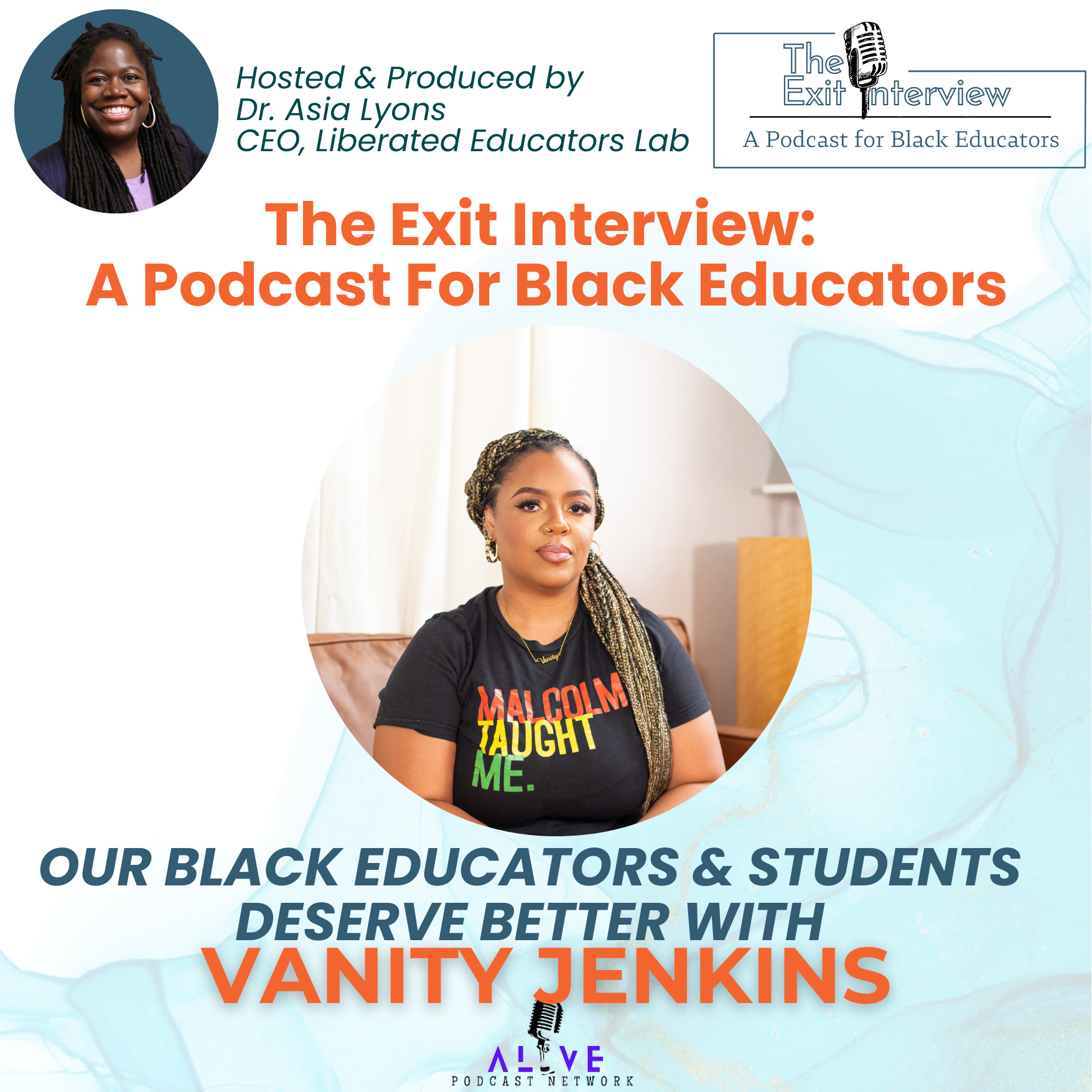
In this episode of "Exit Interview," host Dr. Asia Lyons sits down with Vanity Jenkins, an accomplished educator, DEI consultant, and former executive director of a charter school. Vanity shares her journey from aspiring sports manager to passionate educator, inspired by a college course that revealed the deep systemic challenges facing Black and Latino students. She recounts her experiences teaching in the Mississippi Delta, emphasizing the importance of understanding local context and history, and the unique challenges Black educators face—even in predominantly Black communities.
Vanity discusses her transition from classroom teaching to leadership roles, including coaching, recruitment, and eventually founding a charter school focused on restorative justice and community engagement. She candidly addresses the difficulties of sustaining such schools amid funding inequities and the broader politics of education.
The conversation delves into the historical loss of Black educators post-integration, the need for radically improved teacher pay, and the importance of high-quality coaching and inclusive decision-making in schools. Vanity also highlights the disproportionate burdens placed on Black women in educational leadership and the necessity of systemic change to support Black students and educators truly.
Currently, Vanity works as a DEI consultant and executive coach, supporting organizations and women of color in aligning their values and leadership. She closes by reflecting on the importance of finding joy and maintaining resilience amid ongoing social and global challenges.


In this powerful episode, Dr. Asia Lyons welcomes Vanity Jenkins to discuss the realities, challenges, and triumphs of Black educators and students in America. Vanity shares her personal journey from aspiring sports manager to passionate educator, her experiences teaching in the Mississippi Delta, and her transition into educational leadership and DEI consulting. The conversation explores the historical and systemic barriers facing Black educators, the importance of context and community, and actionable steps for creating more equitable and supportive educational environments.
About the Guest
Vanity Jenkins is a Teach For America alum, former teacher and school leader, and current DEI (Diversity, Equity, and Inclusion) consultant. She has worked across multiple states in roles ranging from classroom teacher to executive director of a charter school, and now supports organizations and women of color through coaching, strategy, and professional development.
Key Topics & Discussion Points
Vanity’s Path to Education:
- Inspired by a sociology of education course and the stark realities of the school-to-prison pipeline.
- Decision to join Teach For America and teach in the Mississippi Delta.
Teaching in the Mississippi Delta:
- The importance of understanding local history and context.
- Challenges and surprises of working in a predominantly Black district.
- Lessons learned about community, trauma, and the need for culturally relevant pedagogy.
Leadership and School Founding:
- Transition from classroom teaching to coaching, recruitment, and leadership.
- Founding and leading a charter school with a focus on restorative justice, community engagement, and no-suspension policies.
- The heartbreak of school closure due to funding inequities and systemic barriers.
Systemic Issues in Education:
- The impact of integration on Black educators and the loss of Black teachers post-integration.
- The need for radically improved teacher pay and better funding for schools.
- The importance of high-quality coaching, manageable class sizes, and inclusive decision-making involving students and parents.
The Burden on Black Women in Education:
- The trend of Black women being placed in challenging leadership roles without adequate support.
- The need to recognize and support the contributions of Black women educators.
Current Work and Advocacy:
- Vanity’s work as a DEI consultant and executive coach.
- Supporting organizations in turning DEI statements into actionable strategies.
- Running fellowships for women of color to foster authentic leadership and well-being.
Finding Joy and Resilience:
- The importance of intentionally seeking joy and maintaining mental clarity to continue advocacy work.
- Personal sources of joy, including family, nature, and celebrating small wins.
Notable Quotes
- “Context is just incredibly important no matter what you’re doing. But especially as a teacher, in order to teach someone, you have to know the people that you’re teaching.”
- “A reason why we don’t have Black teachers is because thousands of them lost their jobs post-integration.”
- “If you want to do social justice in the classroom, you need to make sure that your Black students are achieving at the highest levels possible. That is your social justice work.”
- “We need a radical shift in how we compensate teachers. Starting pay should be $75,000.”
- “If we really want to change education for Black kids, we have to change the teachers, the policies, and the system.”
Resources & Links
- Vanity Jenkins’ Website: shiftedconsulting.com
- Connect on LinkedIn: Vanity Jenkins
- Instagram & Facebook: @ShiftedConsulting
Shoutouts
- Mr. Bellin and Mr. Paxton (6th grade teachers)
- Ms. Menace (7th grade social studies teacher)
- Dr. Adrian Dixon (PhD advisor)
- Vanity’s grandmothers and mother, all educators
Connect with the Show
- For guest info, resources, and more episodes, visit our website (link in show notes).
- Follow us on social media for updates and community discussions.
Thank you for listening! If you enjoyed this episode, please rate, review, and share with your network.
First of all.... have you signed up for our newsletter, Black Educators, Be Well? Why wait?
Amidst all the conversations about recruiting Black educators, where are the discussions about retention? The Exit Interview podcast was created to elevate the stories of Black educators who have been pushed out of the classroom and central office while experiencing racism-related stress and racial battle fatigue.
The Exit Interview Podcast is for current and former Black educators. It is also for school districts, teachers' unions, families, and others interested in better understanding the challenges of retaining Black people in education.
Please enjoy the episode.
Peace out,
Dr. Asia Lyons
Our Black Educators & Students Deserve Better with Vanity Jenkins
[00:00:00]
dr--asia-lyons--she-her-_1_05-28-2024_110311: Welcome back everyone to another episode of the Exit Interview, a podcast for black educators with your host, Dr. Asia. Another guest, another day, another black educator. I'm here today with Vanity Jenkins. She's here to share her story and we're super excited to hear it. She is a TFA alum. We have seems like a lot of TFA folks on our podcast. I don't, I'm not saying it's a pattern, so don't jump down the throats folks. I'm just saying, I'm noticing this, that we've had a ton of TFA folks, so love to hear your story and we always start off with that first question. made you decide to go into education? What's your story?
vanity--she-her-_1_05-28-2024_130310: Awesome. Thank you so much for having me. Um, Dr. Asia, um, one thing that TFA does well is it gets people interested in education who perhaps might not have, should have been, might not, um, you know, would've thought about it. You might wanna have a whole nother podcast about the [00:01:00] things that are wrong with it.
'cause I could give you a lot of information there. Um. But yeah, so I, um, I was actually an undergrad and I was planning on majoring in sports management. Um, I was a basketball player and so I was like, yeah, this is what I wanna do. Um, and I was taking a sociology of education course. And, um, that's where I learned about the correlation between the test scores of third grade black and Latino boys and their likelihood to end up in prison.
Um, and so in that moment I was like, Nope, I'm gonna be a third grade teacher and we are gonna not let that happen. Um, however, I was a junior at the time, so I was trying to figure out. How was I going to become a teacher? Um, I was at Rutgers University. They did have a five year teaching program with a master's.
So I was looking at that. Um, I was also looking at Sarah Lawrence. They had a, um, a five year master's degree program. Um, and [00:02:00] around that same time where I'm trying to figure out how am I gonna get into the education? Space. Um, a recruiter from Teach for America contacted me. And so, um, you know, they shared their spiel about how, um, you know, the, the mission was to support students who, um, went to schools that were, uh, impoverished or economically disadvantaged.
Um, it sounded very aligned to what I wanted to do. Um, and that route seemed, um. It seemed like it would be the quickest and most effective way at getting me the licensure that I wanted based on kind of where I was in my undergrad experience. Um, in order to do the Rutgers program, I basically would've had to start back over as a freshman, and I'm like, these loans are already crazy.
I'm not trying to do that.
dr--asia-lyons--she-her-_1_05-28-2024_110311: That
vanity--she-her-_1_05-28-2024_130310: Sarah Lawrence was also very, very expensive. Um, and so it seemed like. The best fit. Um, and so that is why and kind of how I joined education, [00:03:00] um, left New Jersey and was placed in the Mississippi Delta at the time. Um, so stayed there for about four years. Mm-hmm.
dr--asia-lyons--she-her-_1_05-28-2024_110311: So I have a question kind of going back to being in sports management. First me, was there, uh, a reaction from your family when you said, Hey. I've decided based on what I've listened to, what I've heard in my sociology class, I'm gonna be an educator. Was your family shocked? Did they support you? How did that conversation go?
If there was a conversation?
vanity--she-her-_1_05-28-2024_130310: Yeah, they were definitely surprised. Um, at the time I was also interning with the women's basketball team, so I got to work with Coach c Vivian Stringer, and I was just like on this path to go into sports management. Um, one of the things that I was learning though, through that internship is. There was never a downtime.
Um, like we worked through winter break, we worked through spring break. We couldn't go anyplace. Um, and I was kind of like, I don't know if this is [00:04:00] actually for me, like I don't know if I want to be on all the time. Um, but when I told my parents, they were surprised, but they were also happy. So I come from a family of educators.
Um, both of my grandparent, both of my grandmothers were educators. Um, my father's mother was a professor at Claflin in English and French. Um, and then my mom's mom was a special education teacher for, um, 30 years. So people were surprised, but um, they were also happy, I think.
dr--asia-lyons--she-her-_1_05-28-2024_110311: That's awesome. And to have that lineage. I feel like tons of folks that we've had on the podcast have talked about grandfathers and grandmothers, great grandparents being educators and it more pushing, saying, well, we are not surprised.
vanity--she-her-_1_05-28-2024_130310: Right, right,
dr--asia-lyons--she-her-_1_05-28-2024_110311: come to this side because you
vanity--she-her-_1_05-28-2024_130310: right.
dr--asia-lyons--she-her-_1_05-28-2024_110311: you're in a family, educators. So thank you for that. And tell us, you just got into it and I kind of cut the story off your four years in the Mississippi Delta. Tell us about that experience.[00:05:00]
vanity--she-her-_1_05-28-2024_130310: Yeah, it was, um, it was a very different experience. I think, you know, I was young and ignorant in a lot of ways, and so, um, my family is from South Carolina, so I'm like, oh, I'm gonna miss. It'll be just like going to South Carolina. Um, and didn't really take the time to learn about the history or the context of where I was going before I got there.
Um, and so I, I definitely think that was a mishap on my part, um, because context is just. Incredibly important no matter what you're doing. But especially as a teacher, in order to teach someone, you have to know the people that you're teaching. And I think that I took that for granted, um, because I was black, right?
I'm like, okay, it's gonna be black people from the south. I've been in the south, you know, every summer at my grandma's house, it'll be fine.
dr--asia-lyons--she-her-_1_05-28-2024_110311: Yeah.
vanity--she-her-_1_05-28-2024_130310: And again, just didn't understand the need for that historical context and understanding. Um, Mississippi is a very, very different place from where I grew up. I taught in [00:06:00] Marks Mississippi, which is, um, equipment County.
It was where Martin Luther King started the Poor People's Campaign. It was the poorest county then, um, and still is to this day. So, uh, the level of poverty. Was also very, very different. Um, I also made assumptions going there that, you know, Mississippi was 50th in education. I knew that for a long time because my parents would always say, um, South Carolina says, thank God for Mississippi, because if it wasn't for Mississippi, South Carolina would've been 50th.
dr--asia-lyons--she-her-_1_05-28-2024_110311: wow.
vanity--she-her-_1_05-28-2024_130310: but my assumption was. That white people would be in charge of everything. And that is why education was so far behind in Mississippi.
dr--asia-lyons--she-her-_1_05-28-2024_110311: Hmm.
vanity--she-her-_1_05-28-2024_130310: Um, and so when I got there and realized that. You know, the leadership was at my school was all black. At the district level, it was mostly black. Um, and so I had to figure out and kind of reconcile within [00:07:00] my own mind, well what else is happening here?
Like, if everybody is black, why aren't the kids learning? Right? Um, and so had to again, just do some deeper understanding, deeper knowledge building, deeper contextual understanding of how the. At play in rural Mississippi, um, still position black people at a disadvantage even when black people are in leadership.
Um, and so had to, had to do some more learning there.
dr--asia-lyons--she-her-_1_05-28-2024_110311: I love that you talked about. Studying the historical context of the district or the county or the area, that, first of all, you're the first person who's come on, come on the show and said that. I think about some of the, uh, HR strategies that I've heard folks use talking about specifically from Colorado going to HBCUs and bringing folks here. And then some educators don't last more than a year.
vanity--she-her-_1_05-28-2024_130310: Mm-hmm.
dr--asia-lyons--she-her-_1_05-28-2024_110311: I wonder about. [00:08:00] folks who are coming from the east coast, from the south, not taking their time to think about the context. Maybe it's like, oh, it's gonna be snow, so I'll learn how to
vanity--she-her-_1_05-28-2024_130310: Right.
dr--asia-lyons--she-her-_1_05-28-2024_110311: or whatever. People assume about Colorado, but not thinking about. Who is, how the school systems are set up, what P policies are there to support or that harm children of color and white children also.
vanity--she-her-_1_05-28-2024_130310: Mm-hmm.
dr--asia-lyons--she-her-_1_05-28-2024_110311: be able to say, looking back, it was a mistake not to take into consideration the context. I love that. And I also love that you, it admit like, hey. thought, I'm black.
They're black, it's gonna be fine. And realizing that's not the case because that again, that cements that black folks are not a monolith, right? Just because you're the south and a black person in one place doesn't mean you're gonna be the same somewhere else. So I love that. Thank you. Please continue.
vanity--she-her-_1_05-28-2024_130310: Yeah. Um, I definitely think those things are, um, something that we overlook, especially with all of the media now around needing more black teachers. [00:09:00] Um, we forget that a large reason why we don't have black teachers is because of integration policies. Um, my uncle was one of the first people to integrate his high school in Orangeburg, South Carolina.
And, um, him and my father often talk about how much more rigorous their all black education was, how much more prepared their all black teachers were. The level of excellence. That was demanded of them at their all black school and how that basically just fell flat when they went to an integrated school.
The work, the coursework wasn't as rigorous. The coursework, um, was easy in a lot of cases. They weren't held to the same expectations. Their teachers weren't as bright. Um, and so we forget that. A reason why we don't have black teachers is because thousands of them lost their jobs. Teachers, principals, admin, um, you know, post-integration.
The black folks were the ones to lose their jobs, not the, the white people when schools integrated. And so all of [00:10:00] that historical context is important. And I think we often forget about the how we got here and we just jumped into trying to solve the problem. Um, but for me, a black girl, you know, who was.
Pretty much raised in New Jersey, coming to Mississippi where I don't understand the culture. I couldn't begin to solve a problem if I don't really understand what's happening. Um, and so like I mentioned, knowing that it was where Martin Luther King started the Poor People's Campaign, I didn't know that in my first year.
Um, and, you know, I didn't have the. Both the contextual knowledge from history, but also the history from talking to people. Um, and so there was a wonderful elder at our school, Ms. Melcher. Um, and she kind of just took me under her wing, um, because I was struggling my first year, as you know, most first year teachers do.
dr--asia-lyons--she-her-_1_05-28-2024_110311: Mm-hmm.
vanity--she-her-_1_05-28-2024_130310: and started telling me more about the history of the place. Um, one of the other pieces of context that is important is there was only one elementary, middle, and [00:11:00] high. School in the entire county. Um, and so sometimes, you know, when we think about parent involvement, right? Sometimes parents didn't wanna come to the school because they faced trauma at that school or because there were, you know, some family beef happening, um, because, you know, a lot of the same families kind of had the same leadership positions there.
And so, um, one of the things that I started doing in my second year. When I would have events for parents, I would have them at the McDonald's or at the library, or a more neutral place because the school could be hostile for some parents given the importance, like one, the importance of this. In the community, but also everybody doesn't have a good time at school.
Like that's just something that happens and sometimes we don't understand. Um, and you know, we're talking about trauma and trauma informed practices now, which I think is great, but sometimes parents have real trauma about coming into a place. That they didn't have a good experience at. And so again, like I didn't know those [00:12:00] things in my first year.
I didn't know who to ask. I didn't, and I didn't prioritize the history 'cause I'm trying to keep my head above water. Um, but all of those things really impacted me in my second, third, and fourth year there because I had a better understanding of how to support not only the students but the families.
Mm-hmm. Right,
dr--asia-lyons--she-her-_1_05-28-2024_110311: wherever it needs to be, right?
So
vanity--she-her-_1_05-28-2024_130310: right.
dr--asia-lyons--she-her-_1_05-28-2024_110311: feel like they. Have a place where I know where that is and I belong there. And we go
vanity--she-her-_1_05-28-2024_130310: Right.
dr--asia-lyons--she-her-_1_05-28-2024_110311: where they belong because we need to be the guest in that particular
vanity--she-her-_1_05-28-2024_130310: Right, right.
dr--asia-lyons--she-her-_1_05-28-2024_110311: as teachers, hold power in schools, teachers, admin, school psychs. We hold power. And I don't think that folks think about it that way because for so many of us, school was a good place to be.
vanity--she-her-_1_05-28-2024_130310: Mm-hmm.
dr--asia-lyons--she-her-_1_05-28-2024_110311: imagine it being anything [00:13:00] different.
vanity--she-her-_1_05-28-2024_130310: Yep.
dr--asia-lyons--she-her-_1_05-28-2024_110311: Yeah. So in your four years, taught what grades and then is that. I know that you taught, you were in education a little bit longer than that, so tell
vanity--she-her-_1_05-28-2024_130310: Yep. Yep.
dr--asia-lyons--she-her-_1_05-28-2024_110311: as well.
vanity--she-her-_1_05-28-2024_130310: Yeah, so I taught, um, just about every grade and every subject. At some point I was at a middle school, so my first year I was the fifth grade ELA teacher. My second year I looped with my kids and taught them, um, sixth grade English, which I was so grateful for. 'cause I was like, I can make up for the mistakes in my first year, um, and push you all a lot.
Farther because I was just a better teacher in my second year. Um, and then in my third year I started off as a interventionist, but we had a lot of gaps that year, um, with positions not being filled. So I taught seventh grade math at one point, sixth grade math. Fifth grade English, eighth grade science. I was kind of just a floater until we could, um, fill some of those positions.
So that [00:14:00] was a little bit of a crazy year for me. And then, um, in my fourth year, um, I supported our gifted students in ELA across. Um, all grade levels at the middle school. Um, I stayed in education after that. I didn't leave education. Um, I did leave Mississippi, wanted to be closer to closer to home. So I actually came to South Carolina where I was a teacher coach for a couple of years.
Um, eventually I. Led the recruitment of teachers. I led our programming and, um, professional development team. I led our coaching team and I led, um, our Pathways team, which was basically to support educators in finding their next position in education, even if it was more broad than the classroom. Um, so I did that for about.
Six years and then I moved to Dallas, Texas where I was the senior managing director of culturally relevant pedagogy. I was working, um, [00:15:00] for an organization that was essentially doing school turnaround. Um, and they wanted their curriculum to be embedded with CRP, and so my team was kind of responsible for that.
Um, unfortunately that organization closed because of COVID. Um, and so I left and actually opened my own school. So I was the executive director of a charter school in Cincinnati. Um, and that was definitely an experience. Um, absolutely loved my staff, loved our parents and families, um, but I didn't. No, again, um, all of the kind of dirty politics that sometimes, um, come with charter schools.
Um, when I was originally a teacher, I was like, I was very anti-charter. I was like, I'm gonna be a public school principal. That's it. I have no interest in charters. But as I started doing more work with principals and coaching them and supporting them, I saw. How [00:16:00] little freedom there was for public school principals to do what they know is right for their kids or to do what their kids or families needed.
There is a lot of bureaucracy in, um, public education sometimes. And so at that point I was like, well, I can't be a public school principal because I'm gonna wanna do X, Y, and Z and I'm not gonna want anybody to tell me I can't do that. Um, so that's when I started looking into charters more and. I have found that there are, in some cases, um, a lot of times community-based charters can provide a really, really strong education for kids.
Um, again, this could be a whole nother podcast topic, but there are a lot of problematic charter schools. Um. And, but I think it's, it's like with everything, right? There are some great public schools. There are some challenging public schools, there are some great charter schools. There are some challenging charter schools.
There are great private schools. There are challenging private schools. Um, I don't think it's unique to any one area of education. Um, but [00:17:00] unfortunately what happened for us there was, um, just in an imbalance in our funding structure from the very, very beginning. And so we weren't able to overcome that.
Um. Lots of reasons why, uh, but unfortunately our school did have to close. It was very, very heartbreaking. Um, our parents were offering to pay tuition to keep the school open. Um, and really because I think we did a lot of things differently. Uh, we had a no suspension policy at our school. That was just, you know, something that I was, I was not going to allow, um, kindergarten, first, and second graders to get suspended in my opinion.
There is nothing that someone that age can do that would warrant a suspension. Um, we focus a lot on restorative justice, so our kids had restorative circles every morning. Um, they would have them throughout the day in the beginning of the year to kind of get them accustomed to that process. Um, we had a lot of free play, which unfortunately doesn't happen as much [00:18:00] in the early grades, even though it is very, very important for development.
Um, we brought a lot of community organizations in. We had a community garden, um, that the students were able to be a part of and they would, um, make their own snacks sometime based off of the things that were grown in the garden. And so we just did a lot of things very differently that I think was refreshing and exciting to parents.
Um, but again, unfortunately because of funding issues, we weren't able to stay open.
dr--asia-lyons--she-her-_1_05-28-2024_110311: Yeah, I know we talked about this in our like short conversation
vanity--she-her-_1_05-28-2024_130310: Mm-hmm.
dr--asia-lyons--she-her-_1_05-28-2024_110311: we recorded today, about how so many charter schools who have really good intentions to support our children. You can't get the enrollment or the funding just
vanity--she-her-_1_05-28-2024_130310: Mm-hmm.
dr--asia-lyons--she-her-_1_05-28-2024_110311: many other charter schools have burned bridges in community
vanity--she-her-_1_05-28-2024_130310: Yep.
dr--asia-lyons--she-her-_1_05-28-2024_110311: kind of hard for the community to trust that, um, particular charter school will do right by their children
vanity--she-her-_1_05-28-2024_130310: Yep.
dr--asia-lyons--she-her-_1_05-28-2024_110311: of all the harm that has been done.[00:19:00]
vanity--she-her-_1_05-28-2024_130310: Yep.
dr--asia-lyons--she-her-_1_05-28-2024_110311: that's unfair to folks who want to make sure their children are thriving, want to see children liberated. That they'd never get that chance to fully see that come to fruition because
vanity--she-her-_1_05-28-2024_130310: Yep.
dr--asia-lyons--she-her-_1_05-28-2024_110311: of charters in that particular area, or in a general sense across the United States.
vanity--she-her-_1_05-28-2024_130310: Yeah. Yeah, yeah. Absolutely. And I think the unfortunate thing now, now this is just vanity talking. I do not have data to back this up, but just a trend that I am seeing, um, is, you know, a lot of those harmful charter policies were done by white folks. Um, a lot of white men were charter leaders in the beginning.
Um, and then it shifted from white men to white women. And what I'm seeing now is charters hiring a whole lot of black women, a whole lot of black women to be eds or principals. I was a ED and a principal. Um, and you know, they are putting us in these almost impossible situations, not because they [00:20:00] necessarily believe in us.
Right. And, you know, when I took the role, I'm like, oh, they believe in my leadership. Right? Um, but it's, it's not really that. It's because. We know this is a, a hot mess and we think you can fix it. Like we know this is a setup, but if anybody can fix it, it's a black woman. So let us give this to you and you know, if you're successful, then yes, we're gonna take all of the glory.
But if you're not, it's on you that you, you know, couldn't pull it off.
dr--asia-lyons--she-her-_1_05-28-2024_110311: Yeah, that's happened time and time again here in the Denver area too. And I'm thinking of a particular school that happened too in my neighborhood. Um, and we had this conversation about black women in education and how. We're doing this work constantly and showing up for our children, and it's not serving them or us as it should.
vanity--she-her-_1_05-28-2024_130310: Mm-hmm.
dr--asia-lyons--she-her-_1_05-28-2024_110311: like you've been saying this whole time, that's another podcast episode. But, but it's something to be, to think about is how much work black women are putting in. [00:21:00] Education. I know that we talked about this a little bit about how there's a lot of recruitment efforts to support black men going into education, and I a hundred percent support that. And at the same time, while we are recruiting black men to, to come into our schools and our districts, we also know that black women are holding it down.
vanity--she-her-_1_05-28-2024_130310: Mm-hmm.
dr--asia-lyons--she-her-_1_05-28-2024_110311: educating children in all the ways and we're, we're school psychs, we're counselors, we're there, we're everything.
vanity--she-her-_1_05-28-2024_130310: Mm.
dr--asia-lyons--she-her-_1_05-28-2024_110311: That has to be recognized one of these days.
vanity--she-her-_1_05-28-2024_130310: Mm-hmm.
dr--asia-lyons--she-her-_1_05-28-2024_110311: thank you for that. I appreciate that. And I know that that had to be, like you said, super heartbreaking to tell those families that the school wouldn't open. Now, thinking about that and thinking about your work as a, um, a recruiter, so you worked recruiter for educators, my next question is thinking about all the work that you've done, the places that you've lived. What do you think that organizations like TFA school districts unions, [00:22:00] charter, public, private, what can they do to keep black educators? keep them well, let's, let's be very clear. Um, and teaching in their, their area. What is some ideas that you have? If you have any?
vanity--she-her-_1_05-28-2024_130310: Yeah, absolutely. Um, I'm gonna leave Teach for America out of the picture for this question, but all of the other entities that you talked about, number one, and I'm not the first person to say this, we have to tackle teacher pay. It is unacceptable what teachers are getting paid right now. My first year as a teacher, I made $27,000, and so literally.
Could have made more being a manager at Walmart, right. Um, to teach people's children. When I moved to South Carolina, I showed my grandma the pay scale, um, from one of the districts, the district that she worked in, in South Carolina, and it was the exact same from when she retired. And so. We cannot have a conversation about wellness if we don't think about, [00:23:00] you know, Maslow's hierarchy of needs.
If we don't think about the fact that people need to be able to live, especially in this economy with inflation, teacher pay needs to be tackled. And I'm not talking about in a. A $10,000 increase. I think we need a radical shift in how we compensate teachers. Um, I think starting pay for teachers should be $75,000.
Um, again, just given the amount of work it takes to be a good educator, um, I think that is not too much to ask. Right. And a good educator is. Always working more than seven to three or eight to three or whatever your hours are. Um, planning lessons, grading papers. I used to have to read 112 essays, right?
Like, I can't do that during the school day. Um, and so if we want to radically shift what is happening in the space, we have to start with teacher pay. Um. The next thing that I would [00:24:00] say we need to really think about, um, and the defunding of education. I don't think people realize that this has been a 30 year process.
It's not like just one day we woke up and schools were defunded. Um, but they have been picking and penny pitch penny pinching around education for the last three decades. Um, and so now we're at this point where we can really see that schools don't have the things that they need. Um, but I think we need to go back to truly funding schools, making sure that teachers have manageable class sizes, making sure that teachers have professional development that is helpful, not just, you know, some random thing that is not, um.
Address to the needs that you have in your classroom. We need to make sure that teachers have supplies. We need to make sure that, um, we have a robust curriculum and that there's time for teachers to internalize the curriculum. We need to stop changing curriculums every two years and go in for something that is new and shiny.[00:25:00]
Um, we need to make sure that we have quality coaches for teachers. Um, one of the things that we really focused on, um, when I was a teacher coach. Was making sure that we weren't just going in and, you know, writing good job today, right? Like, what does that mean? But that we are, um, using coaching models on six week cycles.
We're focusing on one skill. We're making sure you master that skill, and then we're moving on to the next skill. And the skills are all connected to student learning and growth. And so if the kids aren't learning. Nothing else matters. And that's something I used to tell, um, our teachers all the time. You know, with the conversations around critical race theory or conversations around DEI, all of those things are important and I would tell my teachers, if you wanna do social justice in the classroom, you need to make sure that your black students are achieving at the highest levels possible.
That is your social justice work.
dr--asia-lyons--she-her-_1_05-28-2024_110311: Let that [00:26:00] part. That is your social justice work. That's
vanity--she-her-_1_05-28-2024_130310: Yeah.
dr--asia-lyons--she-her-_1_05-28-2024_110311: right. Close that access gap.
vanity--she-her-_1_05-28-2024_130310: Right, right,
dr--asia-lyons--she-her-_1_05-28-2024_110311: and,
vanity--she-her-_1_05-28-2024_130310: right,
dr--asia-lyons--she-her-_1_05-28-2024_110311: and that work supports generations of black folks.
vanity--she-her-_1_05-28-2024_130310: right,
dr--asia-lyons--she-her-_1_05-28-2024_110311: focus on, I love that you said that. Sorry to
vanity--she-her-_1_05-28-2024_130310: right.
dr--asia-lyons--she-her-_1_05-28-2024_110311: but I
vanity--she-her-_1_05-28-2024_130310: No, it's okay. Um, because sometimes, you know, you have a first or second year teacher asking me, well, how do I have a conversation with this parent about race? And I'm like, that parent is black. They, they know that they're black. You don't need to be the one talking to them about race. What you need to be doing is making sure that that black child is reading on or above grade level, is performing on or above grade level on all standards.
That is your social justice work, educating the children. The other things we can talk about when you get there, but if you're, if. All of your kids aren't on grade level, we don't even need to talk about that. We need to make sure that you are teaching and holding high standards for your students. Um, and so I think that, [00:27:00] again, supporting educators and making sure that they have the tools to be successful and the tools to make sure that their kids are learning is another thing, um, that schools can do.
If I had to pick like just three, 'cause I know I've said a lot, but if I had to pick just three, I would definitely say teacher pay. Um. High quality coaching for educators, and I think we need to have a conversation around student behavior, right? Because I hear so many quote unquote horror stories about students misbehaving in classes or students doing this, that and the third, and I remember both as a student and a teacher.
As a student, I could turn it on and off, right? There were some teachers I was always going to perform for. I remember my seventh grade social studies teacher, Ms. Menace, an older black woman. I never spoke in that class. I never got talks too much in that class because Ms. Menace was about her business and I was gonna go in there.
Do [00:28:00] my work. I wanted to perform for her. I wanted to do well for her. And that was the relationship that we had. Now in seventh grade, I was in middle school. I could also be wild. There were some other teachers that got a whole different vanity. Right. Um, and I don't think that we. We put the emphasis on the adult and not the child, right?
As the adult, you should be able to make me wanna perform. Like that is one of your jobs. You are the adult in the classroom. That's what you get paid to do. Um, and so they're in the conversation around student behavior. I think a couple of things, like one times have changed, kids have changed, so some of our rules are antiquated.
Some of the things that kids get written up for, you know, wearing hoodies or dress code violations. Is that really important? Like again, does it have to do with educating the child? If some of those things aren't important, let's just get rid of them. We don't need, you know, these, um, hyper fixated rules, in my opinion, [00:29:00] um, around student behavior or student conduct.
And sometimes there are, you know, real concerns. My mom is a high school educator right now, um, and there are fights almost daily at her school, right? And so. She's frustrated, the administration is frustrated. And I've said to her, well, have y'all talked to the kids? Have y'all brought the kids in and asked them what you all can do?
Because suspending them isn't working. Okay. You suspend them for 10 days, they come back, they get in another fight, they're suspended another 10 days. Now your attendance is messed up 'cause you got all these kids suspended. Um, and it, it just doesn't make any sense. And so I think that we do need to have.
More community conversations. We need to bring students in, you know, middle school and above. Any big decision I don't think should be made without students. Um, in elementary schools, I think it should be parents. That's another thing at, at the school that I ran, we had parents on our leadership team, so we weren't making any big decisions that didn't have parent input because ultimately.
It is their school too. Your chil, you're [00:30:00] trusting me with your baby, your most precious gift. How can I not include you in the choices and decisions that we're making for your baby while your baby's here with us for eight hours? Um, and so I think that we do need to have. Some conversations, some inclusive conversations, inclusive of parents, inclusive of families and children around what the expectations should be at school, and how can we create systems around those expectations to ultimately support student learning.
dr--asia-lyons--she-her-_1_05-28-2024_110311: Yeah. And you said a mouthful. I wrote a lots of things down. Um, and this idea of student voice. And did you talk to the students? I had a, uh. A guest. Come on, Srin Bryant, shout out to her who talked about that as well when she was put into a class when the teacher quit half year, halfway through the year. And she said to the students, I heard this about you and that about you all and this about this class, but let me talk to you, what's going on? And so they were able to give her context and [00:31:00] she was saying she didn't think that people had stopped to ask them what was going on in the classroom.
vanity--she-her-_1_05-28-2024_130310: Mm-hmm.
dr--asia-lyons--she-her-_1_05-28-2024_110311: And that's so important and it, we can. People will come up with all kinds of excuses. Oh, I they, they're gonna say this, they're gonna say this. We don't have time. But if you want change to happen in whatever situation, talk to the folks who are most impacted by what's
vanity--she-her-_1_05-28-2024_130310: Most approximate. Yep.
dr--asia-lyons--she-her-_1_05-28-2024_110311: Yeah. Um, this is a fantastic conversation. We're gonna go to a break and then we come back.
We'll dig into the second part of our show.
vanity--she-her-_1_05-28-2024_130310: Awesome. Sounds good.
dr--asia-lyons--she-her-_1_05-28-2024_110311: Alright, welcome back everyone. So we are here with Vanity Jenkins. She's given us some gyms. She's talking about teacher pay. She's talking about moving from one, um, subject to another when she was in college, from sports management over to education, just jumping right into it and teaching in the miss the Mississippi, uh, Delta area. So my favorite part is show. question I have to ask you, and you've already mentioned some folks, um, Ms. Melcher and [00:32:00] your mom, but who are some black educators that you would like to shout out on your episode?
vanity--she-her-_1_05-28-2024_130310: Sure. I have a, a couple. Um, so sixth grade was my favorite year of school. I had two black male educators, Mr. Bellin and Mr. Paxton. Um, absolutely loved them. Also, wanna shout out my grandma, um, both of them, my nana and my grandma Bernice. Um, the. First real educators in my life. Um, my mom too, of course. Um, and I also wanna shout out my advisor right now.
I'm a PhD student. Um, and so Dr. Adrian Dixon is just incredible. Um, wanna shout her out as well. Um, and then.
I will also shout out Ms. Menace, my seventh grade, um, social studies teacher who just kept me together when I was, uh, acting crazy sometimes, um, as a, as middle schoolers do. [00:33:00] Um, but yeah, I have been very blessed to have, um. A trend of black educators in my life. And I know that there's more and more data coming out about the importance of black educators.
Um, but for me personally, I, every time I had at least one black educator in my, um, educational trajectory, I just, I tried harder, I did more, I had more respect for learning, um, than I did with my, with my white teachers.
dr--asia-lyons--she-her-_1_05-28-2024_110311: I love that. Thank you so much. So you started to get into it a little bit before the break. Tell us, what are you doing now that you are no longer in a traditional education space?
vanity--she-her-_1_05-28-2024_130310: Yes. So, um, I am currently a DEI consultant. I focus on a couple of things. Um, I do do some work with schools usually over the summer, and sometimes I was. Support them during their [00:34:00] professional development throughout the year. That work really focuses on culturally relevant pedagogy. Um, and this idea that, uh, I talked a little bit about, um, I think that people forget that there again is a history.
Of, uh, tools and strategies for how to educate black children. Um, and on, even though we know this, even though culturally relevant pedagogy has been out for decades, people are still like scratching their heads like, huh, how do I get the black kids to learn? And it's like, it's not the new, shiny, flashy thing.
You have to understand culturally relevant pedagogy. You have to get to know your kids. You have to have cultural competence as an educator, you have to understand that equity is, um, is at play all the times. You have to understand racial equity and people just don't wanna do that. It's hard. Um, it's not the shiny, flashy thing.
It's not, you know, the new curriculum that promises [00:35:00] to, um, catch all your kids up in one year and, and all of those things, like they don't even. Sound genuine.
dr--asia-lyons--she-her-_1_05-28-2024_110311: Yeah.
vanity--she-her-_1_05-28-2024_130310: genuine, but people in districts will buy on and latch onto them quickly instead of doing the longer work, which is talking about race with your white educators, helping your white educators understand their own biases.
Recruiting more teachers of color and supporting those teachers of color once they get there so that they are able to stay. Again, going back to teacher pay. Um, there are black children are not the problem. The problem is the system that they have been put in, um, and this system that was never made for us.
Um, and a system that ultimately doesn't want us there, a system that already sees our deficits before we enter the building. Um, and so if we really want to change education for black kids, we have to change the teachers. We have to change the policies, and we have to change the system of education that we're [00:36:00] in.
dr--asia-lyons--she-her-_1_05-28-2024_110311: Yeah. I love that. And tell us, where can folks find you if they want to work with you, work with your firm to get support, either in the school space or other? The spaces that you work in,
vanity--she-her-_1_05-28-2024_130310: Definitely, and I forgot to finish answering your question.
dr--asia-lyons--she-her-_1_05-28-2024_110311: you're
vanity--she-her-_1_05-28-2024_130310: So,
dr--asia-lyons--she-her-_1_05-28-2024_110311: You
vanity--she-her-_1_05-28-2024_130310: um, outside of, um, supporting schools, I also support organizations, um, specifically around DEI strategy. Uh, so a lot of times organizations will have, especially post 2020, they'll have a nice shiny DEI statement. They'll have a DEI commitment, but their, uh, black employees are still having terrible experiences at work.
And so I help organizations understand how can we turn this, um, how can we turn this statement into tangible, into a tangible strategy that has goals, that has goals that we can actually. See that we can measure that. We can figure out how we're doing. Um, because a lot of times [00:37:00] people will have very lofty DEI goals that you can't measure, you can't track your progress.
And so really helping organizations put their money where their mouth is in terms of their DEI strategy, um, to ensure that the system actually changes for people. Um, included in that is usually professional development. For the staff to learn about some of the things we've already talked about around cultural competence, around, um, effective inclusive management, inclusive leadership trainings.
Um, and then I also do a lot of work with women of color in particular. Um, I have a fellowship with, uh, my colleague, shout out Rachel Vicenti. Um, and we run a fellowship for women of color. We do it usually about three times a year, and it can be women of color from any industry. Um, and it's really focused on helping women of color unpack the layers and the masks that we put on in order to be quote unquote successful [00:38:00] at work.
And instead really align your vision and your values so that you can be authentically in wherever you are, both personally and professionally. Um, and then I'm also an executive coach. Um, I do coach white folks. Not a lot at one time. I predominantly coach people of color.
dr--asia-lyons--she-her-_1_05-28-2024_110311: part.
vanity--she-her-_1_05-28-2024_130310: but I will take some white folks here and there.
Um, again, really focused around equity, focused around DEI, um, and focused around values aligned leadership. So if you want to learn more about any of that, you can definitely check out my web. Site it is shifted consulting.com. Um, you can also find me on LinkedIn. I'm very active on LinkedIn. Um, vanity Jenkins, you can friend me on there.
Um, and then you can also follow me on Instagram and Facebook at Shifted Consulting.
dr--asia-lyons--she-her-_1_05-28-2024_110311: I love that. Thank you so much. And we will also have Vanity's information in the show notes, so [00:39:00] you can also go on our website and grab those as well and the links and we'll be there. And then our last question, what's been bringing you joy these days?
vanity--she-her-_1_05-28-2024_130310: Yes, I love this question. Um, and one thing that has been bringing me joy, I moved back to South Carolina in October, so just being home, being able to pick up and see my grandma, um, always brings me joy. The weather is bringing me joy. I love hot weather. I know a lot of people don't, but, um, when it's 80 degrees, I still like, have a jacket on.
I enjoy. Um. I really, really enjoy warm hot weather. Um, being able to go to the beach is also very healing for me and just watching the water, seeing the waves, um, always just replenishes my soul. Um, my daughter just got into the Baylor TIP program. Um, she's nine, so I'm very excited and happy for her.
That's bringing me joy. [00:40:00] Um. And just this, I think this, um, this moment in time that we are in, um, you have to be very intentional about joy. And so sometimes it's something small like seeing a butterfly or, you know, seeing a ladybug. Um, because when, when I am active in understanding. Where we are today in terms of, you know, genocides happening in multiple countries.
And not only happening, but I, I believe this is the first time in history where they are being live streamed, right? It's not like we're reading about it in a newspaper and we're seeing one picture. We are literally seeing live video images of, um, the American Empire, um, supporting genocides in countries and it.
Continues to break my heart and, you know, shatter my soul at the, the devastation that, um, other people are living through, and the empathy that I have for parents [00:41:00] trying to protect their children, um, in, in the chaos that they are living in. And so I try to hold, I hold them with me and, and I try to be intentional about my joy as well because, um, I know that.
I can only fight if I have the clarity of my mind, right? And so if I just get stuck in a cycle of depression or, um, worry, I'm gonna be that, that much less effective at being able to advocate and being able to fight for other people. And so I try to find joy in even the smallest things, um, so that I can continue to be an advocate and to support, um.
Parents, other people around the world who are just, um, under the constant bombardment of, uh, dehumanization.
dr--asia-lyons--she-her-_1_05-28-2024_110311: I love that. Thank you so much. you for coming on the show. Thank you for sharing your wisdom. Folks. Make sure you reach [00:42:00] out and talk to Vanity and get on her roster of clients. drive my folks crazy now. Right. But definitely see how about having her come to your organization to support. Um, and I guess that's the end of our show.
Thank you so much for coming on.
vanity--she-her-_1_05-28-2024_130310: Thank you so much. Thank you for what you're doing and talking to educators. Um, we need to hear more from them again, that proximity piece. And so if we're gonna fix it, we've gotta talk to educators, so thank you.
dr--asia-lyons--she-her-_1_05-28-2024_110311: Yeah, no problem. Alright you all, we'll talk to you later. Peace.

CEO
A native South Carolinian from Orangeburg, Vanity Jenkins is buoyed by her deep ties to her native state and Midwestern roots. A lifelong commitment to equity for children in underserved communities has guided her. A graduate of Rutgers University, Vanity started her career as a classroom teacher and 5th-8th grade level reading interventionist. After pursuing a Master’s in Education, she became a teacher coach, senior leader for the South Carolina region of Teach For America, and the head of design at Teaching Trust. This organization works to develop school leadership teams, executive directors, and assistant superintendents in Dallas, TX. In her last three roles, she led her teams to outpace national goals by over 30%. Vanity is bolstered by the hope that her work will lead to dismantling systems of oppression and that there will be a world in which all children and communities thrive. Vanity Jenkins serves as the Executive Director for Citizens of the World Charter School in Cincinnati, Ohio. Vanity Jenkins is also the founder and principal consultant of ShiftED Consulting. She created the organization with the vision of abolishing racism and anti-blackness from organizations across America. ShiftED’s mission is to provide communities the knowledge and skills to eradicate anti-blackness and white supremacy culture individually, interpersonally, and systemically so that individuals and organizations can build inclusive, productive, and thriving environments. She has designed and facilitated content for over 2000 principals, non-profit employees, and C-Suite leaders…Read More