For the Love of Black Women with Stacey Taylor-Brandon
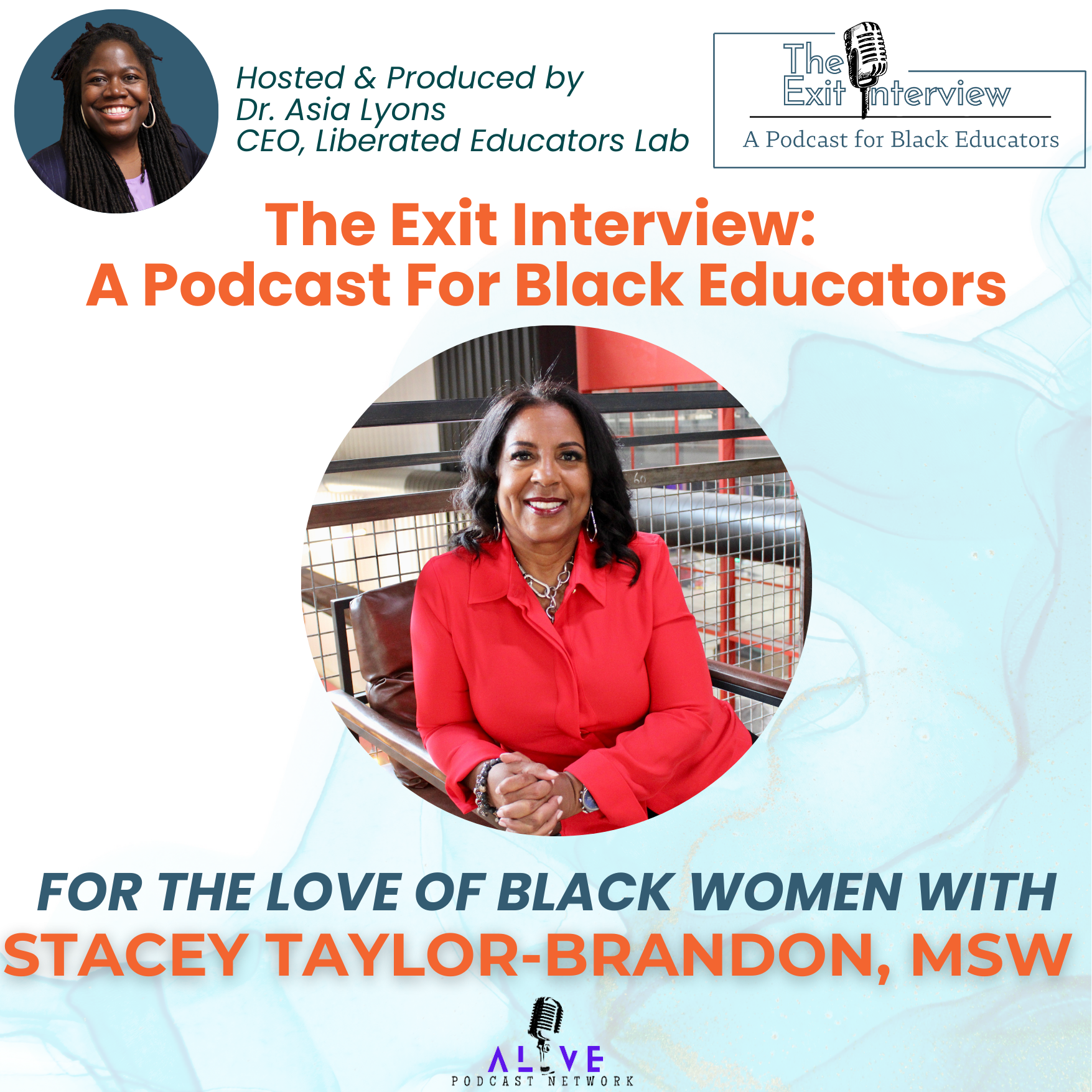
In this heartfelt episode of The Exit Interview, host Dr. Asia Lyons welcomes Stacey Taylor-Brandon, a seasoned former school district social worker and passionate advocate for Black women’s wellness. They focus on the unique experiences of mature Black women in education, the importance of rest and joy, and building supportive communities.
Dr. Lyons begins by acknowledging the challenges Black women face in educational systems and introduces the podcast’s goal: to preserve the stories of Black educators who have left traditional education roles. During Mental Health Month, the discussion centers on wellness, with Stacey sharing her transition from a 28-year career in education to supporting mature Black women.
Stacey shares her experience of “racial battle fatigue” and her decision to leave her district. She talks about the emotional aftermath, including time for rest and self-reflection, which inspired her to create spaces—both virtual and in person—for Black women to connect, reflect, and heal. These gatherings, known as “Sisterly Bonds,” focus on joy, community, and honoring personal and ancestral legacies.
Throughout the episode, Stacey and Dr. Lyons discuss the challenges faced by mature Black women, such as societal expectations, the need to always appear strong, and the difficulty of prioritizing self-care after many years of serving others. Stacey emphasizes the importance of “getting rid of the shouldas” and invites women to embrace the second half of their lives with freedom and authenticity.


Guest: Stacey Taylor-Brandon
Host: Dr. Asia Lyons
Episode Overview
In this powerful episode, Dr. Asia Lyons sits down with Stacey Taylor-Brandon, a former school district social worker and the founder of “Sisterly Bonds,” to discuss the journey of mature Black women in education and beyond. The conversation explores the challenges of leaving traditional education spaces, the importance of rest and joy, and the creation of supportive communities for Black women. Stacey shares her personal story of transition, healing, and the evolution of her work in wellness, offering inspiration and practical advice for listeners.
Key Topics & Discussion Points
The Exit Interview’s Mission:
Archiving the untold stories of Black educators who have left traditional education spaces, with a focus on wellness and retention.Stacey’s Journey:
- 28 years in education, experiencing “racial battle fatigue.”
- The decision to leave and the emotional aftermath, including rest and self-discovery.
- The creation of virtual and in-person spaces for Black women’s wellness.
Sisterly Bonds & Community Care:
- The evolution of “Sisterly Bonds” from virtual gatherings to in-person events.
- The importance of joy, rest, and honoring ancestors in healing spaces.
- How these gatherings foster connection, support, and liberation for mature Black women.
Challenges for Mature Black Women:
- Societal expectations and the “strong Black woman” trope.
- The struggle to prioritize self-care after years of service to others.
- Embracing the second half of life with freedom and authenticity.
Practical Advice & Resources:
- Building support networks through book clubs, sororities, and local organizations.
- Leveraging platforms like LinkedIn for connection and opportunity.
- Encouragement to take small steps toward community, even if it feels uncomfortable.
Intergenerational Wisdom & Support:
- The value of intergenerational dialogue and learning from elders.
- Shout-outs to influential Black educators, especially Dr. Carolyn Jones.
- The ongoing work of Black women in education and the need for more wellness-focused spaces.
Joy & Celebration:
- Stacey’s sources of joy: family, consulting work, and a recent vow renewal in Ghana.
- The importance of celebrating milestones and everyday happiness.
Notable Quotes
- “Rest is resistance.”
- “Joy is deeply in our DNA.”
- “When you save Black women, you save children.”
- “Don’t feel guilty. You’ve done enough. You can leave. You can save yourself.”
Resources & Links
- Sisterly Bonds (virtual and in-person gatherings)
- Black Educator Wellness Cohort (Denver)
- Colorado Black Women for Political Action
- Delta Sigma Theta Sorority, Denver Alumnae Chapter
Authors Mentioned:
- Dr. Bettina Love
- Dr. Gholdy Muhammad
- Resmaa Menakem
- Rachel Rodgers
How to Support
- Subscribe to the Black Educator Be Well newsletter.
- Join the podcast’s Patreon for bonus content and community perks.
- Share this episode with friends, family, and colleagues.
- Celebrate and support the mature Black women in your life—ask about their stories, listen, and build intergenerational connections.
Thank you for listening!
If you enjoyed this episode, please rate, review, and subscribe. Your support helps us continue to share the stories and wisdom of Black educators.
First of all.... have you signed up for our newsletter, Black Educators, Be Well? Why wait?
Amidst all the conversations about recruiting Black educators, where are the discussions about retention? The Exit Interview podcast was created to elevate the stories of Black educators who have been pushed out of the classroom and central office while experiencing racism-related stress and racial battle fatigue.
The Exit Interview Podcast is for current and former Black educators. It is also for school districts, teachers' unions, families, and others interested in better understanding the challenges of retaining Black people in education.
Please enjoy the episode.
Peace out,
Dr. Asia Lyons
Episode with Stacey Taylor-Brandon
Stacey Taylor-Brandon: [00:00:00] It's hard. It's challenging. They are constantly on attack. And so any Black woman who is working in those systems right now, I just shout you out and thank you. Thank you. And when it's time for you to be done, don't feel guilty. Don't feel guilty. You've done enough. And you can leave. You can leave. And you can save yourself.
Dr. Asia Lyons: In a world where the recruitment of Black educators dominates headlines, One question remains, where are the conversations with folks who are leaving education? Introducing The Exit Interview, a podcast dedicated to archiving the untold stories of Black folks who have departed from traditional education spaces.
I'm Dr. Asia Lyons, and I'm embarking on a mission alongside myself. Themed guests. Together we [00:01:00] shed light on the challenges, triumphs, and experiences of black educators aiming to inform and empower communities to invest in understanding the crucial issue of retention and education. Welcome to the Exit interview, a podcast for black educators.
Welcome back to another episode of the Exit Interview, a podcast for black educators. Folks, you're going to be hearing this in May in its mental health month or so. I'm bringing back my favorite folks to talk to you all about mental health and wellness. Folks had, you've seen on the podcast before, like today's guest, and we have some new folks coming down the pipe.
So just really excited because a big part of the work that we do here is talking about health and wellness, but we also have the Black Educator Wellness Cohort that we support here in Denver. And so it's really important that we get that information out to folks who are listening to us all over the country [00:02:00] about what it means to be well.
So, I brought on one of my favorite people, Stacey Brandon. Stacey and I were in the same school district for a very long time. She is one of the reasons why I had to get to scooting out of the district because she's like, hey, it's time to go. And so now we're here so many years after I've left since 2018, and it's 2024.
And she's been doing some really dope things since she's tired from being a social worker in the school district. And I wanted to bring her on to talk about how she's supporting mature Black women and their wellness. So welcome to the show, Stacey. Welcome back.
Stacey Taylor-Brandon: Thank you, Asia. I'm so excited to be here.
And I'm just so proud of your success. Oh, thank you. And you can't quantify success. You know, in the ways of the white world. But I mean, what I've seen from you is just pure joy. You know, I love joy, but just to see you shine in this podcast, in [00:03:00] the work that you're doing, liberating folks, I'm just elated and so proud.
You're my friend and I'm thankful you
Dr. Asia Lyons: brought me back. Yeah. See, this is why I love her. She got me cheesing on this Sunday morning while we're recording. Yeah. Yes. Yeah. So, I mean, let's just jump right into it. Can you tell us about your personal journey and what led you to focus on supporting community care with mature Black women?
Yeah, definitely.
Stacey Taylor-Brandon: I'm going to try to keep this concise because I talked a lot last time. I tend to talk a lot because. What happens to me is I get joyful and you're hearing me talk about joy and I just can't contain it. But, you know, just really succinctly, I gave Asia advice to leave when I should have been giving my own self advice to leave the district that I was in.
I finally did. And I got to go owe it to Asia too, because she kept coaching me up and, you know, her favorite question she just asked a guest the other day is, Uh, really para, are you really like staying [00:04:00] because of para, but you know, I saw the light. So I left district after 28 years and I was really in a space of racial battle fatigue that Asia just really has coined and is work, uh, using her voice to get that out there.
I had all the symptoms. I went into another toxic environment, this time led by black folks, got terminated, never been terminated in my life. So there was a big wake up call. Fortunately, I had a husband that said, You know, you never rested. You went from one place to another place within six weeks. So just take your time.
So, taking my time was, I had already, like, planned out. Okay. You know, God's plans, your plans are not God's plans, my plans were not God's plans. And so I got terminated in January thinking I was going to have a job by June. And that has not been my journey, right? During that time, I had already started leaning into this space that I had opened up because of black educators.
I love that Asia is [00:05:00] really moving into the black educator wellness space. But in my role as the district director, I had all these black women really calling me and saying, This is what I'm experiencing. So around Christmas one year, I just said, I'm just gonna open a virtual space, have people come, women come, black women come, and we just really talked about, um, what was happening in our space, but I didn't want to just focus on the trauma.
Really. I felt like sometimes in those spaces. We traumatize each other and it's just like trauma Olympics, right? Like my trauma is worse than your trauma and we all have it. You know, we all have racial battle fatigue and stressors and all that. And I felt there's just another way. And so I was reading a lot of work by the Dr.
Patina Love and Dr. Godi Mohammed, and they were really just talking about black joy as being dope. And then Res Momenicum was talking to me about healing. And so the women in that space said, you know, we should get together more often. And so. I just started having a virtual space every quarter where I just open it up [00:06:00] and now it's has evolved to what is called reflect, re imagine, and rest.
And I got that really from the work of Dr. Sean Jenwright. For PIVOTS, it is my kind of like, I keep it with me all the time. And then that has evolved into what I call Sisterly Bonds. And so I'm really working on these spaces of joy. Sisterly Bonds is the virtual space, but it's also really digging into and Asia is pushing me around.
I have now in person experiences. I've had two working on the third one, and it really is focused around the four. As we talk about mature women, to really gather in sisterhood and connection, as Dr. Joy, the Black Girl Therapy says, sisterhood heals, I believe that. And so with that, my focus is on joy, that joy is deeply in our DNA, that is deeply in the way that our ancestors [00:07:00] also survived some of the most horrific circumstances.
You had to have some type of joy. In the Bible, it says the joy of the Lord is my strength. So I'm really talking about how do we connect around joy experiences that you have to set every joy experience up, but every day, every hour you experience a little bit of joy. So that's what, what I'm doing. That's how I'm living.
That's how I'm experiencing my life and liberation and freedom for me right now.
Dr. Asia Lyons: Yeah. I love that. I love that. And I want to just make a comment that. You talked about this going from one job, one to another, and your husband pointing out like you gave yourself no time to rest and you're like, okay, I'm going to rest from December to June and then you're right.
And that's necessarily the plan, which our plans are just so different from what we end up really doing. We had a guest on the podcast, Jalen Jenkins, who also talked about. this need for rest between and how much joy it brought [00:08:00] for her, she traveled and did a little bit of resting and here in the United States, in New Mexico at a lavender farm, and then she went to Hawaii for a little bit.
Yeah, yeah. And so I always want to when people mention this like break or rest or respite time to emphasize that because I think that people, and I'm sure you know this as well, feel like the next job is going to be different. So you don't need to rest because that'll be a fresh start. And it never works out like that.
Stacey Taylor-Brandon: No, no, no. I listen to Jalen and I love that too. I want to get to that lavender farm. That sounds awesome. But the rest that your body, your soul, your mind, everything needs is sometimes the rest that we can't even imagine what that looks like. And so until you just give in to that, lean into that, then you discover just how much the rest is needed.
And the rest is resistance. It's one of my books, too, that I, I hold dearly [00:09:00] to my heart. So thank you for pointing that out.
Dr. Asia Lyons: Yeah, of course. So, I mean, you already got into why this space matters. But I see that you're emphasizing like mature Black women. I know based on your own experience, but is there another reason specifically why you've chosen that particular or your particular group of women?
Stacey Taylor-Brandon: Yeah, it should because so now that I'm 55, you're ready to be 56 and I yell that proudly and I tell people, I mean, I tell women because you know, they get ashamed when they hit 40 or 50 like I'm so old, but you know what? Some people don't get to be this age. That's what I say that some people don't get to be 55 and they would love to be 55.
I am loving this second part of my life. I was a mom. I am a mom. I should say four children. It was a very busy time. My kids have a big age span. My youngest is 23. My oldest is 36. Today is her birthday. Oh, yeah. And yeah, [00:10:00] shout out to Calista. And I was a mom for a very long time. I got married early. And then I came to this point, I'd put 28 years into a school district, gave them everything.
And I remember, I was still in the district at 50, I was like, Okay, what's next, Stacey? What's the second part of your life going to be like? And I think when we as mature women or older women, I like to say mature season, we really get stuck in, you know, we did all this. This was the way we were supposed to do.
I followed all the rules. I got into a job. That I stayed into almost 30 years, right? So I could get my pension and you do all these things. I was the mom, you know, is that the schools that I did everything for everybody else. And in that time I lost myself, so that's why I had to go therapy at 40 and then again at 50.
And so I felt like this time for a mature woman is really this unpacking of what we were [00:11:00] supposed to do, and then many of us did it, and then we still weren't happy, right? Whatever, how you quantify happy? But what can the second part of your life really be? And how can you embrace it? Being a mom of grown children, or if you don't have children, being the steward of your life at this moment.
I have more days behind me than I have ahead of me. And I want them to be full of just freedom, freedom to embrace who I am. And so I wanted to bring that to my space with mature women. I wanted them to find liberation and freedom in just. You know, getting rid of the shouldas, especially as black women, getting rid of the, if I admit that I can't do it all, that somehow defines me as being weak.
If I ask for help, that just mean not the strong black woman that my mom raised me to be. I just want to get rid of all those things, all those constraints. And that's what I want to bring to the spaces that [00:12:00] I'm in with the virtual women I get to be in connection with.
Dr. Asia Lyons: Yeah, I love that. And you're talking about, I keep hearing myself say, I love that.
And so you're talking about some of the challenges that you're hearing probably with your group and with yourself. And so when these women are gathering in person or when they're gathering online for the quarterly gatherings, What are some ways that you bring this rest and joy into the space so that they can, even for a short amount of time, for some folks, can feel that deeply?
Like, what does that space look like for the people who are with you?
Stacey Taylor-Brandon: Yeah, what I try to bring in is that first, you know, God is the lead of my house, of me. So I always invite myself to pray before and really ask him to give me the words and the wisdom that I need to bring in a space, give me the peace.
And so I really walk into my spaces [00:13:00] just with that peace of This is what is needed at this time. Secondly, I bring in the ancestors. And so I really ask women to put in the space, the women that have come before them, both the ones that they are connected to through DNA, but those that are folks that really speak to us as ancestors.
So for me, bell hooks and Maya Angelou. And Audre Lorde is one of the women I just adore. Yes. And then my grandmothers and my own mother who passed away. Just my aunties, right? We all have those aunties that were so critical to us. So I asked them to bring them because we are holding a space with them too, as Black women.
And then the first question I really ask is, what has brought you joy in the last few months? Really, like we got to ground ourselves in this joy. Like I said, it could be little, it could be big experience. The fact that I get to walk outside and enjoy the sun, that is a joy for me every single day. And I ask them to ground themselves in [00:14:00] that.
And then one of the things is that because we're on virtual, it's hard to, uh, Hard to mimic intimacy when you're in connection with people in space. I really try to go into small groups and because these are women mostly that I know, I really try to feel some connections that they have. You know, I feel like I'm a community connector already.
And so I'm trying to get women to just expand. So here's, what's interesting. I would say all of us as black women have been hurt by other black women. So some of the times there's a tendency for us to be like, Yeah, I can't go into space with black women, black women that hurt me, all these things. I've been hurt by black women, but I have been loved beyond infinity by black women.
So I refuse to go into that. So I'm going to connect you with some black women, some dope black women that you are going to feel connected to and love just in that little bit of 90 minutes. And so the women that come out of my space always are like, I didn't know you had this dope friend. I didn't know you had this.
Yes, [00:15:00] because I love black women. I love being a black woman, so I want to put you in touch with black women so that we can love on each other. That's what we need. So anyway, that's what I try to create is a love of black women, a love of joy, a time where we're not in there talking about all the things that we have to go through, because there's time and a space for that, but there's a time and a space for us just to be.
And space connected and loving on ourselves and loving on each other. So,
Dr. Asia Lyons: yeah. And this idea, so I've been in the groups before, right? And you definitely communicate that. Yeah. And that's, and the meeting, the zoom, it, it feels like everything else around me falls away and I'm right there and you are definitely a hundred thousand percent a community connector, you know, everyone, it's a gift, it is, it's a gift.
Yeah. And that joy and loving on Black women and loving on yourself as perfectly as exactly right. Along with the [00:16:00] Zoom sessions, the online sessions, you also have started doing some out in community sessions. Tell us a little bit about that.
Stacey Taylor-Brandon: Yeah, those have been small so far, but you know what, you know, you put your vision out there.
So I'm putting my vision out there and I had, my first one was a key because I wanted to be an intimate space at Teelee. Shout out Ms. Risa down at Teelee. I love her space. I love that you take your time to just be connected around key. And so I had about five Black women in that space and they were educators.
So it was really good to just. Connect them around, you know, who are you at this moment? What's your purpose? And even if you don't know your purpose, what are those things that you want to lean into and bring you a little bit of joy, right? And so again, joy, joy, joy. You're gonna hear me talk that all the time.
The second space I did was I connected with Ms. Tawani Clark, who is this amazing yoga yogi. [00:17:00] She's my yoga person. She does it online and I've been trying to get more into yoga. So we did this space. We had Santa Mu, if you haven't heard of her, she's an amazing flutist, and drummer, and storyteller, and we just moved our bodies, uh, had about 12 women in that space, and my next space is, I was talking to my sister in law, you, Asia, the other day, I'm gonna really get down to the Museum of Black Women.
If you haven't been down there, really go there. That makes you feel so loved. So I'm gonna have a experience there. But before that, we are gonna get out in the spring at the end of this month and do the Castle Rock inly, uh, . And I thought it was, I, I, well, you said
Dr. Asia Lyons: that before. I was like, oh, lordy. Oh boy.
Stacey Taylor-Brandon: It's not a previous man or two. It's manageable. I did it up and down one time. And I got it. Well, no, let me take that back. I went up and then came back down. I think we got to get in touch with our bodies. And this is not [00:18:00] about, you know, being in the tip top shape. It's just about doing something different, connecting with other women, and encouraging other to try something that's new and joyful.
Being in the sun, working your body, being in space. So that's my next one. But really, every quarter I would like to bring women together in some spaces connected around different experiences that we may or may not have had. So that's my next step. And then, you know, my next step is really to create a space for women, you know, I mentor a lot younger women.
Between the ages of 18 to 22 and that's a space where women are trying to really young women are trying to you know There's so many negative things coming at them How do they feel good about themselves when social media is saying you have to show up just like this So my vision for that is to create a space already called in hair stories because we are so connected around our hair But to bring the, the young ladies that I'm connected to mentoring to space, [00:19:00] but that's down the road.
So those are some of the visions I have in my head about what I'm
Dr. Asia Lyons: creating. Yeah. I love that. Again, there I go again, saying it, the spaces, the in person, the moving of physical body, all those things are so important and we have to continue to be thinking about that. I guess the, the thing that I want to ask next is, like, based on all the things that you know, the people you know, like what resources or support networks do you recommend for mature Black women who may be struggling with creating spaces for themselves, but cannot get to Denver to be a part of this space, or maybe not be able to meet with you online with the rest of the group?
What would you suggest?
Stacey Taylor-Brandon: Yeah. You know, there's so many sisterhood networks wherever you are in your immediate space. I'm kind of an extrovert introvert as funny because I don't like to network and believe it or not. I don't I mean, I'm this community [00:20:00] connector, right? I know a lot of people. I still want to know more people, but Dr.
Asia will always tell me like you need to get on LinkedIn and you need to go to these places. And I feel that's a big challenge for me. So that's one thing I will say to you that she says to me is in your immediate space, there are networks around, like I just joined Colorado Black Women for Political Action.
They wanted to do this for years. And I was challenged to do it because that means I got to put myself out there. I like to go through my, like, know somebody that knows somebody that knows somebody, but I am learning you have to be bigger than that. So, I mean, you got to expand your horizon a little bit bigger than that.
So I want to tell people that women that are out there is that, you know, your book clubs, I mean, I was in a book club for 12 years. That was my social network. I have a small group of friends that I do game night with, you know, you just got to start doing these things and you find out people [00:21:00] are connected to other people.
Right. One of the things I do, I recently was so blessed to finally, like what they say, it was delayed, but denied, but not denied, became a member of Delta Sigma Theta Incorporated, Denver alumni chapter. So that has been a network for me of amazing, beautiful black women. That I'm connected to, I would say resources are, of course, I just said that LinkedIn because that just really, once you start repo, do like me, repost for a little bit and then add a little bit of things, but I'm networked for some amazing black women who are out there that are doing the work of being liberators and finding freedom and having their own network and having their own entrepreneurship.
That's what we need. So, you know, I wrote down so many different things. I read a lot. [00:22:00] So I follow authors that I believe in, especially Black women who, you know, Rachel Rogers is one of those amazing women that I always talk about. Dr. A is just going to get to some amazing people. So she, y'all to her about Black wealth and generational wealth.
All the things that I didn't grow up knowing about. So I just think that you have to take that, if you're an introvert like me in some ways, just take that step to just open up and, Just try something that you haven't done before. That's what I would recommend. Yeah. And maybe I've missed something. Yeah.
Dr. Asia Lyons: I mean, think about, I know folks are thinking LinkedIn, I don't need a job.
I'm not looking for work. No. But what I found is that so many organizations and folks put flyers out for events on LinkedIn. Or you can connect with people and go have coffee and things like that. And maybe it's not for everyone. Maybe LinkedIn is not for everyone, but I've found that [00:23:00] as I've connected with people and reposted and shared some things that this community that was really small because I live in, I call it the state of Denver, because it's mostly Denver, that my connections with the state of Denver have expanded out.
because of LinkedIn, right? Because people are graduating from school or getting promotions or doing these different events and I'm celebrating with them. And so you find yourself saying, Oh, I'm going to be in Florida for a conference and you live in Florida. Let's go hang out. Right. And I think that's maybe not a way that everyone would think about connecting with others.
But I found that to be really successful if you are consistent, right? If you make sure that you're checking in people are looking to connect with other people. And I know folks like, I don't want to talk to people from my old job.
Stacey Taylor-Brandon: Yeah. Right. You don't
Dr. Asia Lyons: have to accept. No. You don't. You don't. And I have not accepted anyone from my old school district.
Right. Yet. So it doesn't have to be that way. But [00:24:00] those are just some ideas. And I really, really love that. I think I have a couple more questions. One, how can listeners contribute to supporting the wellness of mature Black women in their families and broader communities? If they're listening to this and they're not a mature black woman, how can they be of support of aunts and mothers and neighbors and coworkers who are mature black women?
Hey there, beautiful people. It's me, Dr. Asia. Before we dive back into our conversation, Kevin, I have something exciting to share with you. Are you a dedicated black educator or support black educators? Well, if so, we've got some great news for you. We're thrilled to introduce the latest addition to our podcast community, the Black Educator Be Well newsletter.
It's a space dedicated to all things Black educator healing, wellness, and more. We believe that taking care of our Black educators is crucial, and this newsletter is designed to do just that. Picture this, exclusive insights into self care practices tailored for Black [00:25:00] educators. Inspiring stories from fellow teachers who've overcome challenges and tips for creating a positive and supportive environment at work and at home.
Subscribers will get early access to our upcoming podcast episodes, special interviews with guests, and even some surprise giveaways. How do you become a part of this amazing community? It's easy. Go to xanterviewpodcast. com or check out the link in this episode's show notes. Now let's get back to the conversation.
Stacey Taylor-Brandon: Yeah, that's a great question, Dr. Asia, and I loved when, when you talk about, um, mature Black women. One of the things I think is that, going back to what I said before, is that when we see our aunties and our grandmothers, And the mothers of the church and, you know, these women that you looked up to, we believe that they have it all together, right?
And I wouldn't say that they don't, but what, what I've discovered is that they have gone through some stuff. [00:26:00] They've gone through some stuff and they got some stories to tell. They have some medicine for you. So when you believe that they have it together, just ask, you know, what have you gone through that has brought you to this space?
Where you look like to me, you holding it together and they will probably sit you down and say, uh, that's what it looks like to you. Let me tell you what I've been through. So just being in a space to just ask, just go and just be in space. With women that have seen and lived and been in experiences, that's the biggest thing.
Don't shy away from those spaces where you can glean with, have intergenerational conversation. So not just looking at, you know, the women that are like aunties and our grandmothers. And let me tell you this funny story, Asia. I am a grandma, for real. I have three grandchildren, one on the way. [00:27:00] So I was talking to a youth the other day, and, and you know him, I'll tell you him afterward.
And he asked me if I was coming back to this space that I worked at last year, where I was connecting with kids. And I said, no, I'm not going to be there this summer. And he said, Ms. Stacy, you gotta be there. You're the grandma of the space. He said, nobody messes with you. Nobody talks back to you. And I was like, oh lord, truly that, like grandma space, right?
I'm still looking in the mirror like, no, no, no, no, I'm not. But to be seen like that says a lot. Says that, that they see me as somebody that's, because when I look, when I think about my grandmas, my aunties, that was somebody that was solid. That was, you know, that you knew you're going to get the truth.
That you knew that they loved on you, but also held you. And held your heart in your hands, like I say, and they saw you. So I thought, [00:28:00] Oh, that's beautiful. At first I was like, and next I was like, that's beautiful. But to be able for him to say that to me means that I created a space where an intergenerational space where I can have that type of, Conversation.
And I don't try to act like in any way that I know everything. I rely on my young mentees to tell me what's going on, to be open with what I don't know, what I haven't learned and how, what I can still glean from. So I think that's what the community can do is not be shy, not be afraid, not to just be in space with older folks, seasoned folks, and just share our collective ways of being.
Because culturally there's ways of being that we know. That yes, some of them we have to do away with, but there's so many things that make us as Black folks who we are. And it is something that we need to share with each other and be proud of and love. You know, like when you go in a place and you hear certain [00:29:00] music, right?
We don't have that many places in Denver, right? But when I'm like in Atlanta or D. C. and I walk into a space and they're playing my music and I know how to flow in that space. Just in Ghana, Ghana was the same way, right? Even though it was Afro beats and it might not be. There was that whole space was a place where I just knew how to flow.
And we got it. I know I went off, but there are ways that we as a community can flow together.
Dr. Asia Lyons: Yeah, I love that. I love that. So in the tradition of our podcast, I have two questions to ask you. Two more questions. The first is. Is there a Black educator, and I know there is, or multiple Black educators that you would like to shout out on this episode, on your episode?
Stacey Taylor-Brandon: Well, the first one, and you know her, Dr. Carolyn Jones, and you're shaking your head like you knew I was going to say that. She's everything to [00:30:00] me and she came into my life and when I was 16 years old, I tell everyone she changed the trajectory of my story. It became full circle when I was a director in the office that she started, um, in Cherry Creek schools.
And I love her. I don't talk to her nearly enough, but she was the black educator that first saw me when I was 16 and said to me, who do you want to be? Where do you want to go? And she made college a reality for me. Not that everybody needs to go to college. It was because of her. So I shout her out anywhere I go.
As a black educator, that was the most important person in my life. Other black educators I will shout out are just black women educators that are holding it down in systems of racism, right? When I think about black women in that space and what I know to be true is they're [00:31:00] fighting every single day to make a difference for not only kids of color, but white kids too.
And it's hard, it's challenging. They are constantly on attack. And so any black woman who is working in those systems right now, I just shout you out and thank you. Thank you. And when it's time for you to be done. Don't feel guilty. Don't feel guilty. You've done enough. And you can leave. You can leave. And you can save yourself.
Dr. Asia Lyons: You can leave and you can save yourself. Yes to all that. Yes, yes, yes to all that. Because we will stay and say, who's going to replace us? What about the kids? What about? And Rhonda, uh, you know, Rhonda, she'll, her episode. Yeah, she, on her episode, she said, my kids need me. They need a mom that's well and that's whole, that's happy, right?
And even like you said, even if people are not raising children, you need you, [00:32:00] right? I love, love that. And Dr. Carolyn Jones, This is a full circle upon full circle because now she works at my daughter's school.
Stacey Taylor-Brandon: Oh, she's still doing
Dr. Asia Lyons: it. She's still doing it. Yeah. And I don't know how I found like connect the connection that she was a person you've always talked about.
But now she's a grandmother at my daughter's school. And I love that for my daughter. And I love that for her school because she's an older Black woman, mature Black woman. who is making sure that the folks at her school are taking care of our Black children, right? And I see her walking in the school, she's doing her thing.
I know that she's there to make sure that things are going the way they're supposed to be, that we have equitable education for our Black children, there's representation for our Black children. And so, yes, definitely shout out to Dr. Jones and all So many Black women who are still teaching, and we have this conversation so much about recruitment, or like not enough Black men in education, and I'm saying all [00:33:00] that is true, but in the meantime, when we were trying to recruit Black men, Black women are holding it down.
Absolutely. We are, we are, we are, and I think we need more spaces that focus on Black women wellness. who are in education because there's just not enough spotlight shown on what we're trying to do while districts are trying to recruit from everywhere and anywhere or make sure that they have enough Black male representation that we're still doing this work and we always have been.
Stacey Taylor-Brandon: I always have been. You think about when we had segregated schools before Brown versus Board, and that's a whole other conversation, but it was Black female educators educating our kids. They're the ones that lost their jobs, right? And we are still there fighting every day for just the sanity of our Black kids, so thank you.
And I love that that's what your work is moving towards, into the Black educator wellness. Cohort, you had a [00:34:00] cohort, but now you're going to have a whole, but be ways of being, yeah. The Black Educator Wellness Institute. Oh.
Dr. Asia Lyons: Yeah.
Stacey Taylor-Brandon: Need it. Need it. Need it. So congratulations on that. Because when you save Black women, you save children.
So that I can't wait to see, I cannot wait to see it. I'm going to be right there helping, supporting, doing whatever I can.
Dr. Asia Lyons: Yeah. My last question, what's bringing you joy these days, Stacey? Joy, joy.
Stacey Taylor-Brandon: There's so many things that bring me joy every day. I already talked about walking every day because I get to be in the sun.
My consulting business is bringing me joy. My children, every day they bring me joy. My son is, is one of the black male educators, I have to say that. I worry about him, but I also know that he's needed in the space that he is, my oldest son. So my kids and my grandkids bring me joy every day. Let me tell [00:35:00] you, the biggest joy recently, me and my husband.
30 years, our anniversary is June 11th. We actually renewed our vows in Ghana. Nobody knew it, we just did it. So that was a big joy. And being Ghana, oh, being home, that was so much joy. Oh, much joy. So, those, that's a few of the things that are bringing me joy these
Dr. Asia Lyons: days. Yes, yes, yes. Well folks, You heard it from Stacey, return guest.
If you haven't heard her first episode, go back and listen to it. We'll have all of her information in the show notes that you can contact her, reach out to her via her social media or email if you'd like to. And we thank you so much for being on the show. Thank you so much for the work that you're doing for mature Black women, for me, for my daughter.
Shout out to Dr. Jones. And we're just gonna keep on doing this work, right?
Stacey Taylor-Brandon: Yes, until I'm on the other side, I am [00:36:00] not letting go of love of Black women, I'm not in joy for Black women and liberation for us as Black women. So thank you for having me again. Dr. Asia, I love this podcast. Every time I'm gleaning so many things from the Black women you introduced me to.
So
Dr. Asia Lyons: sorry. Yeah, no problem. All right, folks. Another fire episode. We'll see you on the other side. Peace. Thank you for tuning in to another episode. We hope that you've gained valuable perspectives and a deeper understanding of the conversation surrounding Black educator retention. As we conclude this episode, we encourage you to join our Patreon to support our work.
Plus, as a patron, you receive bonus episodes, merch giveaways, and much more. Stay engaged with us on our social media, sign up for our newsletter in the show notes, take a look at our YouTube page, and interact with us on our website. Remember, the stories we've shared today are just the beginning, and your participation is vital for the future of [00:37:00] education.

Diversity, Equity and Inclusion Consultant
Stacey Taylor Brandon has over 30 years of experience in the field of education serving in the capacity of school social worker, PBIS Coordinator, Educational Equity Coordinator and Director of Inclusive Excellence.. Stacey holds a Bachelor of Arts in Child Development from Spelman College and a Master of Social Work from University of Denver. She also holds a K-12 Principal License. Stacey is the mother of four grown children and grandmother of three. Stacey is passionate about racial equity and racial healing. As a proud Black woman, Stacey is committed to honoring the humanity of all people, by acknowledging, understanding, and interrupting predictable patterns of racialized inequities and hierarchies.