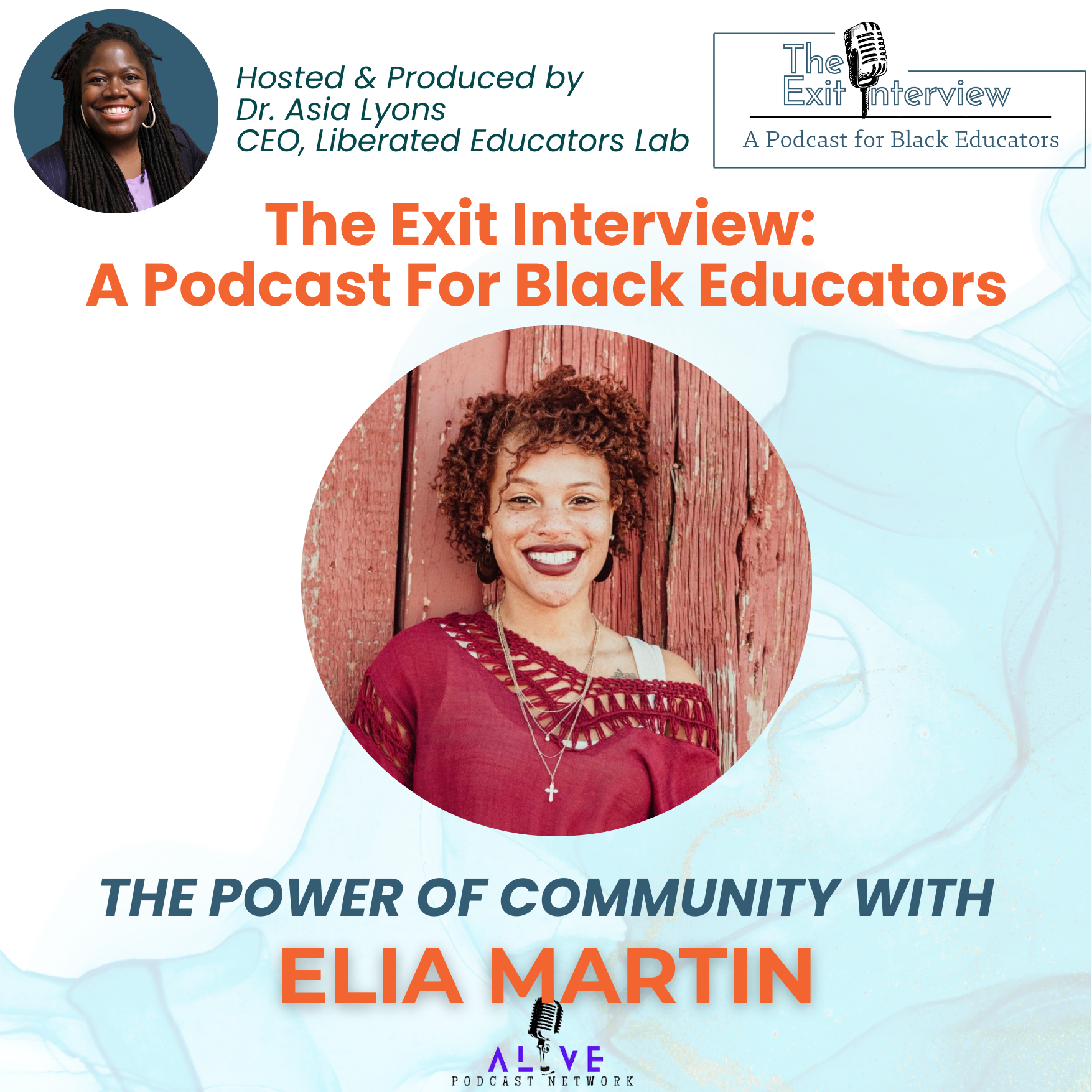
The Power of Community with Elia Martin
In this inspiring episode of The Exit Interview, we have the privilege of hearing from Elia Martin, a former educator and social worker turned grant manager, who shares her transformative journey through education, social work, and beyond. Elia's story takes us from her initial dreams of becoming a dentist to finding her true calling in supporting youth and families, mostly in Black communities. She discusses the challenges and motivations behind her career shifts, emphasizing the importance of mentorship, the impact of leadership changes, and the quest for better opportunities. Elia also delves into her current pursuits, including her work in grant management and her passion project, the Mommyana podcast, dedicated to the experiences of Black motherhood. Join us as we explore Elia's journey, her insights on Black educator retention, and her valuable advice for those contemplating a career transition.


Show Notes: The Power of Community with Elia Martin
Host: Dr. Asia Lyons
Guest: Elia Martin, MSW – Grant Manager, Podcaster, and former Denver Public Schools educator
Episode Overview
In this episode, Dr. Asia Lyons welcomes Elia Martin, a Denver native, social worker, and passionate advocate for mentorship and community. Elia shares her journey from aspiring dentist to social work, her experiences in Denver Public Schools, and her transition to grant management and podcasting. The conversation explores the importance of mentorship, the challenges Black educators face, and the power of community support.
Key Topics & Highlights
1. Elia’s Path to Education and Social Work
- Grew up in Denver, attended East High School, and started college as a pre-dental major.
- Switched to human services after realizing her passion lay elsewhere.
- Inspired by a mentor she met while working at Wells Fargo, which led her to social work and youth mentorship.
2. Early Career and Mentorship
- Job-shadowed a social worker, which opened doors to working with youth and families.
- Emphasizes the critical role of mentorship in her own development and advocates for its importance in education.
3. Experience in Denver Public Schools
- Served as an AmeriCorps member, then advanced to case manager and program coordinator roles.
- Coordinated mentoring and career exploration programs, exposing students to STEM careers.
- Built lasting relationships with students and families, highlighting the impact of authentic connections.
4. Transitioning Out of Education
- Left DPS due to leadership changes, desire for better pay, and the need for professional growth.
- Pursued a master’s degree and moved into grant management for homeless programs at the state level.
- Discusses the challenges and rewards of shifting from direct service to a macro-level role, and the benefits of remote work as a mother.
5. Challenges for Black Educators
- Addresses issues of micromanagement, lack of authentic support, and performative DEI initiatives.
- Advocates for better pay, supportive environments, and mentorship programs specifically for Black educators.
- Stresses the importance of pairing new Black teachers with experienced Black mentors to foster belonging and retention.
6. Shoutouts and Community Recognition
- Shouts out her former supervisor and Darlene Sampson, a mentor and advocate for Black women in social work and education.
- Highlights the importance of community, support networks, and representation.
7. Life After Education: New Roles and Passions
- Now a full-time single mom, grant manager, and aspiring group fitness instructor.
- Hosts "The Momana Podcast," focusing on motherhood, especially for Black women.
- Shares her journey into podcasting, the challenges of building an audience, and the fulfillment it brings.
8. Advice for Career Transitions
- Encourages listeners to align their resumes with job descriptions and not be afraid to try new fields.
- Acknowledges the learning curve and initial intimidation but emphasizes growth and self-advocacy.
9. What’s Bringing Elia Joy
- Finds joy in motherhood, personal growth, travel, and pursuing new goals.
- Recommends travel destinations like Cartagena, Colombia, and San Diego, and encourages listeners to embrace life fully.
Resources & Links
- The Momana Podcast: Available on all major platforms and now hosted on Urban Spectrum’s podcast network for Black podcasters in Denver.
- Connect with Elia Martin: [Contact info/links as provided by Elia]
- Shoutouts: Darlene Sampson, former supervisor at DPS, and all Black social workers and educators making a difference.
Key Quotes
- “Mentorship is really critical. I think we all need mentors and I wish that I would've had one earlier on.”
- “Black educators need supportive environments to show up as their authentic selves.”
- “Anything’s possible. If you want to try something new, put yourself out there.”
Call to Action
- Support Black women podcasters by listening, subscribing, and sharing "The Momana Podcast."
- Reflect on how you can support Black educators and advocate for authentic mentorship and equity in your community.
- Don’t be afraid to pursue new opportunities and invest in your own growth and happiness.
Thank you for listening to "The Exit Interview." For more episodes and resources, visit [Podcast Website/Link]. If you have questions or want to connect with Elia, check the show notes for contact information.
First of all.... have you signed up for our newsletter, Black Educators, Be Well? Why wait?
Amidst all the conversations about recruiting Black educators, where are the discussions about retention? The Exit Interview podcast was created to elevate the stories of Black educators who have been pushed out of the classroom and central office while experiencing racism-related stress and racial battle fatigue.
The Exit Interview Podcast is for current and former Black educators. It is also for school districts, teachers' unions, families, and others interested in better understanding the challenges of retaining Black people in education.
Please enjoy the episode.
Peace out,
Dr. Asia Lyons
The Power of Community with Elia Martin
[00:00:00]
dr--asia-lyons_2_03-20-2024_102404: Welcome back to another episode of the Exit Interview, a podcast for black educators with your host, Dr. Asia Lyons. Super excited today. I'm always excited about the podcast. I'm always telling people like, this is gonna be so great, and I'm so excited about the whole thing because I always am. Today we have Aaliyah Martin on our podcast, and she's gonna share her story.
Uh, she reached out via LinkedIn. And or actually act through our, through our messaging system and which you all can do as well, is reach out to our messaging system and say, Hey, I'm interested to be on the podcast. And so here we are. Thank you for coming on the show today.
Yeah, no problem. Um, so, you know. It looks like [00:01:00] looking through your bio, you are an, uh, local to Denver. We'd love to hear your story. Tell us all about yourself. Yeah. Share. How did you decide to become an educator? What was that story like for you?
elia-martin--msw_1_03-20-2024_102403: native. Sorry, these allergies are getting me down today. But, um, yeah, I'm a Denver, Colorado native. Um, I attended East High School, graduated back in two. Thousand nine. Um, after I graduated, I ended up going to, um, UNC for my undergraduate degree. When I started there, I started majoring in Predna because my family really wanted me to become a dentist.
Looking back, hindsight, I kind of wish I would've stuck to it. I would've been a baller by now. But, at the time I honestly like wasn't too confident in that. Then I was taking a lot of science classes, chemistry and biology, and I just really wasn't doing that well in them. So I think I kind of lost my confidence with that.
I'm like, there's no way I'm gonna be able to continue sticking that out. So, um, I changed my major over to [00:02:00] human services. at that time I was actually working at Wells Fargo. I worked there all throughout my undergrad, as lead teller. And I really enjoyed working there because I worked with a lot of my classmates.
It was always a really fun time, but I wasn't necessarily interested in like pursuing a career in baking. Um, anyway, I ended up meeting this super dope white dude that worked there that would come there to do deposits for his nonprofit. His name was Mark. and he would come and make deposits for his, he worked for a nonprofit that provided educational services to like refugee students and their families. And I would talk to him a lot about his job and he really seemed to enjoy it, and he was like super passionate about it too. We were able to like just continue connecting and he actually invited me to come shadowing with him, um, just so I could learn more about his job. I was like, I just changed my major over to human services, so I would, and you're a social worker.
He was a social worker, so I would like to learn more, [00:03:00] um, about what you do. And so I spent a lot of time like just job shadowing him and, um. really introduced me to the field of social work at UNC. At the time they did not have a social work program, so like human services was the closest thing that was like most closely aligned to that. but honestly he really just opened the door for me wanting to work with young people and their families. Um. I gained an interest in mentorship because I saw what it had done for me while I was spending a lot of time with Mark. and so for me, like mentorship is really critical. I think we all need mentors and I wish that I would've had one earlier on.
Um, but I'm so grateful that I did have one. so once I graduated. And I ended up moving back to Denver and landed a job in behavioral, in a behavioral health treatment facility for youth. And I quickly learned that that was not the type of job or the type of like the sector of social work that I [00:04:00] wanted to do that takes a really strong individual and like the mental health piece, um, it was just a lot for me. Um, and so I really wanted to gain a job like where I was still able to work with youth, but more in a like. type of capacity rather than like therapeutic. Um, and one of my friends had just got hired on with the Department of Family and Community Engagement as a program coordinator, um, for Denver Public Schools. And she was like, Hey, you should apply to be in a AmeriCorps member. And I was like, dang. Like if I do AmeriCorps, I'm going to take a huge, like, drop in my pay, but. Again, I really did wanna get back to the school system and like be working with youth. So I ended up taking that leap of faith and um, I applied to be an AmeriCorps member.
I did a year of service. Um, and then after that I was offered a professional position within Denver Public Schools, um, to come on as a case manager. And [00:05:00] so I gladly took that. And, um, from there on my career just began to advance. Every year I was promoted into a higher position. Um, and then after three years with the Department of Family and Community Engagement, I decided to transfer teams and work for the Career Connect team as a regional program coordinator for career exploration and mentorship. And this job really was right up my alley. Um, I worked at Manuel and at CEC where I coordinated. The mentoring program and a career exploration, a career exploration program that really just gave students exposure to different STEM related careers, um, that they wouldn't typically be exposed to. And I really enjoyed this role.
Um, I got to connect with students and their families, but kind of in a different way. And I built really close bonds with a lot of them, and. I'm still connected with a lot of 'em to this day on social media, so that's really cool. Um, but like I said, yeah, I really just like being able to expose them to [00:06:00] non-traditional careers like engineering, manufacturing, and um, just different careers within the sciences.
It was a really dope job and we visited some really cool places and I was able to learn a lot, um, in this role myself too. So that's kind of how that went.
dr--asia-lyons_2_03-20-2024_102404: That's a very interesting path that you took, right? Yeah. A lot of folks we talked to didn't necessarily start out in education and college, but got there typically in that time. And so to hear you talk about this experience with the with Mark, um. The banking situation and this like full circle moment is really, really interesting.
So how much time was that from the shadowing at the bank until the end of this particular part of your, your life journey?
elia-martin--msw_1_03-20-2024_102403: for Denver Public
dr--asia-lyons_2_03-20-2024_102404: I,
elia-martin--msw_1_03-20-2024_102403: Ooh. That was probably, I
dr--asia-lyons_2_03-20-2024_102404: yeah.
elia-martin--msw_1_03-20-2024_102403: at the bank in 2010. I [00:07:00] graduated in 2013 and I left DPS in 2019. So that was like almost 10 years. Uh, nine years. Yeah. It was
dr--asia-lyons_2_03-20-2024_102404: Yeah. Yeah. The, yeah. You know, it's interesting you're talking about, I wanna make sure I get this right, the Department of Family and Community. Engagement. So we've had Rhonda who was working in that same department, um, also come on the show and you didn't know that she had been on the show. So I think that's pretty, pretty cool.
And she was still there. Obviously you had moved on, but she was still there. Um, and so okay, working almost 10 years, having these great experiences, really understanding. Like very early on the ways in which you wanted to work with youth and that not being in this more, um, trauma informed space, like students experiencing a lot of trauma.
Uh, so doing all that work, 2019 comes what makes you [00:08:00] decide it's time to move on to do something different?
elia-martin--msw_1_03-20-2024_102403: to leave DPS because, well, once the leadership change took place, which made the job less enjoyable for me, and also I needed to earn more coins, honestly. Um, I'm not a person who likes to be micromanaged and I'm gonna get the job done. I just need to be trusted to do so. So that played a huge role. Then I just wasn't, like I said, making enough money. And during that time I was also, um, working towards my master's degree and I finished in 2019. So I wanted to kind of put my degree to use. Um, at the time I thought I wanted to be a school social worker, but I had completed my field placement, um, at a high school and I found out how I was able to observe like how overworked and underpaid they were. And, um, it just wasn't a route that I wanted to take. So I had another friend, you know, friends put you on. It's important to have a good network of friends. Yes. And she also had
dr--asia-lyons_2_03-20-2024_102404: Mm-hmm.
elia-martin--msw_1_03-20-2024_102403: like me and [00:09:00] she got hired on with the state as a grant manager for homeless programs. Um, so I applied and I got hired. Um, and I was also getting a bit burnt out from like the direct service aspect of work. So I think taking on a more like macro level approach to social work and being more behind the scenes, it's been a lot, it's been really refreshing for me. Plus I'm able to work remotely now and I have a 2-year-old daughter, so it just works really well for me.
Um, I'm getting paid really well. I learned a new skillset and I'm still able to help others just in a different capacity. Um, but I do miss working with students, so sometimes I'll pick up like a substitute job here and there just so I can be around the kids and still be somewhat immersed in like a school environment.
dr--asia-lyons_2_03-20-2024_102404: Yeah, that totally makes sense. And shout out to social workers. Uh, social workers. I have a good friend, Isha, she's a social worker. She [00:10:00] works at C-D-P-H-E and she talks about the care. She doesn't work with children, but she talks about the her caseload and trying to get people services and convince folks that they need to get the support that they need.
And so, yeah, social work. In and outta schools is not easy. I can only imagine and shout out to friends, right? Having a good network is so important because they're able to tell you, Hey, come over here, or do this thing or consider this thing. And it sounds like, like you said, that mentorship piece, whether that be peer to peer or someone else has been really valuable for you.
elia-martin--msw_1_03-20-2024_102403: think social workers are very like undervalued, but yeah. Such critical roles, like you said, inside and outside of school. So yes, shout out to social workers, especially black social workers. There's not a lot of.
dr--asia-lyons_2_03-20-2024_102404: Yeah. Especially black social workers. Yeah. Oh, a hundred percent. Um, and I, I wanna point out a couple of things that you mentioned, [00:11:00] like the coins. The micromanagement. Right. Um, and we talk a lot about people here on the podcast who come on, talk about this micromanaging piece and what that feels like and then trying to, um, uh.
Empower themselves to speak up, but still folks are still wanting to just be right there on top of you. And that's really been a, a huge burden for people. And I know I typically will a talk about this in a little bit, but the question that we ask is, what do you believe that school districts can do to.
Um, keep black educators and that micromanagement piece comes up so much that there's not a space for people to be their authentic selves and to do the work in a creative but thorough way. Um, and it's unfortunate that people, black folks in particular that work in education are not given the space to do what we do best.
elia-martin--msw_1_03-20-2024_102403: yeah, I would say like, just better pay for one, better support. I know a lot of different organizations, school districts too, [00:12:00] are like incorporating DEI practices, like within the framework of a lot of their, um, departments and stuff. And I think that's important. But sometimes it feels like even in those, um. Those spaces, like the right people are not always in those right spaces, and it almost feels like they're just creating it to check off a box. Like we're having these ongoing, repetitive conversations with no real solutions. So I think they should be more solution based rather than just, okay, this is a problem.
Like we know the problem exists, but what are we going to do to actually solve it? And I think it's also important
dr--asia-lyons_2_03-20-2024_102404: Yeah.
elia-martin--msw_1_03-20-2024_102403: give people the ability to advance themselves into leadership level roles. I mean, no one wants to stay at the bottom forever, right? Um, and whether that's just like you being good program coordinator or a supervisor, um, I think they should give everyone opportunities, um, to become directors, chiefs of staff, [00:13:00] um, just really to be able to climb that ladder up higher.
dr--asia-lyons_2_03-20-2024_102404: Yeah, that all that makes sense. I also, I wanna point out something you said too. About transitioning out of this work, being able to work remotely, having a 2-year-old, and all those pieces, and that's really important to folks. And again, we'll get into kind of like what you're doing now in a little bit.
I'd like to ask a question as you were leaving DPS and you're applying for jobs, or you found this other job. What was the response of the people who work with you? Like how did they, did they, you feel like you got a lot of support for your transition? What was that conversation like, if any at all?
elia-martin--msw_1_03-20-2024_102403: from my direct
dr--asia-lyons_2_03-20-2024_102404: I.
elia-martin--msw_1_03-20-2024_102403: Um, he was a black male and I have actually like, grew up with him, him and my brother. We're really good friends, so shout out to ez. Um, he was very supportive about me moving on. Um, thought it was a [00:14:00] great opportunity for me too. But, um, when I was referring to leadership, I was referring to the leadership that was actually in the schools that I was at, that I actually had to work. closely with on a day-to-day basis. Um, they were not so supportive of that. You know, I think that it was convenient for them to keep me around and kind of keep me at the bottom. Um, so like they weren't trying to advance me or give me more opportunities, but kind of just to keep me there. So, um, that wasn't a great feeling either, but, um, it was nice to know that my direct supervisor was in full supported, and I appreciate that. Like I said, he was a black male, so I think he just wanted to see me succeed as a black woman too. So that was.
dr--asia-lyons_2_03-20-2024_102404: Yeah. I love that. I love that. Shout out to him. Um, and that, that guilt piece, we hear that a lot, that folks get guilted by family, by friends, by coworkers. Um, what are you gonna do? What about my favorite? It's like, what about para here in this [00:15:00] Yeah. State of Colorado, people are trying to guilt folks out of leaving because they only, like, you only have seven more years.
You only have. 20 more years, you can just stick it out for the para. Not to say that you don't have different benefits, but I feel like that's the tactic to keep us from thinking about doing other things and using our skills in ways that work best for us. Um, so you kind of got into it just a little bit, but I'd like to circle back to that question of.
What is it that you believe that school districts can do to keep black educators in our school spaces? Do you have, I mean, we talked a little bit about the DEI piece and doing some true DEI and not just this performative piece. We also talked about the micromanaging, but is there anything else that you'd like to add to that, that folks who are, and our guests who can listen to this, can hear to think about how they can perhaps show up differently
elia-martin--msw_1_03-20-2024_102403: Just
dr--asia-lyons_2_03-20-2024_102404: black educators?
elia-martin--msw_1_03-20-2024_102403: pay us as equal [00:16:00] as our, um, white counterparts of, you know, um, create more supportive environments for us to like just show up as our authentic self. Um, I think like even having like mentoring or like coaching programs like black staff to come on, kind of like a, how am I trying to explain this?
Maybe like if you're a new teacher coming on board, if you can be paired with another black teacher who might have been in the building for a couple years prior and kind of show you the ropes, um, and get you better accustomed to things. I think like the support piece is something that's really lacking.
I think a lot of it's just. Don't feel supported and kind of feel out of place, like we just don't belong. Especially if you're in a predominantly white school and you're like one of the few black teachers, um, you're gonna be like that token black person and you're, it is gonna be hard to show up and just especially show up and just be your authentic self every day.
So, um, supportive environments are super important.[00:17:00]
dr--asia-lyons_2_03-20-2024_102404: Yeah, that totally makes sense. And so it sounds like you all didn't have a mentorship or coaching program while you were in the school district, so I. Yeah. And I feel like some districts do and some districts don't, but I don't know how many focus specifically on black teachers with black mentors. And I've said this before on the podcast, when I was in the school district that I was teaching in, we had a mentorship program called Star, and I was connected with a black mentor.
Um, but I didn't realize until maybe like five years ago. How rare it is to have a black person connected with another black person in that district. And so it made me think someone had to have been behind the scenes aligning the stars because had I not had her, I don't know where I would've been for that first year.
She just gave so much insight and was super supportive of the work. Uh, I love that. I love this idea of these mentorship programs and really being [00:18:00] considerate of. The eth uh, the perspectives of black folks who are going through teaching and not just connecting us with anyone. Right? So that matching is so, so important.
And that makes a lot of sense. And I know that folks are thinking, you know, they really focused on that retention piece. I mean that recruitment piece, but that retention piece, that mentoring is a part of it. I love that. Yeah. Um, so. When we get back, I'm gonna ask you a couple more questions about what you're doing now and all the things I'm really excited to get.
This is my favorite part, so really excited to to get there.
elia-martin--msw_1_03-20-2024_102403: Okay.
dr--asia-lyons_2_03-20-2024_102404: so when we get back, we'll dig into that.
- Welcome back to another, uh, another episode. We're in mid break. We just got finished talking, uh, to Leah about all of her work as a social worker. Her ideas around mentorship and their needs to [00:19:00] be a matching of mentors for new educators and not just teachers, folks. We're talking about admin paraprofessionals when we call, talk about educators.
So, second part of the show, my favorite part, first things first. Is there a black educator that you would like to shout out who taught you, who is still in the district, maybe that you left or that you know now that you'd like to just amplify their voice right here on this podcast while you have the chance?
elia-martin--msw_1_03-20-2024_102403: I already mentioned, my, um, past supervisor is super supportive. Um, just always trying to elevate black people in whichever way he can in the educational space. And then there's Darlene Sampson. sure if you've heard of her before, but wouldn't not be surprised if you had. Oh, nice.
dr--asia-lyons_2_03-20-2024_102404: Oh yeah, she's been on our show.
elia-martin--msw_1_03-20-2024_102403: she's a black, um, you, she's a great mentor. She, she was a great mentor for me, so I wasn't actually like paired with her. Um, but I did get to meet her. and she [00:20:00] helped me a lot while I was at DPS and I just appreciate her like authenticity and willingness to share her wisdom with me as a young black professional. Um, and she also supported and advocated for me strongly while I was pursuing my MSW degree. So I really appreciate her for that as well. Um, now she's working, I believe at Metro State University, doing great things over there. Um, but shout out to Darlene. I know she's mentored a lot of different black women in DPS too. A pretty positive impact on many people's lives. So yeah, that's.
dr--asia-lyons_2_03-20-2024_102404: Yeah. Small world. Yeah. She came on the show in our first season, so like 20 22, 20 21, and shared her story about DPS and about just moving on. Um, and I think she's doing a ton of consulting right now. That much I do know. I don't know if she's still at, uh, Metro, but she is doing some consulting. I just saw her recently.
So yeah, shout out to her because. She has been for a lot of people, a [00:21:00] great mentor in, in the social work world and beyond, so I love that. Again, two full circle moments in the same podcast. That's awesome. Um, yeah. And so the next question is, you kind of got into this again. Tell us what you're doing now that you are no longer in a traditional teaching or education space.
elia-martin--msw_1_03-20-2024_102403: a full-time single mom and I also work as a grant manager with the Department of Local Affairs. Um, I'm also working towards becoming a certified group fitness instructor because I really enjoy exercising and I wanna help others maintain a healthy lifestyle. And I'm also working on growing my own podcast.
I have a podcast called The Momana Podcast, where I discuss everything related to motherhood since that's such a huge part of my life now. Um, but yeah, check it out folks. It's streaming on all platforms, but that's really all I've been up to. Yeah.
dr--asia-lyons_2_03-20-2024_102404: Uh, yeah, that's a lot. That's a not [00:22:00] single mom podcaster, certifications, working full time. Um, let me ask you a question that I know that people are curious to know. And you're talking about being a grant manager, which is so, it sounds so different than the work that you did before. Um, interestingly, love my friend Isha with social work and then she went to grant management and then went back to direct services.
But can you tell us. For those folks who are thinking about transitioning from maybe a social workspace in a school to something outside of the education space, what that resume looked like, what did your, what was that experience like for you? Did you have to convince yourself that that was something that you could do?
Um, what was that process like for you?
elia-martin--msw_1_03-20-2024_102403: done before. Um, but I always felt like I was pretty good with numbers since I did work in the bank. But this is completely different than working in the bank, honestly. as far as resume goes, I always look at the job description and I try to align [00:23:00] those key words in the job description with. What's written on my resume, that's just something I've always done. honestly, I was really like intimidated to be, honestly to start this job because it was something I had never done, didn't have any knowledge of like how grants worked or anything like that, but, um. was able to come in and learn, and I had my friend there too, who had already been working and she was like a huge, huge help for just helping me learn my job because I was, I remember when I first started, I was like, what is going on?
I'm in these meetings, I don't know what they're talking about. It's completely different, like jargon. I have so much to learn and um, I'm working with homeless individuals. The grant that I manage, we provide funding to local governments and nonprofits throughout the state to help address homelessness.
So. That was a new world for me as well, just learning all the different terms and jargon associated with homelessness. So, um, there was a huge learning curve, but anything's possible. [00:24:00] If you wanna try something new, put yourself out there. Um, and I would just encourage you to try it. Nothing that's worth something is gonna be easy.
You're gonna have to put the work in, you're gonna have to educate yourself. but accept that new challenge. If you've become burnt out from your job and you want to try something different. There's no reason for you to stay unhappy. Um, there's a lot of different job opportunities out there, a lot of opportunities for you to just advance yourself and grow your skillset, and I'm so happy that I did that for myself.
dr--asia-lyons_2_03-20-2024_102404: Yeah, I love that. That's awesome. And you're right, it's the fear, right? Once we kinda get over that piece and accept that this is just what it's gonna be, then we can lean into it a little bit more. And I know that there's so many folks who've been in education since they graduated from undergrad. Or whatever, and they've done it 20 years, 15 years, and it can be very intimidating [00:25:00] to not move from school to school in a district, but into a totally different field where, yeah, obviously your skills can transfer, right?
But it is not the same at all. Even the environment. Like you said, you're in a meeting and you're thinking, I'm writing notes down, but nothing's, nothing's registered, but I'm just going to try my best. But it works out as we can see talking to you, it works out. Uh, I love that. Thank you for that. And then I want, let's hear more about Maana.
I wanna hear about how that came to be. Um, folks who are thinking about podcasting may be interested in that, that thought process. Please tell us more about that.
elia-martin--msw_1_03-20-2024_102403: I've always listened to them. Um, and I had been wanting to start one before I even became a mom. I used to always try to convince my friends, like, let's just like record our conversation. We could turn into a podcast. nobody was ever down, unfortunately. But then when I became a mom, I was like, wow, this is like such a life change.
I would like to create a space for other women, [00:26:00] particularly black women, to just come together and for us to share our different experiences and um, just to really support one another. So that's why I was created. Um, definitely trying to grow my audience around that. It's just me that's doing it. So, um, having a podcast is a lot of work. A lot of work to market it, um, to have different guests come on. Um, but I'm really enjoying that and that's something that I definitely wanna put a lot more of my time and effort and energy into. Um, but yeah.
dr--asia-lyons_2_03-20-2024_102404: Yeah. Um, and we'll have the information about your podcast in the show notes so folks can listen in. And you said it's on all platforms, Spotify, and everything else, right?
elia-martin--msw_1_03-20-2024_102403: I had a RSS feed going to this platform called Bus Sprout, and I actually just switched it over to the Urban Spectrum. They have like a platform for individuals who have. Black people who have, um, [00:27:00] podcasts in the Denver metro area. So I just switched over to their RSS feed and I will share that with you for sure.
I would love if you could, put that at the bottom of your podcast for me.
dr--asia-lyons_2_03-20-2024_102404: Yeah. And folks, I want you to go out there. You're supporting this by listening to my podcast, go out and support her podcast as well. It takes time and every listen, every download counts. So we just wanna make sure to support black women on our podcast, not just with finding work or. They're transitions, but also these adventures that may not necessarily pay, but are just fun.
Just want to, to spread awareness. Um, all right, well, my last question, my favorite question, I always say they're all my favorite questions. My favorite question is, what's bringing you joy these days?
elia-martin--msw_1_03-20-2024_102403: mother is really my greatest joy. say it's the most challenging, yet the most rewarding job though, in the whole universe, I'd say. So. I really enjoy it and I invest, I invest so much of my [00:28:00] time and energy into my daughter. I just love her so deeply. So that's really something that's been bringing me joy. I'm thankful that I'm able to work remotely because I've been able to watch her grow and spend so much quality time with her and just really be her first teacher. Um, it's been a blessing. Seriously. So right now I'm just working towards, um, you know, reaching out with my goals and becoming the best mother. Excuse my voice again. Y'all becoming the best mother that I can be. Um, really trying to grow that podcast like I mentioned, and becoming that group fitness instructor. I've been traveling a lot more, which has been nice, me and my daughter, so that's been really fun as well. But really, I'm just trying to enjoy my life.
You know? You only get one.
dr--asia-lyons_2_03-20-2024_102404: Really, I am just trying to enjoy my life. You know? You only get what? Yeah, that's exactly right. I love that. Um, any place you would recommend people travel to, that you've traveled to, that you love?
elia-martin--msw_1_03-20-2024_102403: place. My most favorite place [00:29:00] that I've visited was probably South America. I went to Columbia, I went to Cartina Bogota. I really loved Cartina. That's more like on the coast. Um, beautiful beaches, amazing food, and there were so many black people there. I was like really amazed.
I'd never been to South America before, so, um. But I was really impressed by that. I was like, wow, these are all black people that speak Spanish. This is crazy. Um, so I really loved that. I would, that that's high on Louis. Um, recently I just took a solo trip to San Diego by myself. Um, stayed at a resort that was really nice. San Diego's a beautiful place if you wanna stay in state or in the States, but yeah,
dr--asia-lyons_2_03-20-2024_102404: Mm-hmm.
elia-martin--msw_1_03-20-2024_102403: are my suggest
dr--asia-lyons_2_03-20-2024_102404: Okay. All right. All right, folks. Get that passport and you don't have to be a teacher to travel in the summer. Right? We love that. We have off in the summer. That's why I love being teacher. We have spring break. We have. Yes, but you can [00:30:00] also have other jobs that involve you taking vacation. So don't let that be the reason that you feel like you have to stay in a place.
Alright, folks? Yeah, for sure. Um, all right folks. So that was our episode and you have questions. We'll have all the information for Aaliyah in the show notes and we'll talk to you later. Peace.

Social Worker
Elia Martin, a Denver, Colorado native, boasts an impressive professional trajectory rooted in her early years in Denver’s Parkhill neighborhood. An alumna of East High School within the Denver Public School system, she graduated in 2009. Elia's academic pursuits led her to the University of Northern Colorado, where she earned a Bachelor of Arts in Human Services in 2013.
Upon graduation, Elia embarked on a career within the Denver Public School system, initially serving as an AmeriCorps member before ascending to the role of School-Based Regional Coordinator in the Department of Family and Community Engagement. In this capacity, she contributed significantly across various schools in the district. Culminating her six-year tenure in public education, Elia last served as a Regional Coordinator for Career Exploration and Mentorship in the Department of Career Connect. Here, she managed a pivotal program focusing on mentoring and career exploration for students at Manual High School and CEC Early College.
Further advancing her expertise, Elia obtained a Master of Social Work from Western New Mexico University in 2021. This led her to pivot towards macro-level social work. She currently holds a pivotal position as a Grant Manager with the Department of Local Affairs, overseeing the Emergency Solutions Grant. This role entails managing significant funding allocations to nonprofits and local governments across Colorado, aimed at addressing homelessness. Additionally, Elia contributes her expertise as a newly elected board member of the Metro Denver Homele…Read More