Educator to Education Consultant with Dr. Cletis Allen
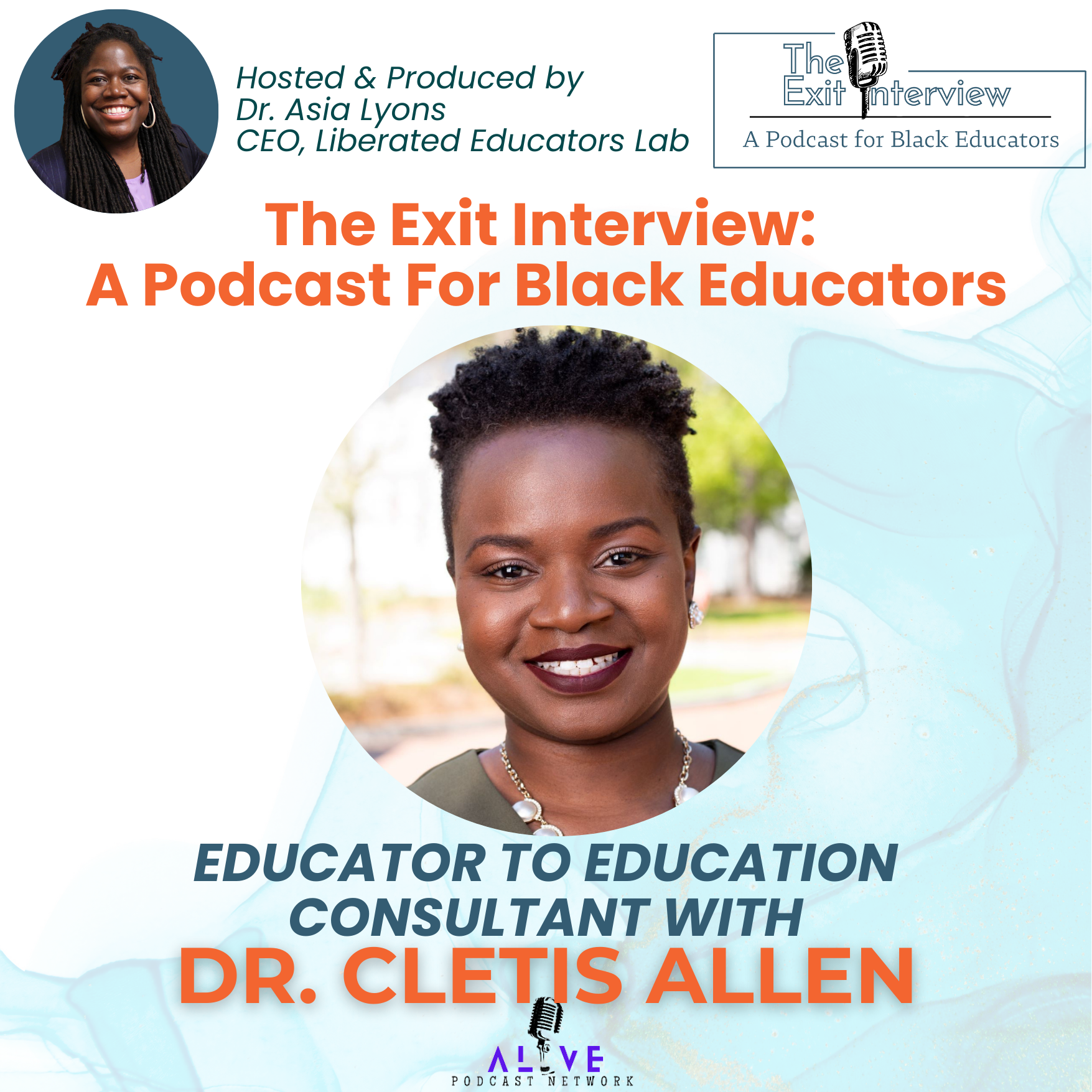
In this episode of the Exit Interview podcast, host Dr. Asia Lyons welcomes Dr. Cletis Allen, an educational thought leader with over 13 years of experience in teaching, curriculum development, and educational consulting. Dr. Allen shares her unique journey into education, starting with an initial interest in nursing before discovering her passion for teaching and advocacy.
Dr. Allen discusses her teaching career in Georgia, working with early elementary students and high ESOL populations, and her transition into curriculum writing and professional development. She highlights the importance of culturally responsive literacy instruction and her doctoral research on the interconnectedness of content, teachers, learners, and learning spaces.
The conversation explores Dr. Allen’s decision to leave the classroom and pursue consulting, the challenges and support she encountered from family and colleagues, and the broader context of Black educators navigating career transitions. Dr. Allen offers insights on the need for representation in curriculum decision-making, the value of teacher voices in unions and policy, and practical advice for educators considering consulting or entrepreneurship.
The episode also features shout-outs to influential educators in Dr. Allen’s life, including her mother and a longtime friend, and concludes with Dr. Allen reflecting on the sources of her joy: food, family, friends, and the fulfillment she finds in her work and personal growth.
Listeners are left with actionable gems about building a consulting business, the importance of networking and professional organizations, and the courage to pursue new paths in education.


From Classroom to Consulting: Dr. Cletis Allen on Culturally Responsive Education & Career Transitions
Host: Dr. Asia Lyons
Guest: Dr. Cletis Allen, Educational Consultant, Curriculum Developer, and Board Member
Episode Overview
In this inspiring episode, Dr. Asia Lyons sits down with Dr. Cletis Allen, a dynamic educational leader with over 13 years of experience spanning classroom teaching, curriculum development, and educational consulting. Dr. Allen shares her journey from aspiring nurse to passionate educator, her commitment to culturally responsive literacy, and her bold leap from the classroom to entrepreneurship.
Key Topics & Timestamps
[00:00] Introduction & Guest Bio
- Dr. Asia Lyons introduces Dr. Cletis Allen, highlighting her extensive background in education, curriculum writing, and consulting.
- Dr. Allen’s credentials: classroom educator, curriculum auditor, board member, and owner of Cletus Education Consulting LLC.
[03:00] Dr. Allen’s Educational Journey
- Early reluctance to teach and initial pursuit of nursing.
- Realization of her calling in education through tutoring and leadership roles.
- Teaching experiences in Georgia, working with pre-K, kindergarten, and ESOL students.
[10:00] Transition to Curriculum & Leadership
- Moving from classroom teaching to curriculum writing and professional development.
- Advocacy for diversity and representation in educational materials.
- Roles as district science and literacy ambassador, MTSS and Section 504 coordinator.
[18:00] Pursuing a Doctorate & Research Focus
- Motivation for doctoral studies and the decision-making process.
- Research on culturally responsive literacy instruction and Schwab’s four Commonplaces.
- The importance of teacher agency in curriculum implementation.
[28:00] Leaving the Classroom: Family, Friends, and Colleagues
- Navigating generational expectations about career stability.
- The emotional and practical considerations of leaving a secure teaching job.
- Support and skepticism from family, friends, and coworkers.
[35:00] Consulting & Entrepreneurship
- Founding Cletus Education Consulting LLC.
- Current work with ed tech companies, school boards, and curriculum projects.
- Advice for educators considering consulting: clarity of mission, networking, and professional development.
[45:00] Representation & Retention of Black Educators
- The need for Black teachers in curriculum decision-making spaces.
- The role of unions and professional organizations in amplifying teacher voices.
- Strategies for supporting and retaining Black educators in the field.
[55:00] Shout-Outs & Influences
- Shout-outs to influential educators, including Dr. Allen’s mother and longtime friend Mr. David Etheridge.
- The importance of mentorship and community in education.
[60:00] What’s Bringing Joy
- Dr. Allen’s love for food, family, and friends.
- The fulfillment of waking up each day enjoying her work and personal growth.
[65:00] Where to Find Dr. Allen
- Website: cletuseducationconsulting.com
- Instagram, Facebook, LinkedIn: @cletuseducationconsulting
Notable Quotes
- “I wanted to advocate for teachers in different levels, in different spaces.”
- “Representation in decision-making spaces is critical for real change in education.”
- “Be clear about the problem you solve—your mission will attract the right clients.”
- “Waking up every day and liking who I am and what I do brings me joy.”
Resources & Links
- Cletus Education Consulting LLC: cletuseducationconsulting.com
- Black Doctoral Network: blackphdnetwork.com
- National Council of Teachers of English (NCTE): ncte.org
- National Education Association (NEA): nea.org
Connect with the Show
- Host Contact: bewell@lionseducationalconsulting.com
- Interested in being a guest? Reach out via email!
Thank you for listening! If you enjoyed this episode, please subscribe, rate, and share the Exit Interview podcast.
First of all.... have you signed up for our newsletter, Black Educators, Be Well? Why wait?
Amidst all the conversations about recruiting Black educators, where are the discussions about retention? The Exit Interview podcast was created to elevate the stories of Black educators who have been pushed out of the classroom and central office while experiencing racism-related stress and racial battle fatigue.
The Exit Interview Podcast is for current and former Black educators. It is also for school districts, teachers' unions, families, and others interested in better understanding the challenges of retaining Black people in education.
Please enjoy the episode.
Peace out,
Dr. Asia Lyons
From Educator to Education with Cletis Allen - The Exit Interview Podcast
[00:00:00]
dr--asia-lyons--she-her-_1_03-10-2024_103524: Welcome back to another episode of the Exit Interview, a podcast for black educators with me, Dr. Asia Lyons, and today another special guest. We keep this guest fire all day long, um, and today is no different. Before I have Dr. Allen coming in and introduce herself, I'm gonna read her bio so that you all know what we're dealing with today, all the magic that we're, we're in the presence of today.
So. Dr. K Cletus Allen is an educational thought leader with over 13 years of experience in multiple roles in education, including elementary, classroom educator, professional learning, facilitator cu, curriculum, auditor and writer and governing board member of a local chapter, high school charter high school.
Charter school with licensure in reading English speakers of other [00:01:00] languages, ESOL, and K five science. Dr. Allen is the owner of her elementary education consulting firm. Cletus Education Consulting LLC in her doctoral work. A document analysis of the presence and relationship between Schwab's commonplace in the literacy curriculum that's adopted in high needs schools.
Dr. Allen examines the roles and interconnectedness of content. Teacher learner and learning spaces in the literacy curriculum and the opportunities to incorporate culturally responsive literacy instructional practice during the curriculum adoption and instructional implementation. She works with large and small educational organizations to incorporate cross-curricular strategies from a culturally responsive literacy instruction, CRLI perspective across content areas.
In addition to Dr. Allen Sup. In addition, Dr. Allen supports educators, educational leaders and professionals with cultivating CRLI and inclusive [00:02:00] practices in their daily instruction. Within P five learning spaces outside of education space. Queen Clee, I love that and enjoys time with family and friends.
She spends time reading, traveling, eating vegan food and crocheting. Welcome to our show. That was a mouthful. It took everything I had to get that one out.
dr--cletis-allen_1_03-10-2024_123524: I know it could be a little extensive, but I just want it to be comprehensive
dr--asia-lyons--she-her-_1_03-10-2024_103524: Mm-hmm.
dr--cletis-allen_1_03-10-2024_123524: I am, not only as a person, but as a professional in the education space. But thank you for having me on your podcast.
dr--asia-lyons--she-her-_1_03-10-2024_103524: Yeah, of course, of course. So, you know, the, the folks, um, always wanna know the things, always wanna know how people move in and sharing space and how they end up moving from a classroom educator to what you are doing now. So we'd love to hear about that. So let's go ahead and get this started. Tell us about your educational journey.
How, you know, how you knew you wanted to be an educator, what that journey looked like for you. Let's hear it.
dr--cletis-allen_1_03-10-2024_123524: [00:03:00] Okay, so I. Actually a different pathway from most when they're deciding if they wanna become a teacher when they were younger, to be quite honest, um, I did not wanna be a teacher. I tried my best to not go into education at all because I had, as a child my own perspective of, you know, teaching because, you know, growing up. In Chicago, you know, I had an experience. I was like, yeah, I'm not gonna be a teacher. I always found myself in teaching where I'm tutoring I was a part of like Junior National Honor Society where I'm supporting people in those ways when I was in high school. then when I got to college, I actually went to college for nursing.
dr--asia-lyons--she-her-_1_03-10-2024_103524: Oh, okay.
dr--cletis-allen_1_03-10-2024_123524: thought I was gonna [00:04:00] be a nurse working with children, so I thought I was going into pediatric nursing, but when I started, you know, taking the classes, I said, oh no, I'm not gonna work with children in that way. So I transitioned into the education field and it just took off from there. So that is my pre-teacher educational journey. And once I became a classroom teacher and I continued to get these degrees, um, I really understood, you know, kind of what I wanted to do as a teacher, the populations that I wanted to serve. But most importantly, I also wanted to advocate for teachers in different levels, in different spaces. So in a nutshell, that's how my journey started.
dr--asia-lyons--she-her-_1_03-10-2024_103524: Yeah. Um, and I feel like so many folks who come on the podcast start in a different career field or imagine themselves doing something different. I, myself was in [00:05:00] chemical engineering. Right. And mostly 'cause that's what my dad wanted me to do, and then found the education path in a whole different way that most people do.
Um, so how long were you teaching? Did you, it sounds like you might have done some coaching work. We'd love to hear about that. And where did you teach?
dr--cletis-allen_1_03-10-2024_123524: So I started my career teaching in Georgia and
dr--asia-lyons--she-her-_1_03-10-2024_103524: Mm-hmm.
dr--cletis-allen_1_03-10-2024_123524: in Atlanta metropolitan area, and I started teaching pre-K, loved pre-K, I moved to kindergarten, loved kindergarten. Like, I love those younger grade levels because you have an opportunity to really mold those children and give 'em those first experiences when it
dr--asia-lyons--she-her-_1_03-10-2024_103524: Yeah.
dr--cletis-allen_1_03-10-2024_123524: like, formal schooling within the US education system.
dr--asia-lyons--she-her-_1_03-10-2024_103524: Yeah.
dr--cletis-allen_1_03-10-2024_123524: really enjoy that experience, which started in 2012 and um, I taught a high ESOL population or el depending on, you know, where you are in the country. [00:06:00] And I loved it. But then I transitioned into another school after four years. I went to, uh, Atlanta Public Schools and I taught in the Bankhead area or you know, the West side area if anyone is familiar with, you know, Atlanta. And I enjoy my experience there as well because those children reminded me of me and
dr--asia-lyons--she-her-_1_03-10-2024_103524: Sure.
dr--cletis-allen_1_03-10-2024_123524: and, you know, those experiences. So I, um. Taught first grade, I taught third grade and then I taught third grade EIP, which is like small intervention classroom. But while I was there, I also was one of their district science and literacy ambassadors.
So while I
dr--asia-lyons--she-her-_1_03-10-2024_103524: Oh, so you, you signing up for a lot of work here.
dr--cletis-allen_1_03-10-2024_123524: well, I was teaching, yeah. I was also not only writing like their science curriculum, but I was also doing like. PD for the district. [00:07:00] So I was teaching and then doing the curriculum, writing curriculum work, and that was my first introduction into doing that. And I loved it. I
dr--asia-lyons--she-her-_1_03-10-2024_103524: Hmm.
dr--cletis-allen_1_03-10-2024_123524: curriculum work. I love, you know, writing, you know, putting the resources together. But also while I was in that role, I felt like I was also being an advocate, ensuring that the materials were diverse for the children that we were serving. Um, across the district. that was, again, a great experience for me. So did that. I was there for three years and then I went back to my old district and, um, became one of their MTSS and Section 5 0 4, uh, coordinators at an elementary school. So, because, um, within my degree you talk about intervention, you talk about the MTSS process, that was an easy transition. Um, into that role. So by the time get to, you know, basically year [00:08:00] 10, I finished my doctorate. And when that, and when I finished my doctorate, that's when I transitioned into, uh, curriculum development with my company.
So overall
dr--asia-lyons--she-her-_1_03-10-2024_103524: Oh, I see.
dr--cletis-allen_1_03-10-2024_123524: yeah. So that's, um, my journey.
dr--asia-lyons--she-her-_1_03-10-2024_103524: Yeah, it's interesting. Um, we've had a few folks with doctorates on the podcast, uh, and they still, they find their way out of the classroom in different ways. So when you talk about transitioning, when you went back to school to get your doctorate, we wanna hear about that journey because so many folks are thinking about that.
Was it always a plan to leave after you finished, or how did you come about that decision?
dr--cletis-allen_1_03-10-2024_123524: so. So what I'll do is take a step back because you asked me, you know, what's the journey? What was that journey of actually going into like doctoral work? Right.
dr--asia-lyons--she-her-_1_03-10-2024_103524: Mm-hmm.
dr--cletis-allen_1_03-10-2024_123524: okay, so when I finished my first degree in 2011, I went actually back to get my master's the same time I was actually in undergrad and grad [00:09:00] school at the same time, which is. I wouldn't advise anyone to do, but I was able to do it. I was young, I, I was ambitious. I did it. So I finished my master's degree in 2013. I ended up going back to get my education specialist degree in 2014 and finished that in 2015. So by the time I got into my specialist degree, I was like, you know, I think I can really, you know, add to something. Um, I really wanted to talk about, you know, my experiences when it comes to, like, curriculum and teaching and things like that. I didn't know how I wanted to do it, but I was like, okay, I, I can do this. So talked to some of my old professors and I was deciding between two different schools. Um, one school was Mercy University and the other school was Georgia State because I got my master's at Georgia State and I got my specialist degree at Mercer. So. When I made my decision, I was like, you know, I really [00:10:00] enjoy the environment. When I was at Georgia State, when I, um, had, you know, met some of my classmates, a lot of my professors, we were just closer versus when I was at Mercer, everything was online. So I didn't have that one-on-one connection that I did with the professors at George State. So. When, you know, both of the acceptance letters came back, I just went on ahead to Georgia State. um, when I started my program in 2017, that's when I said, okay, I need to kind of decide, you know, what I wanna focus on. I know it's curriculum, I know it's gonna be something about instruction, but you know, what is it that I really want to look at? And once I, you know, got into the courses and reading the research. That's when I understood, you know, I, I really do align with, you know, Geneva Gay's theory of culturally responsive pedagogy.
dr--asia-lyons--she-her-_1_03-10-2024_103524: Yes, yes.
dr--cletis-allen_1_03-10-2024_123524: no, I really wanna look at this also [00:11:00] from the curriculum and instruction lens. Like, how does, does, how does it affect, you know, curriculum, which not only includes the materials, but includes the learning space as well.
So that's how I included Schwab's four Commonplaces as an overall theoretical approach when it comes to my dissertation,
dr--asia-lyons--she-her-_1_03-10-2024_103524: Mm-hmm.
dr--cletis-allen_1_03-10-2024_123524: looked at culturally responsive literacy instruction when it comes to, okay, how are teachers being able to add to the curriculum when they are actually implementing it in their classrooms?
dr--asia-lyons--she-her-_1_03-10-2024_103524: Which is what we always do. Or have, we have to figure that part out. Yeah, for sure.
dr--cletis-allen_1_03-10-2024_123524: And especially when you're talking about, uh, teachers, specifically black teachers who are teaching black or other people of color within their classroom, how are they actually using this to support the children that they are serving within their classroom? So, yeah, so that's how, you know, I kind of made my decision and, um, went into doing my research. So. [00:12:00] I say, if anyone is considering, just consider, you know, what do you see as a problem or something that you added, and then go from there. As long as you have a reason as to why you are going into the doctoral space that you, you are adding to the work that's there. So you can continue to, you know, build on the corpus of research and then people can build from you.
dr--asia-lyons--she-her-_1_03-10-2024_103524: Yeah. I love that. So when it is time for you to leave, you're making this decision to leave, right? Tell me what the conversation was with family, with friends, and with coworkers of, I'm finishing my doctorate. It's time for me to go, I'm going to go into consulting. What did that look like? What did that sound like?
dr--cletis-allen_1_03-10-2024_123524: Okay, so let's start with, let's start with family and friends. So. My parents, you know, they were hard workers. You, they been on their jobs for, you know, [00:13:00] a long time blue collar jobs. And from their perspective, you know, growing up it's like, you know, you work your job until you make you do your 30 years and then you retire, which
dr--asia-lyons--she-her-_1_03-10-2024_103524: Yeah.
dr--cletis-allen_1_03-10-2024_123524: makes sense because that was the era that they grew up in. what they were taught. You know, when you have that opportunity you provide for your family and then you retire and be a grandparent or you know, live your life or do whatever. as a teacher, of all, I understood that I had other that I wanted to do outside of the classroom.
Specifically work with teachers. knew that in order for me to do that, I couldn't stay a classroom teacher in order to support teachers. I said, okay, well maybe I can move up to like an instructional coaching role or maybe a district level role. But then just from my [00:14:00] experience, when I saw just the level of, um. Work that had to be put in and the amount of red tape that some of the people who are in these positions were in where they couldn't do the work that they really wanted to do. It made me go, well, if I get into these roles, which I know I would be great in. wanna ensure that I do the work that I feel is going to make an impact within classrooms.
But now, I mean, this is not only classrooms, but it's, you know, at the administrative level, it's at the district level and so on and so forth. So me, making the decision and having the conversation with my family, it's like, okay, you sure you gonna do this because. Put in your 30 years and you still young.
And keep in mind, when I made the transition in 2021, I was, on. I was 31,
dr--asia-lyons--she-her-_1_03-10-2024_103524: Mm-hmm.
dr--cletis-allen_1_03-10-2024_123524: it was like, [00:15:00] okay, now hold on. Are you sure? Like it was, it was just those questions, but they supported me because they knew, they, they knew they baby, they knew Cletus,
dr--asia-lyons--she-her-_1_03-10-2024_103524: Yeah.
dr--cletis-allen_1_03-10-2024_123524: siblings. They was like, oh yeah, she, she's gonna be okay.
So having that support from them was great. My friends, of course, they were also very supportive. They was like, oh girl, you got this. Like, I know you can do it. It is new, it is different, but you can handle this. So that was, that wasn't a problem. Talking to, um, some of my coworkers, you know, they didn't see it at the time, but they knew I had the skills.
So it was like, I know you can do this, but maybe you can do this, you know, at the district level. Maybe this role will open up and they'll do it for you. Maybe they'll make an exception for cle.
dr--asia-lyons--she-her-_1_03-10-2024_103524: Mm-hmm.
dr--cletis-allen_1_03-10-2024_123524: like, Hmm, maybe, maybe not, but let me just go this route for a minute if it doesn't work. I can always go back into the classroom or, you know, do something at the [00:16:00] district level because I'm, I'm still a licensed educator, so for me that was the space.
But then once I saw the opportunities open, when I decided to make that transition, I said, oh, well stay
dr--asia-lyons--she-her-_1_03-10-2024_103524: Yeah.
dr--cletis-allen_1_03-10-2024_123524: make it work. Mm-hmm.
dr--asia-lyons--she-her-_1_03-10-2024_103524: It's interesting that you talk about your family, you're from Chicago and this idea of work the 30 years get the gold watch. Right. And I feel like so many of us can resonate with that from our parents or grandparents who, like I, my family's from Detroit Uua Union, Ford Motor Company, the whole work pension.
dr--cletis-allen_1_03-10-2024_123524: Mm-hmm.
dr--asia-lyons--she-her-_1_03-10-2024_103524: so there's so many of us who are thinking about taking that leap but have been told. Either through example or just actually told, um, that yeah, like, just stay in the job and they'll make an exception for you. Or, you know, are you sure you wanna do that? Things are, are kind of rough right now. Think about doing something else or make it a side hustle and instead anything but taking the leap and not that they, they want [00:17:00] to.
To, um, push us away from that ideas, but they really want us to be successful and are scared for us. I feel like more than they're hating, it's just like they wanna make sure that we can eat right.
dr--cletis-allen_1_03-10-2024_123524: Exactly, and I
dr--asia-lyons--she-her-_1_03-10-2024_103524: Yeah.
dr--cletis-allen_1_03-10-2024_123524: piggyback on what you were saying, again, I understood my parents' perspective
dr--asia-lyons--she-her-_1_03-10-2024_103524: Yeah.
dr--cletis-allen_1_03-10-2024_123524: me that because when you, you know, are growing up. In the seventies and the eighties, they had a different climate and environment, you know, as black people, as young black people.
So for them it was like, Hey, you know, we got these good jobs. We are just gonna do this so we can support our family and we want you to be comfortable as well, where you don't have to struggle or you know, you're trying to go here or there trying to secure employment. Because also in their mind it's like, okay, you're a teacher, you're gonna always have a job.
So. Just continue, you know, down that path, work your years and retire and live comfortably. But [00:18:00] there were other plans for my life
dr--asia-lyons--she-her-_1_03-10-2024_103524: Yeah.
dr--cletis-allen_1_03-10-2024_123524: that's, you know, and that's how I decided to continue. And again, they're supportive. Very, very supportive.
dr--asia-lyons--she-her-_1_03-10-2024_103524: Yeah, that's awesome. I think too, um, about your colleagues, you know, try this, try that, try this. And I think a lot of folks who shift into consulting and working for themselves haven't, don't necessarily have the experience of having people in generations do it before them or know educators who've left the field and do that.
And so it's one of those. Again, same thing like maybe the, the district and the power that we put on the district to do things for us versus us doing things for ourselves is, um, is really amazing. And I remember as a teacher, um, in a school district, uh, in here in the Aurora Denver area, thinking like, oh, my district is this, my district is that.
And when I left teaching thinking, oh my goodness, like this [00:19:00] district is. A grain of sand on the beach of all the amazing things
dr--cletis-allen_1_03-10-2024_123524: Yes,
dr--asia-lyons--she-her-_1_03-10-2024_103524: there in education that I would've never known had I stayed in the classroom.
dr--cletis-allen_1_03-10-2024_123524: yes.
dr--asia-lyons--she-her-_1_03-10-2024_103524: Yeah.
dr--cletis-allen_1_03-10-2024_123524: agree with that because sometimes I feel like, and this just could be my experience, I feel like as a teacher. role of teaching, you're sheltered because your focus is your students and ensuring that they not only learn, you know, grade level skills, but they also are successful, you know, with whatever exam that they're taking, whatever benchmarks, you know, so on and so forth. So in that case, your focus is solely on, you know, content. It's also on, you know, success of the grade level. So you're not really thinking about all the other aspects of education, whether it's policy, whether it's [00:20:00] curriculum, you know, that where I am in now. There's also, you know, when you think about design, there's just so many levels. To education that unless you see it or you have experience with it or you engage with it, your focus is just on teaching and there's nothing wrong with that as well, because there are great educators, especially a lot of our black educators, who are very, very good when it comes to ensuring that our students have a safe space within. learning space and they are really getting the content and those grade level skills. But there are others who have, you know more, they have a vision to ensuring that everyone has a. learning experience or an experience that really reflects their life and experience. And that is going to take a leap of faith for you to kind of step out of what is norm and ensuring that you [00:21:00] not only maybe create a niche, but you can also find a space that can kind of cultivate those skills as well.
dr--asia-lyons--she-her-_1_03-10-2024_103524: Yeah, I love that. Um, I remember thinking when I was, after I left teaching. For six years. I taught fifth grade for six years. I taught sixth grade.
dr--cletis-allen_1_03-10-2024_123524: Mm-hmm.
dr--asia-lyons--she-her-_1_03-10-2024_103524: coming out and thinking I'm a sixth grader, but I, I, I was focused so much on the thing, like teaching that there was so many other things that I did not know or understand, just like you're saying.
And I'm like, my, in some ways my growth was stunted by me because I was so focused on this one area. Um. And going out and first working in the nonprofit sector and then going into business allowed me to grow in all the ways you're talking about. I love that. So I, I have a question for you, um, around this line.
So you, obviously, you are leaving education with this idea of, I know I'm, this [00:22:00] is my plan, right? It's not necessarily a push out, but for folks who. And if, I'm sure you've seen this in your years of teaching black educators leaving the field of teaching, right. And the experiences that they've had. So thinking about that in particular, what have you or what do you suggest school districts, unions folks do to keep black educators in the field of teaching?
Whether in curriculum instruction, deans teach, like in that space, what are some ideas that you have based on what you've seen out here in in your community?
dr--cletis-allen_1_03-10-2024_123524: So the first thing I would suggest is for districts to ensure that there is representation of black teachers when it comes to. Being a part of the curriculum process. Right. So just to go back to a little bit of my journey, I had the opportunity [00:23:00] to be a part of the vetting and auditing process when it comes to curriculum decisions for the district. So because of that, I felt that that was really important. because the district also had just other unique ideas that they had where if a curriculum was chosen that they would kind of go to different schools and have, you know, some of the leaders kind of look at it and see, and maybe a couple of teachers to kind of test it out. I think it's really important to have. The actual teachers who are actually going to be implementing curriculum to be a part of the process when it comes to choosing, because at the end of the day. I understand when it comes to like financial budgets and decisions that are made at a district level, that everything trickles down and those decisions affect, you know, what happens in the classroom. when [00:24:00] we're considering those voices, we need to make sure that the teachers are not only at the school board meetings, but they're also, um, in those conversations when it comes to making those choices, as I said. Um, when it comes to local unions, again, I feel like there needs to be inclusion of teachers when it comes to, you know, their voices with whatever mission or statements that they have for the year. Um, when I was in the classroom, I was a part of NEA and um, and GAE. So that's like Georgia Education Association Educators, which is like the subsidiary of NEA. with that, I also had an opportunity to share, you know, some of my concerns across Georgia with Georgia teachers and other leaders and even some policy makers when it comes to, you know, what are some of the, some of the missions [00:25:00] and some of the challenges that teachers are facing and what we can do to support that. So just ensuring that there is space for me for to have a voice, but then also listen to some of the solutions and see how we can implement it in ways that service black children, but you know, children overall. Mm-hmm.
dr--asia-lyons--she-her-_1_03-10-2024_103524: Yeah, that makes so much sense. And this idea of representation in decision making spaces. So our last guest, uh, Yasha Chapman, shout out to Yasha. She said the exact same thing about being in these spaces where curriculum is decided upon. Um, and. She does similar work as you do, and I definitely should connect you two,
dr--cletis-allen_1_03-10-2024_123524: Yes,
dr--asia-lyons--she-her-_1_03-10-2024_103524: yeah.
Yes, and I a hundred percent agree with that. The decision making spaces and of course going back to and paying them for their labor, right? Because sometimes teachers are so eager just to be seen. I feel like we overdo it for free. [00:26:00] Right. And for folks who go out to the, the. Consulting space, the business space, after being in teaching and doing so many things for free, then we get into a whole nother ball of wax about charging we worth, which I'm gonna ask you about in a little bit.
But yeah. But yeah, so I, I love that. I love all their suggestions and your ideas. So when we get back from our break, we'll get into my part of the show. My favorite part of the show that we talk about all the things that are happening, what you're up to, what's bring you joy. And we'll be back in a minute.
Alright, welcome back to the show. Um, so if you haven't, if you're just catching up with us, Dr. Allen's given us all the gems. First of all, don't have to go into loving teaching from preschool. Like you don't. Right. Um, talking about representation. In decision making spaces, [00:27:00] talking about her, um, ideas around shifting from, from being an educator to working on cur curriculum and instruction families and how our families supported her.
All the things. So now we're gonna get into the part that I really love, and the first question that we ask in this section is, is there a black educator that you would like to shout out on our podcast?
dr--cletis-allen_1_03-10-2024_123524: Definitely. I mean, I have a plethora of friends and colleagues that I would, I mean, love to shout out
dr--asia-lyons--she-her-_1_03-10-2024_103524: Go for it. Go for it.
dr--cletis-allen_1_03-10-2024_123524: But I specifically would like to shout out one of my longtime friends, he's a math educator. He's also a curriculum development specialist in the Chicago land area.
He actually, he actually teaches at my old high school now.
dr--asia-lyons--she-her-_1_03-10-2024_103524: Oh, that's cool.
dr--cletis-allen_1_03-10-2024_123524: Uh, Thornton High School
dr--asia-lyons--she-her-_1_03-10-2024_103524: Okay.
dr--cletis-allen_1_03-10-2024_123524: um, his name is [00:28:00] Mr. Mr. Eridge, David Etheridge. He actually just finished his ed specialist degree in leadership and is considering going into the doctoral space. So I just wanna shout him out because not only is he very, very, um. Insightful and has an expertise when it comes to math education, but he's also very active when it comes to NEA and his local, uh, NEA. He supports, uh, teachers at his school he needs to sit in for meetings and kind of be that support. He's always there, he's always advocating for the children
dr--asia-lyons--she-her-_1_03-10-2024_103524: Mm.
dr--cletis-allen_1_03-10-2024_123524: the school, making sure they have multiple opportunities to finish what. Uh, he's teaching when it comes to math, but also ensuring that he continues his education so he can not only be effective in the classroom, but beyond. So I just wanna give Mr. Eridge his [00:29:00] shout out. He's literally a one day older than me, so he'll always say that, you know, he's older, but literally by a couple hours. So I just, I really wanna shout him out. Also, I just want to, uh, shout out really my first teacher, which was my mom, you
dr--asia-lyons--she-her-_1_03-10-2024_103524: Yes.
dr--cletis-allen_1_03-10-2024_123524: was very, very active with all of my siblings when it came to our education. That was very important to her. She always read to us when I was teaching pre-K for my first year, she came from Chicago. Down to Atlanta and really read to my children and was engaged because that was who she is in spirit. So anytime she had an opportunity, she always came to support. So Mama, mama Allen, I support you. Thank you so much and uh, we gonna continue to do this work.
dr--asia-lyons--she-her-_1_03-10-2024_103524: Yeah, I love that. Shout out, mama Allen. Shout out. Uh, Mr. [00:30:00] Eridge. Uh, so the next question is what are you doing now? We talked about it at the beginning of the show, but we love to hear about your work. Um, and then in particular too, for folks who. Thinking about moving into the consulting space. Some, some gyms you have that you've come to realize in this space.
We love to hear about that too.
dr--cletis-allen_1_03-10-2024_123524: Perfect. So right now I am still a consultant when it comes to curriculum writing and development. Uh, I work with one large educational ed tech company, and then I've worked with a few large. In small organizations when it comes to curriculum writing or training development across different states. Um, and I enjoy what I do and I love what I'm doing. I'm, as I've said, I'm also a governing board member for a local alternative high school here in the Atlanta metropolitan area. So. Serving on [00:31:00] that also gives me a space to see what governance looks like and how governance not only affects at the administrative level, but trickles down for the students as well.
And because of my different experiences when it came to, you know, being as a teacher and then the school board, I just try to make sure I'm very reflective and. Also, I try to ensure that I don't do the things that I saw when it came to governance ensuring that I am being very. I'm doing everything that I'm supposed to do with Fidelity, and I think that's really important when it comes to leadership because when you're on a governing board, that's the biggest thing. You wanna make sure there's oversight, but you don't have your hands into what is actually being done [00:32:00] within the classroom level. understanding that whatever you decide as a board affects everybody. So just ensuring that I'm very re reflective with that and I love what I do, as I say. So having that experience and being on this board, um, just gives me the other side when it comes to like K 12 education, within, like I said, this Atlanta space. So that's that. Um, when it comes to consulting. Here's what I say. First thing I say is make sure that whatever your skillset is or whatever problem you're trying to solve, that you're pretty clear about it. a lot of people when they're deciding to transition or if it's just a side hustle. To, you know, do some consulting, whether it's with, you know, [00:33:00] teachers or it's with curriculum or anything else.
When it comes to education, they try to do everything, which I totally understand because as a teacher you do a lot, you wear so many hats in the classroom that you have, you know, a lot of expertise in a lot of things, sometimes when you are focused on. mission and then the problem that you can solve, it can really attract the type of clients that you would like to work with. So I think that's number one. Also, before you decide to transition into consulting, or you, again, you're building this business maybe as a side hustle. Start having those conversations with family, friends, and colleagues and get them to understand your idea or what you would like to do. Um, and I think that will help plant a seed.
So when you decide to maybe be [00:34:00] full within your business. Or again, if you still want it to be a side hustle, people will know what you're trying to do, so then your name starts to travel When it comes to, you know, different meetings or you're having conversations at conferences or in other spaces like that. The last, I guess, gem that I, I will also give that maybe a lot of people may miss or may not consider is attend a few conferences and
dr--asia-lyons--she-her-_1_03-10-2024_103524: Yes,
dr--cletis-allen_1_03-10-2024_123524: conferences as well.
dr--asia-lyons--she-her-_1_03-10-2024_103524: yes.
dr--cletis-allen_1_03-10-2024_123524: an opportunity for you to not only network with others within the space, but that gives you a chance to see what. Other colleagues are doing not only within the city that the conference has held, but around the country or even around the world, because you never know who's gonna be there.
You never know who's gonna show up for a session. And if you are presenting, you never know how [00:35:00] you can make an impact on those participants. And they may refer you to their district leader and then have an opportunity. So that is, um, really vital to even if you can in the summer to attend a conference and really have an opportunity to speak.
And there are also some free conferences that you couldn't attend, especially if, you know, cost is a factor. There are opportunities to do that. You would just, you know, have to do some research or you're just gonna, you know, have to make a financial investment and say, Hey, I'm going to, you know, attend this conference because I really have a goal in making sure that, you know, I network, I learn more, I connect with other folks. Also, to add to that, something I just thought about. If you're not a member of any type of professional organization, it is an opportunity to [00:36:00] join one and or two. You know, again, NEA is a good one. I'm a member of the Black Doctoral Network, so I get an opportunity to network also with PhD students as well.
I'm a member of NCTE, so I get an opportunity to network with some of the, uh, English teachers. Not only in the Atlanta area, but of course around the country. So that gives you an opportunity to, again, continue to have conversations, tell people the problem that you can solve. And again, that can lead to conversations when it comes to, you know, having clients and doing the work that you would like to do.
dr--asia-lyons--she-her-_1_03-10-2024_103524: Yes to everything you said. Doubling down on the conferences, attending, but also speaking, I just, I finished, just flew back from Austin and spoke at South by Southwest and
dr--cletis-allen_1_03-10-2024_123524: Oh,
dr--asia-lyons--she-her-_1_03-10-2024_103524: yeah, exactly what you said happened, happened where you were in a, there weren't, weren't a ton of people in the room, but the right people were there to say like, Hey, I love what [00:37:00] you're doing.
Let's connect. I got some ideas about doing this in another part of the country, so I love, love, love that. Um, those, that was perfect. I'll just leave it that way. Uh, last question. What's been, what's been bringing you joy these days?
dr--cletis-allen_1_03-10-2024_123524: Joy. Oh, first of all, I love food. So food brings me joy.
dr--asia-lyons--she-her-_1_03-10-2024_103524: Yes,
dr--cletis-allen_1_03-10-2024_123524: even though, um, I'm, well I'm vegan, but I'm actually starting to transition to be more raw plant-based. finding food and places to eat and recipes to try that, first of all, that brings me joy. 'cause I love to eat and I love to snack. And I love to have energy, so I love food. You know, spending time with family and friends also brings me joy to see all of the wonderful success that they have [00:38:00] and seeing the happiness that they are having within, you know, their spaces of success. brings me joy because of course, I mean, I have a level of success, but just to see them, you know, work hard and, um, achieve the things that they plan that they would like to, whether it is career fam, their own families, or if, if it's simple, you know, self-care things.
dr--asia-lyons--she-her-_1_03-10-2024_103524: Mm-hmm.
dr--cletis-allen_1_03-10-2024_123524: that is always awesome, but also what brings me joy is being able to wake up every day and say that I like who I am and I enjoy what I do. And understanding that, you know, there are so many levels when it comes to, um. Mental illness and you know, having certain levels when it comes to depression and other [00:39:00] things, which are, of course, that's for, you know. A different time, a different story,
dr--asia-lyons--she-her-_1_03-10-2024_103524: Don't worry.
dr--cletis-allen_1_03-10-2024_123524: all experience it. I mean, even myself, you know, there are times when you know, when you feel like, man, am I, if what I'm doing, is it really making an impact? You know, sometimes you May 2nd guess yourself, but I understand that I was put on this earth to do what I do and what I do is unique to. The space, but I am me and I like me and I wake up every day enjoying me and you know, my family and friends and significant other enjoys me. So I think, you know, being able to wake up and say, you know, I like who I am and I love the work that I do is truly a milestone in my life. And that, and that brings me a lot of joy.
dr--asia-lyons--she-her-_1_03-10-2024_103524: Well, folks, we gonna wrap it up with that, Dr. K Clus. Allen, thank you so much for coming on the show.
dr--cletis-allen_1_03-10-2024_123524: Thank
dr--asia-lyons--she-her-_1_03-10-2024_103524: Thanks. Yeah. And tell us, uh, tell the [00:40:00] audience where they can find you, social media, your email so that they can reach out if they would like to. So.
dr--cletis-allen_1_03-10-2024_123524: Sure. So website, isus education consulting.com. And it's cletus education consulting.com on Instagram, Facebook, and LinkedIn. I'm not on Twitter, so, or X, excuse me. So, you can find me on those platforms.
dr--asia-lyons--she-her-_1_03-10-2024_103524: Fantastic. Alright folks, that's another beautiful episode. We'll see you again. And remember, if you're interested in being on the podcast, reach out at be well@lionseducationalconsulting.com. Peace.

CEO/Charter School Board Member/Writer/Vegan
Dr. Cletis Allen is an Educational Thought Leader with over 13 years of experience in multiple roles in education, including elementary classroom educator, professional learning facilitator, curriculum auditor and writer, and governing board member for a local charter high school. With licensures in Reading, English Speakers of Other Languages (ESOL), and K-5 Science, Dr. Allen is the owner of her elementary education consulting firm, CLETIS Education Consulting LLC. In her doctoral work, “A Document Analysis of the Presence and Relationships between Schwab’s Commonplaces in a Literacy Curriculum that’s Adopted in High-Needs Schools,” Dr. Allen examines the role and interconnectedness of content, teacher, learner, and learning spaces in a literacy curriculum, and the opportunities to incorporate Culturally Responsive Literacy Instructional practices during curriculum adoption and instructional implementation. She works with large and small educational organizations to incorporate cross-curricular strategies from a Culturally Responsive Literacy Instruction (CRLI) perspective across content areas. In addition, Dr. Allen supports educators, educational leaders, and professionals with cultivating CRLI and inclusive practices in their daily instruction within P-5 learning spaces.
Outside of the education space, Queen Cle enjoys time with family and friends. She spends time reading, traveling, eating vegan food, and crocheting.