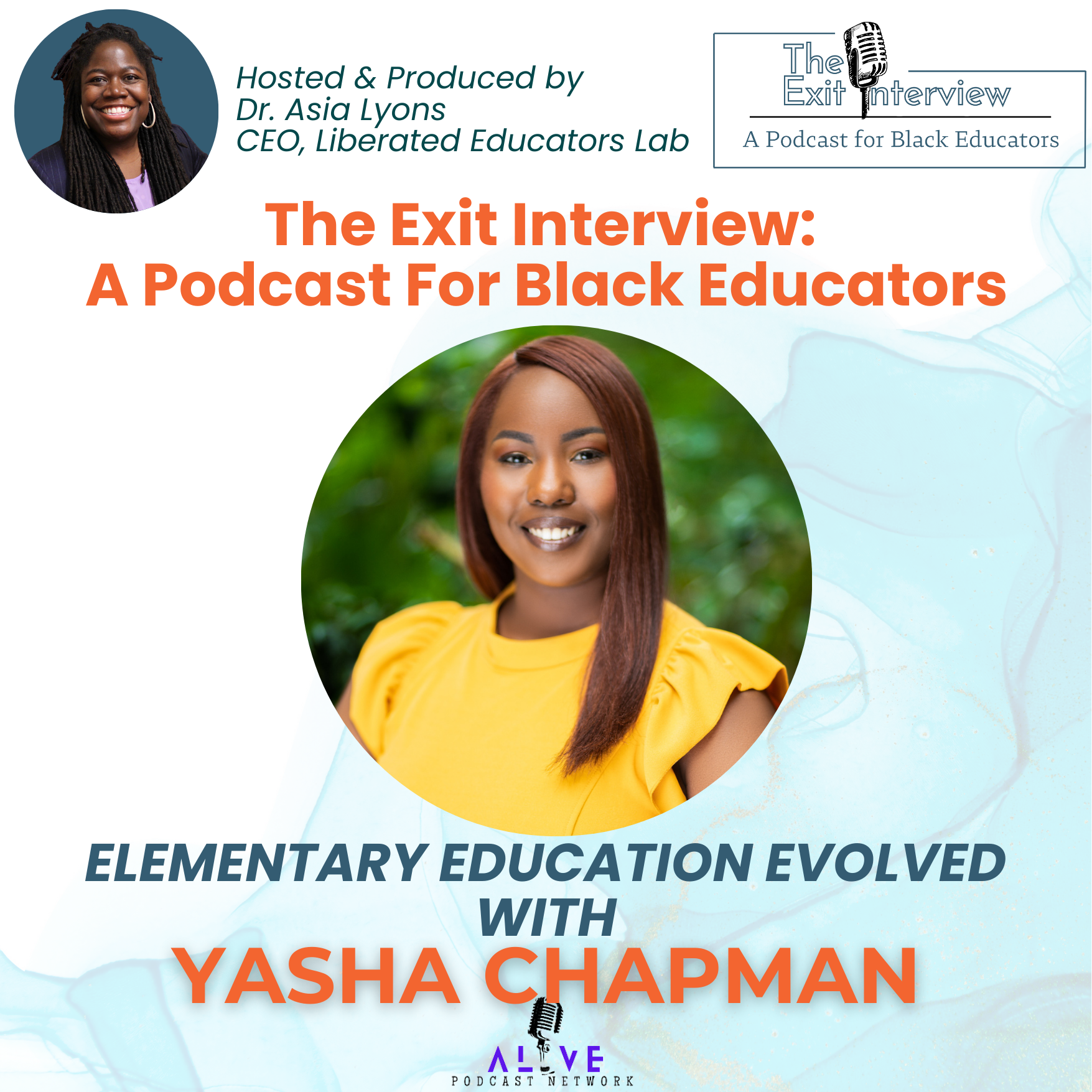
Elementary Education Evolved with Yasha Chapman
In this episode, of the Exit Interview: A Podcast for Black Educators Yasha Chapman, an accomplished Black educator and CEO of Elementary Education Evolved, shares her experiences and insights about the challenges faced by Black educators and the importance of retaining them in the field of teaching. Yasha discusses her journey in education, from initially wanting to be a pharmacist to becoming a classroom teacher and eventually an instructional coach. She emphasizes the need to amplify the voices of Black educators, involve them in decision-making processes, and compensate them for their expertise. Yasha's consultancy, Elementary Education Evolved, focuses on providing professional development and coaching for new teachers and aims to close the academic achievement gap for Black and Brown students in the K-5 setting. This episode offers valuable insights and strategies for school districts, human resources departments, and school unions to better retain Black educators and create a more inclusive and supportive educational environment.


Elementary Education Evolved with Yasha
In this powerful and deeply reflective episode of The Exit Interview: A Podcast for Black Educators, Dr. Asia Lyons sits down with Yasha Chapman, CEO and Lead Consultant of Elementary Education Evolved, to explore what happens when grief, misalignment, and purpose collide—and how clarity can emerge on the other side.
Yasha shares her journey from aspiring pharmacist to classroom teacher, instructional coach, and ultimately educational consultant. She reflects on the personal losses that reshaped her identity, the professional reckoning that followed, and the courage it took to leave a traditional school system that no longer aligned with her values or supported her healing.
This conversation centers grief as a leadership experience, examines misalignment within education spaces (even those serving Black communities), and highlights the power of reclaiming mission without abandoning students. Yasha also offers concrete strategies for retaining Black educators and thoughtful advice for those considering entrepreneurship or consulting as a path forward.
This episode is an invitation to honor your evolution—and a reminder that leaving a space does not mean leaving the work.
✨ What You’ll Hear in This Episode
🔹 Finding the Path to Education
Yasha’s unexpected journey from pre-chemistry major to early childhood educator
The moment she realized students who looked like her needed her
How early affirmations from students shaped her calling
🔹 Teaching, Coaching & Seeing the Bigger Picture
Teaching Pre-K through 5th grade across multiple states as a military spouse
Why instructional coaching became her favorite role
Using data, teacher strengths, and student learning styles to drive real growth
Achieving dramatic literacy gains—even while grieving
🔹 Grief, Identity & Professional Misalignment
Losing her aunt and father within 24 hours—and returning to work without time to heal
“Learning a whole new version of myself” after loss
Recognizing misalignment between stated missions and lived practices
The heartbreak of realizing a dream job no longer aligned with her values
Why grief + misalignment became the catalyst for leaving
🔹 Leaving Without Abandoning the Mission
Why leaving a school does not mean leaving children
Designing a lane where purpose, healing, and impact coexist
“Don’t abort your mission—just change the place where you carry it out”
🔹 Retaining Black Educators: What Must Change
Yasha shares concrete strategies districts and schools can implement, including:
Increasing pay to reflect expertise and labor
Amplifying Black educators’ voices beyond DEI committees
Including Black teachers in curriculum selection and decision-making
Leveraging Black educators as paid experts and professional development leaders
Ensuring representation with power, not tokenism
🔹 Elementary Education Evolved
Why early literacy is critical to long-term student outcomes
Closing academic achievement gaps for Black and Brown students in K–5
Supporting new teachers and those on improvement plans
Coaching and professional development through a social justice, equity, and empathy lens
🔹 Consulting & Entrepreneurship Advice
Using data to confirm your value
Identifying your zone of genius and niche audience
Designing offers that are sustainable and aligned
The mindset work required to believe you belong as a consultant
Navigating loneliness and building a strong support system
🔹 Joy, Purpose & Meaning-Making
Finding joy in understanding the why behind painful experiences
Seeing life’s “love letters” in hindsight
Trusting that purpose unfolds through connection and clarity
🖤 Episode Dedication
This episode is dedicated to Mrs. Beverly Godby, Yasha’s fourth-grade teacher in Savannah, Georgia—her “forever teacher”—whose ongoing love, wisdom, and support shaped the educator Yasha has become.
Yasha and her team offer coaching and professional development for educators, schools, and districts committed to equity-centered, student-affirming practices.
💌 Stay Connected with The Exit Interview
Subscribe to the Black Educator Be Well Newsletter for wellness, reflection, and resources
Support the podcast on Patreon for bonus episodes and giveaways
Follow us on social media and YouTube
Visit our website for more episodes and offerings
🎧 Final Reflection
This episode is a reminder that grief can sharpen purpose, misalignment can clarify values, and leaving can be an act of devotion—to yourself, your mission, and the students you still serve.
If this conversation resonated with you, consider sharing it with another educator who may be standing at the edge of change.
First of all.... have you signed up for our newsletter, Black Educators, Be Well? Why wait?
Amidst all the conversations about recruiting Black educators, where are the discussions about retention? The Exit Interview podcast was created to elevate the stories of Black educators who have been pushed out of the classroom and central office while experiencing racism-related stress and racial battle fatigue.
The Exit Interview Podcast is for current and former Black educators. It is also for school districts, teachers' unions, families, and others interested in better understanding the challenges of retaining Black people in education.
Please enjoy the episode.
Peace out,
Dr. Asia Lyons
Elementary Education Evolved with Yasha Chapman - The Exit Interview Podcast
Yasha Chapman: [00:00:00] So I'm having to learn a whole new person because I'm no longer the same Yasha. The Yasha before had two parents. This Yasha has one. And so now I have to get to know who she is while I'm trying to perform and. And shine and, you know, just help these teachers grow. And, you know, to be honest, you know, leadership, sometimes we just had difference of visions, you know, although we were saying on paper, our missions are the same, our practices and the actions that we're doing weren't lining up.
And so that was honestly the first time in my whole educational career where I was met with, I am misaligned. This is the first time where another educator or another organization's philosophy of education does not align with mine. And that was really, really scary.
Dr. Asia Lyons: Welcome to The Exit Interview, a podcast for [00:01:00] Black educators, where we, Dr. Asia and Kev, delve into the crucial but often overlooked conversations surrounding the retention of Black educators. While the spotlight shines in recruiting efforts, we turn our focus to the stories of those who've left the field of teaching.
The exit interview aims to spark dialogue among school district administrators, school unions, families, educators, and anyone else passionate about fostering a more inclusive and supportive educational environment. Join us as we elevate these narratives, shedding light on the challenges faced by Black educators, and providing valuable insights for the future of education.
Welcome to The Exit Interview.
Welcome back, everyone, to another episode of The Exit Interview, a podcast for Black educators, with me, Dr. Asia. Kevin is out somewhere. It's Super Bowl Sunday. Who knows where he is? [00:02:00] But we're here with our guest, Yasha Chapman, and the show must go on. Welcome to our show, Yasha.
Yasha Chapman: Thank you so much for having me,
Dr. Asia Lyons: Dr.
Asia. Yeah. Thank you for answering the call to be on the podcast. I'm going to read your bio. I read it earlier to myself and I said, she got it going on. So I'm going to read it for folks. Yasha Chapman, CEO, lead consultant of Elementary Education Evolved. Yasha is an accomplished educator with a rich background in various educational roles, having served as a classroom teacher, curriculum coordinator, writer, and instructional coach, holding degrees in early childhood education and curriculum instruction.
She's dedicated to both student success and supporting fellow educators. Yasha's influence is evidenced by her impactful professional development sessions and the impressive academic growth of students with over 80 percent meeting or exceeding math and reading standards. Targeted literacy focus approach notably increased reading proficiency from 6 percent to 72 [00:03:00] percent and enhanced teacher competency by 55%.
Yasha's lifelong dedication showcases her unwavering beliefs in equitable education and empowering educators to ensure every child's success. So glad to have you on the show. So glad to share your exit interview story. So let's just jump right in. First things first, tell us how'd you get into education?
How'd you become a classroom educator? Is it from your childhood? Did you get inspired as an adult? Just share your story, share all your ideas.
Yasha Chapman: Okay. So I actually started off as a pre chemistry major. My goal is to be a pharmacist. That was the plan. And as I went through my courses, I kept failing everything.
And this was the first time in my whole life where I started failing classes. And so I, of course, it made me think, is this the right path? Is this something I should be doing? And so I went to our career center on campus, [00:04:00] took a lot of personality tests, and classroom teacher kept popping up, like, in all the top 10 of my answers.
My college was able to orchestrate me to go in and shadow a teacher to see if that was something I would be interested in before completely switching my major. And when I did that, I met this student who asked if I could be her mom. And I asked her, you know, why would you want me to be your mom? And she says, because you're helping me with my schoolwork.
And it was at that moment, the light bulb went off and I was like, this is what I want to do to just know that students that look like me needed my help. They were asking for my help. And I felt like that's where I could be of service. And so I went back, I changed my major to early childhood education and I've been rocking it out ever since.
Dr. Asia Lyons: That's interesting. So I had a similar story in that I was in chemical engineering and like flunked out. You didn't flunk out of college, mind you, but I totally did. It was a community college working at a [00:05:00] childcare center at the campus. A teacher said to me, you know, you should be a teacher. You should think about being a teacher.
And so this very, like, I was set to be an engineer because that's what my family wanted for me, did not do well, and then ended up kind of taking a pause and saying, like, maybe I should think about something else. And I love that you took that personality test and thought about it and went ahead and say, you know what, I'm going to try this out.
And that your school was very supportive of that. So that being said, tell us how long were you in education? Even though I read your bio, we'd love to hear the entire story of, like, We don't necessarily need to get into like the exiting part just yet, but Where did you teach or what grades or like those types of experiences that you had?
Oh yeah,
Yasha Chapman: okay. So I have experience teaching all grades pre k through fifth grade with the exception of fourth grade. I spent the majority of my time in pre k and second grade with second grade being my absolute favorite. I've taught in states [00:06:00] of Georgia. So I mentioned before the interview started, I'm a military spouse.
And so I moved around the country a bit. So I've taught in Georgia, I've taught in North Carolina, South Carolina, as well as New York. And I've done some work for written curriculum and coordinated curriculum in Pittsburgh, Pennsylvania. So just been a little bit of everywhere. Like I said, my favorite job would have to be, of course, classroom teacher comes first, but instructional coaching won my heart.
That's where I really got to see like the bigger picture. Come together, working from like a backwards approach, if that makes sense. Of course, as a teacher, you go straight working with the students and their data. Whereas a coach, you kind of work backwards. So you're working with the data. You're working with the teachers and their teaching styles.
And then you're working from there learning how to incorporate their teaching styles with the styles of their [00:07:00] students and creating plans and meetings around their students learning styles and combining that with the data. And now we have to figure out how we can make this curriculum relevant and engaging.
And so it's a world of fun for me. It's kind of like being a doctor or going back to being a pharmacist, being a chemist in the lab where you're just trying to find all the right potions and the right pieces to make this fit. And so I take, I find great joy in doing that.
Dr. Asia Lyons: Yeah, I love that. The coaching piece and that instructional coaching piece is so important.
If folks are willing to take the instruction, right? Oh yeah. That's the part that sometimes people struggle with, I find. We have folks who are in our Black Educator Wellness cohort here in Denver who do coaching, who are instructional coaches, Black women, and they just get all kind of pushback from, uh, non Black folks around instruction.
And we got to, and this is in our first cohort, hear [00:08:00] about folks really having some struggles around being respected as an educator, as a professional, just because of their skin versus, like, I've been in the field for X amount of years. Right? So I'm glad to hear that you enjoyed that and it was a good experience for you.
And you said you taught every grade, but what
Yasha Chapman: grade? Fourth. I did not teach fourth grade. For elementary? Yes.
Dr. Asia Lyons: That was one I did teach, and I have a strong preference for fifth and sixth.
Yasha Chapman: Yeah. They come with drama, that's the puberty stages. Yes. People say, yeah, I don't want that.
Dr. Asia Lyons: Yeah, I think it's interesting.
I used to think, oh my gosh, my 5th graders are so mature. But when it comes down to it, when I get to 5th, my 5th graders were mature, of course. And then when I looped up and taught 6th grade, I'm like, this is great. Like, they're like big 5th graders at first. We just had some really great times, but so how long were you in the traditional education space?[00:09:00]
Yasha Chapman: I was in the traditional education space for eight years.
Dr. Asia Lyons: Okay. And then so thinking about that time, you're no longer in the traditional space. Um, but so tell us. What made you decide it was time for you to branch out on your own, become a consultant, and if you did something between the consulting and the teaching, what was that?
So how did you make that decision that it was time to move on? That's a really
Yasha Chapman: good question. So life happened to me. In 2021, I lost my aunt and my dad within 24 hours of each other. And so my aunt passed on a Friday, and my dad on a
Dr. Asia Lyons: Saturday. I'm sorry to hear that.
Yasha Chapman: Thank you. And I was given time off, but it wasn't enough time to me.
At this time I was living in New York, as I mentioned, and my family was in Georgia. And so my time off consisted of traveling and planning for funerals, and [00:10:00] I did not have time to grieve. And so I go back to work and. I'm a coach, and I'm also used as like an administrator at this particular school that I'm at.
And so there is no time to grieve because teachers have goals. We, you know, we're doing evaluations, observations, all of the things. And the environment that I was in just was not conducive to my healing. And I became torn because I wanted to keep doing what I was doing, but I wanted to have more control over my time.
And more control over like who had access to me, who I actually worked with. Cause going back to that resistance, I also experienced resistance. And so I just kind of wanted to design my own lane to where I can kind of, I know it won't be in a perfect world, like every teacher won't be ready to work, but just kind of have more of a say so in choosing or selecting the teachers that are more open and prepared to being coached or more receptive to that and [00:11:00] just more aligned with my vision.
Of how I see education and my philosophy around that. And so said all that to say, that's what really pushed me out the door. I can honestly say, had that not happened, I would have still been in that situation trying to make it work, not seeing another way out and not thinking about how to do it in a different way.
And so that's what actually gave me the courage
Dr. Asia Lyons: to do it. Yeah, the environment I was in was not conducive to my healing. That's really profound. And first of all, again, I'm so sorry to hear about your aunt and your father passing in such a short amount of time. That has to be devastating. And there's so many of us folks I've talked to people in community who talk about.
The show must go on, type thing. And they're not ready to get back into that energy. And everybody, it seemed like for them, wanted them to be back to normal. Right. Right, like, come on, do the thing, cheer, you know. Maybe there's like a food [00:12:00] train or there's a card, but there's like, but we still have to teach and there is no space.
Because teaching is so fast paced, in fact, you just said there's not this time for a pause and to say, like, I just need to take this day off again. I need to have this couple more days. There's just no space for that, especially in districts where if you don't have any sick days, then you start to lose time.
Oh, man,
Yasha Chapman: that's the whole thing. That was the difficult part was because for me, there was no getting back to it was getting to know a completely different version. So I'm having to learn a whole new person because I'm no longer the same Yasha. The Yasha before had two parents. This Yasha has one. And so now I have to get to know who she is while I'm trying to perform and shine and, you know, just help these teachers grow.
And, you know, to be honest, you know, leadership, sometimes we just had difference of visions, you know, although we were saying on paper, our missions are the [00:13:00] same, our practices and the actions that we're doing weren't lining up. And so that was honestly the first time in my whole educational career where I was met with, I am misaligned.
This is the first time where another educator or another organizations. Philosophy of education does not align with mine. And that was really, really scary, really scary. Mm hmm. Yeah. The, those two events combined literally was the force that pushed me out and was like, what are you going to do? Because I know I'm good at it.
And the stats that you read, the 6%, the 72%, that was in the middle of my grieving. That was done after my father's funeral. And so if I can do that while I'm broken. What can I do in an environment that is supportive, that is aligned, where the leadership and everything else makes sense? I can truly thrive.
That's the [00:14:00] lane I wanted to walk in.
Dr. Asia Lyons: It's interesting that you're talking about this misalignment and realizing the misalignment. Because that, too, feels like a grieving, right? Oh, yeah. It really was. Mm hmm. Because you're like, we're doing this together. I'm sorry. Go ahead. Go
Yasha Chapman: ahead. Go ahead. I was going to say it was my dream job in a sense, because I'm working, the staff there was predominantly Black.
So I'm working with my people. Our students are dominantly Black. So we understand what's at stake. We understand the work that we have to do. And for whatever reason, you know, sometimes as women, This becomes this thing where we can't get out of our emotions or we start to feel intimidated by someone or we just want all the credit and the focus shifts from the students and the teachers into our own egos.
And that is not a space where I operate in when I'm working with [00:15:00] children. I am outside of my ego because it is not about me. And so just recognizing and understanding that I have to work around people who put the mission above their own ego and their pride. So even taking a shift and understanding the type of people that I do want to be aligned with, like just listening to their conversation and even going deeper, looking at their actions.
What are they actually doing to show that they're in alignment with what they're
Dr. Asia Lyons: saying? Yeah, it's interesting. We had Brittany Joy on an episode actually right before yours, and she talked about like the contention in elder women, specifically in Black communities, she taught in Atlanta. And she talked about this expectation of this is how we do things here, even with all her, like a lot of us with being Black, like her situation, your name is very similar.
Yeah, and I, like thinking about that [00:16:00] morning, it's that feeling of when you realize it's not in alignment. When you realize that for some people's entire lie, oh, I thought it was this way, but the whole time you've been thinking this way, it's a sadness. It's like, I thought we were going to go and do this forever.
I thought we were for the kids. I thought you were down with us. And then you start to realize that's not the case. And for some people, then once they realize that, they can't fake like everything is okay. They can't be in a space of like, I'll just do my job. Some people say, I got to get out of here. And so when you talk about having that experience with the, on the education side and mourning the loss of what you thought was going to be your career and who people were and the mourning of your family, I could see why you would go in that direction.
That totally makes sense. Yeah,
Yasha Chapman: it was time. And I'm glad I did more than anything. What it showed is my capacity. For what I can handle and what I can overcome and what I can accomplish and you [00:17:00] can still do it. Like you just have to be mission driven. Don't give up on your mission. You can give up on places.
You can give up on people if you want, right? They tell you not to, but don't abort your mission. If educating your youth is your goal, you can do that anywhere.
Dr. Asia Lyons: Yeah, a hundred percent. I'm glad you said that. Because that's the thing I talk about all the time on the podcast. People say, well, I'm just a teacher.
I just taught third grade, just taught whatever. And if I leave, where am I going to go? And I always tell people, if you want to leave education in the traditional sense, go where the kids are. There are kids in after school programs, summer programs, all types of programs that you can be a part of who need your expertise.
And so you don't have to feel that, well, this is just what it is, right? There's all kinds of ways to make sure that our children are well, are happy, are moving towards self actualization that doesn't involve a classroom. in a traditional sense, right? [00:18:00] 100%. So, thinking about your story, we always ask, like, what do you feel is a strategy that school districts, human resources departments, school unions can do to keep Black educators in the classroom?
Do you have any ideas? If that's possible, what do you think it could be that would help? Maybe not necessarily you go back, but other teachers who are in the field stay or those who are in that pipeline to be retained. What are you thinking about?
Yasha Chapman: Well, the first thing we would have to do is up the pay, increase pay.
That would make the profession and the role itself more attractive. And once they do that, I would say allow these teachers, like, amplify their voices, because what I find is when it comes to the students who are in a state of emergency right now, which are black and brown students, they've been in a state of emergency since education began, right?
And especially with [00:19:00] the past 30 years with this academic achievement gap not closing, it's widening. Which is ironic, given all the research and technology. But you have to use them as experts in the sense of culturally responsive practices. Just because they do understand the culture of black and brown families better than those who are non white.
That's just the reality of it. And so to isolate them or exclude them from decision making or things that directly impact, you know, curriculum or the kids is a disservice. They should be present in those rooms where decisions are making. And when I say they, I don't mean one, I mean three, four, five.
Because one person of color in a room is not going to cut it when it's time to make decisions. There has to be power in [00:20:00] numbers. And so, we need it to be a fair representation of the people that you're making the decisions for. Those demographics, those same people need to be present in the rooms when decisions are being made.
And so, I said that to say, putting them in those positions to where they have a say in what actually happens within that school building or within that district. That's one way you can retain them. Use their expertise. Let them shine. Give them opportunities to present professional development trainings.
If you use them as a resource for classroom management, because we're typically pretty good at classroom management. And they sometimes use their classrooms as, you know, the pass off for those students who don't behave well. Instead of just using them as a, you know, just seeing your kids here. No, let that teacher present a training to other teachers who are struggling with classroom management.
So that you're [00:21:00] Leveraging their expertise, right? Oh, and pay them to do it. Absolutely. Because that is outside of their job description at that time. Right. But you want to give them those opportunities for elevation, for promotion, for them to shine and showcase what they know, because. Listen, they are moving data out here.
They are managing classrooms, they are empowering, they are creating inclusive environments. Not all, but the good majority are. And I'm not saying that all white teachers aren't, because some are, right? But there are way more, I believe, that need help in just closing that gap of implementing culturally responsive practices.
And so I think once we up the pay, we amplify voices, we put Black teachers in a position to be promoted, to showcase their strengths, we will have an opportunity to retain them.
Dr. Asia Lyons: Yeah, I appreciate that. Thank you. [00:22:00] Yeah, this idea of amplification of our voices is really important. I feel like a lot of folks will say it from the audience.
We do that already. We help, we ask them to be in charge of the DEI committee, right? Um, you know,
Yasha Chapman: stereotypical roles. Yeah. I mean, like taking it a step further, like, Hey, if we know we're getting a new curriculum next year, is it okay if I sit in on this meeting? Is it possible that. We're able to look at the curriculum that you're thinking of purchasing before you purchase it, and then let's give our feedback.
Let's give the strengths and the weaknesses of this curriculum, or how we feel it could enhance culturally responsive practices, or how it could help do the opposite of that. Like, that's what I mean by amplifying voices. It goes deeper than DEI initiatives, right? Because we want to get in our hands in the heart of what's making the school right.
Yes, DEI is good, but the curriculum is what these [00:23:00] students are learning. This is what the teachers
Dr. Asia Lyons: are teaching. This is the bread and
Yasha Chapman: butter, right? So this is where we want to focus on. And then the teaching and learning aspects, that can come later with the DEI, those types of things. But I think we have to push to be in more facets than just DEI initiatives.
We need to be involved in how we communicate with parents, parent outreach, community outreach, the resources
Dr. Asia Lyons: that we buy, the books
Yasha Chapman: that we're using to supplement our
Dr. Asia Lyons: curriculum, all of those things. Yeah, I love that. Of course, 100 percent agree with what you're saying. That outreach piece is important. I was just in a conversation with someone.
We were talking about that same thing. Thank you so much. I appreciate that. So, we move on to the second part of our podcast. But we'll take a short break right here, and then we'll get back in a moment. Stay tuned. Hey there, beautiful people. It's me, Dr. Asia. Before we dive [00:24:00] back into our conversation, Kevin and I have something exciting to share with you.
Are you a dedicated Black educator or support Black educators? Well, if so, we've got some great news for you. We're thrilled to introduce the latest addition to our podcast community. The Black Educator Be Well Newsletter. It's a space dedicated to all things Black Educator healing, wellness, and more. We believe that taking care of our Black Educators is crucial, and this newsletter is designed to do just that.
Picture this, exclusive insights into self care practices tailored for Black Educators, inspiring stories from fellow teachers who've overcome challenges, and tips for creating a positive and supportive environment at work and at home. Subscribers will get early access to our upcoming podcast episodes, special interviews with guests, and even some surprise giveaways.
How do you become a part of this amazing community? It's easy. Go to xanadupodcast. com or check out the link in this episode's show notes. Now let's get back to the conversation. All right. Welcome [00:25:00] back to the second part of our podcast. And I'm super excited because this is my favorite section. which is really talking about you as our guest and talking about what you're up to and all the things.
So first things first, we want to ask, do you have a Black teacher who's been in your life in the past or the present who you want to shout out and dedicate this episode to?
Yasha Chapman: Oh, I absolutely do. Her name is Mrs. Beverly Godby. In Savannah, Georgia, she was my fourth grade teacher. I like to call her my forever teacher, just because she has not stopped teaching me anytime I need her, I can call on her and she is there ready to give with open arms, whether that's resources, whether that's her knowledge, whether it's of her time, she's just been a very, very impactful person in my life, so.
Ms. Godby, this is a shout out to [00:26:00] you. Thank you for all that you have done for me and so many other students in Savannah,
Dr. Asia Lyons: Georgia. Thank you, Mrs. Beverly Godby. We dedicate this to you and hopefully she'll hear this episode when it drops, for sure. And then, so, what are you doing now that you are no longer in the classroom or in a traditional school space?
Tell us all about Elementary Education Evolved, how it started, all the things, we want to know the details. Okay,
Yasha Chapman: so that is my baby. Elementary Education Evolved, we are truly on a mission to do just that. Evolve mindsets, evolve practices, and just help close academic achievement gaps. That is our biggest mission for Black and Brown students in the K 5 setting, as well as helping to increase teacher retention for beginning elementary school teachers.
And the focus is on elementary because we know that once they get to middle school, [00:27:00] The chances of if they are not able to read beyond the 8th grade level that we know the chances of them dropping out increase. The chances of them getting involved in crime increase. And so we really want to close the gap and make sure that students are on the track to reading on grade level so that they have a future full of possibilities and opportunities.
So that is again why we focus at the elementary level. And as well as that's where my expertise and my background is. And so we provide professional development training for new teachers, for staff, schools, districts, daycare centers, anywhere where there are teachers teaching children of color, we are there to show up.
We are there in person. We are there virtually. We also offer coaching, one on one coaching and group coaching, again, for new teachers or either teachers that are on improvement plans. That needs support and that is what we [00:28:00] do. Our training is done through a lens of social justice and equity and a big focus on empathy, practicing empathy and what we do with all of the various topics from classroom management to guided reading groups, to looking at math from equity centered lens.
And so, yeah, that's what we do.
Dr. Asia Lyons: Yeah. I love that. I love that. And it's always much needed, right? I think that sometimes folks think, Oh, my school district already provides these things. And that's not every school district. And even if they do, doesn't mean that they're doing a good job at it. So that's awesome.
Can you tell us like, how did this brainchild come to be? Because I know there are folks out there who are thinking about starting a consulting firm. who have the skills that you're talking about, can do the things that you're talking about. So could you give folks out there a tip on how to get started in consulting, some things that you [00:29:00] thought about, some mistakes that you made, that would be helpful for folks to know who are interested in going in that direction?
Yasha Chapman: I would say if the one thing that prompted me to do it was that I know I had the data to support that I was a value. So making sure that you are for sure offering something that is of value. And that's tangible, like you, you know, you can replicate or duplicate this process time and time again and get the same results.
So that's the first step in realizing that you do have something to offer. Then niche down, what are you good at? What's your zone of genius, right? And so I know in my role as an instructional coach, yes, I work with veteran teachers. I work with new teachers. I realized that I got less pushback from new teachers and they were more receptive because they were more eager to grow.
And so that's where I feel like I can get the highest leverage of my skill use and see a quick [00:30:00] turnaround. For what it is that I'm trying to see within the classroom. And so just identifying and understanding what group that you work well in, like what's your target audience, so to speak. And then what services you want to offer.
Do you want to do group coaching? Do you want to do a one time thing? Do you want to. Make it a continuous thing, you know, evaluate your offers and decide on what it is that you want to sell or promote to schools and other districts. So those would be some places that I would start. And I probably left this out.
I know I left this out. The most important thing is to believe that you can do it. And that is hard in itself. And to be completely transparent, I still struggle with it. At least once a month, I go through this thing where it is. What I'm doing working, is it worth it? But it's really about your mindset and just believing in yourself.
Yes, you can do it. Yes, this is worth it. Yes, this has a [00:31:00] bigger purpose and you're going to see the rewards of all of your labor if you just keep going. I
Dr. Asia Lyons: love that. Thank you so much. And I remember, and this is no longer a thing on Instagram, I don't think, but it was a time where we used to see folks talking about business advice and they would do like a dance and then be pointing at the corners.
Mm hmm. Do the LLC, and then do this thing, and then you can buy a mansion and have a G Wagon. And it does skip over these mindset pieces, right? Especially for folks who, the students come to you. You don't have to go find, uh, clients. You don't have to go figure out. So for some people, health insurance. For some people, figure out some, all the types of things.
And so I think that as a challenge that we don't talk about is you have to believe. And if you're a K 5 teacher. You know, if you're a good K 5 teacher, students are always, you're the best, you're awesome, you're amazing. But when you're out here by yourself, running your business, there are no kids. [00:32:00] Okay.
And when you're in your office by yourself. Yeah. Yeah, like hyping you up, right? So, that's the part too, I think, I also want to talk about, and I want to ask you, Ashley, is like, I don't want to make any assumptions, but if you started off solo or you're still solo now, how do you, for someone who's in elementary schools moving around all the time, contend with working by yourself or the loneliness sometimes that can happen within entrepreneurship?
That's a good
Yasha Chapman: question. Ooh, I have a good support system. And so I'm an Aquarius. I don't know if this helps understand my personality. I'm a little bit of a loner anyway. And so I like to be alone and by myself with my thoughts. But when that does get to be too overwhelming, I have friends that are there cheering me on, reminding me of why I'm doing this, why I started.
My mom is a great support. My husband is awesome. And so it makes my life [00:33:00] easier because these are people that I naturally like and enjoy. I'm not forced to be around them. And so it's a sense of relief. So I get to work hard and then when I need to relax and release and relate, I have my family and friends that are there to fill in the gap for that.
And then I just get right back to it. So I would say having a strong support system.
Dr. Asia Lyons: Yeah, I love that that has definitely is key. And I think, and not one more piece, fellow entrepreneurs have always been helpful. Oh yes, absolutely. Because people understand, yeah, they understand what you're going through.
They understand that loneliness piece or not being a final client or client that flakes all those things. People have gone through it and they can totally a hundred percent relate. Yeah. I love that. Thank you for that advice. Well, our last question that we ask here really, truly my favorite question is what's been bringing you joy these days?
Ooh, [00:34:00]
Yasha Chapman: what has been bringing me joy these days? I think just as I keep going and life unfolds, just understanding the purpose behind some of the pain I had to endure. I don't know if that makes sense. So it just, the dots connecting everything, everything making sense now. And I see why I had to go through this experience, or I see why I had to work with this person.
Literally, it's just like God has just been leaving little love letters, just showing me why he took me through what he took me through. And in this present moment, how it connects. And so that has been bringing me immense joy.
Dr. Asia Lyons: I want to end the show on that. I'm going to end the show on that. No comment.
Well, folks, if you want to connect with Yasha and her team, reach out to them at www. lmedevolved. [00:35:00] com and her information will be in the show notes. Thank you so much for coming on. Thank you so much
Yasha Chapman: for having me.
Dr. Asia Lyons: And we'll talk to you later. Bye.
Thank you for tuning in to another episode. We hope that you've gained valuable perspectives and a deeper understanding of the conversation surrounding black educator retention. As we conclude this episode, we encourage you to join our Patreon. to support our work. Plus, as a patron, you receive bonus episodes, March giveaways, and much more.
Stay engaged with us on our social media, sign up for our newsletter in the show notes, take a look at our YouTube page, and interact with us on our website. Remember, the stories we've shared today are just the beginning, and your participation is vital for the future of [00:36:00] education.

CEO/Lead Consultant
Yasha Chapman, CEO/Lead Consultant of Elementary Education Evolved, is an accomplished educator with a rich background in various educational roles having served as a Classroom Teacher, Curriculum Coordinator/Writer, and Instructional Coach. Holding degrees in Early Childhood Education and Curriculum Instruction, she's dedicated to both student success and supporting fellow educators.
Yasha's influence is evidenced by her impactful professional development sessions and the impressive academic growth of students, with over 80% meeting or exceeding Math and Reading standards. Her targeted literacy-focused approach notably increased reading proficiency from 6% to 72% and enhanced teacher competency by 55%.
Yasha's lifelong dedication showcases her unwavering belief in equitable education and empowering educators to ensure every child's success.