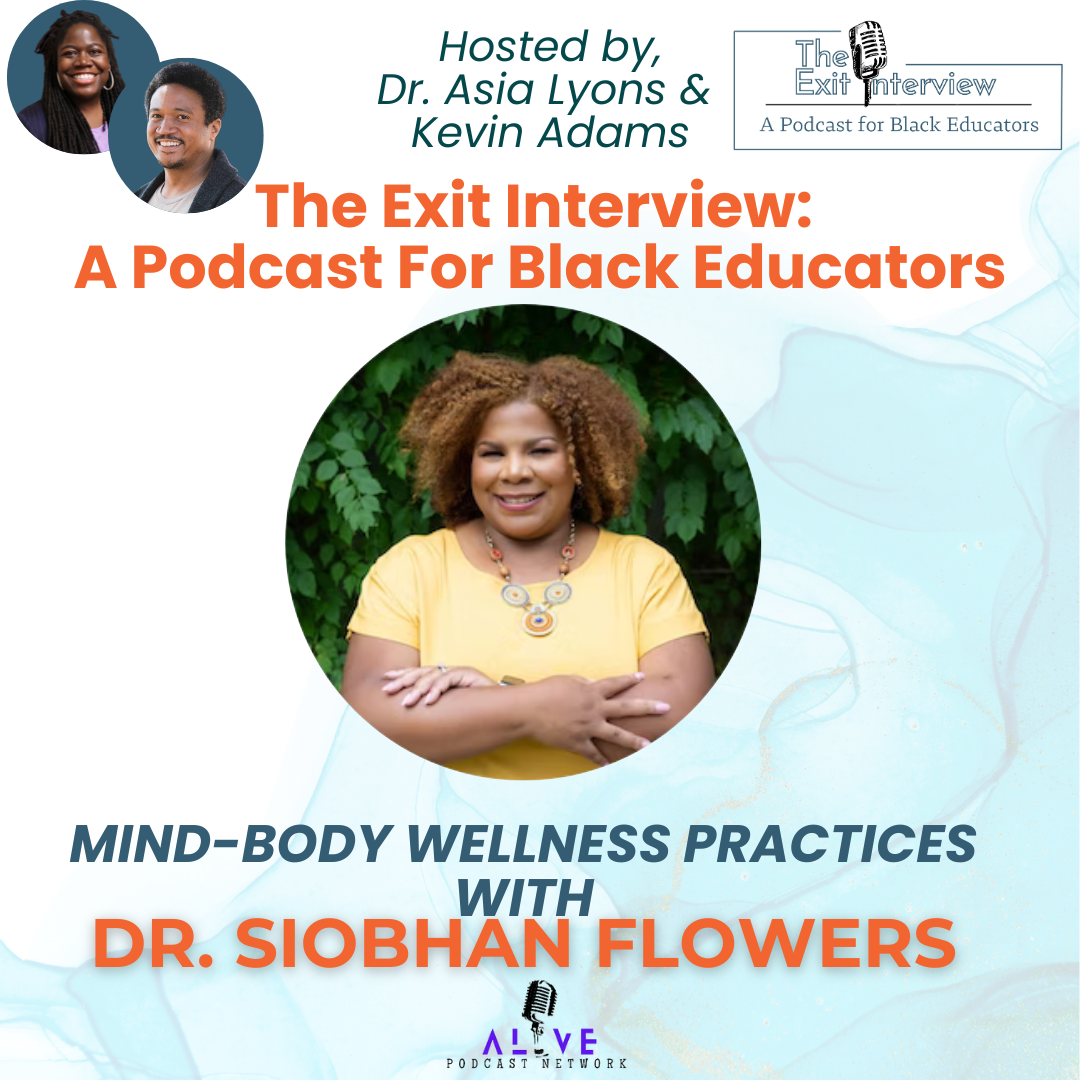
Mind-Body Wellness Practices with Dr. Siobhan Flowers
In this episode, Dr. Siobhan Flowers, a licensed psychotherapist and educator wellness strategist, joins Dr. Asia Lyons and Kevin Adams on the 'Exit Interview' podcast. They discuss burnout and mental health in black educators, dissecting the systemic and institutional barriers contributing to dissatisfaction and fatigue. Dr. Flowers shares her unique approach towards wellness, stressing the importance of mind-body connection, self-regulation strategies, and mindfulness. She provides pragmatic steps for educators to integrate self-care processes into their daily routines. Additionally, they examine the implications of shifting DEI efforts in Texas and ways educators have adapted to these constraints. The episode is peppered with personal experiences, a deep focus on values, and practical advice, making a compelling conversation about the importance of wellness and self-comprehension in the challenging realm of education.


Episode 27: Mind-Body Wellness Practices with Dr. Siobhan Flowers
Hosts: Dr. Asia Lyons & Kevin Adams
Guest: Dr. Siobhan D. Flowers, Licensed Psychotherapist & Educator Wellness Strategist
Episode Summary
In this powerful episode of Exit Interview, Dr. Asia Lyons and Kevin Adams welcome Dr. Siobhan D. Flowers, a licensed psychotherapist, educator wellness strategist, and former high school counselor and English teacher. The conversation centers on the unique challenges Black educators face, the impact of systemic inequities, and the importance of mind-body wellness practices for sustaining a long and healthy career in education. Dr. Flowers shares her personal journey from K-12 teaching to higher education, her passion for representation, and actionable strategies for self-regulation, healing, and community care.
Key Topics & Segment Breakdown
**0:00 – 2:00 | Opening & Introductions
- Dr. Flowers discusses the importance of realistic expectations and how work impacts personal well-being.
- Dr. Lyons introduces the podcast’s mission: elevating the stories of Black educators and addressing retention.
**2:00 – 6:00 | Guest Bio & Early Career
- Dr. Flowers’ background as a teacher and counselor.
- The significance of representation in education and her transition to higher ed.
**6:00 – 12:00 | Navigating Career Transitions
- Dr. Flowers shares her journey from K-12 to higher education, including personal motivations and the impact of her father’s passing.
- The emotional challenges and growth that come with leaving the classroom.
**12:00 – 18:00 | Trends in Higher Ed & Racial Battle Fatigue
- Discussion of mental health, burnout, and the lack of support for Black faculty.
- The importance of community, policy changes, and representation in leadership.
- Navigating DEI rollbacks and creative resistance in restrictive states like Texas.
**18:00 – 25:00 | Grief, Loss, and Disenfranchised Grief
- Dr. Flowers explains symbolic and disenfranchised grief among educators, especially with the loss of DEI initiatives.
- Personal stories from the hosts about grief in the wake of political and social events.
**25:00 – 32:00 | Healing, Wellness, and the Role of a Wellness Strategist
- Dr. Flowers defines her role as an Educator Wellness Strategist and the importance of implementation over information.
- The intersection of mental health, wellness, and education.
- The need for community and support for educators, especially in their early years.
**32:00 – 40:00 | Wellness Strategies for Black Educators
- Normalizing the challenges of working within oppressive systems.
- The concept of “compassionate productivity” and balancing professional and personal life.
- Anchoring work in purpose and values-based living.
- Practical self-regulation strategies and the importance of mind-body connection.
**40:00 – End | Retention, Healing, and Resources
- Discussion on why Black educators stay or consider leaving the profession.
- The difference between knowing what needs to change and implementing it.
- Dr. Flowers’ advice: embody healing, honor your humanity, and practice self-compassion.
- Resources: Dr. Flowers’ digital planner with self-regulation strategies, group coaching, and free webinars.
Notable Quotes
- “You have a birthright to wellness. It needs to come from a place of self-love.”
- “Wellness is liberation. It’s not a luxury, but a vital element for our long-term survival.”
- “You have to feel to heal.”
Guest Bio
Dr. Siobhan D. Flowers is a licensed psychotherapist, educator wellness strategist, and former lead high school counselor and English teacher. She specializes in Black Educator Wellness, teaching self-regulation and mind-body practices to reduce stress and prevent burnout. Dr. Flowers is based in Dallas, TX, and serves clients nationwide through her private practice and coaching programs. She has been featured in Essence and Counseling Today.
- Website: balancedblackeducator.com
- LinkedIn: Dr. Siobhan D. Flowers
- Instagram/Facebook: @balancedblackeducator
Resources & Calls to Action
- Free Digital Planner: Download Dr. Flowers’ planner with 20+ self-regulation strategies at balancedblackeducator.com
- Group Coaching & Webinars: Check the website for upcoming free events and group programs.
- Connect: Reach out to Dr. Flowers for coaching, consulting, or speaking engagements.
Connect with the Show
- Website: ExitInterviewPodcast.com
- Share & Review: If you enjoyed this episode, please share, post on social media, and leave a rating and review.
- Be a Guest: Are you a former Black educator? Contact the show to share your story.
First of all.... have you signed up for our newsletter, Black Educators, Be Well? Why wait?
Amidst all the conversations about recruiting Black educators, where are the discussions about retention? The Exit Interview podcast was created to elevate the stories of Black educators who have been pushed out of the classroom and central office while experiencing racism-related stress and racial battle fatigue.
The Exit Interview Podcast is for current and former Black educators. It is also for school districts, teachers' unions, families, and others interested in better understanding the challenges of retaining Black people in education.
Please enjoy the episode.
Peace out,
Dr. Asia Lyons
Dr. Sioban Flower: [00:00:00] It's the mind having realistic expectations really impacts how we feel about ourselves and the work. And then how we feel about the work and what we're doing influences how we show up, whether it's professionally or at home. And so you don't want to have any type of professional environment totally drain you to the point where you are absolutely depleted and have nothing else left to give, for your families.
Dr. Asia Lyons: Amidst all of the conversation about recruiting Black educators, where are the discussions about retention? The Exit Interview podcast was created to elevate the stories of Black teachers. Professors, counselors, social workers, and administrators who have been pushed out of the traditional education space.
My cohost, Kevin Adams and me, Dr. Asia Lyons are on a mission with our guests to inform school districts, teachers unions, family, students, educators, and others interested in understanding the challenges of retaining black people in education. Welcome to. Exit interview, a [00:01:00] podcast for black educators.
Welcome back everyone. This is episode 27 of the exit interview, a podcast for black educators. Kevin, episode 27. Can you believe it?
Kevin Adams: 27. Like I think about it like in years. So when I was 27, I was finally, I think that was, I started teaching. Officially wasn't a substitute. Yeah. So lucky number.
Dr. Asia Lyons: Yeah. Lucky number 20.
Dr. Sioban Flower: I started teaching at 27 also.
Kevin Adams: Oh, there we go. All right. There we
Dr. Asia Lyons: go. That's so awesome. And so for those who can see and hear, we are here with a special guest, Dr. Siobhan D. Flowers. And I'll just go ahead and read your bio. So Dr. Flowers is a licensed psychotherapist and educator wellness strategist, and also a proud former lead high school counselor and seventh grade English teacher.
Pause for seventh grade. Let's go.
Kevin Adams: Middle school love in the house,
Dr. Asia Lyons: always. Yes, [00:02:00] always.
Kevin Adams: Seventh grade is the off year, too. Seventh grade is the off year. Six, six. Love sixth graders. All right, we know what sixth graders are like. Eighth graders, we know what they're like. Seventh graders?
Dr. Sioban Flower: And that was my first grade and only grade, so I really only know that seventh grade middle school dynamic.
We can be sweet, yeah.
Dr. Asia Lyons: In her coaching and consulting practice, Dr. Flower specializes in Black Educator Wellness and takes pride in teaching self regulation strategies and other mind body wellness practices. As a way of reducing stress and preventing burnout, she has been featured in both Essence and Counseling Today magazine and continues to hold space and create outlets for black educators to prioritize their mental wellness and emotional well being.
Dr. Flowers maintains a therapy private practice based out of Dallas serving clients throughout the state of Texas and a coaching practice serving educators in schools nationwide. Welcome, Dr. Flowers.
Dr. Sioban Flower: Thank you so much for having me. [00:03:00] I'm glad to be here. Thank you. Yeah,
Dr. Asia Lyons: we're glad to have you. And we already started talking about education and you being an educator.
So tell us what helps you decide to become first an educator, K 12, right? And then now you're a professor. So tell us about that journey.
Dr. Sioban Flower: Yeah, I know it sounds cliche, but I've always considered myself a lifelong learner. And so it was really when I graduated with my bachelor's and thinking about what I wanted to do, just wanting to.
Make an impression, a positive impression on young people. And so again, got started there at the K 12 level. As we said, seventh grade English transitioned into being a high school counselor with that transition towards my first master's degree, and it was really in my own kind of graduate program that I really fell in love with the idea of like teaching and higher ed, because I had a positive experience with my professors and really was engaged with the content.
And I thought, this would make a really good [00:04:00] transition. And Again, K 12, taught seventh grade, transitioned to becoming a lead high school counselor. But then when I made the decision to go back again for my PhD, that's when I decided to really focus on the mental health piece kind of head on.
And that's when I actually got my first higher ed position. And being in that environment, working with the adult learners, just loved it, never looked back. And I think too, just from a representation standpoint. From my bachelor's to my first master's and second master's and PhD, all of those years, I only had two black professors, and they were both black women, I had zero black male professors, and I know we know how important representation is, and so it was really important for me, also, to be in that number to where, again, the students were Of color black students in particular could see themselves in me.
And so I think in terms of being a model of what's possible, it was important for me to show up in that way. And so that kind of also what guided my career path into the [00:05:00] higher ed field as well.
Dr. Asia Lyons: Yeah, that makes total sense. The transitioning out of middle school, I love the K 12 to the higher ed.
Was that a difficult decision? Kevin and I have talked about this so much, about the students expecting us to be there, showing up, and being the first and only, sometimes, in the K 12 space. Was that a difficult transition for you? I think it was
Dr. Sioban Flower: in the beginning, but I knew I was called to even greater purpose, if you will.
And in and around that time, my dad had passed away and I remember having several conversations with my dad about me one day, going back and getting my PhD. And so I just had this revelation you know what, if not now. When? And so I think that also motivated me for a different reason, but of course.
Even still today, I still, there's parts of me that kind of miss that K 12 environment and just the relationship that you build and the rapport with the students and all of that. And so it was hard, but I knew I needed to [00:06:00] leave that environment to do what I felt like my next level consisted of or the next phase of my life.
Yeah,
Dr. Asia Lyons: a hundred percent. That transition, it's necessary for sure, and sometimes it's easier than others in the situations. Yeah, I
Dr. Sioban Flower: just viewed it as part of my growth.
Kevin Adams: Dr. Flowers, your story, I think on the exit interview, we look for trends, right? We look for the repeating patterns, right? And I think what we see with your story of how you got into education is a passion to support kids.
And to be there, now you are here with us, it's important to delve into how you got there, with this passion to be with kids and now you're on the exit interview. When we think about things that you've noticed in your experience, your professional career, what trends do you notice in higher education regarding black staff, [00:07:00] faculty fatigue, how we get through it all?
Dr. Sioban Flower: Yeah, so I think there's a number of things that we can touch on. Just. The lens that I typically view things are related to mental health and wellness, and so I can speak more to that piece of it, but I think, obviously, racial battle fatigue, impacts us on a mental and emotional level.
And so I think, issues related, of course, the more obvious things like chronic stress, if left unchecked. Easily leads into burnout. And so I have seen a lot of my colleagues in that space. And I think because of those things, just like the overall just lowered sense of job satisfaction, maybe it not turning out to be exactly what they thought it was going to be.
And I think all of those things really just a decreased kind of overall sense of well being. And so I'm not really feeling like they can fully show up authentically. As themselves, and I think a lot of that is the lack of community and support that may exist on a lot of college and university campuses where there's no opportunity for black [00:08:00] faculty and staff to come together and have just a safe space to share their experiences to share best practices, resources for fighting racial battle fatigue.
And so I think. That's maybe more of the negative side. There are some lessons that I've noticed. I really feel well, and these are trends that I hope become more developed, but like a more intentional effort regarding like policy and structural changes around maybe reviewing, revising tenure and promotion processes, making sure those processes are equitable.
I also think things related to what does the representation look like in leadership roles beyond just the faculty in the classroom, but the higher up, like the administrative staff, what does the racial makeup of that level look like? And I think too, just addressing the pay disparities. I think that's also another way that we can really be intentional about making sure that we feel valued and so really making a concerted effort.
Again, the pay disparities, all of the things that speak to [00:09:00] us feeling valued and being able to show up in a positive way. So the increased advocacy and awareness in that area is definitely important. Whether that's through faculty associations, or, even the way that a university honors and values.
The black student population can positively affect the black faculty and staff. And so I think, yeah, I can definitely a holistic approach is what is needed. And so I've seen again, both good and bad. Of course, I think like increased DEI effort are always warranted. But, unfortunately, if you're in a state like mine in Texas, where it's been ruled that it's DEI department in any public.
College or university, people are having to get real creative around what that representation could still look like within the confines of the law. But again, it's just important to not let again, external, whether it's political pressures, whatever the case may be, not to deny [00:10:00] us of our humanity in terms of our birthright to be able to show up in these spaces.
As ourselves to be able to take up space and know that we really belong there.
Kevin Adams: I think that's so important, when you talk about the context of political state right now and what it is overall. And then I think of we're here in Denver. And I'm sure in Texas, the same thing, there's a teacher shortage, in particular, a teacher of color shortage, in particular, a black teacher shortage, in particular, a black male teacher shortage, you think about all of this, but you said something that I'm interested in. So tell us, and I love the underground parts of it, what are teachers in Texas doing to get around the law right now? What are they doing to maintain? Is this what I wonder about, DEI is outlawed, all the things that luckily enough, like I'm allowed to talk about in my building and I made the transition to being a building leader, an assistant principal, supporting [00:11:00] Native and Indigenous education at my school.
Which we can go into a whole episode about why that's important, but what are they doing in Texas to resist? I think resistance is important for all of us educators of color.
Dr. Sioban Flower: Yeah, so I think first of all, I noticed some Creativity with the names, more of a focus on Accessibility in general less on again like race and ethnicity Even though, again, you can still, have ways to target larger audience and groups of students and people, but again, it could be labeled as something else.
Versus maybe what it was previously called. And I think, too, what I've seen, not necessarily that I have a direct impact in this area, but just more equity in terms of like admissions policies and practices to still be able to, again, maintain a diverse student body and still allow them to feel welcomed without them having, again, like an entire separate department.
And so I think, again, some of [00:12:00] the educators, the higher ed educators that I have as clients, they. Have had to do their own grief work around what this transition has meant for them because they've devoted their whole life, basically, to DEI efforts, and now just feeling and witnessing it being just ripped away from them for reasons that, again, we just don't, we do and then don't understand.
And again, I think there's been a lot of emotional pieces to this, too, that aren't always. Talked about, but again, I think it just goes back to and what ways can we still show up and make our presence known without it being determined by some again, external party with their own agenda and to not let that impact ultimately what students and black faculty want to experience on campus.
Dr. Asia Lyons: Yeah. Can you talk more about, you said grief work, that more educators that you're talking to who are your client are experiencing their own, it's shifting and moving through grief. Can you talk more about that? Yes.
Dr. Sioban Flower: So [00:13:00] grief, I think in general is difficult for the average person to talk about. There's not necessarily a comfort around it because, I think we are really driven towards fixing things and pushing through uncomfortable emotions.
But to sit with grief and there's the traditional grief when someone passes away, but then there's also the symbolic grief or what we call disenfranchised grief, which is the type of grief that. It's rarely acknowledged, and so that's what makes it disenfranchised, and I think, again, the type of grief and loss that the educators that I've worked with have experienced, particularly around stripping away of DEI efforts, that definitely falls under more of that symbolic loss, that disenfranchised grief, because they also have not necessarily had a space to really Share what's come up for them around their identity and their humanity and the passion that they have in this work.
And what does it mean when someone else says that what you do doesn't [00:14:00] matter essentially. So I think there's a lot of loss embedded in that dynamic. And so that's something that I do help my clients work through and process because it's a byproduct that's not. Often talked about and I often have to bring it up to my clients because they'll have these experiences and these emotions behind it and they're not quite able to really label it.
And so I offer some of the language and the verbiage around that, as you are experiencing a type of grief or loss around this.
Dr. Asia Lyons: It's interesting because you're saying. It's this conversation of what you do doesn't matter. And I really think also, yeah, who you are, what it's saying is who you are. It doesn't matter.
Your identity. I was in a group supporting a group actually this last week. And we were talking about the topic of grief and just like the reality that some people in folks buildings or in their counter campuses are really happy about this, when Trump was elected, I think about. But I was sitting in assembly [00:15:00] and one of the teachers on our staff, most of us were shocked, but he, I looked over and he has like his American flag socks on.
He was excited. He was so excited. And I just think about so many of us I thought that we all would be grieving, but for him, it was a celebratory time. And then the grief also came of I thought I could trust this person. So I was also grieving relationships that I thought were solid. And that's a hard part, I think, too, is that people who you thought were going to be supporting this or will just look past or let's just keep going. Let's just forget about it. And it's I thought that you would be in solidarity, and that's just not been the case. So that grief, I totally can relate to that.
Dr. Sioban Flower: Yeah, and I had a similar experience like on, when January 6th happened, because it's one thing to know that privilege and all that exists, but then when you actually see it on display, it was just a very sad day for me. And I was actually, it was a day that I had to teach students, and I [00:16:00] was just visibly emotional and I made it clear.
It's about the country, but not so much about the country. I was saddened by what happened, but more so again, just the symbolic nature of it. Knowing that, again, we as black people, as people of color would not have had that same privilege to express our anger and frustration in the same way.
And so for me, there was a kind of similar to what you said. There was just some grief and loss around that. Just being so direct in your face.
Kevin Adams: No, it's funny that you both bring that date or those moments up, because I can think distinctly how it felt in my school community. The day after Trump was elected, we had an assembly.
Lucky enough, we had the great H Soul from Denver come through and lead an assembly and he had Kendrick planned, he had Alright planned, so a lot of us felt the vibe in the room, which was a good thing, I think we needed that, but then I remember January 6th, and I remember specifically coming in and being like, the [00:17:00] next day, that's what the lesson is.
This is what the lesson is. And it was about the inequity, the injustice, because I was like, if, and I work at a school that's predominantly Latinx. And if any of them had taken to the streets like that, we know what would have happened. Yeah. We know what the outcome would have been.
Dr. Asia Lyons: Yeah. A hundred percent. So thinking about toxins were in the conversation of talking about grief, I also want to talk about healing. And you say in your bio, you say in LinkedIn and folks check out Dr. Flowers on LinkedIn and other places, if you haven't, you talk about being an educator, wellness strategist.
Can you tell us what an Educator Wellness Strategist is and what helped you decide that was one of the paths that you wanted to take in your work?
Dr. Sioban Flower: Sure. As the name implies, focused on the wellness of educators. The reason why I specifically chose The verbiage of like strategist versus maybe like coach or some [00:18:00] other name is because I'm really big on the implementation of things.
And I think, we live in an information age, anything that we basically want to know in terms of what to do, like information, we go on Google and all of that. But it's one thing to know something and then something completely different in terms of coming up with a plan, coming up with systems, coming up with the implementation of how do you actually incorporate these wellness practices.
Into your day to day life, especially with the busyness that comes with being an educator and being stretched in so many different ways, wearing so many different hats. And so what really drove me to this work, of course, having my background as a mental health therapist is helpful because, again, I feel like my own personal zone of genius, anything at the intersection of mental health and wellness and education.
And the reason why I specifically focus now in my therapy practice. I see clients from all kinds of occupations professions, but specifically in my coaching and [00:19:00] consulting, I wanted to focus on educators because even all those years prior, like I never forgot my own experience, even with all of the experience that I have now in terms of different jobs, I can honestly say my time, especially like in the K 12 environment, it was one of the most rewarding yet most challenging.
Jobs and positions that I've ever had. And so I'd never forgot just how overwhelmed I felt. The levels of anxiety teetering on burnout and the lack of support wished I had more of a community, especially like my first few years of teaching. And so just really wanting to bridge that gap and be that resource thinking about, what I could have definitely used or benefited from when I was in those.
positions and so just decided to bridge the two worlds together in terms of what my background and who my background can help with now.
Dr. Asia Lyons: Yeah, that makes so much sense. The reciprocity. I [00:20:00] think that's huge. I think about And not to say that you use the word pain, but I think about my grandmother's hands.
Oh, yeah. Yeah. And it taught the conversation on clean and dirty pain, right? And what does it mean to do something with the pain? I don't want to put words in your mouth to say it was, you talked about being close to burnout, but thinking about how folks can take these experiences they've had in education.
And do something with that, that can bring joy or wellness or healing to others and to themselves versus internalizing that and letting it eat them up from the inside. So totally makes sense to me. What are you thinking about Kevin?
Kevin Adams: Just ultimately, I hear a lot about wellness and we talk about wellness in my school districts and in my building.
And what does that mean? And how I think for particular black educators, wellness in the educational environment, or Kano educators, [00:21:00] Latinx educators, indigenous educators, LGBTQ plus educators, it really means there's a lot wrapped up into it, right? Because not only is it our experience Educators as professionals.
It's also our experience as students, and I think there's a lot that goes into that and I'm just thinking about my life, my position right now, and just thinking about how that plays out with the educators I work with, educators of color. Because, at times, and I've experienced this, where I have certain ideas about what got me where I am, and maybe those ideas weren't always positive or the right things, and how do they impact how I interact with my students of color, right?
In particular, my black male students. And how does that affect my overall wellness of who I am? As an educator, when you take that away, and it's you have to resolve those contradictions that exist. I
Dr. Asia Lyons: love that. You make a good [00:22:00] point, Kevin. We were once black children in schools. Yep. Yep. I think maybe one reason why it doesn't always come to mind for me is because I was a product I'm a product of Detroit Public Schools.
To the DPS, Detroit Public Schools, and having black teachers. And having white teachers who understood they understood the assignment, right? Okay. Yeah. Like Mrs. Cooper in who was at least 147 years old and she was about the black kids, right? She got it. And when I think about so many of our students, Black children are not in spaces like Detroit Public Schools where there are Black kids, and Black teachers, and Black janitors, and Black principals, and Black like all the things that are Blackity Black in the 80s and 90s.
That's right. It's yeah, I have to remember that. Depending on
Kevin Adams: where you live, right? Yes, it all
Dr. Asia Lyons: depends where you live. Yeah, you make a really good point. Because you're from [00:23:00] here. For those who don't know, Kevin
Kevin Adams: I have a transplant. I grew up, that's a whole other episode, Asha.
You know that we'll go into that one day.
Dr. Asia Lyons: Yeah, we'll have to talk about your Highlands Ranch experience from Atlanta.
Kevin Adams: From Atlanta. Yeah, that's right. I tell people about it that's a show. That's the show. Yeah. We should talk about that.
Dr. Asia Lyons: Yeah. Hey, we're talking about this idea of what it means, like what your clients are talking about as far as some of the like close to burnout or burnout that they're experienced.
So like what strategies for those who are listening who may not be able to work with you because of all the reasons, like what are some strategies that black educators can utilize in their day to move towards healing, to move towards a wellness journey. From experiencing just burnout from education being a difficult career to on top of that racial battle fatigue, experiencing the emotional, psychological, physiological responses to racism related stress, what can they do to support [00:24:00] themselves?
And I want to add, what can they do to support their families as well? Because, of course, our families are experiencing a lot of this with us. Yeah,
Dr. Sioban Flower: so I think the key themes that I see that show up often, and first, I just, I tend to want to normalize their experience, because when you think about what it means to be an educator and work in education being one of the oldest and largest institutions that exist in this country, and so with that institution, Thinking about, institutionalized oppression, systemic racism, just being folded up into that institution and so being very careful about what you choose to take on in terms of self blame, like what is yours to truly own and take responsibility for and what is just an unfortunate byproduct of the system that you're a part of.
And so I think really tapping into that piece in terms of the mind body connection is really important, knowing that you have. A birthright to [00:25:00] wellness. And so it really needs to come from a place of self love though. So again, not being super critical of yourself, not being overly judgmental. It's we cannot guilt or shame anyone into changing.
And that includes ourselves. And so really approaching it from how can I support myself? How can I encourage myself? I talk about, I don't know if this is a real term or something that. In my head, I've just made it up. I call it compassionate productivity, where you realize
Kevin Adams: that Dr. Flowers, that's a real term that you made up in your head.
So that's you. That's you.
Dr. Sioban Flower: I'll own it. I'll take it because in my mind, it's one of these things. Again, we're human beings, there's this, especially being within education, it's I don't really believe that there's a such thing as being caught up, like the work will never end. There's always going to be something that you could be doing on your plate.
And the truth is, it's going to take up however much time you allow it to take up. And so you have to [00:26:00] decide, where's that line in the sand for me? And I think this is where that family piece comes in, because whether you realize it or not, at work, your students, your colleagues, or even at home, your family, if you have children, extended family, people are looking at you as like a model and an example, like how well are you actually balancing.
The two, and I think there's some conversation on, if balance is really real or if it's a myth, I tend to prefer like integration more so than just straight up like balance, because to me, balance implies that everything has to be equal at all times. And we know that's just not real life. That's just not how life works.
And so I like to look at it as balance happening in seasons. And again, August, September, the season of the school year starting, I think people will tend to naturally lean more towards focusing on their professional work as educators. But then being very intentional about, okay, at what point can I ease off of this?
And then... Fold [00:27:00] more into my personal, my family. So balancing energy, I think is really important. And then also just, anchoring your work in something bigger than yourself in terms of what sense of purpose and meaning do you derive from your work, does it go even deeper in terms of, when you are feeling at your tipping point, almost tapping into that, like ancestral strength to be able to say, what.
I can do this. There's a long history of people having it way worse than I have now and keeping a healthy perspective on this and not letting it overwhelm you. So even if you have to take a step back, knowing that you're doing that from a place of self love, I think is really important. And so all of these things working together, I really truly believe it's the mind having realistic expectations.
Really impacts how we feel about ourselves and the work, and then how we feel about the work and what we're doing influences how we show up, whether it's professionally or at home. And so you [00:28:00] don't want to have any type of professional environment totally drain you to the point where you are absolutely depleted and have nothing else left to give, for your families.
Also talk a lot about values based living and have clients identify what. Are your top three to five values and what do those values look like in your real life in your day to day? What do you see yourself doing that is representative of those values and then realistically, how often are you able to tap into that?
What can you do in terms of carving out time and space to really have more opportunity to infuse those values into your life? Not just saying it, but embodying it is really important. And I think that goes back to. The mind body connection, you want things to be aligned. So that way you feel like you're able to show up as your full self, regardless of where that happens to be.
I love that. I
Dr. Asia Lyons: have so many questions.
Kevin Adams: Lacing the atmosphere with jewels, as they say, [00:29:00] but there was so much there that I'm thinking about. But this idea of authentic self showing up and feeling comfortable in the space and everything that you're talking about, is stuff that I'm sitting at as a new building leader.
How do I do that? And also balance because kids have needs too. And like I've said before, we got to hang up. We got stuff that we are working through ourselves. And I love that idea of being able to tap in and know who we are. Like our values, I think that's an important point. Why do we show up and do this work on a day to day basis?
And I think for all educators, but in particular our experiences, our interviews, Asia with black educators of color, it seems we come with the mission. We're driven, right? We're driven with this mission that there's something bigger. But I appreciate all of that. I hope that our listeners take those [00:30:00] ideas to heart because some of that stuff is the hard stuff to come to terms
Dr. Asia Lyons: with.
Yeah. I think that the first thing that you said that I wrote down was be careful what you take on. And we had Dr. William Smith on the podcast some time ago now, it's been a minute. He talked about picking your battles, right? And I've had people just last week, I was talking to one of my mentees. And she asked me, what should I do when I just hear people saying all out of the box things?
And I told her, I said, you have to decide what hill you're going to die on. You can whack a mole and just every kind of hit it, and wear yourself down. Or you can decide what can I impact? How can I preserve my sanity to keep going? When for her, she's a therapist that goes from school to school.
Not just one community. It's a six or seven different schools. That is a lot of conversation to be doing. And so I let her know. Yeah, we love to I want to tell her off. I want to say this. I want to do this. You don't fight
Kevin Adams: every fight. I'm
Dr. Asia Lyons: not fighting every [00:31:00] battle. No, yeah. That's not
Dr. Sioban Flower: sustainable at all.
Dr. Asia Lyons: It's not. And I understand why people do it. Because it's this is our kids. This is our schools. This is our community. And it's not fair that people come in and harm our children. I 100 percent get that. And at the same time, I always talk about this idea of all the ways that we show up and we're preparing for the conversation with the person and we're rehearsing it the night before and then we have the conversation and replay it in our mind and we call our friend and tell them what happened and we text our other friend.
All that takes away and robs us of time that we could be spending doing anything else. That's And so I know that I'm going to be, let's say, in a conversation that was 30 minutes prepping and do all the things and it takes actually four hours of my time away, that's shaving time off my life.
Kevin Adams: Yes. As my granddaddy said, shown up.
Yeah.
Dr. Asia Lyons: So I just love that. I just want to hit that home for people. We open our eyes to the realizations that racism [00:32:00] exists and the school systems are all lip service or whatever your situation is. And we want to run out and attack the whole thing. And it's, I don't know if that's such a good idea for people.
So I'm glad that you said that. I want to ask a follow up question here. When you are talking to Black educators who are your clients, do you find that a lot of your clients Are thinking about leaving or are on the way out or have left as you are supporting them or do that just overall? Do you feel like most of the folks that you work with just while they're with you?
They're staying in education.
Dr. Sioban Flower: I think it's more along the lines of, they're still in education. They plan to stay. However, the seed has also been planted in terms of them. Questioning or wondering what are the opportunities out there exist? And I think especially as it relates to what they're perceiving as a better quality of life, can a position out there exist for me where I can have that kind of elusive.[00:33:00]
Work life balance, and I can be able to actually leave work at work, or if I need something to do my job, it doesn't have to come out of my own funds, all of these types of wonderings that they're having in their mind. But yet, and still, at least for now, the majority of the educators that I work with, they are still committed and determined to still stay, in the classroom, in the school buildings because of the work that they've been called to do.
But it definitely has popped into their mind in terms of that sustainability piece. If nothing changes or if it gets worse, how long am I going to be able to last in this environment?
Dr. Asia Lyons: Yeah. Thank you for that. I feel like so many people I talk to who are teaching one year and the next year they're not and some go back in a different school district or different.
position inside the same school district, but Kevin and I, we always ask the question what do we believe, what do folks believe that districts and unions can do to keep black educators and people have all types of ideas. But what we find [00:34:00] is, we don't know, I shouldn't speak for Kevin. I
Kevin Adams: don't know. AJ, you speak for me, we heard the same thing.
Yes, we did, Kevin. We've been listening to the same conversation. Yes,
Dr. Asia Lyons: we have. I just didn't want to speak for you, Kevin. I'm just saying, people, I don't... But what
Kevin Adams: is the change? And I think we have these conversations over and over. With people, nothing changes. We see the same thing. Over and you just wonder, as Gerardo, our great colleague would say, is it a bug of the system or is it a main feature?
Is that the intention?
Dr. Asia Lyons: Yeah. So just to wrap us all up today. So our last question, I'm thinking about it now that I've written the question and I'm asking you thinking about your story. I'm making some assumptions, but I'm going to ask the question anyway. What are you noticing on the other side of your own journey that you would like to share with others that are listening in the audience?
Dr. Sioban Flower: Sure. Yeah, I think it's an important question because first of [00:35:00] all, I'm glad that you have framed it as it's a journey. It's an ongoing process. It's not a. Destination. So again, as it relates to like our growth and our evolution, thinking about it as a lifelong journey. But I think some of the main things that I have noticed in terms of healing and growth, not just with myself, but with educators that I work with getting to a place where you can actually embody the healing, not just talking about it, but being about it, almost what you just said.
Like we know. The problems that exist, we know how to keep and retain black educators, but what are we actually doing? And so there's a big difference between having information and, again, implementing the actual knowledge. And again, just, you have to be grounded. In your body, have a very strong sense of identity, knowing again who you are in relation to others around you, who are you in relation to the environment around you.
So just having a really strong sense of self, I think, has been really important for me to feel like I have [00:36:00] more autonomy, be more in control. And I think too, instead of allowing things to instantly trigger me. I work really hard for my first reaction is to always become curious about something and if I can, if it's not anything just outright egregious, always try to give the other person the benefit of the doubt instead of wondering if they're okay, I'm assuming, okay, you know what, maybe they're going through something right now, is there a way for me to be a little bit more generous or compassionate towards this person until I find out what their intention was or more information.
So again, things that are within my control. Okay. Reduce the stress around me, I think is really important. And again, it's a lot about honoring your own humanity. It goes back to that piece, and what ways can you be kind to yourself and to other people? And almost like that ownership piece that we talked about earlier, what do I have the current capacity to do?
Because I don't want to crash and burn. You cannot be all things to all people, even though, again, that's. Probably innate in [00:37:00] a lot of educators just really wanting to show up in that way and, but, that's not a recipe for long term wellness as humans. We don't have this infinite supply of willpower and self discipline and energy.
We have to pause. And replenish ourselves. And so that's why I really feel like wellness, it's not like this luxury, something that, Oh, it'd be nice to do. It really needs to be like a vital element for our longterm survival. So I think all of those things really, what I tend to focus on in terms of my healing journey and things that I'm very mindful of now, because there can be true recovering in healing, but it is, there's not any.
Like short term quick fix. It really has to be embodied as a part of your lifestyle.
Kevin Adams: Thank you. I think that's so important. I think that's the thing that is often dismissed and, I guess a person who's gone through professional development and all of the things where we talk about bias and all of those things, I think.
[00:38:00] That's missing a lot of the times is the acknowledgement of the humanity.
Dr. Asia Lyons: So important. Yeah, it is. So you, tell us about your business, how people can work with you, tell us all the things. This is a time for folks to say okay, I've got to get more. So tell us about
Dr. Sioban Flower: that, please. I invite everyone listening to stay connected with me.
Again, you can find me on LinkedIn, just Dr. Shabandi Flowers. The name of my coaching and consulting is Balanced Black Educator, so like on Instagram, on Facebook, even the website, balancedblackeducator. com, you can connect with me there. And so several times throughout the year, I offer like free webinars, free trainings, and I do have a group coaching program.
One thing that I can offer as a freebie, if you visit my website, I have a digital planner with about 20 to 25, what I call self regulation strategies. Going beyond self care in terms of, yes, getting your hair done, getting your nails done is important, but we actually want to [00:39:00] do some of the things that release the stress.
from our bodies because the stress can get trapped, like even at the cellular level. Also, things like racial trauma lives in our bodies and so we need to really be mindful about what we're doing in terms of stress release activities that really give us an opportunity to discharge a lot of that negative energy and reset ourselves.
And so I talk a lot about just nervous system regulation, what it means to be able to. Have that mind body connection. And so again, it's a free planner, but it gives you some specific like self regulation strategies that you can practice. And it offers you an opportunity to plan when you're going to implement those things.
And so again, it goes beyond just talking about it. I really want you to be intentional about when are you going to incorporate these activities into your life? Some of the things you can do during the school day, some things, may be better for when you're at home or have a day off, but it's really about being mindfully intentional about your wellness.
And again, viewing it as not something that [00:40:00] you do like after the work is done. But viewing it as an integral part of how you show up each and every day. Love
Dr. Asia Lyons: that. Kevin, last word before you wrap it up for today. Thank you,
Kevin Adams: Dr. Flowers. Yeah, thank you. I love the wisdom. I think one thing that I've never thought about, and I think probably as black male educators, It is mind body wellness, how I take care of myself.
Me and Asia have talked about it, the John Henry syndrome. With it, black educators will put on their selves that I know I put on myself. And I just think... The world for people like you, who are pushing this type of work and getting us to think about this stuff because it causes me to remind myself that, Hey, I'm doing the best I
Dr. Asia Lyons: can.
Yeah,
Kevin Adams: I'm being intentional. I come at the work with love and light and I can afford, especially as I move into my new position, I can give myself grace. Because [00:41:00] absolutely, I don't have to get it. All right. As long as I'm trying to do the right thing.
Dr. Sioban Flower: Yes. Wellness is I like to frame it like wellness is liberation.
And that can definitely be a part of your liberation practice. How you show up being that model and that example that you don't have to choose. One over the other, and also you have to be able to be willing to feel what's coming up for you. It's an important part of your healing process. So I like to say also, you have to feel to heal.
That's an important part of what this journey looks like.
Dr. Asia Lyons: Love that. You have to feel to heal. All right, folks. This has been the exit interview a podcast for bike educators. Thank you, Dr. Flowers for coming on and we will see you all on another episode. Peace out.
Thanks for listening. If you enjoyed this episode of the Exit Interview, a podcast for Black educators, please help support the podcast by sharing it with others, posting on social media, and leaving a [00:42:00] rating and review. And as always, we're looking for former Black educators to interview. If that's you, send us a message on our website, ExitInterviewPodcast.
com.

Licensed Psychotherapist / Wellness Consultant
Dr. Siobhan D. Flowers is a Licensed Psychotherapist and Educator Wellness Strategist (and also a proud former lead high school counselor and 7th grade English teacher). In her coaching and consulting practice, Dr. Flowers specializes in Black educator wellness and takes pride in teaching self-regulation strategies and other mind-body wellness practices as a way of reducing stress and preventing burnout. She has been featured in both ESSENCE and Counseling Today magazine and continues to hold space and create outlets for Black educators to prioritize their mental wellness and emotional well-being. Dr. Flowers maintains a therapy private practice based out of Dallas serving clients throughout the state of Texas and a coaching practice serving educators and schools nationwide.