Supporting Black and Brown Male Educators with Dr. Dedrick Sims
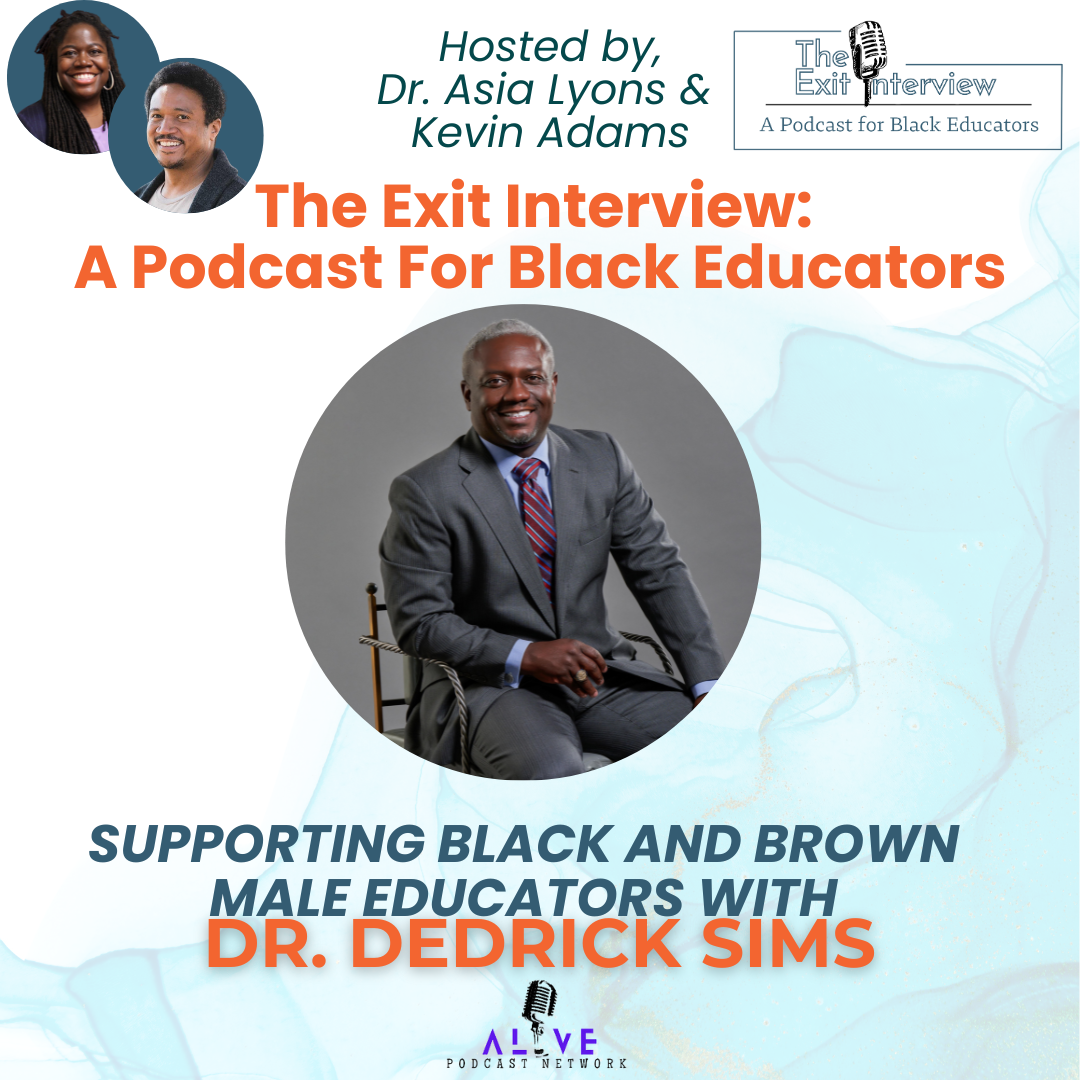
In this thoughtful and insightful episode of The Exit Interview: A Podcast for Black Educators, Dr. Dedrick Sims discusses the importance of Black and Brown male educators, the challenges they face, and the steps needed to support them more effectively. He also shares his personal journey in education and his ongoing work to improve the lives of young men and boys of color through his organization, the Sims-Felder Foundation. In a candid conversation, Sims talks about the role of counseling in addressing personal and systemic issues, shares the impactful results his foundation's programs have achieved, and explores the need for societal-level changes to genuinely support Black educators and students. The episode concludes with lively audience interaction, ending on a note of collective inspiration and motivation. Whether you're an educator, a parent, or simply invested in promoting better educational outcomes for all, this episode is a must-listen.







In our first live tapping, Kevin and Dr. Asia sit down with Dr. Dedrick Sims of the Sims-Fayola Foundation to talk about the importance of retention and recruitment of Black and Brown male educators, his own education story, and what it means to heal while doing the work of educating our youth.
Dedrick is currently serving as the Chief Executive Officer of the Sims-Fayola Foundation. The Sims-Fayola Foundation's mission is to improve the life outcomes of young men and boys of color and improve the capacity of youth professionals who partner with them.
Dedrick's career in urban education began in a high school classroom over 20 years ago as a substitute and has since served in roles as a High School Biology and Chemistry Teacher, Secondary Curriculum Administrator, Master Lead Teacher, Technology Coordinator, Alternative School Teacher, Dean of Students, Assistant Principal and Principal of both traditional and charter public schools (Co-Ed and Single Gender), and school Founder.
Dedrick's commitment to education extends outside the classroom as well. As a published author of three books and numerous professional articles, Dedrick uses his experience to build the capacity of others to serve students with informed excellence. As the Sims-Fayola Foundation CEO, Dedrick provides professional training to educators around the country in single-gender learning, working with young men and boys of color, and school and program design through an equity lens. Through the Sims-Fayola Foundation, Dedrick's work has impacted over 14,000 young men and boys of color and provided workshops and coaching to over 6,000 professionals who work with young men and boys of color. Dedrick has also been the lead designer and founding member of three Arkansas, Colorado, and Louisiana charter schools.
Dedrick's community involvement includes having served as an appointed member of Colorado’s Workforce Development Commission, Colorado’s Serve Commission, the Governor's Juvenile Justice and Delinquency Prevention Council, a Youth Commissioner for the city of Aurora and Denver, among other efforts. Black Enterprise Magazine selected Dedrick as one of the national 100 Modern BE Men of 2018 , Sisters Enterprise's "Random Acts of Kindness" 2020 honoree, and one of the African Americans Who Make A Difference for 2021. Dedrick has served his country as an officer in the United States Army and is a Kappa Alpha Psi Fraternity member, Inc.
The Denver Urban Spectrum, GlobalMindED, Blended Magazine, Voyage Denver, Shout Out Colorado, and Spark The Change have highlighted Dedrick's work and personal story.
Dedrick is an avid golfer and loves to read, travel, and do karaoke!
First of all.... have you signed up for our newsletter, Black Educators, Be Well? Why wait?
Amidst all the conversations about recruiting Black educators, where are the discussions about retention? The Exit Interview podcast was created to elevate the stories of Black educators who have been pushed out of the classroom and central office while experiencing racism-related stress and racial battle fatigue.
The Exit Interview Podcast is for current and former Black educators. It is also for school districts, teachers' unions, families, and others interested in better understanding the challenges of retaining Black people in education.
Please enjoy the episode.
Peace out,
Dr. Asia Lyons
Supporting Black and Brown Male Educators with Dr. Dedrick Sims
[00:00:00] What you see is heavy or what you see is noisy out there. It may not truly be noisy. It could be just you. You haven't healed from when your dad didn't show up or you didn't heal from when you saw your mom doing this or
Dr. Dedrick Sims: the neglect or being left on the stoop. And you got to deal with that. In our community for so long, mental health and support and counseling has been taboo or not even just don't even have access to it.
And so you never had that healing moment, but now you're a teacher trying to heal and regulate kids. Nah.
Dr. Asia Lyons: Amidst all of the conversation about recruiting Black educators, were other discussions about retention. The Exit Interview podcast was created to elevate the stories of Black teachers. Professors, counselors, social workers, and administrators who have been pushed out of the traditional education space.
My co host, Kevin Adams, and me, Dr. Asia Lyons, are on a mission with our guests to inform school districts, teachers unions, families, students, educators, and others [00:01:00] interested in understanding the challenges of retaining Black people in education. Welcome to Exit Interview, a podcast for Black educators.
We are back! But different Kevin, where are we today?
Kevin Adams: We are coming live and direct from T Liz. Cafe and bookshop. Mm hmm. Very good. We are so happy to be here live. We got an audience. Audience, make some noise for us. Yeah, there we go. There we go. And we are so happy to have our guest here today, Dr. Sims. Dr.
Sims, welcome
Dr. Dedrick Sims: to The Exit Interview. Oh, thank you so much. I'm excited to be here and excited to have this conversation that I think is so, so critical. So thank you for having me.
Dr. Asia Lyons: Super excited. I met Dr. Sims some time ago, we were trying to remember what year it was, but at least ten years
Dr. Dedrick Sims: ago? Probably.
You know, when you vibe with people, you forget beginnings and [00:02:00] endings. Yeah,
Dr. Asia Lyons: I love that. We vibe. We vibe. So yeah, it's been a, I know Louis was not around, so definitely kept in contact. Dr. Sims is busy out here in these streets. He's doing the thing. Oh, a hundred percent. I've had meetings with him where he's in the car headed to somewhere.
out of state, like several meetings where he's like Go ahead and start talking. I might lose you, but I'll come back. So, he's definitely busy. So, we're so excited that you had time to come and connect with us because you are a busy
Dr. Dedrick Sims: man. Yeah, my schedule's quite disrespectful.
Dr. Asia Lyons: That's a good way of putting it.
That's a good way of putting
Dr. Dedrick Sims: it. It's quite disrespectful. Disrespectful,
Dr. Asia Lyons: yeah. No, for real. So I guess we'll just jump into it because he has other things to do. As he said, He has a disrespectful schedule. It does not care, right? It does not care. No, it does not care. So we're going to start off the way we always start off is tell us your story.
How did you get into education?
Dr. Dedrick Sims: You know, I got into education [00:03:00] out of the military. I've always had kind of this natural orientation to teaching when I was in college. I was tutoring other freshmen. I was tutoring seniors. And I always had the ability to get the information to someone in a way that they understood it.
And when I got out of the military, I started teaching, right? I started teaching, went down to Mobile, Alabama, and started teaching, uh, high school anatomy, physiology, biology, and chemistry, and fell in love with it. My first year of teaching, I was voted Teacher of the Year. There you go. There you go. That's awesome.
Kevin Adams: Wait a minute.
Dr. Asia Lyons: Wait, he said my first year
Dr. Dedrick Sims: teaching. First year teaching. And it was Teacher of the Year as voted, you know, like in the school. I was brand new. That's big. It was a huge school. And I think what made it so special to me that it was voted by the students. It was voted by those who we were impacting.
So it wasn't anything political about it. And so I took that and I still see that as one of my biggest accomplishments of all [00:04:00] the things I think I've done. I think that that's probably one of the biggest ones first out the gate. And so I moved from teaching and became a master lead teacher. Then I went down to Mossport, Mississippi and did director of curriculum and instruction.
And then I went to hip and became a principal of an all boys school in New Orleans. And then I got this big idea that I could do this better. And so frustrated with the educators who I was being surrounded with. They weren't in it for the right reasons, there was a bunch of politics going on, all the kids in the school looked like me, they were suffering, and I felt like we were just in this rat race.
And I got the idea of starting a charter school. I left New Orleans and came to Denver and opened Denver's first all boys charter school. And I've opened two more since. Hold on, hold on. We
Dr. Asia Lyons: gotta back up a little bit. Nah, man. Guys. First of all, like, I need, it's sometimes, like, two years here, three years here, five years here.
Tell us some of those pieces and then catch us up to how you got [00:05:00] to, to
Dr. Dedrick Sims: Denver. Yeah. So I was seven years in Alabama, two years in Mississippi, two and a half years in New Orleans and then I got to Denver after that. I went to 2010, 2011 charter school conference, met. Now Mayor Mike Johnston, he was Senator Mike Johnston at the time, Peter Groff as well.
And I just went over to them and said, hey, I got this great idea about opening this all boys school. You know, I have, my connection to Denver is I have an aunt that lives here. Okay, okay. And my aunt was saying, hey, look, I know you want to open your own school. There's a lot of things going on in the far north.
This one that was closing down, Montbello, and it was hot. It was hot in Montbello. It was like, politically hot. And she said, yeah, you know, check it out. They're being real friendly to charter schools. They're closing some schools down, so you may have an opportunity. And so when the charter school conference came, I found Mike Johnston, I found Peter Groff.
They were sitting together. I went over and pitched an idea. I said, I got this great idea of opening this all boys school, grades 6 through 12, with a focus on international studies. I'd be for all the kids [00:06:00] and they said, this sounds really, really good. There's a guy I want to connect you with. His name is Mike Hancock.
He said he's a city councilman right now, but I guarantee you, he's probably going to be the next mayor of Denver. Oh, wow. So back in the days when Southwest flights were like 89, I was flying back and forth from New Orleans to Denver, like frequently two and three times meeting with Mike. And then he said, I'm going to introduce you to Landry Taylor.
And then it just kind of smooth off from there. And so all that. People who I needed to connect with, initially, I connected with. Sure. And I started to build this coalition here in Denver in 2011. DPS board unanimously approved us to open up. Wow. Unfortunately, that school closed, right? DPS politics. But unfortunately the school closed and I was able to, the foundation kind of grew out of that.
It was, the Sims Felder Foundation was all, was to originally serve as parent organization for the Sims Felder Academy. I wanted to open 10 [00:07:00] schools. And after the first year in the far northeast, we did a really, really good job. We were almost recognized by DPS as having some of the highest growth scores, you know, on the TCAP at that time.
And we did really well. And so I got ahead of myself. I started to go to Atlanta, started to focus, you know, this is actually the first time I'm telling this story public.
Dr. Asia Lyons: And that's what, that's, that's, that's
Dr. Dedrick Sims: why this is the first time I'm telling this story public, man. And so, and so, yeah, I was going back and forth to Atlanta, trying to get the school open in Atlanta, and then just really lost sight of what was happening here.
I overestimated the capacity of. the board and my staff here and, you know, things started to happen. People started to do things that wasn't in alignment with what the model was. And so, you know, I walked away and then school closed, but I found out by a phone call that the school was getting ready to close down.
Yeah, yeah. So I wasn't even, I wasn't even part of it. I had stepped back, you know, to do the [00:08:00] foundation. And so that school closed and then there was a lot of pain and hurt that was associated with it. I wanted to quit and move, but God wouldn't let me. Like it's who I am. The hurt was just manifesting itself in that way.
And then I started to just think about the best things that the school did and started to create programming for the foundation. And that was almost 10 years ago. And now we are 14, 000 boys later.
Dr. Asia Lyons: Wait, wait, wait, hold that story. You jump in the head. This is why, when we have people, we tell them the questions ahead of time, they always jump ahead
Dr. Dedrick Sims: of us, Captain.
I forgot the questions already.
Dr. Asia Lyons: You always say that, right? I do, I have. Do you have any questions, any thoughts, Captain? It is part of the story.
Kevin Adams: If you could, can you tell us about, and I know you said it's DPS politics, And maybe not everybody is DPS related listening to the podcast, but can you talk about, you know, what you mean by some of that DPS politics and, and the closing of the school?
Because I think we've seen this a lot in this [00:09:00] city where people have started really important schools doing really great stuff. Speaking on behalf of myself. I've noticed that the Denver Public Schools don't always
Dr. Dedrick Sims: support these schools. Yeah, I mean, it was a crazy relationship. I mean, you know, DPS does some things right, but in this case, I think we were so unique they didn't know how to treat us.
That we were the only boys school, and I mean, there were times when Office of Accountability would, and Innovation would come out to the school and to do site visits and try to evaluate us and they would say, that's really no school for us to compare you to, but you're doing this wrong.
There's no one to do it. Nobody done it. So it was that kind of relationship. It was a struggle back and forth. And I say DPS politics. There were people who were vocal about how that school should not have existed. This school should have never gotten approved. So I knew from the beginning that we didn't have the kind of support [00:10:00] that we needed.
So we had to prove our model and we did. We proved our model. But again, we had, we had the boys that other schools thought were uneducable. They kicked them out. We had kids coming out of juvenile system. And we had tremendous growth, kids were coming off of IEPs, we had like a 22 percent spread rate, the district I think was around 12 or 14 at the time.
We were able to move kids off of IEPs because the environment that we created, the peer mentoring that we supported, the peer mentoring that was going on, and more importantly, I was training our staff and our teachers on how to work with young men. There's a difference on how to work with young men and how to create learning experiences that are lending itself to the strengths of boys.
And so, you know, we did great. And, but, we couldn't navigate the politics for them.
Dr. Asia Lyons: Can I ask, when you said that people really pushed against you even starting school, what were some of the comments that people were saying, or the reasons, why they believe the
Dr. Dedrick Sims: school shouldn't exist? [00:11:00] I'll never forget, I was, so part of the approval process, you had to have multiple, like, committees to look at your, Charter application and say, yes, this should go forward and no, it shouldn't go forward.
And I never figured I was in one of those meetings with my team at the time. And the guy looked at me who was leading the team and he said, I noticed that this school has an IB for all concept. I said, yes. He said, well, do you know what IB is? I said, yes, I wrote the application, yes, I've been an IB coordinator, yeah, I know exactly what it is.
Oh, but then you know it's tough that every kid cannot do this. And the kids that you're trying to serve, are you sure that they can do this? Can we just pause?
Dr. Asia Lyons: Pause for the loss. Yeah, for the loss, that's what I want to pause for because I'm pretty sure even if that particular person is no longer in a district somewhere, that person is duplicated.
All over the
Dr. Dedrick Sims: [00:12:00] place. It was a community person. They wouldn't even talk to them. This is one of those community panels. Wow. You know, like they give it to the community, they give it to the officials in the school system. Yeah. And this was in that community
Dr. Asia Lyons: one. Interesting. So community members that not believe in their own community.
Oh wow, go ahead, continue, please.
Dr. Dedrick Sims: So I said, I looked at him and I said to myself, I said, you know, this is probably going to get the application denied. I'm about to speak my mind. And I said, sir, do you believe in the IB program? He said, yes, I absolutely do. I think it's one of the best ways to engage kids in learning.
I said, I do too. I said, if we believe that this is the best way to engage kids and learn, then why shouldn't all kids have it? Does this become a teacher capacity problem, an adult problem, or are we still pointing fingers at the kids? And just because these boys that we're looking to serve are boys of color, does that exaggerate your feelings about it?
Is that why you asked me that question? I said, I think it's a [00:13:00] civil rights issue and that we should. Teach all kids in the way that we think is the best way for kids to engage in learning and become productive citizens. So absolutely, I know what IB is, and I know exactly what I'm doing with the school.
I thought we were done, but we got approved. Yeah. I thought we were done. I mean, I'm new to the city, didn't have any allies here, so, you know, but yeah. I mean, I think
Kevin Adams: that's interesting, you know, because right now, in the district, There's a push for advanced classes for all students. So you're on the cutting edge of where we are now today to say that all kids deserve access to advanced classes, to IB classes, to reverse education.
But it's always interesting the way it plays out. But you said they
Dr. Dedrick Sims: approved the school. They approved the school. That's a great model. But I've seen great models not get approved because they didn't have the politics right, or didn't have the right people on the board. I think I just got the first part right.
Because they were, I mean, out the gate. I just felt like we were under attack, out the [00:14:00] gate. So, that's what I meant by the politics. And, I think affirm that, is that we've seen schools after me, after Sims Fields Academy, close, and get attacked in very similar ways, who are serving very similar kiddos. What were some of the
Kevin Adams: criticisms, like, when they, they have to give justification, what were some of the reasons why they said since FIOLA, they were
Dr. Dedrick Sims: pulling their support for the program?
Yeah, well, I mean, again, I wasn't part of it when it closed. I was kind of on the periphery, but it was about enrollment. It was enrollment. It was that the school didn't attract enough kids to pay the bills. But, I mean, I think that was also a result how the then board handled the transition and who came in.
You know, Simsville, that was my baby. It was a school that I created. I understood the why behind it. And when my board and I became at odds and I decided to step back. It was, the school was still so early that people believed more in me than they did the school, right? Sure, sure, sure, sure. So they were [00:15:00] still looking for the promises that I said that, that would happen.
And when I stepped away, then there were some families who started to leave, but the people who were there, I guess they didn't have the capacity to continue to tell the story in the way that I told the story. Yeah. I
Dr. Asia Lyons: mean, and it makes sense, right? It makes total sense. Yeah. Leadership. People do move to a place, go to a particular job, show up in a certain way.
Because of the leadership, right? And for the positive or the negative, it's because of the leadership. So I 100 percent understand what you're saying about that, yeah. So, thinking about that, we hear your story, you're getting ready to transition, and we're kind of in this question of like, what was the thing that pushed you out of traditional education?
So, knowing that the school had closed, you decided not to, sounds like, open another school, obviously, here in Denver. But then you started to talk about the Simsville Foundation, but before we kind of jump into like where you are now, tell us what was that like? I cannot [00:16:00] open another school here. Was it just like DPS?
Cause you could have maybe tried for a different district, right? What was it that said, you know what, instead of going to a different district, we're just going to try a different model altogether.
Dr. Dedrick Sims: I mean, I was still hurt. Right. And. You know, having, having opened three schools, opening one is a monumental task.
Sure. Like, that's heavy work. Not only are you, you know, thinking about the instructional framework and all those things and the model, but you have to get the politics right. You have to convince people to come along the side you. And to support, you have to convince parents this is the best place to, to send their kids.
And you can't do that kind of work hurt. That's a sermon right there. Yup. That is. The rest of the podcast can be about that right there. You can't do heavy, meaningful work hurt. At least not well. That's right. Probably why the exit interview even in it. Yeah. You know
Dr. Asia Lyons: what? And that's exactly right. That's exactly why the exit interview exists, because folks have [00:17:00] realized.
Right? You can't teach in the ways and show up in the ways and be a school psychologist in the way or an admin in the way that you really want to be if you're like
Dr. Dedrick Sims: bleeding. Yep. And when I healed, I thought about it. I went and talked to APS, just trying to really understand the process of maybe this happening again.
But ultimately I decided to open two more schools outside of Denver, one in Louisiana and one in Arkansas. And so when I started to heal and even now, I look back and realize that. One seed had to die for everything else to grow out of that experience with Sims Fella Academy, Denver, two more schools exists, a foundation exists that has footprint in nine states, 14, 000 going on.
It was that and I think also I went through a little spiritual kind of journey myself for that year. I was hurt. I didn't want to go out. I woke up and prayed and [00:18:00] meditated every day and I came across the story of David when he was in the cave of a dulem. I may be saying it wrong, but he went to the cave and when he went to the cave, guess he surrounded himself with 300 other hurt men.
And they spend time in the cave to heal. And when they heal, they went out and did great things. I had to separate myself from the product. The way I came up in the way was my life experiences. The only thing that allowed me to think that I had control over my life. were my accomplishments. I grew up in a very tough way.
Mama's on drugs, the whole nine. Dad wasn't around intentionally. There was violence in our home. There was drug selling. There was shooting. There was all kind of things going on. And the one place that I could find peace was in school and with my accomplishments. Those are the places that I had, I got affirmed.
It was Ms. Van Hoose, it was Ms. Keyes, it was Dr. Posey. Like, you remember those people [00:19:00] who embrace you. And when I knew there was more outside of my four block radius because I was being exposed by my teachers, I started to strive for more. And I'm getting emotional even talking about this right now.
Dr. Asia Lyons: You were just talking about this, like, this year that you were
Dr. Dedrick Sims: just healing.
This year I was healing. So from that time on, from high school all the way into adulthood, I was wearing different masks in order to, like, fit in in different places when I was in the military. So I got to a point where I lost myself, but I was always achieving something and people were always saying, you know, you're doing great here and I'm getting awards there and doing this and doing that.
And so whenever that thing died, whenever the school died, I felt like I died. I felt like I lost my identity. And that period that I went through taught me to detach myself from the thing, that I was worth something outside of the thing. And I think that gave me the energy and the healing to go on to do what I've done [00:20:00] since that thing, which is 10 times more.
I want to
Dr. Asia Lyons: talk about, Kevin, maybe I'm sending you beams here because I want to sit in this idea of healing for a little bit. Yep. Because I find that there's a lot of black educators who leave teaching and are not healing. Right? And then they go into non profit spaces, entrepreneurial spaces, and they're so wounded that they're on the defensive, and it just makes everything much harder for them.
And for lots of reasons, they can't afford to just kind of take a break from the place, whatever the situation is. But so many of us are coming, we talk about racial battle fatigue here on the podcast. People who, and you didn't say it was about race, but people at Black Educators who experience racial battle fatigue, they come out and they think, I'll just, you know, I need a month or I'll, I'll think about this summer or this next job will help me heal.
And that is not the case, right? I was part of some of the work that I do outside this podcast [00:21:00] is we have. Black Educator Wellness Cohort and we had our retreat this last month and one of the people in our cohort said it took her seven months. Like, seven months before she felt like she came back to herself of not working, of doing nothing.
And that's a privilege for her to be able to not work. But there's so many of us who are just out here, just so wounded and so exhausted and so frustrated, but have to keep showing up. And so we're not really back for ourselves when we go on to the next venture. So I'm glad to hear you talking about healing and this need to heal and how it really helped you to.
bloom into what you are now.
Dr. Dedrick Sims: Yeah, I mean, and I took that seriously. I mean, even with the Simmons Fellow Foundation right now, we do initiated an initiative called Self Care Mondays. And so every fourth Monday of the month, we engage in some sort of self care activities. Of the 14 staff that I have, 12 of us are men of color.
And what I do know is that dysregulated people can't help dysregulated [00:22:00] And we are in schools and in communities working with young men who may be dysregulated, need support, STL support. But what I know as a leader, as a black man, that my employees, my team members, my coaches are black and brown men who also didn't get the support that we're trying to give people.
I noticed in even some of the interactions that their response and then sometimes the way they react to the frustration that come with working with dysregulated kids. That it wasn't really healthy. And so I took my own journey of healing and I said, You know what? They are out there mentoring and healing all of these young men that we work with.
It is my job to do the same to them. And so we engage in, like, acupuncture. We've had guys who work for me who just got their first pedicures, massages. Get those heels.
Dr. Asia Lyons: Get those high heels out there.
Kevin Adams: I feel attacked. I know.
Dr. Asia Lyons: I'm looking at you, Kevin. I'm looking. Yeah.
Dr. Dedrick Sims: We do massages, book studies, we're reading Cry Like a Man right now.
[00:23:00] Next week, they're gonna do a mindfulness coach, massage, ear acupuncture, many M I N I facials, and, and massages. So, for the last 90 minutes of our day, every day next week. You know, we're going to do that. Then we have team builders on the weekend sometime as well. But those book studies and the conversations that I have with them and the resources that I have around healing, I'm passing on to our guys.
And we're having conversations, what they're having conversations about their lives and their health and their mental health that they've never had before or in this way. So, it helps them to become better coaches to the boys. You can understand how to re regulate once you learn to re regulate yourself.
Hurt people hurt people, right? Well, heals people heal
Dr. Asia Lyons: people. Yeah, ooh, I love it. Yeah, thank you.
Kevin Adams: I think that's so important in that bigger picture, the humanity of that. Black males of color, men of color, like we are people, right? And [00:24:00] sometimes it's so removed from that. But thinking about your experience, if you could go back and you could have the magic wand, you could talk to Dr.
Morero, you could talk to Susana Cordova, who's now head of All Education Colorado, talk to the union, talk to educators. What things do you think can be done, because one of the things that we're thinking about in the exit interview, I know Asia has her perspective on this question always, but what can be done to retain black educators?
To maintain programs like your academy, to increase that, what do you think, if you could wave the magic wand, what would you do, or tell them to do?
Dr. Dedrick Sims: Yeah, well, I think first we gotta quit, we gotta move from the disposition of tolerating each other. When you tolerate somebody, You already put a barrier up.
I'm going to get through this. You're not fully embracing them, you're tolerating them. And I feel like for so long in education systems across the country, [00:25:00] black educators in particular are tolerated, not included, not really the attempt to try to understand culture in a way that could be beneficial to education.
It's a lot of lip service. But it's not a whole lot of action. We spend a whole lot of money covering up racism. We get the new curriculum, we get the new this, right? We get the new bus route, we tear the school down, we build the school up, we, all those things. And it's just flat out racism in a lot of cases.
Flat out racism. And we gotta call it what it is. And so if DPS or APS or any school system across the country is looking to retain black educators, You have to agree with yourself that they're necessary, that brilliance comes from diversity and inclusion, that black people were really part of the fabric of creating this country.
And that if we were brilliant enough to do that, that we're brilliant enough to be involved in education. You have to invest in black educators [00:26:00] development. And the most important thing is that when we say that we are hurt or been micro aggressed against, you gotta believe us. Yes, period. You gotta believe us.
I think that's
Kevin Adams: really important. They accept our story, our experience, because I think a lot of times they don't. They think it's just us, or it's just a
one
Dr. Dedrick Sims: off, but... A lot of race lighting going on. Over and over again. It's a lot of race lighting, yes, going on. Race lighting, yeah. Race lighting. A lot of race lighting
Dr. Asia Lyons: going on.
I just looked this stat up, that I guess at the end of 2022, there were 888 black teachers in the state of Colorado. just enough to maybe fill an elementary school, right? When I was going through my dissertation research process, the district that I left at the time had 86 black educators. By the end of my dissertation process, when I was double checking all of my information, They were like 46.
Wow. And it only been like two years. I didn't take that long to get my dissertation done, right? So, [00:27:00] though it felt like it. So, yeah, we're not being replaced by Black educators. We talked about this. Folks love to fly out. We're in Colorado. Fly out to HBCUs, set up a whole table and convince people from Atlanta, from New Orleans, from Detroit, from all these, Chicago, thank you.
Um, if you need to come out here, we have this, this, and this, and this, and no, and we'll pay stipends. Branson Lockett, who was on our podcast a while back, she was on the East Coast. They pay for her to move her stuff. They pay for her apartment, some of the like, first and last, all the things, and she wasn't there more than three years.
We know, I cannot remember who told me this. I want to say Stacy, but I don't know if it's true that like most of the educators that we have in Colorado who are black are from here. So like, why would we spend money on the folks already here, right? To fly two people from HR in a school district out somewhere, put them in a hotel for two, three nights, feed them all the [00:28:00] things.
How many programs, how many strategies, how many things can we do to invest in black educators with the exact same money? Right around here. Right here. But not go across the country. Yeah. About, it's from about, and it's always been for me about retention. Because recruitment, to me, people love it because it's sexy, like, ooh, these fresh young, yeah.
But if there's something to be said about the people who have been here 30, 40, not 40, that's a bit much, but 10, 15 years, who know the schools, who know the kids, the political climate, and who are showing up every day. So why don't they get the same amount of love and respect? Investment, yeah. Yeah. Yeah, that's the truth.
So, next question is, you've been talking about it, but it's my favorite question. Well,
Dr. Dedrick Sims: let me say this real quick, if I can, it's on my mind. Around this question of what can school systems do to retain black educators or educators in color in general. Education is a social industry that adopts social ills.
And our country is sick right now. [00:29:00] And this country has been sick for a long time as it relates to how do we treat, you know, black folk. And I don't know that the improving of retention and recruitment of black educators is going to improve without the country's improving their perception about black people, their wealth.
the worth of black people. Some will tell you that we lost our worth when slavery was abolished. Oh yeah. You know, I do some DEI workshops around the country, and there was this one girl who asked me, she said, why do you think that black people have it so bad? Like, why do you think black people have it so bad in the United States?
I said, well, you know, I think that one thing is we were the only group of folks that wasn't invited or welcomed to America. We didn't come in with Lady Liberty waving at us. We came in at ships and couldn't see Lady Liberty. We came in at the bottom of the boat. And so that was a very specific reason that we were brought here, and [00:30:00] when that reason was lost, we lost our value.
And there's still some of that going on right now. Why educate a kid who I don't see as valuable? Yeah. Don't play with me. I can be on this podcast all day. We can do a part two. Folks don't really hear me talk like this unless they're in my workshop. Yeah. That's what's up. The
Dr. Asia Lyons: reason why I like that question, Kevin, so this is Asia's favorite question, is because I don't believe that we can retain Black educators.
Because we don't want to. And I shouldn't say we, because... I'm out here free, right? I'm free, I'm free, so. It was a spree. It was a spree, yeah. And so, and I've always, because like you said, it's not, education system is not in a silo. It's tied to health. It's tied to housing. It's tied to all these other things.
And until we work on all these things simultaneously, we can just forget it. Right? That's the reality of it. That's what I've always believed. I would hope to be wrong, but I have not been wrong yet. Yeah.
Dr. Dedrick Sims: I mean, [00:31:00] but that's how you manage your emotions around because you realize what the real problem is.
Everything else is just a symptom, a manifestation, like you know what the real issue is. And so in order for you to be impactful and effective in what you're trying to do in the little pebble you're trying to throw in this, you have to do it from a healed position. It doesn't mean that everything is right.
But the healing is that I understand why this is happening and I'm going to move in a way that allows me to navigate why this is happening. You know, am I upset that this is happening? Absolutely. But is it going to stop me from doing what I'm doing? No, because I'm in a healed place that allow me to continue to be effective and focus on the main thing.
I keep the main thing the main thing. Yeah, I love that. I'm not going to argue with you about it, but okay, if that's your position, that's fine. I'm moving ahead. I think that's what we
Kevin Adams: do as black people, that we
Dr. Dedrick Sims: flirt. That's what I'm good at. Still love you. I'm just going on. Yeah,
Dr. Asia Lyons: for sure. Again, you've been hinting about it, you've been talking about it this whole podcast.
So, what are you doing now? Nothing. [00:32:00] Yeah. Okay. With a disrespectful, uh, schedule?
Dr. Dedrick Sims: I'm doing everything and nothing. Okay. Everything and nothing. Like John Legend said. Yeah. Everything and nothing. Well, currently, you know, I'm the CEO and founder of the Sims Failure Foundation. We've been around for almost 10 years.
It's crazy to think about that. I remember when I loaned the foundation its first 30, 000. Now we're pretty good. Over the last nine and a half years, we've impact, like I said, greater than 14, 000 young men. We've worked with through workshops and coaching a little north of 6, 000. Youth service professionals who work with this population.
So we're talking teachers, counselors, social workers, law enforcement, school resource officers, you name it. If they are working with young men and boys of color, we have the capacity to support and work with them through workshops and those kind of things. We're based here in Denver, but we have footprints in nine other states and a variety of programs to include a recent expansion to Los [00:33:00] Angeles, so we're working in like seven or eight schools in Los Angeles, in the Compton area, South Central wise, like in the areas where we think we should be.
Yeah, so we have programming that focuses around social emotional skills, social emotional growth. mental behavior, wellness, financial literacy, introduction to the arts. We have programming that exposes young men and boys of color to careers and experiences that are underrepresented by people of color.
So we have great partnerships with a variety of industries, aviation, oil and gas, STEM, jewelry, food and beverage, those kind of industries. We have mentoring programs in person, online, remote. Over the last nine and a half years, Our programs have resulted in a greater than 60 percent reduction in suspension, greater than 60 percent reduction in negative discipline incidents that have to do with violence.
And a greater than 60 percent reduction in insurances for the young men who have gone through our program. So our program is highly, [00:34:00] highly successful. This past year we were in about 23 schools in a different metro area. This year we're projected to be in about 33. We're only limited by how quick I can hire.
So, we have programs that run on the weekend, we have a diversion program now, so try to keep young men and boys of color out of jail. We have two tracks in that program, if you're justice referred or if you're just a parent and say, oh my God, you need some help before you get to that side program. And we're getting ready to launch a male educators of color fellowship to recruit, retain and sustain male educators of color within their first three years.
We're looking to do 20 fellows in this first cohort, we're already at 15, and I feel confident that we're going to get that five. So yeah, and we have workshops, you know, that we do hardwired by nature where we work with educators on creating learning experiences and programming that's considered of both culture and gender.
Working with Boys of Color Workshop Series. We have workshops [00:35:00] for parents called, Connecting with Your Sons. Really understand what boys can and can't do at different age bands, and it's really helped them to become better advocates for their young men, both in life as well as in school. So yeah, I mean, you know, we're not doing too much at all.
Ha ha ha. Working to solve these problems. That's it. That's it. And the latest thing is, before Michael, before Mayor Hancock left, he transferred Denver's My Brother Keeper program to the Sims Felder Foundation. So now we are the backbone organization for My Brother's Keeper, for Denver, that's charged with creating a collective action plan to support young men and boys of color from cradle to college to career.
Love it. So this puts us in the systems change, policy change space, which is where I wanted to be, and I knew that we would be there. We're still doing programming, and we're still doing all the great things that we've done over the last nine and a half years, but this time, The truth is, as great as the work that we've been doing, it's been reactive work.
Sure. We're reacting to the damage that schools and communities are doing to young men and boys of [00:36:00] color. MBK gives us the platform to be involved with the proactive work, to be at the table, to tell the story, and to create the policy that will slow down the damage that's being done. So we're super, super proud of that and looking to really engage in that work.
That's a lot. That's a lot. Beautiful.
Dr. Asia Lyons: Yeah, it is beautiful. Yeah. Which is why I'm so glad you were able to meet with us. I know the scheduling and everything can be, again, disrespectful, but I'm so glad to hear that. Can I back you up a little bit? Yeah. Can you kind of dive more into your recruitment and retention programs that you're rolling 5%.
Dr. Dedrick Sims: And when you look at the research that shows the positive outcomes for young men and boys of color when they have another man in front of them in the classroom, right? Discipline goes down, grades go up, social interactions get better, mentorship happens, social supports increase. And if [00:37:00] that's true, then we're leaving a lot of progress and capital on the table.
And so, the goal is for Colorado to recruit, sustain, and support male educators of color within the first three years. And the reason why the first three years are important because that's when the transition happens. Like, that's when they're gonna leave or they're gonna stay. Or they're gonna stay. And so, because our mission is to improve the life outcomes of young men and boys of color, and we know that having that in the classroom is one of the mechanisms for improvement, then why not?
Why not create sort of a platform to be able to do that? And so these fellows are going to go through a year long experience with us. We just finished creating like all the scope and sequence and the programming. What I'm so proud of is that the first two days, which we call our intensive, is going to focus on them.
It's going to focus on storming and norming with them, SEL. No
Dr. Asia Lyons: icebreakers? No random? None of that.
Dr. Dedrick Sims: None of that. None of [00:38:00] that? Okay. We're going to take them through what I call Scrooge moments. I'm going to take them back through their lives to show them how they picked up things that caused them to be in their own way.
Because sometimes it's not always the man. To be real. Sometimes it's not always the man. Sometimes it's toxic definitions of masculinity that causes us to not succeed professionally. And because we listen to Uncle Leroy, right? And so, I'm going to walk them through moments I call Scrooge moments. Now, we did a pilot of this in Indianapolis last year, and we had 15 guys who were part of the pilot in Indianapolis.
And when I tell you that we walked through Scrooge moments, and there was tears, and there were revelations, and people really understood why they reacted the way they react, and how they show up at work has been wrong. It just validated and gave me so much data that we're moving in the right direction.
And so before we started talking about instructional frameworks and affinity groups, and how do we create classrooms that are anti racist, blah, blah, blah, blah, like you got to get right. [00:39:00] You got to recognize, you have to recognize what you contribute to it. Because what you see is heavy or what you see is noisy out there may not truly be noisy.
It could be just you. You haven't healed from when your dad didn't show up or you didn't heal from when you saw your mom doing this or the neglect of being left on the stoop. And you got to deal with that. In our community for so long, mental health and support and counseling has been taboo. Or, not even just, don't even have access to it.
And so you never had that healing moment, but now you're a teacher trying to heal and regulate kids. Nah. So first, we're going to help you storm and norm within yourself. And then we're breaking it down by quarters. So, once a month we'll meet online, on Zoom, but every quarter we'll meet in person. And we're bringing in national experts to work with them.
So we got Dr. Pedro Noguero, who's already committed. We got Dr. Luke Wood, who has just took over the presidency of Sacramento State. We're looking at Dr. Sean [00:40:00] Harper, and we also have some local talent that we're going to bring in as well, you know, for those quarterly meetings. So our goal this year is to take 20, oh, I forgot about this, the capstone project for the cohort is to create a campaign to convince young men and boys of color in middle school and in high school that teaching is worth it.
See, this is how you prime the pipeline. It won't be enough for me to send out 15 to 20 fellows a year and maintain the system. We need to have 15 to 20, 000 who look at education different, who are black and brown boys to say, I can't wait to become a teacher. So, they're going to put together a campaign to be able to go into high schools to convince them, and that's going to be their capstone project.
And to your point, I don't know if you remember this, that we talked about, you reached out to me, you said, well, what about the families? Remember that? Yeah. She said, what about the families of... The educators. The educators. If they're [00:41:00] not happy, they're, you know, the educators are not going to be happy. So, what we put in here is that...
Every month, the fellows themselves are going to have to come up with some sort of bonding and community building activity that includes the wives, parents, partners of everyone who's in the fellowship. Yes! So if you're moving here, if our goal is to get you to move here from Atlanta and from Houston and from New Orleans and you get here, And you struggle to find your community.
Right. You're going back home. You got a year right now to build community with 19 other fellows and their partners if they have partners. So they're going to take turns hosting these community building sessions in order to build community over, over an entire year. So yeah, that helps with the retention.
Let me
Dr. Asia Lyons: pause. I love that. Because. I was just talking about this idea of, we don't just get pushed out of education by systems, by all the things. We also get pulled out by our family members. Absolutely. [00:42:00] If you come home every night, oh, such and such, such and such, and your spouse or whoever like, well, I got a job over here, I can help you find it.
And they're pulling as the system is pushing our teachers out. Our families are tired of hearing us talk about All the harm and they're trying to figure out how to get us to someplace else. We can downsize our house. We can do this. We can, I can get an extra job. I can. So that's the thing that we've interviewed folks.
RVN shout out. Shout out to RVN Harper. Yes. Yes. That's right. You know RVN. Shout out. She continues to work with us. Yeah. RVN is super dope. And she, when she was teaching. See, she was fantastic. She went part time, right? Her husband put, they were like, okay, let's figure it out. And so he was an entrepreneur and went back into the workplace so that she can go part time, so that she can do some of the healing that she needed to do.
So families are figuring out how to help us leave teaching if that need be. And when we don't think about the family that surrounds the educator, we [00:43:00] 800, actually it's not 888 black teachers. It is 888 black families, right, that are impacted in all the ways. So when they are pushed out of schools, when they're in their car crying before they go to work.
Dr. Dedrick Sims: Or playing gospel music before they go, before they go in work, having a whole Kirk Franklin session in the car.
Dr. Asia Lyons: Listen to me. Listen to me. Israel Houghton. My throat was dry. Yes. Listen. Yeah. And so the thing is, we're not, we're not able to. to show up in those ways and our families see us suffering and they love us and want better for us, right?
And so we have to think about how are we It's going to show up for families, the educator and their families. I love that.
Dr. Dedrick Sims: Well, thanks for bringing it to my mind. I mean, thanks for bringing it to my attention. I was so focused on healing the guys and getting them there and you're like, what about this family aspect?
I was like, you were so right. Yeah. You're right. You ain't happy at home. No papers getting graded. That's it. That's [00:44:00] it. That's
Dr. Asia Lyons: exactly right. That's exactly right. Yeah. Beautiful. So before we started the podcast thing, I told Deirdre, Dr. Sims, I said, here are the five questions. And the last question is, what's bringing you joy these days?
And he's like, uh, that's a hard, that's the hardest one. But he figured something out. So, Dr. Sims, what's been bringing you joy these days?
Dr. Dedrick Sims: Seeing the growth of the foundation. It's not just growth geographically, financially, personnel wise, the growth and the impact. We just went through our data and realized that of the 23 schools we were in last year, we had double digit gains in all the schools, all the schools.
We have boys who come in the programs kicking and screaming and saying, I don't want to leave. Can I come back and, you know, be a part of it, which is what prompted me to create year round programming. So we have, we can engage these young men for an entire year, whether it's career [00:45:00] exposure, financial literacy, social emotional skill development, mentoring, summer school, like we run two summer camps every year, one in Park Hill.
And Montbello for boys. Elementary and Park Hill, middle school and Montbello. So, so yeah, I think I had to reflect on that because that was the hardest question for me. Because I don't take time and people who know me will agree with it. I don't take time to sit back and think about the success or think about, like, the joy in it because I see the work.
And it's like I never not see the work. I think at some point I'll look back at it, but I never not see the work. And for me, it's once you've accomplished one thing or accomplished one goal, there's always another one. If that wasn't true, we wouldn't be still having these same kinds of conversations. 200 years later.
So that's what's bringing me joy is actually seeing it work and the proof of concept working and boys getting healed and families getting resources and finding solutions like that's to an end and to a point to [00:46:00] where I can step back and it runs itself.
Dr. Asia Lyons: Slow down now. Wait a minute. We need your leadership.
Wait. Hold on
Dr. Dedrick Sims: now. I'm previewing something.
Dr. Asia Lyons: Right. Previewing. The next episode. Right. Yeah.
Dr. Dedrick Sims: Next episode. He left. But yeah, that's it. I mean, you know, the organization is very, very healthy place. The right people, got the right people on the bus, in the right seats, and they are so receptive. They're asking the right questions.
They are reflecting on the right things, and they're so open to kind of my guidance and leadership. I love it.
Kevin Adams: So if our listeners want to get involved with the Sims Paola Foundation, what do they need to do? If our students want to get involved. Black educators want to get involved. Educators of color,
Dr. Dedrick Sims: what do they need to do?
Reach out to us. I mean, we have a variety of ways to, to get in contact with us. Our website, obviously, you know, sffoundation. org. We have a healthy social media presence. So, respond [00:47:00] to, you know, any one of our newsletters or posts that go out. Yeah. I mean, if you want to email us, it's info at sffoundation.
org and we'll respond. All right.
Kevin Adams: Well, Dr. Sims, thank you. Yes. Thank you. It's been a pleasure. You've dropped jewels. Oh, for sure. I appreciate it. All sorts
Dr. Dedrick Sims: throughout this. I appreciate it. And we appreciate you. You know, I think, I appreciate the platform. I like the platform. I like the idea. I think it's necessary.
So, thanks for allowing me to be the first live one. Wow. Yeah, first live. Yeah, first live. I got a career
Kevin Adams: in radio
Dr. Asia Lyons: now. Yeah. So, um, well, that wraps up our episode of the Exit Interview, a podcast for black educators. Am I forgetting anything, Kevin? Give me the look. You're not forgetting anything. Okay, good.
All right. Well, we'll see you out here. If you are a former black educator across the state, Make sure that you reach out to us. If you're interested in [00:48:00] sharing your story on our podcast, you can reach us at exit interview podcast com or info@exitinterviewpodcast.com. We have one more speaker. Right? Who wants to come up and share?
Come on up. My
Dr. Dedrick Sims: intuition is
Dr. Asia Lyons: pretty good. So this time I said,
Dr. Dedrick Sims: let them introduce themselves and it worked out. So first of all, thank you. We were baptized by
Dr. Asia Lyons: technology, but I
Dr. Dedrick Sims: will, I'm hoping you will continue to join us. These conversations are so worthy. This was great, and I'm not going to let them get away with this being a one off.
We need to do something bigger, sooner, [00:49:00] because the topic is so important. And I am a product of Denver Public Schools, and I can't tell you all the questions that kept running through my head as you all were talking. The great part, if you're not here, you missed it, because we're going to hold them captive for a few minutes.
Thank you on behalf of T. Lee's Tea House and Bookstore. And you can expect more of this from us. Thank you.
Dr. Asia Lyons: Thank you for listening. If you enjoyed this episode of The Exit Interview, a podcast for Black educators, please help support the podcast by sharing it with others, posting on social media, and leaving a rating and review. And as always, we're looking for former Black educators to interview. If that's you, send us a message on our website, exitinterviewpodcast.
[00:50:00] com.





