Kev's Ideas on Retaining Black Educators
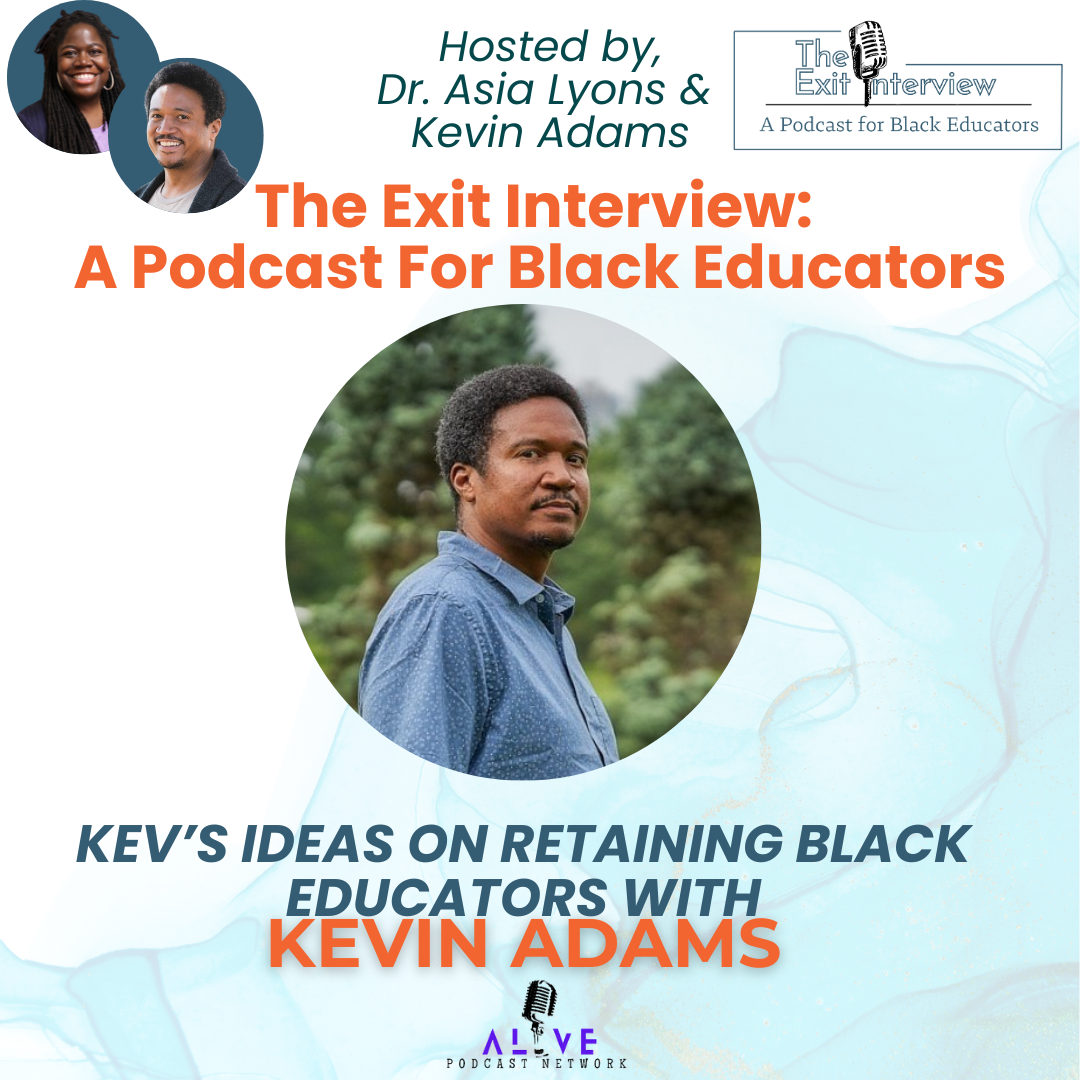
In this episode of the Exit Interview podcast, co-host Kevin Adams reflects on his 18-year teaching career in Denver Public Schools and his transition from classroom teacher to assistant principal. Kevin discusses the unique challenges and experiences faced by Black educators, including feelings of isolation, the importance of representation, and the need for supportive leadership that values equity and creates safe spaces for open dialogue. He emphasizes the importance of honoring Black educators' full identities, including their cultural expressions and intellectual contributions, rather than limiting them to roles such as disciplinarians or relationship-builders. Kevin also highlights the importance of culturally responsive mental health support and the value of spirituality and family traditions in sustaining Black educators. The episode calls for school leaders and colleagues to be more responsive, supportive, and proactive in retaining Black educators, and encourages listeners to continue engaging with the podcast's mission.


Episode Summary: In this special solo episode, co-host Kevin Adams shares personal reflections on his 18 years as a teacher in Denver Public Schools and his upcoming transition to assistant principal. Kevin discusses the challenges Black educators face, the importance of representation, and strategies for retaining Black teachers in the profession.
Key Topics Covered:
- Kevin’s journey: 18 years teaching, moving into school leadership
- The sense of isolation and being “different” as a Black educator
- The value of representation for students and staff
- The importance of supportive, equity-focused leadership
- Creating safe spaces for Black educators to share experiences
- Honoring Black educators’ full identities—beyond disciplinarian or relationship-builder roles
- The role of family, spirituality, and cultural traditions in sustaining Black educators
- The need for culturally responsive mental health support
- Encouraging white colleagues and leaders to be proactive allies
- The mission of the Exit Interview podcast: elevating Black educators’ stories
Notable Quotes:
- “We have these experiences where we at times can feel isolated. We feel alone.”
- “Black educators bring a lot of skills to the work, but sometimes we are highlighted for our ability to build relationships, and we are much more than that.”
- “Strong leaders are going to create space to open, and this space is protected space, right? It honors safety of Black educators and educators of color to really express their feelings and what they’re going through.”
Call to Action: If you enjoyed this episode, please share it, leave a rating and review, and connect with us at exitinterviewpodcast.com. We’re always looking for former Black educators to interview—reach out if you’d like to share your story!
Connect with Us:
- Website: exitinterviewpodcast.com
- Social: Share and tag us on your favorite platforms!
First of all.... have you signed up for our newsletter, Black Educators, Be Well? Why wait?
Amidst all the conversations about recruiting Black educators, where are the discussions about retention? The Exit Interview podcast was created to elevate the stories of Black educators who have been pushed out of the classroom and central office while experiencing racism-related stress and racial battle fatigue.
The Exit Interview Podcast is for current and former Black educators. It is also for school districts, teachers' unions, families, and others interested in better understanding the challenges of retaining Black people in education.
Please enjoy the episode.
Peace out,
Dr. Asia Lyons
Episode 27_ Kev's Ideas on Retaining Black Educators
Kevin Adams: [00:00:00] We have these experiences where we at times can feel isolated. We feel alone. Sometimes you feel like you're getting gaslit because you think one way and the way people talk about students and you hear dog whistles and underlying ideas about race and what kids are capable of that you wanna challenge early on your career, depending on your setting and how comfortable you feel and your goals and maybe the voice that you've developed.
You might be comfortable or less comfortable sharing some of those things.
Abex, all of the conversation about recruiting black educators were other discussions about retention. The Exit Interview podcast was created to elevate the stories of black teachers, professors, counselors, social workers, and administrators who have been pushed out of the traditional education [00:01:00] space. My co-host Kevin Adams, Emme, Dr.
Asia Lyons, are on a mission with our guests to inform school districts, teachers, unions, families, students, educators, and others. Interested in understanding the challenges of retaining black people in education. Welcome to Exit Interview, a podcast for black educators.
Welcome. This is Kevin Adams, co-host of the exit interview here with an exit interview Quick. With a reflection on my school year and an update to all of y'all about what things have changed and what things are looking like for me in the future. And just some thoughts about, you know, the topic that we talk about on the exit interview all the time.
How do we retain black educators? What is their story, their experience, and why is that valuable to hear and understand and what do I think can be done? And also. Just how it impacts the families of [00:02:00] black educators. So here's my go-to. As I said, I am flying solo today. No, Dr. Lyons with me. If you don't know if this is the first time listening to the exit interview, welcome.
Usually we have a co-host, Dr. Asia Lyons and I, myself, and a guest who tells their story about black educator who tells their story about why they've chosen to leave the profession. Why they're giving their exit interview. But this episode's a little bit different. We've just giving you a little quickie, something to tide you over in between.
So some of you may know I am currently a teacher, secondary teacher. I have just finished up my 18th year of teaching secondary school, primary middle school. Shout out to all my middle school teachers, uh, 18 years in the Denver Public Schools, which is quite a long time. For teaching and uh, you know, just coming to the end of my 18th year, I'm exiting the [00:03:00] classroom, but not exiting different public schools not as exiting education.
I'm actually transitioning to become an assistant principal. So I think as I move into being building leadership, I think one of the things that I'm thinking about is how can I put to practice ways to retain and really show black educators that they're valued. Help support them. Hang in there to have long, good careers in the profession.
You know, I think should be a goal of any educator, but it's something that's personally important to me. For those of you who don't know, like I said, primarily middle school. This year I had two high school classes and three sixth grade classes. Shout out to my sixth graders. Rising seventh graders. Now shout out to all middle school teachers.
It is a beautiful and rewarding experience, but like I said, I've taught middle school pretty much my whole career mainly. One thing I [00:04:00] always think about is the first time kind of coming into school and being a black male, black educator is having students to be like, Mr. You're different. And they can't name it always.
Some are comfortable naming it, you know, usually black kids, oh, I never had a black teacher, never a black male teacher like you. You're different. And a lot of students are like, oh, I've never had a black educator. You know, my Latino students will comment that. I've always come into it caring with me that I'm a black educator.
And when I came into the Denver Public Schools, there weren't a lot of black educators. And I think a lot of black educators who teach in, uh, predominantly white settings or predominantly Latinx settings, you definitely feel different. Because you look around the room and there's nobody like you, you're very singled out.
And so I think I've always thought about what keeps me in teaching, what retains me, what holds me in it? [00:05:00] And going through this past year, after two years after the pandemic, at 18 years, realizing all the skills I've developed as an educator, I finally find myself really reflecting on what's kept me in.
What do I think can be done? So one thing, I have a passion for the work, and I think we've talked about it on the exit interview before that black educators, we come with a passion for this work. We believe in it, we're committed. It's a calling, very spiritual based. I was fortunate enough to just return from my family reunion.
Shout out to the Cannon, Easton, and McDuffy families. I love y'all. I love who I am because of y'all. One of the things that became clear when we started talking about our family history was a rich history and a value of education and commitment to education and a variety of educators in and outside of institutions [00:06:00] in our family.
And so like I think trace it back to that and not to say that that's different. 'cause I know there's other families that have strong lineages of educators. But I feel as a black educator that there's something different about the calling. So you know, when you have that calling for the work and you care and you're dealing with black kids or children of color, you start to just really take it personally and it means a lot.
And we all know this, you know, that weighs on us. And so we have these experiences where we at times can feel isolated. We feel alone. Sometimes you feel like you're getting gas lit because you think one way and the way people talk about students and you hear dog whistles and underlying ideas about race and what kids are capable of that you wanna challenge.
And early on your career. Depending on your setting and how comfortable you feel and your goals and maybe the voice that you've developed, [00:07:00] you might be comfortable or less comfortable sharing some of those things. So I think it's really important that leaders, schools, communities are creating space where black educators can talk freely about their experiences and what they're going through.
But I think on the other side of that, and I'm fortunate enough to have a leader this year who deeply values and believes in equity. Deeply works hard to recruit and to retain the black educators that she has in school. She's the reason, gave me the opportunity to move into this leadership position that I'm gonna take next year because she recognized my ability and the value that I play as a leader in a school.
And so I'm really thankful for a leader like that. But she creates space for. Me and other black educators and educators of color to share our perspective. She's there to really, openly and honestly listen to us and [00:08:00] honor our experiences and our ways of being, which I think is really powerful and goes a long way in retaining black educators.
Like I said, the hardest thing is at times when you feel like you have to put on. A mass to survive through it all. So I think strong leaders are gonna create space to open, and this space is protected space, right? It honors safety of black educators and educators of color to really express their feelings and what they're going through and what their experiences are and their perspectives.
And I think also that goes along with that is, is you're going to be responsive to that feedback, right? And I'm not saying that you're doing everything that black educators might want or educators of color might want or that I want, but it's really about being responsive, being thoughtful, not being dismissive of experiences and perspectives.
I think that goes a long way to retaining black educators. And I think this year in [00:09:00] particular, the last three years after the pandemic. I think another thing is really being thoughtful about the mental health needs of black educators and being intentional about how do you really support those needs and help meet those needs for black educators and create space that does it in a culturally responsive way.
Right. Quote, comment like, white folks talk about dogs and yoga. You know, black folks are not always on that stuff, but I mean, different perspectives, like I talked about my family reunion. One important thing, and I think a lot of black educators have said is spirituality. And at times schools can feel like spaces that don't always honor spiritual or religious perspectives.
I think you have to create space and honor that and really hear and dig in and find out people's traditions and, and what are those traditions that guide them, because those are the things that really mean something. I think all educators, but in particular black [00:10:00] educators and retaining them. Simple things, allowing your black educators to express themselves like you can't check 'em.
We've talked hard about this, people being checked for their music in class, but that's part of how we express ourselves, but also ways of being. Sometimes some folks know black educators, we can get loud. So honoring that. Honoring how we show up that sometimes, uh, black female educators, they sense the urgency and so they express themselves in a way that reflects the urgency.
And so I think the more leaders can understand black folks spend time with them and our ways of being and expressing ourselves super valuable and helps to retain black educators, but also honoring their abilities, their skills beyond intangible things. Black educators bring a lot of skills to the work, but sometimes we are highlighted for our ability to build relationships, and we are [00:11:00] much more than that.
We are intellectuals. I think I plan dynamic, outstanding, strong lesson plans that are engaging at many different levels for my students all the time. And I pride myself on that stuff. Seeing black educators as whole people. Creating space that honors us as whole people, I think is really critical from what I've learned to retaining black educators, but also allowing black educators to find their space and not assigning them roles.
You know, we've heard too much throughout the exit interview and had this experience about black educators being used. The primary disciplinarians when white educators fail to make connections or a place where students are just like dropped off, who nobody else can deal with. The behavioral black kids, the black educators are expected, and I don't think that should always be forced on black educators.
I think you have to work and set [00:12:00] up pd. Do work on white educators so they can develop stronger culturally responsive restorative practices so that they can really address and meet the needs of their students in their classrooms. And also thinking about that, I think about like our colleagues, it can all go to the black educator to lead the fight for equity.
Every time to be the voice who's gonna stand up? When everybody sees what's wrong or what's happening or sees the inequities, we start going through the list of maybe sped roster students, or if you go through starting to go through discipline data and we see the disparities or just we be black educators leaving the building.
And you see how they're being treated. You know, I think rarely have we heard, I'm not saying that it doesn't happen, but of white educators really standing up and having the backs of a lot of the black educators in particular, the black women who we have interviewed on the [00:13:00] exit interview. These are like reflections and as it just came on, I kind of just kicked it freestyle.
But it's fascinating to think about. Stay tuned for the next episode of the exit interview. Please, please make sure to listen. I am Kevin Adams and for my co-host Dr. Asia Lyons. I just want to thank you for rocking with us. I hope you have a great upcoming school year. Peace.
Thanks for listening. If you enjoyed this episode of the Exit interview, a podcast for black educators, please help support the podcast by sharing it with others, hosting on social media, and leaving a rating and review. And as always, we're looking for former black educators to interview. If that's you, send us a message on our website, exit interview [00:14:00] podcast.com.

Co-host, The Exit Interview
Kevin Adams is a veteran Secondary Social Studies Teacher in Denver, Colorado. 2023 marks his 18th year working in the Denver Public School district. As an educator, Kevin is committed to Anti-Racists, culturally responsive practices that can liberate and empower students, families, and educators who have been marginalized by White Supremacist Culture, Misogyny, and Cis-gender heteronormativity. Kevin is the co-creator and co-host of the Too Dope Teachers and a Mic podcast with Gerardo Munoz, as well as the Co-host of the Exit Interview podcast with Dr. Asia Lyons. Kevin is a devoted husband and dedicated father of two teenagers.