Healing from Racial Battle Fatigue with Janet Stickmon
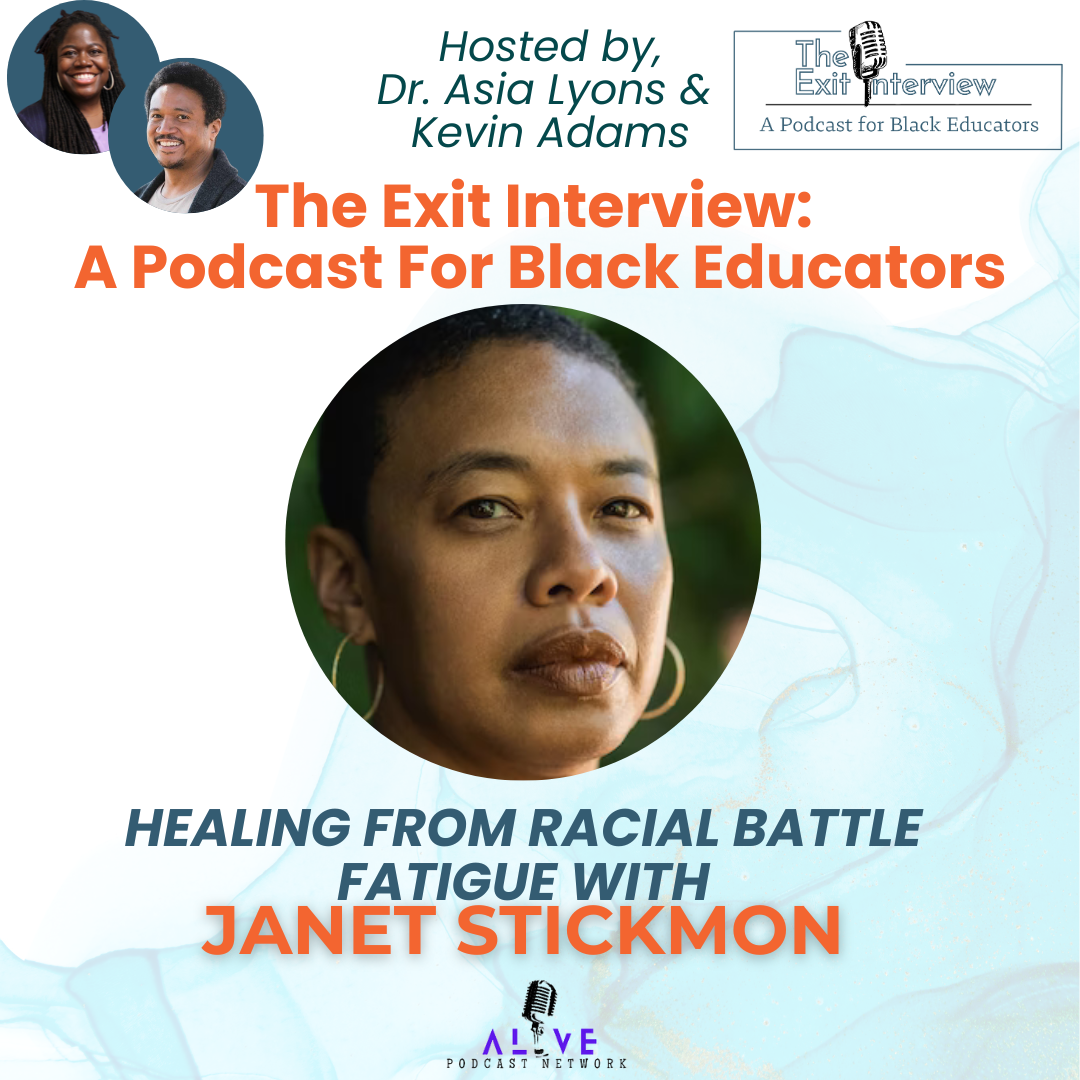
In this episode of the Exit Interview podcast, Dr. Asia Lyons welcomes back Janet Stickmon to discuss the concept of racial battle fatigue, its impact on educators of color, and the journey toward healing and joy. Janet shares her personal experiences with the physical and emotional toll of racial battle fatigue, including health scares and the challenges of advocating for her child in educational spaces. She explains how naming and understanding these experiences is a crucial first step toward healing.
Janet emphasizes the importance of integrating joy into daily life, treating it as essential as a daily vitamin. She describes her healing practices, such as therapy, self-care routines, and engaging in activities that bring her happiness, like swimming and painting. The conversation also explores the idea of abundance—not as material excess, but as having the health, wealth, and love needed for a joyful life.
Janet introduces her Center Joy Power program, designed to help professionals of color heal from racial battle fatigue and cultivate joy and abundance. She shares practical advice on creating self-care plans and meaningful rituals, and encourages listeners to continually ask themselves what makes their eyes light up and their spirit smile. The episode closes with resources for connecting with Janet and joining her program, and a reminder to be kind to oneself on the path to healing.


Episode 24: Healing from Racial Battle Fatigue with Janet Stickmon
Hosts: Dr. Asia Lyons & Kevin Adams
Guest: Janet Stickmon, educator, author, and founder of Center Joy Power
Episode Overview:
In this powerful episode, Dr. Asia Lyons welcomes back Janet Stickmon to the Exit Interview podcast for an in-depth conversation about racial battle fatigue, healing, and the pursuit of joy and abundance for educators of color. Janet shares her personal journey, practical strategies, and the inspiration behind her Center Joy Power program.
Key Topics & Highlights:
Introduction to Racial Battle Fatigue
- Janet defines racial battle fatigue, referencing Dr. William A. Smith’s work.
- She shares her first encounter with the term and how it gave language to her lived experiences as an educator of color.
Personal Story & Health Impact
- Janet recounts two ER visits due to stress-related symptoms, including chest pain and heart palpitations.
- She discusses the connection between workplace stress, systemic racism, and physical health.
- The importance of recognizing and naming the symptoms as a step toward healing.
Family, Advocacy, and Vicarious Trauma
- Janet describes the challenges of advocating for her multiracial child in school systems.
- The added layers of trauma parents experience when supporting their children through racialized experiences in education.
Healing Practices & The Role of Joy
- Janet’s approach to healing includes therapy, self-care, and integrating fun into daily life.
- She shares how her doctor “prescribed” fun, leading her to rediscover activities that bring her joy, such as swimming, parkour, painting, and baking.
- The concept of treating joy as a daily vitamin and the importance of novelty for well-being.
Defining Joy and Abundance
- Janet offers her definition of joy: “what makes your eyes light up and your spirit smile.”
- She discusses abundance as “the amount of health, wealth, and love you require to live a joyful life,” citing Dr. Mario Martinez.
Moving Beyond Healing
- The conversation explores what it means to move beyond healing and live with purpose, service, and joy.
- Janet encourages listeners to create self-care plans and meaningful rituals, such as using affirmation stones.
About Center Joy Power
- Janet introduces her Center Joy Power program, a self-paced six-week online course for professionals of color.
- The program covers defining joy, understanding racial battle fatigue, and building self-care routines and rituals.
- Details on how to join, including monthly meditations and community support.
Audience Takeaways
- The importance of self-kindness and compassion on the healing journey.
- Practical questions for reflection: “What makes your eyes light up and your spirit smile?” and “What do you do with your healing once you achieve it?”
Resources & Links:
- Janet Stickmon’s Website & Center Joy Power: janetstickmon.com
Connect with Janet:
- Instagram: @janetstickmon
- Facebook: Janet Stickmon (Author Page)
- LinkedIn: Janet Stickmon
- Email: hello@janetstickmon.com
Book Mentioned:
- The MindBody Code by Dr. Mario Martinez
Previous Episode with Janet:
- Episode 22 (linked in show notes)
How to Support the Podcast:
- Share this episode with your network.
- Leave a rating and review on your favorite podcast platform.
- If you’re a former Black educator interested in being interviewed, reach out via exitinterviewpodcast.com.
Closing Thoughts:
Janet reminds listeners to be kind to themselves and to continually seek out what brings them joy. Dr. Asia Lyons encourages everyone to reflect on their own sources of joy and healing.
Thank you for listening to the Exit Interview, a podcast for Black educators!
First of all.... have you signed up for our newsletter, Black Educators, Be Well? Why wait?
Amidst all the conversations about recruiting Black educators, where are the discussions about retention? The Exit Interview podcast was created to elevate the stories of Black educators who have been pushed out of the classroom and central office while experiencing racism-related stress and racial battle fatigue.
The Exit Interview Podcast is for current and former Black educators. It is also for school districts, teachers' unions, families, and others interested in better understanding the challenges of retaining Black people in education.
Please enjoy the episode.
Peace out,
Dr. Asia Lyons
Episode 24_ Healing from Racial Battle Fatigue with Janet Stickmon
Janet Stickmon: [00:00:00] I had to say, you know what, no. I'm always worthy of integrating fun, integrating things that bring me joy and doing so on a daily basis because it's something that will keep me going. And, you know, and, and on another level, it's something that helps me to bring my best to my family. My best self to my family and my best self to, whether it be the workplace or the community work that I might do,
Dr. Asia Lyons: aix, all of the conversation about recruiting black educators. Where are the discussions about retention? The Exit Interview podcast was created to elevate the stories of black teachers, professors, counselors, social workers, and administrators who have been pushed out of the traditional education space.
My co-host Kevin Adams and me, Dr. Asian Lyons, are on a [00:01:00] mission with our guests to inform school districts, teachers, unions, families, students, educators, and others, interested in understanding the challenges of retaining black people in education. Welcome to. The exit interview, a podcast for black educators.
Welcome back everyone to episode 24 of the Exit interview podcast. I am here with Jenna Stickman. She's back to talk to us about racial battle fatigue, about healing, about joy, about abundance. You may have heard her episode number 22, and now I invited her back because I wanted her to talk about her work.
It's importance, more of her story, and so she's back in our studio. Welcome back, Janet. Thank you so much, Asia. Yeah. For the audience members who have not heard your story, we're gonna start off with first tell us how you learned about racial battle fatigue, and then your story of [00:02:00] your experience. Tell us more about that.
Yeah, absolutely.
Janet Stickmon: I first learned about racial battle fatigue. It was, I think roughly around 2016 or so when I attended a cultural center conference that was in up here, I think it was in San Jose, and I attended a workshop and it was the central part of the workshop. And I was fortunate enough to hear other people talk about racial battle fatigue in that session.
But then they also gave us some resources and it. I don't think it completely stuck until after I read some of the work, but just knowing that there was language out there to speak about some things that I was experiencing, especially on a physical and emotional level that I didn't know that there, I didn't know that there was existing research out there about this thing called racial battle fatigue.
And when I started reading more, I'll just share [00:03:00] that a brief definition. I think you and many of your listeners are already familiar with Dr. William A. Smith being the scholar who coined racial battle fatigue and essentially defining it as the, uh, psychological, behavioral and physiological strain that's experienced by people of color when we're dealing with and fighting against racism.
And that's something that I had been really. Fighting against and dealing with throughout my career as an educator, and I knew that something was going on in my body. I think I was just sharing with a, a friend and colleague earlier today, some of the experiences that led to me doing some work around racial battle fatigue, and that was two ER visits, one in 2000.
One in 2016 and then a second time around 2019. And when [00:04:00] that first visit, I was experiencing chest pains, chest tightness, heart palpitations, and I checked myself in at the er. Actually, if I back up a little bit, I remember calling up Kaiser and explaining to them what was going on and they said, okay, you should check yourself in at the er.
I said, oh, I don't know if it's that bad. And I said, I just kept that in the back of the mind of my mind and hung up. And then the pain and the tightness persisted. And I called later on in the afternoon and explain. And they again recommended You should go to the er. I said, oh, that's what the other person told me earlier, and I don't know if it's all that serious.
And she said, you do realize that since this you were. Told to go to the ER earlier if you don't go to the ER the second time that you're refusing care and okay. I said, oh, okay. And I went, and when she put it, [00:05:00] when the advice nurse put it in those terms, I thought, wow, here I was. I, there was a part of me that wanted to find out what was wrong with me, but when they said I had to go to the er, I was scared.
I did. There was almost a part of me, yeah. Really want to know. But when she put it in those terms, I was like, oh, okay, let me just go. So I go in and they take all the necessary tests. They were very thorough and they found that nothing was wrong. All the tests came out normal. And I spoke to the doctor, I said, Hey, I'm happy that all the tests came out normal, but what do you attribute the The chest pain and chest tightness too?
And he looked at me and asked me, so how's work? And I think I shared this part of the story with you during the last interview. And I started to weep. I just wept right away. And that was a, yeah, communication that the source was many of the things that I was experiencing at work, and I knew what it had to do [00:06:00] with, I knew it had to do with the stresses associated with dealing with oppressive administrators.
I knew that a lot of the stress was associated with the resistance I was getting when it came to expanding our ethnic studies department and revising the curriculum, and then not just restricted either it, it had built up. And I think that's one of the things that I really love about Smith's work, what he talks about.
Racial microaggressions and macroaggressions contributing to it, contributing to the various manifestations of racial battle fatigue. But there was also something in one of his recent talks, the way he described it as systemic racism related, oh, how, pardon me. Let me see how you, how it, it was a systemic racism related stress.
Injury, repetitive stress injury, and. Okay. Really key [00:07:00] that the, oftentimes people will talk about racial microaggressions or even just microaggressions in general, being these tiny little cuts. And I like that analogy because you. When you get that one little cut, you think, oh, okay, not a big deal. I think I can survive.
But if you have an accumulation of these tiny little cuts over time, it takes a toll and you look down and your whole body is covered in blood.
Dr. Asia Lyons: Certainly. Yeah.
Janet Stickmon: Yes.
Dr. Asia Lyons: Yeah,
Janet Stickmon: and that was very, it was very telling when I looked at not only my career as an educator at the community college, but also things that I experienced as a high school teacher, and then also as a black and Filipino parent of a multiracial child in.
Trying to put her child through the school system, whether it was public or private. I was battling [00:08:00] instructors and administrators to affirm the brilliance of, of my child. And so there were, it was all these battles on different fronts that I think contributed to not just the chest pains and the chest tightness and the heart palpitations, but what I didn't mention is being unable to sleep.
TMJ. Uh, sometimes I would catch myself clenching my fist before bedtime or clenching my knuckles. Mm. Some of that I actually still do. So it's an ongoing journey. It's on an ongoing journey, and I think half of the, I think a huge step toward beginning to heal one's racial battle fatigue has a lot to do with first.
Being able to name it and admit that the symptoms that one is experiencing is attributed to the ways in which we're [00:09:00] dealing with and fighting against various types of racism.
Dr. Asia Lyons: I wanna say one thing that, I'm glad you talked about this and we haven't talked about this much lately on our podcast. And I think that your episode, your previous episode is where we touched on family a little bit.
You mentioned like enrolling your child into school and that experience and having racial panel fatigue from that. Yeah. I think it's really important for our audience to think about that too. Yeah. As we're supporting aging parents, as we're supporting children that we take care of in all these different capacities.
That's the other layers, right? That vicarious trauma and the added layers that happen that racial battle fatigue happens from.
Janet Stickmon: Yes, yes. Most certainly. Those added layers that even though it may not necessarily be impacting you, if as a parent, if it's impacting your child, that's your child. Yeah, so anything you can to [00:10:00] make sure that your child is emotionally and physically safe when you drop them off to at school.
And yeah, I like how you put that absolutely. The vicarious trauma and the, and the ways in which. The traumas being experienced by the child, and then when one, as a parent comes in to intervene and have the necessary meetings with this one and that one, whether it's a teacher or administrator when and one trying to defend one's child, the kind of trauma that's associated with that too.
When you are met with resistance by the leadership of the school, it Yeah. Deeply frustrating. Because that's what I had discovered time and time again is that whether it was the teacher or, or sometimes the principal or vice principal, they weren't, they didn't always have the student's best interest in in mind.
They were busy defending the teacher. They were busy. [00:11:00] Yeah. The teacher and the biases of the teacher, they never really wanted to, are, I think, surprised that some of these administrators and teachers. Had when my husband and I would come in to discuss whatever infraction of a teacher had or a student had had caused when it came to our child, they, I don't think they realized that they were getting too educators that knew about this stuff.
Yeah. And had the language and had the resources, and were ready to do trainings for educators. No, I don't. And I think that's one of the things that a lot of, unfortunately, you know, white teachers and white administrators perhaps end up taking advantage of the fact that they may have some, that they have parents that may not necessarily have the language, they know exactly what's happening to their child.
They're, they know that the, [00:12:00] there's an injustice that's taking place that the, their child's very dignity is not being honored and respected. But they may not. Mm-hmm. The language that is used in academia that would allow the teacher or the principal to actually give it the respect that, that they're not using the language that allows them to hear it, they truly should respect.
Dr. Asia Lyons: Yeah.
Janet Stickmon: And the fact that they know their child better than anyone else, assuming that. The parent and the caregiver is, does have a close and honorable relationship with their child and always respects their, their dignity and their wellbeing, et cetera.
Dr. Asia Lyons: I'm, it's really, we have to keep that in the forefront, I think, when we are having these conversations.
So you will found yourself in the hospital and you've, and you also talked about being at this conference. And then realizing sometime later, like I'm like, I have to accept the fact that I'm [00:13:00] experiencing racial battle fatigue. Yeah. So what is your approach? Because you're saying I'm still clenching my hands sometimes.
I'm still doing some of these things. So what is your approach to healing your racial battle fatigue?
Janet Stickmon: My approach yet, personally, since 2016, it has involved making sure that I have fun. That of course is not the be all, end all, but that has been central to my healing. Of course, what was necessary, especially early on, was therapy.
Seeing a mental health professional and getting that ongoing care and support and, and then there's the making sure that I. Was having fun that I was doing. Also the basics when it came to healthy living, taking care of my diet, making sure I was doing, I was making sure that I was physically [00:14:00] active, all those sorts of things.
Resting well, so some of those basics and then of course, making sure I was having fun. That really came about through a conversation that I had with my primary care doctor immediately after. That first er visit because he asked me, so what do you do for fun? And I didn't know how to answer that. And so that's when I realized I, I need to get reacquainted with myself.
I need to get reacquainted with myself. I need to get back in touch with the things that genuinely bring me joy. And so, in a nutshell, over time, what I found has been central to. Maintaining joy in my life and treating joy as if it were a daily vitamin has been swimming, parkour, C painting, miniatures. I also love to cook and bake, and so those have [00:15:00] been some of the things that really bring me, bring me joy, and I have to make sure I integrate those things into my daily life.
Something that I talk to my clients about, especially through the Center Joy Power program. Is having a sight for self forgiveness, and this would be an activity, a person or space, what have you. That allows you to be curious and experiment and be able to make mistakes and be able to laugh at your mistakes and accept them fully and still have that very thing, not keep you from being curious.
Okay. So I went and saw my primary care doctor and we had a, a conversation just about, you know, my everyday habits. And then he asked me, you know, so what do you do for fun? And I didn't know how to answer that question, and that's when I knew I needed to return to doing the things that, [00:16:00] that, that were fun.
And he basically prescribed fun for me. That was, that was my. That was my homework. I love that. Yeah, I love that. Yeah, so I mean, he of course connected me with a, you know, with a therapist there at Kaiser. But, you know, my, my, my homework was, he said, this week, I want you to have fun. And so that's when I started to really think about what it meant to do, what it meant to treat joy as if it were a daily vitamin.
And that's something that I regularly, a mantra that I, I keep in, you know, my own mantra that I repeat to myself. But it's something that I share with my clients in the Center Joy Power program that, you know, I think myself, I include myself in this as well, but I think many of us are so used to waiting until all the work is done, and then we deem ourselves worthy enough to [00:17:00] have some yes.
You know, and, and I think that has served its purpose for me for a very long time, especially throughout K through 12, throughout my university life. But there, you know, there's a price that one pays that because especially, you know, once you enter the workforce, there's always work to be done.
Institutions will continue to give you more and more work. And unless you say no. They will, you know, they will continue to give you work and, and you will continue to do that work and not rest until it's all done. If that's your, if that's your mentality, and I knew I had to change that mentality. Yeah. I had to say, you know what, no.
I'm always worthy of integrating fun, integrating things that bring me joy and doing so on a daily basis because it's something that will keep me going. [00:18:00] You know, and, and on another level, it's something that helps me to bring my best to my family, my best self to my family, and my best self to, whether it be the workplace or the community work that I might do, so,
Dr. Asia Lyons: Hmm.
I love that. I treat joy as if it were a daily vitamin. I love that. And as you were saying that, you were asking the question or you were reflecting on what your doctor said about when's the last time you had fun. Yeah, I had to think about that too, because it's Sunday and I worked a lot today, right? I worked a lot today and I was thinking when you were talking like, what do I like to do to have fun?
Right? And so I would hope that the audience members are thinking about that. And I hope that they're gonna do something about that [00:19:00] because something I love to do is I love to go on drives For folks who don't know, I live in Denver, or I live in Aurora, which is a suburb of Denver, and I don't go to Aurora, I mean go to Denver much.
And so I found myself having coffee checks and dinners with folks. These little restaurants and places in the city of Denver that had never been in that neighborhood. Oh. And so it brings me joy. Yeah. It brings me joy to, instead of coming home directly the way I came, I like to take the side streets and turn left and right and look around and have the windows down and just take my time.
And that really brings me joy. I love doing that. So, yeah, I just wanna put that out there for folks. Thank you for that. So,
Janet Stickmon: um, appreciate and I, you had reminded me of, of something if, if I may, if I may add when you were talking Yeah. Mm-hmm. Driving into different parts of Denver and going to restaurants you've never been before, [00:20:00] taking a route that, that was new to you.
I think this is something that I, I share with folks as well, you know, just the importance of novelty. I mean, there's so much research out there about how healthy novelty is, you know, for our brains, for our just general wellness. And, you know, when we do things that are new and out of the ordinary, it really is, you know, on a, a neurological level, it's really healthy for us.
Yeah, so that's all that
Dr. Asia Lyons: makes sense. I'm gonna keep, I'm gonna keep doing that. I'm gonna keep doing that. So what does it mean to work towards healing and move beyond healing so that you can integrate into your daily life? I know you talked about like doing these fun things and for folks who don't know, Janet has a whole list of activities including parkour, but for us.
A he a healing athlete is [00:21:00] what she calls herself. But so tell us a little bit about that, what that means to integrate joy into people's daily lives. Beyond the novelty part too. Also. Yeah, for
Janet Stickmon: sure, for sure. I first define, I think it becomes really important to be clear about our definitions of joy because I think joy.
It gets tossed around, but I think oftentimes one's association with joy is jumping for joy. You know, I, I wanna feel joy and, you know, do I wanna jump for joy? Uh, maybe not necessarily. I, I like to think that there, when one says I want to embrace and enjoy. Joy in my, my life that it may not necessarily be the jumping for joy sort of feeling.
It may not necessarily be one, wanting to feel a certain level of exuberance all the time. It could mean that one wants to feel, you know, anything from, from the [00:22:00] exuberance to a sense of peace and awe. And, you know, I have come to, you know, define joy as that, which makes our eyes light up and our spirit smile.
And I think because, because there are so many different ways in which one might define joy, I think it, it becomes important to just simply sit with and meditate on that idea. You know, what is it that makes my eyes light up and my spirit smile? And if we give ourselves that time to respond to that question, that can lead us to the activities, the people, the spaces that really allow for that feeling to, to emerge or, and, and be experienced.
And so I think that one, it's important for one to sit with that question. I think that it's also important to come up with a self, basic [00:23:00] self-care plan. So I, I, I often talk about, yes, you know, we need to do the healing, but yeah, it's important to make sure we move beyond healing. I, I am one to think that, you know, there, there are a lot of spaces that advocate for healing from this and that, and, you know, of course I'm all for it.
Any, any sort of space that allows us, especially as educators of color to. Engage in a set of activities, reflective activities that help us to regain wholeness. I'm all for, but one of the things that I really invite people to think about is, you know, well, once we, if we take a good look at our brokenness, whatever that is, and then we engage in activities to heal that brokenness.
All right, well, let's say I'm healed. What do I do with that [00:24:00] healing And is healing the, the end point is just being whole and just existing in our wholeness. Is that enough? You know, and I like to, to think beyond that satisfaction of just being there with one's wholeness. Okay, now what do you do with it?
You know, can, is there a, a deeper sense of meaning that you can get from your very existence that's tied to purpose, that's tied to service, that's tied to, you know, joy and, and joy in all these various parts of our, our lives, whether it's, you know, our relationships with our families, friends, et cetera, or, you know, our professional aspirations.
And so I think that. That question of, you know, what is it that makes my eyes light up and my spirit smile is most certainly necessary to ask [00:25:00] oneself. At the same time, it's important to create a self-care plan that gets at the heart of, well, how am I being conscious of my diet? Am I having a healthy, balanced diet?
You know, am I sleeping well? Engaging in certain activities that are conducive to my sleep hygiene so I can sleep well, you know, what kind of physical activity am I engaged in, and is it sufficient to meet the goals that I've set for myself? So those, those are just a, you know, two, two main things that I think, uh, can allow one to not only reach a place of healing, but also.
Beyond that healing.
Dr. Asia Lyons: I hope folks in the audience are taking notes because I've written down so many questions that you just asked that are going to go into my journal tomorrow [00:26:00] morning, and I love it. This is fantastic. This question of what do I do with the healing, like after that, what's after that?
And what an interesting question because. So many of us haven't gotten to the place of healing. How many of us can imagine something beyond it? Yeah. Right. And I wonder if folks, and I'm thinking about this question and I'm wondering, there must be, you know, thinking about living in the United States, this is where this podcast is being recorded.
Do we fully heal? In Trumps America, right? Like are we fully healed or is there a, is there a maxed out space that we can be in? And that's of course for a different show probably. But I think about that. Like there is a space of healing. Of course. We have to get to the what we can, how we can in the best ways that we can.
So [00:27:00] thank you for putting that out there in space. You talked about in our, our time together before the podcast started, the importance of not just joy but abundance.
Janet Stickmon: Oh
Dr. Asia Lyons: yeah. Can you talk to us more about that?
Janet Stickmon: Sure, sure. Yeah. Thank you. Yeah. I definitely see a connection between joy and abundance.
Abundance is another one of those words that we often hear, get tossed around. It has a variety of, of meanings and definitions. The definition I use. In my program, but also in my life is a definition by Dr. Mario Martinez, who's a clinical neuropsychologist, author of the book, A Mind Body Code, and he talks about abundance being the amount of health, wealth and love you require to live a joyful life, a wellness life, and and I, I absolutely love that and.
If I'm not belaboring the point, is it okay if I repeat that [00:28:00] for, for your listeners?
Dr. Asia Lyons: Oh, I was going
Janet Stickmon: to ask
Dr. Asia Lyons: you, I was gonna ask you to repeat it, please. Yes. Yeah.
Janet Stickmon: Abundance being the amount of health, wealth and love you require to live a joyful life, a wellness life. And the first time I heard that it, it really hit me hard because.
I think my prior associations with abundance had a lot to do with opting at the expense of another person or at the expense of other, uh, uh, uh, another group of people. And I, I think it was quite freeing. I think it was quite freeing to hear that particular definition because it had nothing to do with having.
So much that others were deprived and it had nothing to do with some outsider standard of what a lot was, but it had to do with [00:29:00] my own measure of what I required in, in just those general areas, you know, health, wealth, and love in order to experience joy, in order to feel well. And so, yeah. Yeah, I, that's, that's the abu that's the definition of abundance that, that I use, and it, it has changed my, my life and I, I most certainly want to give credit and shine to Dr.
Martinez. Yeah,
Dr. Asia Lyons: we'll put Dr. Martinez's the link to the book in the show notes so that folks have it, because it's be, I feel like a lot of folks. Want to pick that up, including myself. Yeah. He has a very voice, so, oh, it's not audible. Perfect. Yeah, my best friend, audible is my best friend. Great. A, he has a soothing voice.[00:30:00]
Oh, awesome. Awesome. Okay, we're here for it. Lots of good information. Oh, wow. Okay. So. You've talked about racial battle fatigue. You've talked about your definitions of like how you believe we can heal or how you believe you are healing and I've healed. Then also you talked about the definitions of joy and abundance.
Can you tell us about Center Joy? Power, uh, first
Janet Stickmon: started actually as soul Care Power in fall of 2020. And I decided to create a space live virtual group coaching program for other professionals of color that were experiencing racial battle fatigue and, and did wanna tap back into to what brings them joy.
And so that started fall 2020 and I, and I had that cohort successfully complete the program [00:31:00] in 2020. And then the. Second and third launches of the program, that's when I renamed it and called it Center Joy Power, and so I've, since that first launch, I've had three cohorts successfully complete the program.
Do just amazing work. They were already doing amazing work to begin with, but they really wanted to refine and, and, and heal, you know, some things in their personal professional lives and, and really feel that authenticity of, of joy in whatever space they, they entered into. And so it has blossomed into a self-paced six week online program.
As of. December of 2022. I wanted to make sure that what I was making available to these three cohorts was more widely available and, and that was officially launched in December, [00:32:00] 2022. And it has a set of six weekly modules that people can access and go through at their own pace. And then there are monthly.
Meditations and monthly circle discussions where they can have that added support. They're connected to other people that are in the program now throughout the six weeks, and this was the case with the live virtual as well as with the new self-paced version. Within those weeks, we move from what is our definition of joy?
We start with. Joy, we then move into what is racial battle fatigue? What is racism related stress? How do these things show up in our, our physical and mental health? How are our physical and mental health impacted? And we move through [00:33:00] all these different ways. Two particular frameworks that I walk folks through in order to tap into joy.
And we basically get to the point of being able to create one's own self-care plan, but also create a set of rituals, uh, that have joy at the heart of one's daily life. So with the basic. Self-care plan. We have folks engaged in having a routine and honoring the importance of a routine and staying committed to whatever goals you set for once for yourself.
But I think it becomes nice to also talk about rituals because rituals. Have a certain sacredness to them, have a certain depth of [00:34:00] meaning. Whereas, you know, routine, although they serve their purpose and we do need to have a certain level of structure in addition to that, having a set of rituals, and I can share an example of one of mine, you know, can really ground us in having some depth of, of meaning and, and, and sacredness that can help us to.
Stay on track and stay true to ourselves. And, and when I say sacred, you know, it doesn't necessarily mean attached to a particular, you know, religion. So I have affirmation stones, and they're actually, you know, I, you may see them in. You know, different floral stores or, or, or what have you. They either come in stones or they're these very hard seeds and they'll have joy inscribed on them or gratitude or hope or whatever.
And [00:35:00] before I go to bed, I, you know, without looking, I'll choose one of the affirmation stones and I'll just look at it. And so, for instance, one might be shine. And I'll sit with it at the edge of the edge of my bed and just allow myself to be quiet and just see what bubbles up in terms of images, sensations, words when meditating on that.
That concept of, of shine. And again, it's, I think whenever one is, you know, meditating on one of the affirmation stones, it's so important to just. Just wait and see what bubbles up for you and not force oneself to, oh, what do I think of when I think of shine? Or whatever the word may be. We don't have to try so hard because, you know, then the, the, the, the feelings and everything don't, don't naturally come up on their own.
You know, we get other things. [00:36:00] So in any case, that's what I do. And then I go to bed and I wrist with that, that word on my mind. I wake up with that word on my mind. It's, it's very fascinating. And then that word stays with me throughout the rest of the following day. And, you know, this isn't anything that I necessarily found in a book and said, okay, this is what I'm gonna do.
This was trial and error. I was trying different things. I thought this might be a good idea. Hey, let's try it and see what happens. And, and. It worked very well for me, and so I try to keep that up as often as possible. Do I do it every single day? Not always. Sometimes I miss certain days, and sometimes my own crankiness gets in the way.
Sometimes my own bitterness gets in the way, and, and, and when it does, sometimes I feel like fighting through the bitterness. I have to be honest about those feelings too, but still remind myself of the value that I [00:37:00] extract from the ritual. You know, and, and do that gently with myself. I, I think there can be a temptation to apply a certain level of rigidity to our self-care plan, the kind of rigidity that we experience in the workplace, because, you know, we're so accustomed to, you know, being, you know, having structure and being productive and being efficient and, and that's how we feel like.
That's how we, that's where we draw our confidence from. But I really invite people to exercise caution around that. It's speaking partly, you know, from, from experience that you know, it's important to exercise compassion toward oneself, and especially if we want to come to a place of healing and wholeness to be kind to ourselves.
You know, I share with my daughter. That mantra, be kind to yourself. And [00:38:00] that's something that an old friend from college used to say to me, be kind to yourself. Add to that, you know, let let your mind rest. That's something I say to, to, you know, my daughter and, and, and friends. Mm-hmm. Especially when our minds just keep thinking and overthinking.
Just, just let, just let your mind rest.
Dr. Asia Lyons: Yeah. I love that.
It's interesting as you, again, great minds. I'm gonna give my some flowers to Dr. Ellie Cahill, who is my co-facilitator for the Black Educator wellness cohort that we run here in, in the Denver area, because she brought that same basket of stones to our, one of our healing circles. Yeah, we passed it around and mine that.
I grabbed that was health. And so it's, it's sitting on my altar, have an altar in my office, and it's sitting there. But same idea. We kind of paused for a second and then things that [00:39:00] came up, we spoke about them and I never thought about that being a part of a ritual, but it does make sense that it can be right and there's no, obviously there's no rules.
So a question that I have is. When you talk about folks joining your sessions, signing up for your courses, do you find there's a specific demographic of folks that join? Is it mostly older folks, a specific gender, socioeconomic status, anything like that?
Janet Stickmon: I say as first, as far as age, I'd say I've had a range between twenties to.
About fifties, uh, and I actually fifties or sixties. And then typically, I think the majority of them have been women, but there have also been [00:40:00] men who have re-registered as well. There's been quite a mix as far as ethnic background, of course, all of them being from communities of color and. I'd say many of them being academics, and that may be a function of who my immediate social circle and professional circle may be, but I've also had people in other industries from tech to theology, to healthcare lawyers.
So it there's been a, a broad range.
Dr. Asia Lyons: Yeah. That's awesome. For those who have not listened to episode 22, can you tell us how to, and this going to be in the show notes, it's also all, but can you tell folks how to sign up for one of your sessions or one of your courses? What that looks like, how to contact you if necessary.
[00:41:00] Sure.
Janet Stickmon: The way in which people can register for Center Joy Power is through going to my website, janet stickman.com and you'll, it'll lead you to the proper place to register and you can also contact me via. I am on Instagram. You can find me on Instagram at Janet Stickman Facebook, also at Janet Stickman.
You just wanna look for the author page, and you can find me on LinkedIn as well. I'm also at Janet Stickman. If folks wanna send an email, you can reach me at hello@janetstickman.com. I tried to make it fairly easy across the board. Yeah, they can sign up through my website, janet stickman.com. And basically, like I mentioned before, it is a self-paced program where they can go through the six week recorded modules on their own.
And I try to make it as full sensory as possible so that [00:42:00] even though one is doing it on their own, they still get a sense of me be accompanying them along along the way. Then of course when they want the, in the virtual contact, they have the monthly meditations and circle discussions that they can be a part of.
Dr. Asia Lyons: Thank you so much. This was awesome. Janet. Are there any last words before we close out that you would wanna share with our audience? Last words, I'd say
Janet Stickmon: just remembering to be kind to ourselves and maintaining that. Definition of joy that that I often share. Just constantly take stock of what it is that makes your eyes light up and your spirit smile.
Dr. Asia Lyons: Love that. Thank you so much for coming on to the podcast again, folks, reach out to Janet, take her course. [00:43:00] I know that it will be healing and refreshing for. All the folks who take that step. So make sure you do that and we will see you on another episode. Thank you so much for joining us and have a great evening.
Thanks for listening. If you enjoyed this episode of the Exit interview, a podcast for black educators, please help support the podcast by sharing it with others, posting on social media, and leaving a rating and review. And as always, we're looking for former black educators to interview. If that's you, send us a message on our website, exit interview podcast.com.

Professor of Ethnic Studies | Wellness Consultant/Coach | Author | Mom
Janet Stickmon is a professor, author, educator trainer, and wellness consultant who has been teaching for 25 years. Stickmon is a professor of Humanities and Ethnic Studies and the founding program coordinator of the Cultural Center at Napa Valley College. Stickmon is the author of Crushing Soft Rubies—A Memoir, Midnight Peaches, Two O’clock Patience—A Collection of Essays, Poems, and Short Stories on Womanhood and the Spirit, and To Black Parents Visiting Earth: Raising Black Children in the 21st Century. Stickmon’s articles are featured in The Huffington Post, Mutha Magazine, Read to Write Stories, Positively Filipino, and Red and Yellow, Black and Brown: Decentering Whiteness in Mixed Race Studies. Her essay “Blackapina” has been featured in a number of publications. Stickmon has 25 years experience practicing meditation and integrating meditative practices throughout all her courses. Janet Stickmon is the founder of CenterJoyPWR®: Strategies for Healing Racial Battle Fatigue—an online experience for professionals of color who want to center joy in their lives. Stickmon has a Master’s Degree in Ethnic Studies from San Francisco State University, a Master’s Degree in Religion and Society from the Graduate Theological Union, Berkeley, and a Bachelor of Science Degree in Civil Engineering from University of California, Irvine. Stickmon also holds a Certificate of Completion for Michael Bernard Beckwith's Life Visioning Mastery program and is currently working toward becoming a National Academy of Sports Medicine (NASM) certified personal trainer.