Centered in Love with Julia Berry
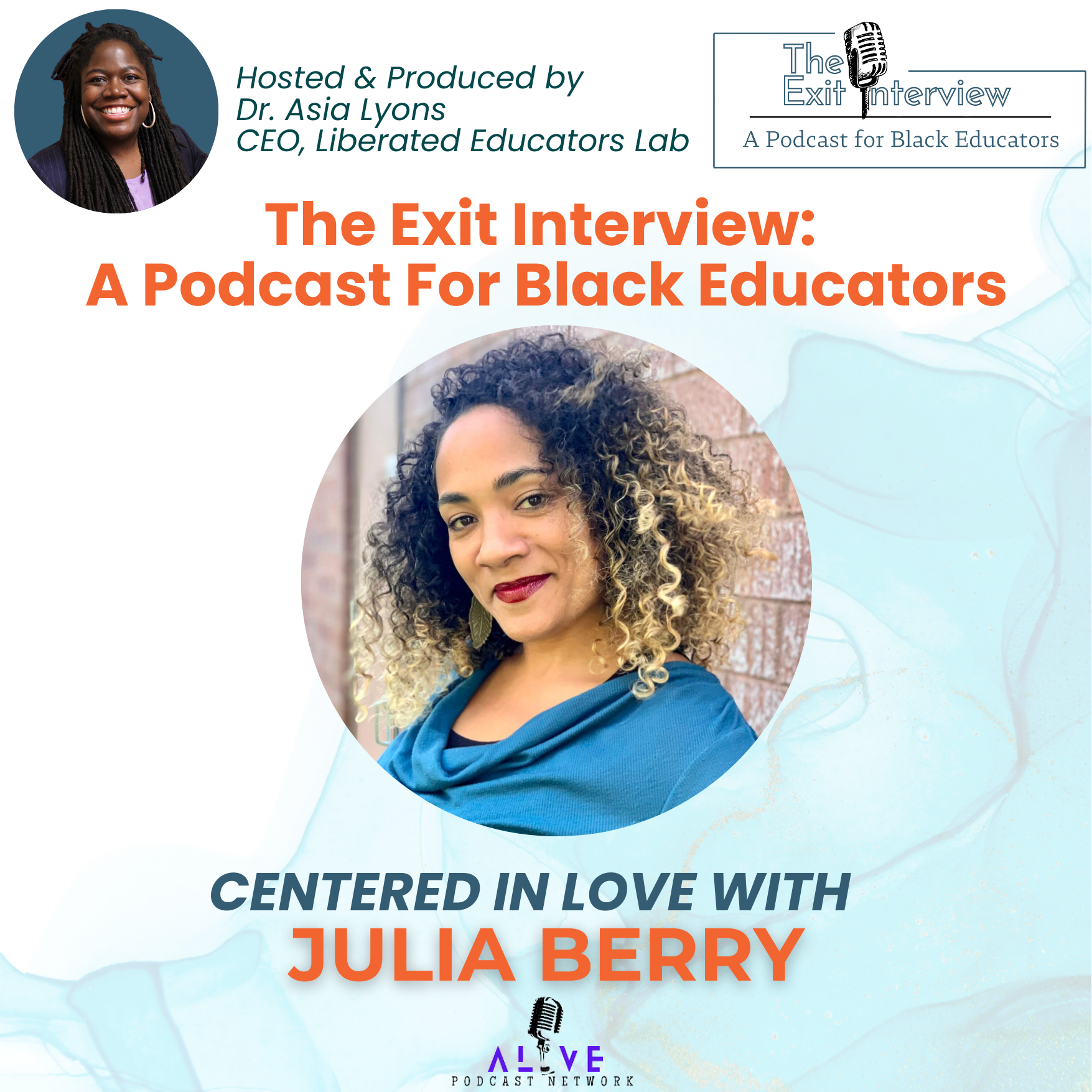
In this episode of The Exit Interview, hosted by Dr. Asia Lyons, Julia Berry shares her transformative journey from wanting to be a teacher, doctor, and dancer as a child to becoming an educator focused on diversity, equity, and inclusion (DEI). Julia outlines her path from excelling in math and engineering, realizing her passion for teaching, to teaching youth in correctional and treatment facilities. She discusses the challenges she faced with leadership due to her bold approach to DEI work. Julia touches upon the impact of race and supremacy on educational settings and emphasizes the importance of leadership involvement in DEI efforts. After leaving several roles due to systemic resistance to change, she finally finds alignment with her values at a community-based organization rooted in ancient African philosophy. The conversation delves into the personal and professional grief Julia encountered, her methods of self-care, and the joy she finds in her children, gardening, and yoga practice.


Episode Overview
In this heartfelt and deeply reflective episode, Dr. Asia Lyons welcomes Julia Berry, an educator, DEI leader, and community healer, to share her journey through education, leadership, and personal transformation. Julia’s story is one of resilience, self-discovery, and a commitment to centering love and humanity in all spaces—especially those that serve Black and Brown youth.
Key Topics & Highlights
1. Early Aspirations and Educational Journey
- Julia’s childhood dreams: teacher, doctor, dancer—rooted in a love for people and learning.
- Initial pursuit of engineering at the University of Maryland, motivated by her strengths in math and desire for financial stability.
- Realization that engineering lacked the human connection she craved, leading to academic struggles and a period of self-doubt.
2. A Leap of Faith: Moving to Hawaii
- Julia’s decision to leave Minnesota and move to Hawaii at 21, seeking adventure and clarity.
- Experiences working various jobs, living in unconventional settings, and finding community through faith.
- Her introduction to youth ministry, which rekindled her passion for working with young people and set her on the path to teaching.
3. Becoming an Educator
- Return to Minnesota to complete her degree and become an English teacher.
- Commitment to serving urban youth in Minneapolis, particularly Black and Brown students, and helping them see their own genius and belonging in the classroom.
4. Teaching in Correctional and Treatment Settings
- First teaching job in a juvenile correctional center, working with youth from her own community.
- Challenges of balancing institutional rules with her relational, love-centered approach.
- Recognition as a “boat rocker” for advocating for student-centered, culturally relevant curriculum and challenging the status quo.
5. Transformation Through Adversity
- Navigating friction with leadership and being cut from her position, leading to work in a treatment center.
- Observations on racial disparities between correctional and treatment settings, and the impact of race on educational experiences.
- Shift in focus from working with youth to working with adults on DEI, equity, and consciousness development.
6. DEI Leadership and Systemic Challenges
- Transition to district-wide equity roles, supporting educators in developing racial consciousness and inclusive practices.
- The necessity of leadership buy-in for meaningful DEI work, and the resistance and isolation that can result from challenging entrenched systems.
- Personal experiences of racial battle fatigue, grief, and the emotional toll of advocating for equity in resistant environments.
7. Healing, Community, and New Directions
- The importance of self-care, journaling, study, and community for sustaining DEI work.
- The role of grief in letting go of expectations and relationships that do not serve one’s purpose.
- Founding her own LLC, In Chin Chim, focused on helping people navigate life’s twists and turns through healing and self-knowledge.
- Embracing yoga and African-centered philosophies as tools for personal and collective transformation.
8. Current Work and Joy
- Consulting with a community-based, African-rooted organization focused on wellness and self-healing.
- Finding alignment with her heart and spirit, and letting go of attachment to outcomes.
- Sources of joy: her children, community circles, gardening, yoga, and daily practices of self-nourishment.
Memorable Quotes
- “I wanted to be the person in the classroom that let them know they belonged. They belonged to me. As learners, they had all the genius that they needed.”
- “All change begins with a conversation. Sometimes it’s with yourself, sometimes with other people.”
- “Everything that I need and all of my worth and value is inside of me.”
- “My only job is to nourish myself—mind, body, spirit, and soul.”
Takeaways for Listeners
- The journey of Black educators and DEI leaders is often marked by both profound impact and significant personal cost.
- Centering love, relationship, and self-knowledge is essential for sustaining oneself in the face of systemic resistance.
- Healing and transformation are ongoing processes, supported by community, spiritual practice, and a commitment to authenticity.
- The work of equity and inclusion is fundamentally human work, requiring courage, vulnerability, and the willingness to grieve and grow.
Connect & Reflect
- Journal prompts: What does centering love look like in your work? How do you nourish yourself as you advocate for change?
- Join the conversation: Share your thoughts and experiences with us on social media or via email.
Thank you for listening to "The Exit Interview: A Podcast for Black Educators." Be sure to subscribe, share, and join us next time for more stories of resilience, transformation, and community.
First of all.... have you signed up for our newsletter, Black Educators, Be Well? Why wait?
Amidst all the conversations about recruiting Black educators, where are the discussions about retention? The Exit Interview podcast was created to elevate the stories of Black educators who have been pushed out of the classroom and central office while experiencing racism-related stress and racial battle fatigue.
The Exit Interview Podcast is for current and former Black educators. It is also for school districts, teachers' unions, families, and others interested in better understanding the challenges of retaining Black people in education.
Please enjoy the episode.
Peace out,
Dr. Asia Lyons
Centered In Love with Julia Berry - The Exit Interview: A Podcast for Black Educators
[00:00:00]
dr--asia-lyons--she-her-_2_08-06-2024_153105: Welcome back to another episode of the exit interview, a podcast for black educators. I'm back folks. I, I know you miss me from two weeks ago from the last episode, but I'm here and I have another guest, Julia Barry has joined me, Julia and I. And yeah, we've been figuring this out for a minute, but you're here.
Welcome to the show.
julia-berry_2_08-06-2024_163105: thank you. I'm so happy to be here and to be seeing you too while we get to talk.
dr--asia-lyons--she-her-_2_08-06-2024_153105: Yeah, and I was saying, you know, before we start recording, it's a conversation. The audience wants to hear your story. I know that Stacey Brandon wants to hear your story, right? Cause shout out to Stacey who helps us get so many, uh, guests on the show. So, um, thank you so much for, for being here and we'll just go ahead and jump in.
Tell us, how did you decide that [00:01:00] going into education was for you? What's your story?
julia-berry_2_08-06-2024_163105: Yes, um, well, and shout out to Stacey Brandon too. Yes, the great connector of Black women and, just, um, friendship and somebody really dear to my heart. So,
dr--asia-lyons--she-her-_2_08-06-2024_153105: yeah, yeah,
julia-berry_2_08-06-2024_163105: Yeah. So let's see my educational journey. I, when I was younger, when I was a little girl, I told my, my mom, like, I want to be a teacher, a doctor, a dancer. I mean, I think I wanted to be, you know, for more things than that, but I can't remember all of them, but those three for sure. And I think it's because I just enjoyed being with people so much in school. And that was, it felt like to me being in relationship, having fun, exploring ideas. I also had some really fun teachers who made me feel like learning was cool and exploring my
dr--asia-lyons--she-her-_2_08-06-2024_153105: yeah,
julia-berry_2_08-06-2024_163105: thoughts and [00:02:00] ideas was a fun thing.
And so. I had those ideas that I wanted to be a teacher, a doctor and a dancer. But then I really, when I got into high school, I was really good at math. And I was like, actually, I want to do something that, uh, I feel really good at and came really easy to me, which was, which was math. and I was like, and I want to try to figure out how to make money.
And I liked, I used to draw, uh, homes on those little chart papers or like graph paper. I designed my own.
dr--asia-lyons--she-her-_2_08-06-2024_153105: yes, yes.
julia-berry_2_08-06-2024_163105: So I thought, well, let me just put them together. I'm going to be a, an engineer of some sort. And so I went to school and I went to, at the time, what was my dream school to be on the East coast. So I'm from the Midwest and I knew I wanted to be around more black people, more Brown people.
And there's a good amount in Minneapolis, but I still felt like, uh, there was something about the East coast and being a fan of [00:03:00] Digable planets and the tribe called quest
dr--asia-lyons--she-her-_2_08-06-2024_153105: Uh, yeah.
julia-berry_2_08-06-2024_163105: east coast as soon as I can. So I looked at a couple of colleges out there and ended up going to the university of Maryland as an engineer major and went out there and it of stopped me in my tracks, actually.
I was like, okay, learned that a lot of the engineering work was going to be at a computer. And I was like, okay, that's not the conversation. That's not the being with people and the sharing ideas that I had envisioned, at least. That's what it seemed like. then, uh, I ended up being in college, living, so going to college park, Maryland or the university of Maryland was, but living in, uh, Silver Spring, Maryland.
So I had to bus and commute in, so I didn't get very tied in.
dr--asia-lyons--she-her-_2_08-06-2024_153105: Okay.
julia-berry_2_08-06-2024_163105: and I really did not like my first year of college in engineering. [00:04:00] as much as I wanted to be on the East coast and be around like all the culture and the beauty of blackness and, um, all the other people's that come to the East coast, I ended up coming back to Minnesota. And then went to the University of, Minnesota here and didn't know what I was doing really, and just kind of lost my motivation learn and to be in school and got caught up in social stuff.
dr--asia-lyons--she-her-_2_08-06-2024_153105: Mm hmm.
julia-berry_2_08-06-2024_163105: and which is a funny thing, because as much as I did love learning, I ended up getting, uh, put on academic classes. probation in my second year of college.
dr--asia-lyons--she-her-_2_08-06-2024_153105: It's feeling like my own story. The engineering probation, but I'm going to let, it's not me today. Go ahead.
julia-berry_2_08-06-2024_163105: but you know, there's themes in my life and, um, being put out is one of them and you'll hear more about that. But, and really it was, I [00:05:00] didn't finish one test and I didn't finish one final project and then I didn't follow through and, and I could have made it up. But anyway, I've got to put on academic probation.
And I was like, ah, I'm going to take a break from this. And I also wasn't sure about engineering, like I said, anymore. So I just started working. And then one day, friend of mine who had joined the Navy, when we got out of college, invited me to visit her in Hawaii. And I was like, yes, because all I'm doing is working and, you know, being 20.
I was about to turn 21. so I got a really cheap flight. I think it was like 246 or something like that. Round trip to Hawaii and flew to
dr--asia-lyons--she-her-_2_08-06-2024_153105: trip. Hold on. Let's just pause on the round trip folks
julia-berry_2_08-06-2024_163105: Dropped off for the
dr--asia-lyons--she-her-_2_08-06-2024_153105: at this point. At this point, 240 would have got you a seat in the bathroom halfway and dropped off in the middle of the ocean, but continued.
julia-berry_2_08-06-2024_163105: Exactly. No snacks, no
dr--asia-lyons--she-her-_2_08-06-2024_153105: Zero.
julia-berry_2_08-06-2024_163105: You
dr--asia-lyons--she-her-_2_08-06-2024_153105: Right.
julia-berry_2_08-06-2024_163105: to wear any [00:06:00] clothes, you know,
dr--asia-lyons--she-her-_2_08-06-2024_153105: You'd help him fly the plane. Exactly.
julia-berry_2_08-06-2024_163105: You'll be cleaning the plane.
dr--asia-lyons--she-her-_2_08-06-2024_153105: Exactly.
julia-berry_2_08-06-2024_163105: I went to Hawaii and that was like spring break of 1999. And I looked around and it was paradise. It was absolutely beautiful. And on the plane home, I was looking out the window, like I'm about to move here. And again, cause I really didn't know what I was doing with myself. And so was March. I came home, I saved up until September. I just turned 21 and I bought a round, a one way ticket, all my belongings, a few of the things that I had here and moved to Hawaii when I was 21 years old and still didn't know what I was going to do.
dr--asia-lyons--she-her-_2_08-06-2024_153105: So let me back up a little bit. I, I need to know why this is all happening. Family, friends, community, what were they saying first that you were no longer in engineering school? 'cause I can only imagine the [00:07:00] bragging that must have been happening in community, but then to say, this is what I'm doing. What was that conversation like?
Or was there a conversation with you or around you about the decisions you were making in, in your twenties and teens? Actually.
julia-berry_2_08-06-2024_163105: Yeah. Yeah. Cause I, you know, when I was in high school, I got, you know, I, I graduated, um, with honors and I was kind of the do gooder in school. I, Learning came pretty easy and I held the job and did all the things. And so when I was put on academic probation, I didn't tell anybody. I had a lot of shame around the choices that I basically didn't make to follow through.
It wasn't like I was failing. It just, it was a test and a project that I needed to finish. And so I hid it for a while. And I just kept myself out [00:08:00] of the limelight and out of the questions. And then at one point, I mean, it took me a while to tell my, my family that, um, I had not been in school because of academic probation.
What I ended up telling them was that I just didn't know what I wanted to do. And I needed a break and I needed to work to make money. And so I made up a story. Um, so when I was ready for me to, when I decided to move to Hawaii, everybody thought I was bananas that like you're, so not only are you, you know, not going to college for whatever reason, now you're moving halfway across the country. And I recruited a friend to go with me. So I wasn't quite by myself, but nobody really knew my friend either. So they just kind of saw me as a wild card, which I still think is a truth to this day, that my family sees me as a wild card. And, uh, know, I do things that people don't [00:09:00] understand. Um, so. Yeah, I went on this adventure and I think also being 21, I was able to sell that narrative a little bit that I'm just gonna, you know, soil my, my oats or whatever you want to call it and, and just go out there and see, and I, I remember everybody just kind of feeling like, well, you know, you can always come home because most of the people that I know don't leave Minnesota. Um, so yeah, and, and on top of that, when I moved friend that I knew that I had went to visit for spring break, moved back to Minnesota, she got out of the Navy and moved back. And I ended up moving in with her ex boyfriend and their, and his five Navy roommates. So everybody was like, you're about to go move into this house with all these men.
And we were like, mm hmm,
we're
dr--asia-lyons--she-her-_2_08-06-2024_153105: I can only, I can only imagine the people [00:10:00] listening to this eyebrows raised to the hairline, right? Um, it's like you said, there's a theme here, so keep going,
julia-berry_2_08-06-2024_163105: So moved to Hawaii, got a temp job working at a Tommy Hilfiger outlet. And this was before Tommy Hilfiger was like a jerk to black folks. This was before everybody was like, I'm never wearing Tommy again. Um, but anyway, did that and did some temp work at a law office that I ended up staying at for the rest of the time that I was there and then got back into school. And also. Cause I was living in that house with those six Navy guys. It was kind of like a frat house, to be honest. Um, there was lots of things that frat houses do happening and it became a little bit for me. And so I used to just kind of cruise around the streets of Honolulu on my own, instead of going back home. And while I was doing that, I met [00:11:00] this woman her name is Trina and she, shared her faith with me, which basically she recruited me to come to a church. And very quickly I got baptized the name of Jesus Christ in the ocean, in the Pacific ocean, and moved out of that house and moved in with a bunch of women, studied the Bible.
And, uh, what that led me to was working in their youth ministry. So I was really, I'm kind of a person that likes to be involved. And again, I like the conversation. I like the relationships. I like being around people and thinking about our thinking. So it was a really fruitful time for me to explore new thinking.
Cause I didn't grow up. Um, looking at the Bible or talking about the Bible. And so it was fun for me to study and learn about these ideas and be in conversation with people. And then I got to do it with teenagers. So here's these, I was [00:12:00] still, you know, young, but here's these. a little bit younger people than me trying to figure out their life. And we got to talk about life together, you know, using, um, this, this text to explore things. And I loved it. And I started also going back to school. I went to Kapi'olani Community College while I was there I started writing a lot. I have always been a writer. I've used to journal and write you know, sad poetry, love poetry, all that
dr--asia-lyons--she-her-_2_08-06-2024_153105: of course, of course,
julia-berry_2_08-06-2024_163105: yeah, that kind of thing.
And I was in an English class there, one of the professors. Suggested that I explore a career in writing or in English of some sorts, and I still was like, eh, you know, I don't know if I wanna be publishing or whatever. But then I was reflecting about how much I loved working with these, the youth, and meeting with them and talking [00:13:00] with them, and with some mentorship, put it together like, I'm gonna be a teacher.
dr--asia-lyons--she-her-_2_08-06-2024_153105: yeah. Um,
julia-berry_2_08-06-2024_163105: know how it was going to unfold. And so then I decided I was going to be an English teacher. So I put them both together and I decided that I wanted to work with about high school age kids. uh, that's what I decided to pursue. And then a little hiccup, maybe it's not a hiccup. It was all meant to be, but while I was there, I also became a mother and I'll spare you all the details of that story because that's probably not the educational exit interview conversation, but
dr--asia-lyons--she-her-_2_08-06-2024_153105: some other time we have time, we can talk about that. Yes. Yeah, yeah,
julia-berry_2_08-06-2024_163105: and coming back to Minnesota. And I really knew that I wanted to be a teacher. And I was a, You know, knew that I needed to finish my bachelor's degree. And so I came back [00:14:00] here went to college, finished my degree. And so knew also, cause I grew up in north Minneapolis, which, you know, north Minneapolis is, well, Minneapolis is a very urban, uh, culturally diverse place, many people know of Minneapolis more so now because of the lynching or the murder of George Floyd. But there's a lot of black people. There's a lot of brown people, and that was who I grew up with. And when I went into teaching, I knew that that was the youth that I wanted to work with. I wanted to work with youth that looked like me that had been in urban situations. And and I really knew that I wanted to be voice and a conduit for them to see themselves and to know that they belong in the classroom, that they have all the genius and the intelligence that they need.
It's just a matter of, you know, pulling back the [00:15:00] layers. So when I got my teaching degree, I started applying to Minneapolis public schools. St. Paul Public Schools, which is our twin city. you know, public education is a little bit slow in their processes. So I had graduated and was looking to start working in August and I wasn't getting any calls back and was getting a little nervous.
And being a single parent at that time, I was like, I need to figure out how I'm secure some employment. And so I started branching my applications out I applied to many surrounding suburbs and stumbled upon this district called Intermediate District 287, which I had never heard of, even though I grew up here. And they had a, a job available out in the suburb that I knew was a wealthy suburb. And I was like, Oh, I don't want to, I don't want to work out in this suburb, but I will be working. So I went to the interview and through the process learned that it was actually, [00:16:00] um, an English teaching position in a high school setting for a juvenile correctional center. And, know, juvenile correctional centers are full of black and brown and
dr--asia-lyons--she-her-_2_08-06-2024_153105: unfortunately, yeah,
julia-berry_2_08-06-2024_163105: so it was all of the people from my neighborhood. I actually taught there and worked with kids there that were, you know, cousins of somebody or somebody's kid that I knew. So I ended up teaching for my first job out of college. this school called, um, the county homeschool it was a small setting because like I said, there were, there were kids who had received charges but were serving in a juvenile facility and they'd be there. I mean, there was also a sex offender program, but they'd be there anywhere from six months to two years depending. And so it was small setting. We had [00:17:00] juvenile correctional officers on site, sometimes in the classroom if needed. But what I knew was still that I wanted to be the person in the classroom that let them know they belonged. They belonged to me. As learners, they
dr--asia-lyons--she-her-_2_08-06-2024_153105: yeah,
julia-berry_2_08-06-2024_163105: genius that they needed and that the experiences that they were coming from because of their own community and family and life position didn't mean that they couldn't choose what they wanted to choose to create for their future. so I really loved it. And I was a teacher who One of my students to let them know I love them, but it was also this setting where the correctional side of it was like, they can't know your first name. can't know where you live. They can't know too much personal information. Don't let them too close. Um, keep your distance. And there were sometimes. where there was some sketchy things that would happen. But I would [00:18:00] say because of how I centered love and relationship and how I was working with them, oftentimes protectors of me. So there, you know, I had a couple of times when there'd be like a fight in the classroom or something like that, but they were always like, Oh, Miss Barry, Miss, Miss Barry, you're right.
You know, Miss Barry, you're
dr--asia-lyons--she-her-_2_08-06-2024_153105: yeah, yeah,
julia-berry_2_08-06-2024_163105: Um, was very rarely that they were targeting me. Um, so anyway, but yeah, so I ended up being in this. place where I didn't think I ever would be and didn't imagine I would ever be, I really enjoyed where I was. And because of how I wanted to be with the youth, I, I stirred things up a little bit because I didn't want to be a teacher, maybe like the correctional setting wanted me to be, I wanted to be relational. I created a lot of the curriculum around what they, what the students needed. We did a lot with. Um, [00:19:00] hip hop and R and B and color theory and, you know, mindfulness and a lot of just getting to know who they were so they could excel and see themselves in the curriculum. Um, Um, and the way that I was, I got kind of deemed the boat rocker.
I remember several of my colleagues saying, Barry, you know, I always rocking the boat and I'm like, I'm not trying to rock the boat. I'm just being myself and
dr--asia-lyons--she-her-_2_08-06-2024_153105: yes,
julia-berry_2_08-06-2024_163105: things that I feel like need to be said. And is another pattern that, you know, I've noticed about myself. That I, I see something and I say something and, and I didn't always do it.
Well, you know, I didn't always do it with care. I didn't always do it with a Couth, I guess. Um, I've gotten better at it now in my older age, but rocking the boat caused some friction between me and leadership. at one [00:20:00] point in time, there was new leadership that had come in all of a sudden my job was going to be cut. So you needed to, I needed to have had a reading teaching license in order to stay and the other English teacher had that. So they cut me and allowed this other person to stay. And I moved to a treatment, a care and treatment setting where I taught some more. Um, but that like kind of some of that friction with leadership because of me seeing things and saying things and surfacing things in the spaces. I think amplified more as I got more experience in teaching and as I started to see that a lot of what was causing issues in the classroom was the way that adults were viewing and perceiving and treating the youth.
dr--asia-lyons--she-her-_2_08-06-2024_153105: yeah.
julia-berry_2_08-06-2024_163105: thought that, you know, something would lead us to [00:21:00] being a little different.
And I think that it cause of a lot of people to see me as a threat in the space.
dr--asia-lyons--she-her-_2_08-06-2024_153105: It's interesting that you say that because, um, I feel like that's a theme that runs across a lot of the exit interviews that I have with folks is that they are outspoken or they've become outspoken or they were told to speak up and now they're doing the thing. And it's like, just joking. We meant to the students, not to us.
Right. Um, I wanted to ask, while you, while you were in your first setting, teaching, did you find yourself, or how did you find yourself shifting and changing, perhaps and maybe not, but in, in the way that you, your mindset as an educator, as a human being, did you feel yourself transforming in these ways because of the experience working with the students?
julia-berry_2_08-06-2024_163105: Definitely. [00:22:00] Definitely. of the things that really maybe inspired me to be more bold and to be more creative and how I was engaging youth in the learning experience was the way that the youth responded. You know, they were like, they wanted to come to my class. They, you know, when different behavioral things happened and they weren't allowed to be there, it was really hard for them and, um, but they would, they would share with me that they had never been seen, like been seen as a valuable student in the classroom,
dr--asia-lyons--she-her-_2_08-06-2024_153105: Yeah,
julia-berry_2_08-06-2024_163105: they felt like they were valued in, in my classroom. And so when I got that kind of feedback, and also, you know, when I would say something in the community of my fellow [00:23:00] educators, and then they would then begin to say something, that also inspired me to be like, okay, so if I kind of crack open, And begin this conversation. Other people have a lot to say, but they aren't saying it without that kind of foot in the door that I saw myself creating.
dr--asia-lyons--she-her-_2_08-06-2024_153105: sure.
julia-berry_2_08-06-2024_163105: yeah, the, the way that the youth responded and the way that my colleagues responded, it felt affirming to me that there is stuff here that we need to talk about. And I'm willing to be the one to kind of break the silence around it. and see what happens.
dr--asia-lyons--she-her-_2_08-06-2024_153105: Yeah, yeah, so you're thank you for sharing that and you're in your second setting and you're sharing a little bit about that So it's obvious you got cut from this first setting they transferred you I'm assuming to someplace else So this [00:24:00] could have been a chance for you like I'm gonna go back to the traditional public schools But made the decision not to do that And we can talk about a little bit why you made that decision, or you can just continue to tell us like about the second experience that you had working with youth in this other setting.
julia-berry_2_08-06-2024_163105: Yeah. Yeah. I would say I stayed because I saw so much beauty and genius in all these youth who had in one way or another been kind of pushed out of their settings, it was, they were criminalized or when I was at the treatment center, it's because they were dealing with mental health, um, or huge life, struggles, huge
dr--asia-lyons--she-her-_2_08-06-2024_153105: Mm hmm.
julia-berry_2_08-06-2024_163105: and
dr--asia-lyons--she-her-_2_08-06-2024_153105: hmm.
julia-berry_2_08-06-2024_163105: it was hard for them to know how to be in a classroom of 30 other, you know, other 30 students.
So it was small settings, a lot of [00:25:00] times the youth were able to step away from what was kind of their norm and really just be with themselves, and I loved that opportunity to be with them in that. And to be a place where they could feel like, okay, maybe I need a break or maybe this assignment isn't working for me.
And Ms. Barry and I, we're going to work something out so that I still can find my value and my worth as a learner here. And no matter what's happening in my life, it doesn't mean that this has to stop for me. So, yeah, so I stayed in it and to lead from a real heart space. In the classroom and with my colleagues and, and then that point about realizing that so much of what was happening to these youth that led them to a correctional facility to our mental health or placement [00:26:00] their interactions with adults and when life things happened, how adults responded to them.
And then I started the other thing that was really. blatant and obvious. When I moved from the correctional facility, it was majority black. And, uh, there was some or Native American and some Asian, but very few white identifying students. And then when I went to the treatment center where people are getting, you know, therapy every day, it was majority white.
dr--asia-lyons--she-her-_2_08-06-2024_153105: Yeah.
julia-berry_2_08-06-2024_163105: Exactly the opposite, which again, it's such a pattern in the United States. And, and so I am, um, a black woman who has a white mother and a black father. And so race and skin color has been a part of my consciousness and my story and how I move about the world. Since I can remember, I can't remember ever being me and not noticing my skin [00:27:00] color. how it is different than, or the same as the people around me. And so I started to see that much race was impacting the, the social construct of race and the way that people have made meaning out of it was impacting how youth were experiencing their learning. And so I was able to create a lot of creative curriculum for the youth in the classroom.
But I really started to think like the adults some work. We really need some work. And, and so then I started to dream about what it would be like to be working in education, but working with adults on their beliefs and their attitudes and their perspectives so that we could have more healthy, human settings for our youth, no matter if they were, you know, in one of our programs in that intermediate district or in the public schools. And so I started. [00:28:00] out more training and certification in DEI, diversity, equity, and inclusion.
dr--asia-lyons--she-her-_2_08-06-2024_153105: Mm hmm.
julia-berry_2_08-06-2024_163105: it was called something else different there, like compass, something else, you know, it always changes. But, uh, so that happened and then I decided I'm going to start working with adults.
And I ended up getting out of the classroom and working in a leadership position for this alternative learning center. And because they were going through a huge cultural reset because they had had so much turmoil and issues in their program. And so I saw it as an opportunity to go in and really be in this position of a support, of a coach, of a, uh, somebody to support the, the adults in that space so that we could have a program for the youth that really with them and infused This racial equity, diversity and inclusion [00:29:00] consciousness with them.
dr--asia-lyons--she-her-_2_08-06-2024_153105: Yeah.
julia-berry_2_08-06-2024_163105: I shifted into that and then I got into, I left that, that ALC leadership. position and went into a district wide equity teacher position where was working with adults all across the district and kind of like equity team type of setup where I would work with them on curriculum, on consciousness development, on knowing themselves, on understanding their own culture and their own racialized experience. Um, and all of this is connected to that, you know, how do I cultivate a space where people can see themselves? in conversation about it with each other, be vulnerable, but also brave so that we can create something different in education for the adults. Cause the adults go through a lot being in those, you know, [00:30:00] high, like setting for type of schools and more so so that the youth can be held and know that they're taken care of. And so I got into DEI work and, and it required me to be able to see things and call people into conversation about it. Um, but that also kind of brought up that one theme I talked about before, where it caused tension in leadership.
dr--asia-lyons--she-her-_2_08-06-2024_153105: Yeah. So this is, this is DEI folks who, who do the work in districts, who do DEI work outside of school districts. It always amazes me, the work that you all do, because, and I just said this on someone else's podcast, I don't have within me, what it takes. To sit in space and convince folks who need to be convinced of the [00:31:00] humanity of folks of color and black people specifically.
And I've seen so many people, Stacey in particular, do it masterfully. I have not been able to do that. And I remember this time, I was in a, a training at the school district I was in and, Oh. Woman behind me. This is, I think it was 2015, 2016. So somewhere Trump was in here and, um, they were starting the, starting the conversation and a woman jumped up within five minutes of the training starting.
And she's like, we're, I'm not going to do this. This is too hard. And she just storms out, her friend storms out. And I just thought, and I believe Stacy was in front and some other folks. And I was thinking, there's no way that you can just sit here I could have just sat there and just calmly kind of kept the conversation going.
Another woman named Tanisha was there. Um, and I was thinking, [00:32:00] I, I'm just not that type of level headed individual that could do that. And so I'm always in admiration when people have taken that on to say, this is something that that's important. And I'm going to be the one that's going to be a part of that movement.
And I always. I just wanted to say that. Hats off for you for doing that work. Um, and so I want to ask you a question of during that time, how or what did self care and community care look like for you when you were doing that work in those districts or in those, um, departments? Yeah, yeah, yeah,
julia-berry_2_08-06-2024_163105: Uh, self care for me is, It's relationship based, I would say. I spend a lot of time in relationship with myself, journaling, um, that writing part of me comes out a lot and I can find, uh, that as an outlet [00:33:00] studying is also a way like reading more and helping to understand my own thoughts and feelings through, you know, I guess I said when I read something, it's kind of like having a conversation with that author about that topic.
So. That kind of relationship with study and then the relationship with other people who are also doing DEI work or the work of trying to figure out how this construct of race has had such a significant impact on how people be, you know, how people treat other and how people be together. So. I had a, I was like creating a network of people that I could talk to and giving myself time to be with myself. And, and in that study too, it was affirming. Cause I was like, I know this is something we have to deal with. I know that this, this thing about [00:34:00] the, our skin color and the way we look and how we've attached value and hierarchy and power to it, it's real because people make it real and people have been making it real. hundreds and hundreds and hundreds, well, thousands of years. And so even though I would go into spaces and there might be somebody who would pop up and be like, this is how I don't need to deal with this, or I don't want to deal with this. Or why do we got to do this at work? You know, we're at work.
What is this about? it was remembering what I knew. And I think actually, what was some deep internal knowing of me, of mine, uh, To trust myself, that what I'm noticing and what I'm sensing and what I'm seeing and saying is a real conversation that has to be surfaced as hard and as uncomfortable and as sometimes as alienating as it is. Uh, I also know that [00:35:00] who I was born to had a big part of this being a part of my purpose in life. And. Sometimes when I was younger, I think younger, younger, you know, I wanted to go away cause it was always in my face. And I don't know exactly when the turning point was like, okay, this is a thing, a real thing that won't go away.
And no matter what setting I'm in, if I'm everywhere I go, Asia, I know that my skin color matters. It doesn't have to. I don't think that it has to stay like that forever and ever, but for the way things are right now and the way that race has been constructed as this social way of interacting, it means something everywhere I go. So part of my willingness to be in the conversation and bring it up was because it was about me loving [00:36:00] myself. It was about
dr--asia-lyons--she-her-_2_08-06-2024_153105: yeah,
julia-berry_2_08-06-2024_163105: being whole and being seen and being valued, especially when people pretended like they didn't see it.
dr--asia-lyons--she-her-_2_08-06-2024_153105: yeah. I love that. I absolutely love that. Yes, yes, yes. Yeah, that's beautiful. So, we're leaving off in a part of our story of Now you're at this district level, continue.
julia-berry_2_08-06-2024_163105: So yeah, district level, a lot of school districts want people to be this work. A lot of leaders want to be able to say we are doing this work in our district. And one of the things that I learned is a necessity in doing this work is that the leaders have to be a part of it. And [00:37:00] so as an.
dr--asia-lyons--she-her-_2_08-06-2024_153105: Say that again, please. Say that again, please. Cause we, teacher, four teachers in the teacher's lounge love to come up and figure out a plan, the PD and the principal or whoever is nowhere around, on purpose. So I need you to say that again.
julia-berry_2_08-06-2024_163105: is absolutely essential in in racial equity, diversity, inclusion, consciousness, work for leaders. To be central in the work. And so I brought that, that knowing and engaged with leadership, you know, we're talking about superintendents and directors of dot, dot, dot. in the district that I was in, they were white people and they were white people in high positions of power had all kinds of stories of. Privileges that were surfaced in these conversations and along with that surfaced a lot of [00:38:00] discomfort and surfaced a lot of ego and insecurity. And the thing I would say is, like, so what?
dr--asia-lyons--she-her-_2_08-06-2024_153105: Yeah, yeah.
julia-berry_2_08-06-2024_163105: one of the things I really tried to do was to normalize that this conversation of race is Like, um, it's like a workout, a workout that many of us have been avoiding for a really long time.
And so when we get into the regimen of it, we're going to shake, we're going to quiver, we're going to sweat, we're going to cry, we're going to fall, we're going to fail. And so I, I have tried and I continue to try and will, I mean, maybe not try, but do create a space where that's okay. Okay. that's really hard in the face of white supremacy to let go of perfection and competition and needing to be right [00:39:00] and needing to be the expert. And so again, I found myself starting these conversations and inviting people in and providing resources and modeling and sharing my own story and my own fumbles and my own, you know, challenges with it. Um, But there was a lot of people not ready to be in that workout with me. And when it came down to it, uh, I think because the system is so designed to keep supremacy going, they fell back in the system and they would
dr--asia-lyons--she-her-_2_08-06-2024_153105: yeah,
julia-berry_2_08-06-2024_163105: the system to marginalize, to isolate, to, um, get the conversation, to be quiet.
And that meant to get me to be quiet. to get me to be marginalized or isolated. And there was actually I when I [00:40:00] was working for the district, was at the district service center and I was in a cube, which was backed by like the I. T. Department. And there was Some other, people too, but it was kind of like back in the corner of the district service center, which was fine because I don't need to be in the center of everything anyway. But I remember after doing a training that all of the district service center employees were also required to go to. And in the district service center, not only were the leaders majority white at the time, Well, there still are, but most of the staff, like the, the administrative assistants and the HR, you know, all the people who are running kind of the backend of the school district were white women. so we running this, this, these conversations and a lot of people did what you, what you had said you, you experienced where they stood up in the middle of it and said, this isn't for me. [00:41:00] Or, you know, they got there, you know, crossed their arms and.
dr--asia-lyons--she-her-_2_08-06-2024_153105: yeah,
julia-berry_2_08-06-2024_163105: bits. And so then when it came back to being together in the district service center, in our cubes together, they would like do everything to not walk past my cube or walk past my cube and look down at their feet or over the other direction, or they're busy on their phone or anything to not engage with me. And remember I was saying that so much of what is motivating for me is being. In relationship, you know,
dr--asia-lyons--she-her-_2_08-06-2024_153105: yeah,
julia-berry_2_08-06-2024_163105: exploring ideas. And so here I am surfacing these really challenging things in love and transparency. And it caused to be so uncomfortable in their own skin that I was like distanced from them. And other things happened. The woman that was supervising me at the time was a white woman and her and [00:42:00] I were pushing a lot of things together. Like we were. Utilizing her access and her presence as a white person. but she ended up getting targeted for some really technical things and fired from the school district.
And so I was by myself then I was still supposed to be doing the work. I met with the superintendent and talked to her about what I was experiencing in tears. And she was very stoic. And very much like, you feel that way kind of approach.
dr--asia-lyons--she-her-_2_08-06-2024_153105: yeah, yeah. So, the
julia-berry_2_08-06-2024_163105: it wasn't just then, but I was still doing my best to try to stay in relationship with these leaders so that they didn't just ice me out. Um, but I think they still ice me out. That's what it felt like. It still felt very much like you saying too much and doing too much. And. We actually want to [00:43:00] maintain the status quo here and you're asking for too much. And is this really necessary? So when I got another opportunity at a different school district because of being in that district service center and being isolated and sitting outside in my car, sometimes crying and trying to like meditate and calling people to boost myself up just to get inside that building.
I was like, I don't need to do this actually. Like I don't need to do this. I don't need to lose myself, uh, in order to be here anymore. So another opportunity came in a different school district and it was a similar role, but a different title because they weren't quite ready to say equity, diversity, and inclusion.
And so I moved there. Um,
dr--asia-lyons--she-her-_2_08-06-2024_153105: first thing I want to say is, um, on the podcast, we often [00:44:00] talk about racial battle fatigue. And I, I, I often mention it because I need the audience, our new folks to know that term and to understand what it is so that they hear your story or their own story and they know what it is. And racial battle fatigue is the time we lose coping with racism.
Um, And so when you talk about sitting in your car and calling your friends, where maybe that was, yeah, it was community, but we spent 10 minutes talking to whomever or 30 minutes talking to whomever about the racism we're experiencing, we actually lost time to other things we can be thinking about, laughing at a YouTube video, whatever.
And, and it, it so harms us. So I want to ask when you left this, this school district. And as we're transitioning to the next one. Did you see yourself as different? Did you see yourself as needing healing? Did you see that this is like a [00:45:00] clean slate? What was your mindset coming from one place to another?
Knowing that, like you just said, they're not quite ready to say DEI. So I'm going to have to do some shifting and changing some things. What was your mindset like during that time? Mm hmm.
julia-berry_2_08-06-2024_163105: yeah, I, my mindset was, I was still, I think what I started to do was, Try to fight to hold onto my beliefs. And I did a lot of crying I think the tears were about self-doubt. And it's like, am I, am I crazy? Like am am I, am I the only one that sees this?
dr--asia-lyons--she-her-_2_08-06-2024_153105: Mm hmm.
julia-berry_2_08-06-2024_163105: And think there's so many other experiences since then, too, [00:46:00] that make me think, have brought this thought to me as well, which is like, how are these people saying, you know, out of one side of their mouth that they are here for the kids and they're here for transformation and they're here for being the change that we want to see. And, and treating me like this. So then I I'm thinking, am I doing something wrong? What am I missing? It's so, so a lot of doubt, a lot of questioning and having to give myself time to just feel that. But I think it was a little scary cause I didn't want to feel so much that I got stuck.
dr--asia-lyons--she-her-_2_08-06-2024_153105: Yeah. Yeah, I appreciate you sharing that with the audience because I know that so many folks probably feel that way too. [00:47:00] And, and not transitioning from one place to another, just being, having all the energy and excitement and wanting to be in a relationship like you talked about and wanting to have a place of belonging and start to see, um, that that may not be possible at that place.
Right? And I think I've talked about this a little bit in the past about this grief that we can feel when we thought it was going to be this way and it's not and then what does it mean to have all those people past your cubicle and to say like that's not my friend and that's I thought that was my friend I thought we had a relationship and it just basically see all these relationships and This future literally die in front of you This is not what it is and it will never be this way.
And I, this whole time I thought it, but perhaps they, they always knew I would never quite get what I wanted or I would never be able to make the change. And so, yeah, I just [00:48:00] wanted to ask that question because I just can't imagine. What that was like to, to, to do all the circles and the doubting knowing that you've read the books, that you've been in a relationship, that you know what, you know, and still come up to this place of what, like, why is it not working?
So thank you for sharing that.
julia-berry_2_08-06-2024_163105: Yeah, no, I think that's that word. Grief is a big part of. the process of being in diversity, equity, and inclusion work in education, which, you know, I, I kind of like bought my head back and forth with diversity, equity, inclusion work, because at this point in my life, it's really human work. It's really work of It's been labeled and boxed and packaged in this thing that happens over here for some people or Some organizations that [00:49:00] sign up for it, really see it as, as our, as our human work of our different identities. And, and specifically this, this ancient kind of system of supremacy that's been masked and coded and snuck in everywhere. So if I think about it more as this is like the work of being human and the work of looking at humans. have adopted this toxic supremacy mindset that attaches to race and all the other identities, intersectional identities, then I think we have no way of being in relationship together without these conversations.
dr--asia-lyons--she-her-_2_08-06-2024_153105: Yeah.
julia-berry_2_08-06-2024_163105: no possible way. And I don't want to pretend that we can be in [00:50:00] conversation without it. I don't want to lie. I don't want to avoid it. And that was the grief was people really want to avoid this. They want to pretend that we don't have to be in this conversation and they will use their power and positionality and privilege to keep it. as silent and distant as possible. And that was, that was, it still is something I'm maybe grieving, figuring out how to release expectation around people, but still live in my own accountability to what I know. And that oftentimes means I lose relationships. And [00:51:00] so, you know, I went to the other school district.
I was there for a year, and then I got this opportunity to be a part of a national, I think they might identify as a global racial consciousness development organization, where I met beautiful and loving. Well, actually I didn't meet her there as an employee. I met her through there as, uh, in a program before Stacey Brandon, Stacey Taylor, Brandon Stacey, Brandon Taylor. Um, but I met her through this organization that specifically did work around racial equity. And I was so excited to be a part of that work because the other thing that I started to recognize. in regards to the whole relationship thing, that when you, when I am inside of a group of people, AKA an [00:52:00] organization, bringing up these truths, and although truths are always changing, just bringing up whatever truths are present at the time, relationship. And when somebody, when I'm in that space, in that group, And somebody has power and positionality over me because we're in a hierarchical organization. It makes those conversations impossible sometimes
dr--asia-lyons--she-her-_2_08-06-2024_153105: Yeah. Yeah.
julia-berry_2_08-06-2024_163105: I was just geeked about the idea of being in this organization. was going to allow me to partner.
So come from the outside and move to the, you know, working with people in other organizations about their consciousness and how the social construct of race had impacted their work and their educational settings, but not have anybody in that organization have the [00:53:00] power or the positionality. to belittle me or to isolate me or to marginalize me or do any of those things because I was coming from the outside and so I Was really excited and loved the work that I was doing still.
Cause I, all of this, again, is so much about learning that's, you know, I would say I'm a nerd for sure. And love to learn and still an educator, always an educator, forever a teacher student. So this just put me in a different way to engage in learning with people very specifically around racial consciousness. And, um, and I also learned about how much, again, because it's about being human and about exploring ourselves as human, [00:54:00] that it had to come from me, like I had to be doing my own work. All the time, every day, so that I could call other people in to that workout. Right. I had to be doing the workout. I had to be sweating and crying and trembling and, lifting new things and gaining new muscles so that I could engage people in that work too. And I believed that the group that I was with was a great place for me to do that. and that we needed to do that together. Um, and I was still the same person. I was still seeing things and saying things that I noticed around me I wanted to talk about that maybe weren't in alignment with being whole with each other, with honoring our [00:55:00] identities, with loving each other. And so I was seeing things and saying things and that same kind of pattern of causing tension between myself and leadership happened again.
dr--asia-lyons--she-her-_2_08-06-2024_153105: I'm glad we're having this conversation because I know so many folks who are in education, who are teachers, who are paras, family liaisons. school psych, so on and so forth, who feel like the next step for them is to maybe do like you did at first, like this DEI at the, at the, in a department at the district level, and then maybe a national org, as if that's the key.
Like once I get to there, specifically national orgs or international orgs, That then I'll be with the people and they'll get me and they'll, we'll be having DEI conversations and it'll be beautiful. And I've heard several times that's not the [00:56:00] case. That once again, we experienced this like second level of grief of I thought and you said the other group never really said it kind of, but this groups that we are about and then I get here and you hire me for my boldness and you hire me for all the things and you love that about me as long as it's pointed in a different direction from leadership.
julia-berry_2_08-06-2024_163105: Yes.
dr--asia-lyons--she-her-_2_08-06-2024_153105: And so listen and everything about if I could scream on this on this microphone That yes that that piece of we love that about you for everyone else But do not call out do not find the loops in the holes in the and try to have a conversation Be don't assume and I really need my guest or my excuse me the audience to hear that Sure Do where going where [00:57:00] you want to go explore, but please these are human beings and you're hearing it Not for me.
You're hearing it directly from Julia saying that same energy that they love That's gonna get that gather the folks and like yeah, this is powerful and you're powerful. Just don't Point that in my direction as your boss,
julia-berry_2_08-06-2024_163105: hmm.
dr--asia-lyons--she-her-_2_08-06-2024_153105: sometimes your colleague. And I just wanted to pause you because I really needed the audience to hear that.
julia-berry_2_08-06-2024_163105: Mm hmm. Yeah. Yeah. And I would add that another layer to the grieving or to, to me having a new perspective, because I think that's what grief also ushers in.
dr--asia-lyons--she-her-_2_08-06-2024_153105: Mm hmm.
julia-berry_2_08-06-2024_163105: Um, but these experiences, experiences in these organizations happening with other black and brown [00:58:00] people,
dr--asia-lyons--she-her-_2_08-06-2024_153105: Yeah. Yes.
julia-berry_2_08-06-2024_163105: white bodied people.
We're talking about black and brown bodied people
dr--asia-lyons--she-her-_2_08-06-2024_153105: Yeah.
julia-berry_2_08-06-2024_163105: yeah, And I am not to ever say that every conversation is easy, like that, that's not it. And yet I do think that all change begins with a conversation. Sometimes it's with yourself and sometimes with other people. But one of the, the things that has been so such a sharp learning curve in this last year and a half.
For me is the lack of conversation that I've been invited into between some of these leaders and me before they've [00:59:00] decided fire me.
dr--asia-lyons--she-her-_2_08-06-2024_153105: Mm hmm.
julia-berry_2_08-06-2024_163105: Um, and so I wish that like, maybe I don't, I mean, yeah, I would say I wish that could say I knew more about their perspective and why things happened. I don't. And I'm like most of us only speaking from my lived experience.
And my lived experience at that organization was that I said things, I asked questions, I surfaced things that someone did not want to be surfaced. And, and I was, I was, um, shut down, shut down through a termination. Um, I, Have all, you know, because I've done so much, all of this has catapulted me into so much work [01:00:00] around compassion and love for people and knowing that people do the best that they can, even if I don't understand it, even if I never will have what maybe you would call closure I know that I'm going through my own life lessons. but being in an organization that I thought was going to be like a dream organization and then being terminated for, um, like the first time in my life and told, I mean, I was terminated for a hood up in a meeting. Um, and think they like taking up too much time in a conversation in a, like a circle conversation and Uh, having the like audacity to say things around upper management. [01:01:00] But it was like, I, again, I thought that I was like, you just said, like, I thought that part of this work is about surfacing the hard things and shining the light on things that we may want to take a look at, but, um, when I was doing what I thought was my best in that way, I was, uh, I was exited, you know, forced to exit. So yeah, there's a lot of lessons for me in detaching my own worth and my own value and my own confidence in knowing what I know from anything external.[01:02:00]
dr--asia-lyons--she-her-_2_08-06-2024_153105: Yeah.
julia-berry_2_08-06-2024_163105: value relationships understand that different human beings that I'm around are mirrors to me, and windows, right, for myself to learn more. I have this huge gift of a lesson that I've had in the, in the last couple of years even though that is true, everything that I need and all of my worth and value is inside of me. So even though I'm having these experiences in these different organizations and I go through these processes of grief and learning new things, I know it's all an opportunity for me to grow and so it's enabled me to really still see these other human beings as whole and valuable [01:03:00] as well, though I don't understand.
dr--asia-lyons--she-her-_2_08-06-2024_153105: Yeah. And I'm sure you've kind of wrapped this idea up in, you know, a couple minutes. But I'm sure the journey to wrap it up has been, yeah, a journey. That being said, You're not working there anymore. What are you doing now?
julia-berry_2_08-06-2024_163105: Well, after that, I went and worked for a government. A state government organization, same kind of thing. Like this is going to be good. But I also, uh, along the way decided I want to start really thinking about how I can develop a business where I can do this work from the outside and partner with organizations. And, uh, but all of that came out of some [01:04:00] really intentional and intense. Pause. to heal. I spent a lot of time in what you may call prayer or meditation and healing circles of black women. Um, I met a, some really powerful black women in that organization that I was talking about. And we came together after that to just examine our wounds
dr--asia-lyons--she-her-_2_08-06-2024_153105: Mm.
julia-berry_2_08-06-2024_163105: and to be each other's salve and also to be each other's fire and fuel recreate and to know our worth. And so when that happened, [01:05:00] know, I spent a lot of time healing. I spent a lot of time exploring myself. I spent a lot of time in my body. I've had a practice of Working with the yoga philosophy since I was in college and I got back into that really heavily and studied the yoga philosophy deeply and went to yoga teacher training, which I didn't know when I first started as a freshman or whatever in college.
But I did learn over the years that yoga is more than just. being in your body and doing some stretchy poses. It's an ancient philosophy, which I would say, it's rooted in, you know, India, but I would say it's borrowed from Kemet from Africa.
dr--asia-lyons--she-her-_2_08-06-2024_153105: Mm.
julia-berry_2_08-06-2024_163105: So the roots of being in your body and connecting and unifying yourself with breath and divine [01:06:00] that I reconnected with over this period of time really grounded me, brought me back to Knowing my divinity even more and trusting that I am right where I need to be and allowed me to, you know, alchemize a lot of energy and to release a lot of energy. So spent time doing that. I spent time with, with friends and my children, and I spent time in my truth and what I needed to say and hearing my voice outside of myself, try to process what I was experiencing. And so I'm so grateful for all of the, the people who listened because I know that's part of this kind of transformation and rebirth of myself that I've been through as well. [01:07:00] Um, but I did go and work at another, that, that state org and knew that it was going to be a short period of time for me to be there. Because I had these business dreams. So I did create an LLC. It's called In Chin Chim, which is in a con word and a Dinkra symbol talks about navigating the twists and turns of life.
And so the work that I really want to do, whatever it is that I end up doing, which I feel like will be weaving all of the things that I have learned and will continue to learn into people just being whole and healed and connected to themselves and each other. I want to, I want to allow people to be in spaces with me and other people and to learn about themselves so that they can navigate the twists and turns of life.
So that if they are, you know, whatever [01:08:00] their dreams are, uh, whatever their visions are, whatever their ideas are, that they, that when they change and when things shift, that they can still find themselves. So LLC is in a pot. simmering on the stove. Uh, I did go work for that state organization knowing that I was still kind of developing that, but this state organization was an opportunity for me to get some income and also build my network in a different way and work in an, an organization that was led by black women. And I worked there for six months and they terminated me. Um, That'd be a longer story as well, but I like to call it another term, a term, a transformation
dr--asia-lyons--she-her-_2_08-06-2024_153105: Mm hmm.
julia-berry_2_08-06-2024_163105: opportunity for me to remember that am inherently worthy that, um, my relationships are [01:09:00] reflections, but they are not my worth. And, um, that just happened this year. And then it was actually funny because. Maybe it's funny. Anyway, 30th, I was on the phone talking to my friend about life and all the things that were happening, which I don't have time to share, but was just saying, I know that this year, it's already been a really robust year for me. There's been a lot of things that have been happening.
personally, and in, in the city, in the state, in this country, in this world, there's been a lot of energy moving around. And I was, we were talking about that and we were talking about how things are really being revealed for each of us, my friend and I, I said something like, well, buckle up, buckle up because this is April 30th, buckle up because, you know, great things. [01:10:00] And the next day was May 1st I got called into a meeting with my supervisor and he terminated me and I was like, Whoa, I didn't mean like that. I didn't mean like that. Kind
dr--asia-lyons--she-her-_2_08-06-2024_153105: Yeah. Yeah.
julia-berry_2_08-06-2024_163105: really me. And it was the, the reason was for a five minute sharing that I did that they wanted. They didn't like how I did it. That's what the reason was. But, um, but I know it's for something deeper and I think it's connected to, again, things that were, I was saying and that were surfacing around me. So anyway, um, and then I, along the way have been studying a Kefra knowledge philosophy, which is, our ancient ancestors in a Kefra in Africa, the knowledge, and it's been. Something that has really been grounding me and teaching [01:11:00] me. And they say that when the student is ready, the teacher appears. And I think like a couple of weeks into May, I got a call this organization where it's led by an African elder. she was like, I want you to come in and basically consult on this project we're doing. And we were talking on the phone. It was like seven o'clock at night. And I was like, yeah, that'd be great. Right. Cause I'm still thinking about in Chinchim and the work that I want to do. Coaching and consulting and facilitating or whatever. And, um, so I was going to come in and we kept talking and I was sharing some of what had happened and what's been going on.
Cause we hadn't talked in a while and, or we hadn't talked to really like that ever, if I think about it. Um, and she said, well, why don't you come [01:12:00] and It'll be kind of like an interview for you to be considered for this position. And I was like, okay. And then we kept talking and she goes, you know what, why don't you just start working here tomorrow? And I said, say no more.
dr--asia-lyons--she-her-_2_08-06-2024_153105: Yeah. Wow.
julia-berry_2_08-06-2024_163105: 22nd. And that's where I am now. I'm at this, this. It's a community based a Kefrin rooted organization that really engages community in exploring a new system of thought that's based in a Kefrin knowledge philosophy, but is really focused on wellness and every individual's inherent power to heal themselves when we know ourselves and when we study ourselves and when we're in community with people who are doing the same thing.
And so it is. so aligned with my heart and my spirit. And [01:13:00] I have no idea what is going to come because I've done so much work on releasing attachment to outcomes, but I know that it feels right. I know that I get to be myself and I get to have the conversations that really feed my soul, which is. in, in love and healing and, and our ancestors, ancient knowing that's connected to the cosmos and the divine. And so, yeah, all is well.
dr--asia-lyons--she-her-_2_08-06-2024_153105: I love that.
julia-berry_2_08-06-2024_163105: And when it's not well, I have developed so many tools to create wellness for myself. So
dr--asia-lyons--she-her-_2_08-06-2024_153105: Last question. Last question. And I know the audience is like, Wait, you're not going in order. It's fine. Today is a different day. Beautiful day. Last question is, What's been bringing you joy these days?[01:14:00]
julia-berry_2_08-06-2024_163105: so many things, Asia. Um, I, the circles of human beings. That I have been a part of cultivating over the last couple of years that I get to talk with and be in conversation with that push me to be in conversation with myself. It's my two children. I have a 14 year old and a 20 year old, um, who bring up their own exploration of ideas that I just get inspired by, like my 14 year old talking about how he knows there's more colors than we actually see.
So I think it's. It's, it's being with people who bring the invisible to be seen.
dr--asia-lyons--she-her-_2_08-06-2024_153105: Mm.
julia-berry_2_08-06-2024_163105: Um, my 20 year old really trying to explore [01:15:00] himself and figure out how to be in a relationship, um, with his partner make room for himself. Uh, it's being out in my tiny little north side backyard, growing tomatoes and, you know, kale. Um, it's being out in the sunshine. It's being able to practice the yoga practice that I've established in my life and being connected and honoring myself. I tell myself every day that my only job is to nourish myself, mind, body, spirit and soul. And so that's what I work for. I don't do it perfectly, but that's what I work for every day. And I let go of the things that I cannot control, which is pretty much everything else.[01:16:00]
dr--asia-lyons--she-her-_2_08-06-2024_153105: Well, folks, we're going to leave it at that. Thank you so much for listening to the Ex Interviewer Podcast for Black Educators with Julia Berry. Julia, thank you for coming on the show and sharing your story. We have a lot to think about, folks. Sit, contemplate, journal, um, be in community, and we'll see you next time.
Peace.

Julia Berry is dreamer, word-nerd, lover, and spirit-relative in pursuit of joy and expansion. She is a weaving of many things and attributes who she is to the other beings before, around, and arriving after her. Julia is rooted in heart intelligence and chooses to let her heart guide her and for her emotions and experiences to be her teachers. She has walked a winding path that explores the fluidity of “truths” and is drawn to respect the complexities of relationships, communication and love (thank you Dr. Joy DeGruy for clearly connecting these three concepts). Julia loves to learn and grow and to examine what it is to be human and to remain curiously engaged in life.
Julia is a Black woman, mother, sister, friend, teacher-student and community member. She learned early on about the function of narratives, such as socially constructed narratives, internalized narratives, and limiting or liberating narratives. This revealed the desire for her to understand and expand her consciousness and "professionally'' led her to a career in education. She completed programs that allow her to teach communication arts and literature, special education EBD, to be a school administrator, coach, yoga instructor, reiki healer and business owner; in addition to numerous trainings and certifications that influence her perspective and capacity as a visionary and transformational leader. She was an educator for years with youth who have received adult criminal charges or were in the midst of treatment. As a teacher she centered love in her classroom and spoke up about nor…Read More