When They Come Back Looking for Us

Something I’ve been thinking about a lot lately is what happens when Black educators are forced to leave their students, not because they want to, but because they have to. We talk about teacher turnover as a staffing, pipeline, and retention issue. But we rarely talk about what that moment actually feels like in a classroom. I think about the first day of school more than I think about the last. I think about students walking back into classrooms in August, looking for the teacher who was there the year before the one who knew them, who laughed with them, who made space for who they were. And I think about what it means when that teacher is gone.
We don’t talk enough about the relationships that are interrupted in that moment or the stories students are left to tell themselves when the person who saw them is suddenly gone. We don’t talk about what happens when we leave them. Not retirement. Not transitions we chose. I am talking about when Black educators are pushed out, when we are forced to leave schools, classrooms, and communities, not because we wanted to, but because we had to.
The hardest truth is that they look for you. They come back to that classroom in August or September expecting to see you, and you are not there. I remember carrying that in my body all summer, knowing that my students would return and I would not be there to greet them. That kind of knowing does not just disappear.
I think deeply about what students believe in those moments. Do they think we stopped caring? Do they think we chose other students over them? Do they believe we simply moved on? Some students may understand, but many are left to fill in the blanks. And what I need people, especially leaders, to understand is that we do not just move on. You may close our file, process the paperwork, and move forward with replacement plans, but that experience stays in our spirit. It lingers in ways that are not easily named and not quickly resolved.
What we are talking about here is grief, even if we do not always call it that. For educators, that grief can live in the body as tightness in the chest, as heart palpitations, as sadness that does not have a clear place to go. Sometimes it shows up as depression. Sometimes it shows up as exhaustion. For many Black educators, it is layered with racial battle fatigue, which makes it even more complex to process. Leaving a school does not mean you have healed from what happened there. I have spoken with educators who needed years before they could even begin to talk about their experiences. The wound does not close just because you leave the building.
And on the other side of that, there are the students. We do not often name their experience as grief, but there is something there. There are students who come back wanting to share what happened over the summer, wanting to reconnect with the adult who saw them, who believed in them, who held space for them. And that person is gone. Their families feel it too, because children carry those relationships home. When a teacher leaves under those circumstances, it is not just a staffing change. It is a disruption of relationship, of trust, of continuity.
We also have to be honest about why this is happening. Black educators are being pushed out because we are pushing up against systems that were not designed for us. The current structure of education continues to center white norms, white comfort, and white success. When Black educators advocate, when we create space for Black children and families, when we practice truth-telling about what is happening in schools, the system responds. And too often, that response is not transformation. It’s resistance, isolation, and removal.
So let me say this plainly. Schools, as they currently operate, do not love children. They may love what children produce. They may love the data, the funding, the outcomes that can be measured and reported. But love would require something deeper. Love would require schools to seek understanding, to build relationships with Black educators, families and communities, to design curriculum that reflects the lives of the students in front of them, to actually listen and believe what Black children say about their experiences. What I see instead is that Black children are often left fighting for those very things, sometimes alone. They are fighting to be seen, to be represented, to experience joy in spaces that were never designed with them in mind.
When Black educators show up to protect that to advocate, to create, to hold space, we are often positioned as the problem. When we leave, students do not just lose a teacher. They lose someone who sees them, someone who understands them, someone who is actively rooting for them. Even when we do not share the exact same background, there is a connection that comes from shared identity and shared experience. That connection matters. It shows up in the small things, in the check-ins, in the encouragement, in the belief that is communicated both directly and indirectly every single day.
For many of us, there is no real goodbye. When I left, I didn’t get to sit down with my students and explain. I didn’t get to close that chapter in a way that honored what we had built together. One day I was there, and then I was not. That is part of why I created The Exit Interview. It exists because so many Black educators never get to tell their story. We don’t get to say what happened. We don’t get to name the harm. We don’t get to say goodbye in the ways we need to. And yet, the love remains. If I could speak to my former students now, I’d tell them that I love them, that I’m still rooting for them, that I’m proud of them every single day.
When we talk about retention, we have to expand what we mean. Retention is not just about keeping teachers in classrooms. It is about creating environments where people actually belong. It is about designing systems where Black teachers, students, families, and communities are all seen as integral, not peripheral. Belonging cannot be conditional. It cannot depend on behavior, performance, or proximity to whiteness. If we’re serious about supporting students, then we have to be serious about supporting the people who show up for them every day.
I’ll leave you with this. Think about all the Black educators you have encountered in your life. How many of them stayed until retirement? And how many left earlier than they intended to? What happened to them? What did they carry with them when they left? And what did students lose in their absence? Because we cannot keep talking about student outcomes without talking about who is in our students’ corner, and who is no longer there.

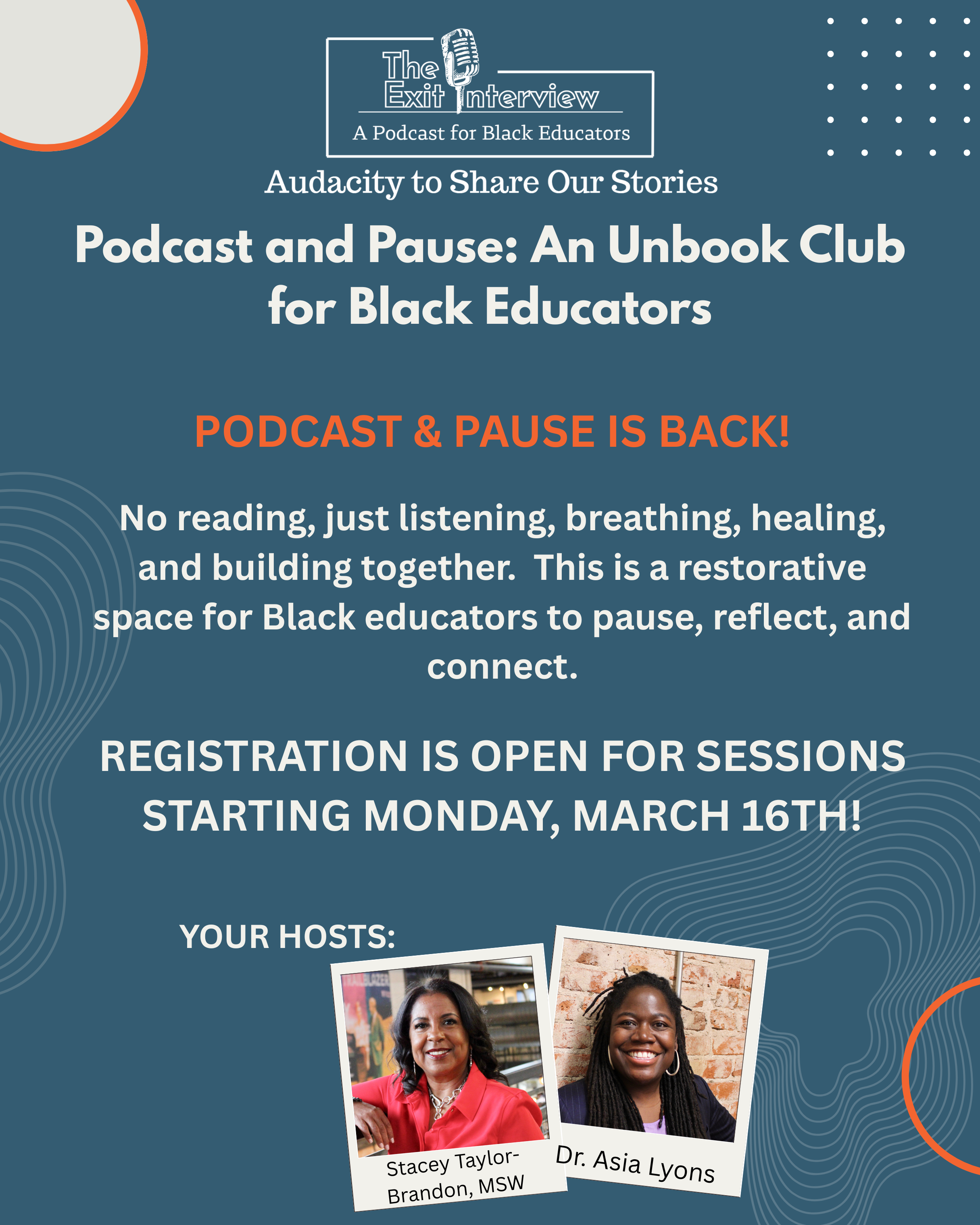
CEO, Lyons Educational Consulting | Host & Producer, The Exit Interview: A Podcast for Black Educators
Dr. Asia Lyons is the founder and lead designer at Lyons Educational Consulting (LEC) LLC. In partnership with communities, organizations, and schools, Lyons Educational Consulting supports co-creating truly inclusive environments that assist Black educators toward self-actualization through wellness spaces.
Dr. Lyons brings a wealth of practical and academic knowledge to her role. She has served as a K-12 educator in the Denver Metro Area and an adjunct professor at the esteemed University of Colorado - Denver School of Education and Human Development. Additionally, she has worked as a school partner specialist, collaborating with schools and non-profits across the Denver Metro Area to provide communities with resources aimed at closing the access gap for Black children and children of Color.
Dr. Lyons' research is a testament to her unwavering commitment to addressing critical issues. Her doctoral studies in Leadership for Educational Equity, with a concentration in Urban and Diverse Communities, delve into the profound impact of racism-related stress and racial battle fatigue on Black educators and their families. As a reciprocal gesture to Black educators, she co-founded and co-facilitates the Black Educator Wellness Cohort, conducting free monthly wellness sessions in the Denver Metro Area as well as other support services for Black educators nationwide. Dr. Lyons has shared her insights at prestigious platforms such as SXSW EDU, Harvard Graduate School of Education, The State of Black Learning, and the National Board of Certified Counselors Symposi…Read More

When Black Educators Bet on Themselves