
Beyond the Principal's Office: Finding New Ways to Serve with Dr. Adrienne Davenport
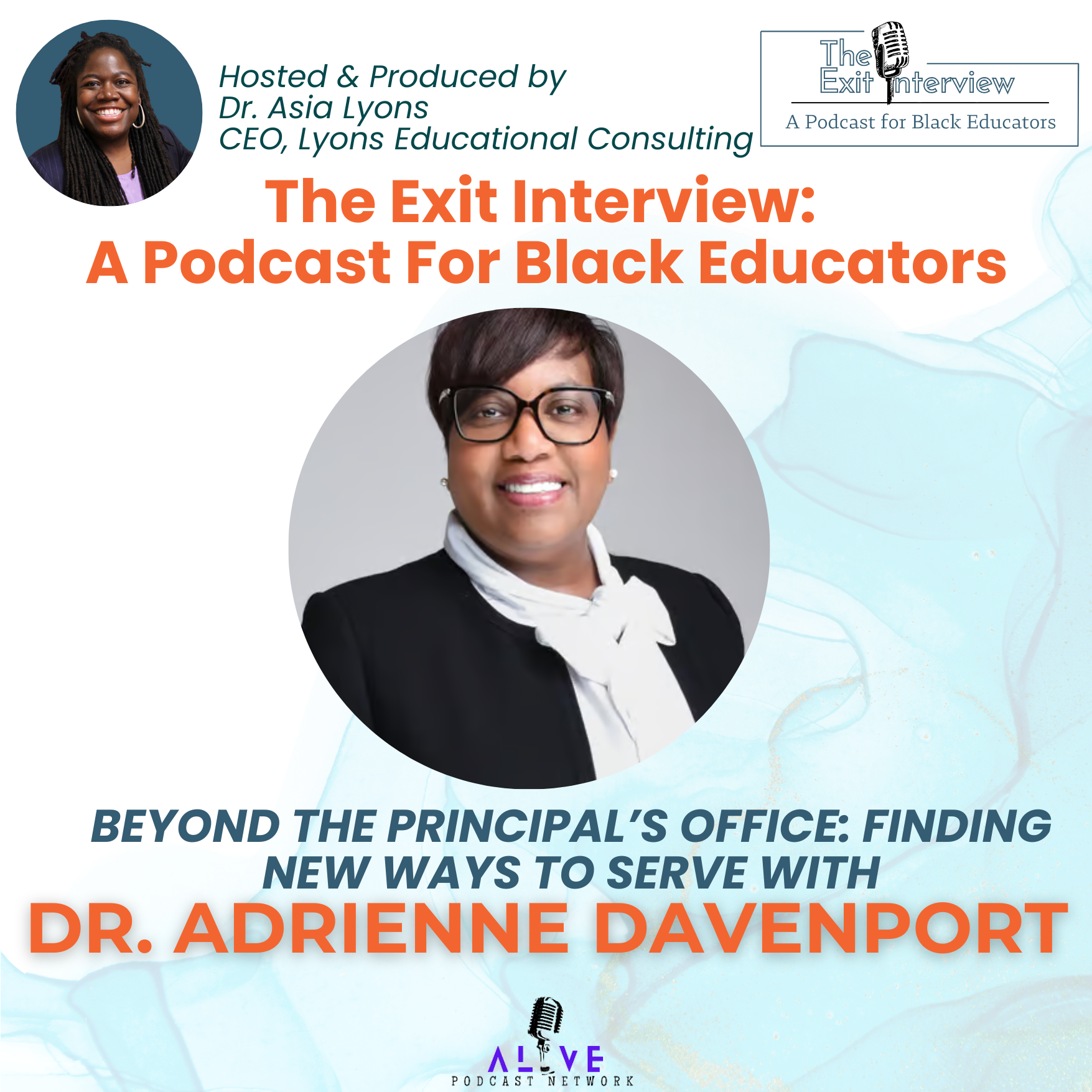
In this episode of "The Exit Interview," host Dr. Asia Lyons welcomes Dr. Adrienne Davenport, a veteran educator, administrator, author, and instructional coach. Dr. Davenport shares her unique journey into education, which began as a second career after initially pursuing work as a paralegal. She discusses her experiences teaching elementary and middle school, her transition into administration, and the challenges and rewards of serving as a principal in multiple districts.
Dr. Davenport reflects on the importance of seizing opportunities, the value of moving between districts for professional growth, and the necessity of self-care and support systems for administrators. She candidly addresses her decision to leave administration during the COVID-19 pandemic, emphasizing the significance of following one’s intuition and prioritizing well-being.
The conversation also explores strategies for retaining Black educators, including the need for better recruitment, support, and leadership pathways. Dr. Davenport highlights her passion for instructional leadership, her work as an interventionist and instructional coach, and her authorship of two books: "My Hope is Built" and "STAND," the latter offering practical strategies for aspiring educational leaders.
The episode concludes with Dr. Davenport’s reflections on wellness, the importance of peace and self-reflection, and shout-outs to influential educators in her life. She shares her contact information for listeners interested in connecting or learning more about her work.


Episode Overview
In this episode, Dr. Asia Lyons sits down with Dr. Adrienne Davenport, a veteran educator, administrator, author, and instructional coach. Dr. Davenport shares her journey from paralegal studies to a decades-long career in education, her experiences as a teacher and principal, and her transition into new roles that continue to impact students and educators. The conversation covers career pivots, leadership, self-care, and strategies for supporting and retaining Black educators.
Timestamps & Topics
00:00 – Introduction & Guest Bio
- Dr. Asia welcomes listeners and introduces Dr. Adrienne Davenport.
- Overview of Dr. Davenport’s career: teacher, instructional coach, administrator, author, and consultant.
03:00 – Journey into Education
- Dr. Davenport’s unexpected path from paralegal studies to substitute teaching.
- The influence of mentors and the decision to pursue teaching as a second career.
07:00 – Family & Community Reactions
- How Dr. Davenport’s family and community responded to her career change.
- The importance of representation and support in the Black community.
10:00 – Teaching & Administration
- Experiences teaching grades 4–8, with a special fondness for eighth grade.
- Transitioning into administration: motivations, challenges, and lessons learned.
- The value of moving between districts for professional growth.
18:00 – Leadership Philosophy & Advice
- The importance of timing, opportunity, and not getting too comfortable.
- Advice for educators considering new roles or districts: “Cast your net wide.”
22:00 – Self-Care as an Administrator
- Strategies for maintaining work-life balance and mental health.
- The role of support teams and the importance of delegation.
27:00 – Leaving Administration & Taking a Faith Walk
- The impact of COVID-19, personal loss, and increasing job demands.
- Dr. Davenport’s decision to step away from administration and embrace uncertainty.
32:00 – New Roles: Interventionist & Instructional Coach
- Working with ESOL students and rediscovering the joy of teaching.
- The transition to instructional coaching and supporting teachers and administrators.
36:00 – Retaining Black Educators
- Barriers to entry: cost of education, certification exams, and lack of support.
- The need for affinity groups, mentorship, and leadership pathways.
- The importance of administrators having teaching experience.
44:00 – Books & Community Work
- Dr. Davenport’s books:
- My Hope is Built: Reflections on faith, grace, and resilience.
- STAND: Five strategies for overcoming barriers to instructional leadership.
- Speaking engagements and ongoing work in education and community.
50:00 – Shout-Outs & Influences
- Shout-outs to Dr. Davenport’s mother, Ms. Jane Walker (sixth grade teacher), and other impactful educators.
53:00 – Reflections on Wellness
- Dr. Davenport’s definition of being well: finding peace, self-reflection, and gratitude.
55:00 – Contact Information & Closing
- How to connect with Dr. Davenport:
- Email: drdconsulting407@gmail.com
- Website: drdconsulting.org
- Facebook, Instagram, Twitter/X, Blue Sky
Notable Quotes
- “You have to be happy and content with you. If I was happy and content with what I was doing, then [my family] was happy as well.”
- “Don’t be afraid to cast your net wide. Growth happens when you step out of your comfort zone.”
- “To be well means to have peace… to be able to be still, to sit in my space, and to reflect.”
Resources & Mentions
- My Hope is Built by Dr. Adrienne Davenport (Amazon bestseller)
- STAND: Five Powerful Strategies for Overcoming Barriers to Becoming an Instructional Leader by Dr. Adrienne Davenport
- National Alliance of Black School Educators (NABSE)
- The Exit Interview Podcast: exitinterviewpodcast.com
About the Host
Dr. Asia Lyons is the host of The Exit Interview, a podcast for Black educators. She is dedicated to amplifying the voices and experiences of Black educators and fostering community and support.
First of all.... have you signed up for our newsletter, Black Educators, Be Well? Why wait?
Amidst all the conversations about recruiting Black educators, where are the discussions about retention? The Exit Interview podcast was created to elevate the stories of Black educators who have been pushed out of the classroom and central office while experiencing racism-related stress and racial battle fatigue.
The Exit Interview Podcast is for current and former Black educators. It is also for school districts, teachers' unions, families, and others interested in better understanding the challenges of retaining Black people in education.
Please enjoy the episode.
Peace out,
Dr. Asia Lyons
Beyond the Principal’s Office: Finding New Ways to Serve
dr--asia-lyons--she-her-_1_01-12-2025_100301: [00:00:00] All right, folks, welcome back to the exit interview, a podcast for black educators. We're in season five and I am super excited. I feel like the momentum is good. I appreciate you all for joining us, listening to us, watching us on YouTube. And we have another fantastic guest, um, Dr. Adrienne Davenport. And I'm going to read your bio because folks need to know what you're up to.
And. We're going to just get started, but so excited. Thank you for having us. Or thank you for coming on the show.
dr--adrienne-davenport--she-her-_1_01-12-2025_120301: Thank you for having me. I am I'm very excited to be here.
dr--asia-lyons--she-her-_1_01-12-2025_100301: Yeah. Um, so Dr. Adrian Davenport is a veteran educator who has served as a teacher, instructional coach and building level administrator. She is also the author of Amazon bestseller. My hope is built reflections of faith, grace, and resilience from an educational [00:01:00] leader. And her most recent release stand five powerful strategies for overcoming barriers to becoming an instructional leader.
Dr. Davenport also serves as an adjunct instructor at Anderson University. She is the owner of Dr. D Consulting LLC, which provides instructional leadership, professional development to individuals, schools, and districts. She is passionate about education and her interests include educational policy and instructional leadership.
She volunteers in her community through various organizations such as the united way in addition. She works with the youth at her church Dr. Davenport loves to read if she enjoys music walking and spending time with friends and family again. Welcome to the show
dr--adrienne-davenport--she-her-_1_01-12-2025_120301: Thank you. Thank you. Thank you for having me.
dr--asia-lyons--she-her-_1_01-12-2025_100301: Yeah, I have to say, you know, this is not on here, but you are quite busy on linkedin I see you in different organizations and programs and doing different things and just really out there in community and Being like I don't want to use the word [00:02:00] busy, but I guess productive and just showing up.
And I, I know the community appreciates that.
dr--adrienne-davenport--she-her-_1_01-12-2025_120301: Yes, very much. So, um, excuse me, being busy and focused on education is is also one of my passions. So I'm glad that I'm receiving some some notice.
dr--asia-lyons--she-her-_1_01-12-2025_100301: Yeah. Yeah. And I, I, you know, what's interesting is it's been a while. We've been trying to get this schedule and I'm glad we finally got you on the calendar. And so we'll just go ahead and get started with our first question. You know, a lot of folks, uh, when they share their story, they ask the interview story to ask them like, what is.
Your journey into education people started, well, I knew I wanted to be a teacher in third grade or I fell upon it in college, you know, but what is your story? How did you decide that education was for you?
dr--adrienne-davenport--she-her-_1_01-12-2025_120301: I've always loved learning. And unlike many other educators, that was not a dream that I had growing up to be a teacher per se. So I guess I didn't think about it [00:03:00] until recently. I was in a, on a online type of thing and people were talking about their experiences and I guess I am a second career. But after I finished my degree in English at that time, being a paralegal was the going thing that was going to be a top career for the 90s. And so I went to a paralegal program, did not find a position in that, in that field. And found myself substituting at my former junior high school. And I still had some of the same teachers and administration that was there when I was going through school. And
dr--asia-lyons--she-her-_1_01-12-2025_100301: Oh, wow.
dr--adrienne-davenport--she-her-_1_01-12-2025_120301: an education. And I was like, no, I just finished a degree.
I don't want to go back to school and get another degree. Because that was at the time that you had to have a degree in education before you could get a master's in education. So essentially they took all of my credits from my first degree. And the only thing I had to do was [00:04:00] take education classes and it just clicked.
Everything just clicked. It was, that was my niche. And so I began teaching fourth grade and as they say, the rest is history. So, I was encouraged to be an educator, but I've always been a lover of learning and of reading, so it was just a natural, a natural transition for me.
dr--asia-lyons--she-her-_1_01-12-2025_100301: I think it's interesting that you talk about this like second career, and I always want to ask folks who take this kind of pivot. When you tell your family, you went to school, this is what you, you're going to be a paralegal, and then you tell them, I've decided to become an educator. What was the response?
dr--adrienne-davenport--she-her-_1_01-12-2025_120301: For some, has always been, particularly within the Black community, a profession that people thought was honorable and was noble. So for some, it was like, that's great. We need more black teachers. You're smart. You've [00:05:00] always been good in school. So that's wonderful for some. It was like, wait a minute.
I'm not sure. Do you really want to be a teacher? Because once again, you go to school, you graduate from high school, you go to college, and then it's time to start working. It's not to pivot and go back to school. And so for, for some, it was like, wait a minute. Are you really sure this is what you want to do?
And then of course, once I began teaching and became, was successful with that, then it became natural for people to see me as an educator, even today.
dr--asia-lyons--she-her-_1_01-12-2025_100301: Yeah, that makes sense. So you started off teaching fourth grade, but obviously that's not where you stay. Let's, let's hear about, um, where else you taught or your transition, all the other places you were. Cause when we talked, uh, you were talking about being an administrator, but I'm sure there was another, like a longer journey between fourth grade and administrator.
So we'd love to hear about [00:06:00] that.
dr--adrienne-davenport--she-her-_1_01-12-2025_120301: Yeah. So I started fourth grade. I had student taught second grade, even though I had a degree in English, I'll be honest with you. Teaching, um, Canterbury tales was, uh, not something I wanted to do. And I loved my secondary, my high school English teacher. And I thought I could never, um, could never live up to her expectations.
So I said, well, let me stick to elementary school. So I started out teaching fourth grade and I've taught fourth through eighth grade and I've taught middle school mostly. And I really enjoyed eighth grade. I think eighth grade. English language arts and literature was my favorite subject and my favorite grade. I think by the time students get to eighth grade, um, as the old expression goes, they really start smelling themselves, so to speak,
dr--asia-lyons--she-her-_1_01-12-2025_100301: Mm hmm.
dr--adrienne-davenport--she-her-_1_01-12-2025_120301: really enjoyed that age group. It was no, no two days are the same in education period, but [00:07:00] particularly working with that age group. But going back to when I was growing up, I was always involved in extracurricular activities and leadership. roles, student council all throughout junior high and high school. So understanding how systems work and what makes systems so to speak, has always been a passion of mine. So it was When I entered education as a teacher, I knew that I wanted to teach for a few years and then transition into administration just to have an impact on the whole. And so after teaching a few years, I earned my master's degree in administration and then began an administrative role in a middle school.
dr--asia-lyons--she-her-_1_01-12-2025_100301: So, so, wait, wait, we got to pause you on that because first, I always say this, the audience knows it. I taught sixth grade for a long time, um, and I never imagined myself like anything [00:08:00] past sixth grade. Right? And to hear you say that you loved eighth grade hats off to you, but, and also, and I'm kind of going back in the story a little bit, you talked about your language arts teacher in high school.
And I feel like so many folks who come on the show talk about their language arts teacher in high school and the impact that they had on their lives in general, or them wanting to be in education.
And I just find that so fascinating. And I wonder what it is about The impact are the topics, the books, the way that they can have
conversation in high school and in that language art space that helps people believe that education, like going into education is for them.
So shout out to your language arts teacher. That's the first thing. And the second thing is, you know, you taught, you know, like, again, taught teaching middle school to me was fun and tough.
dr--adrienne-davenport--she-her-_1_01-12-2025_120301: It is.
dr--asia-lyons--she-her-_1_01-12-2025_100301: Yeah. Yeah. Yeah. [00:09:00] Yeah.
dr--adrienne-davenport--she-her-_1_01-12-2025_120301: there were some, there was some fun days. And of course, there are some challenging days because you're talking about a period of time that your hormones are going everywhere. The peer influence becomes more important than your parents. It's so funny. Some of the middle school students, they come to school, if their parents are there for a program, they're walking 10 steps ahead of the parents.
dr--asia-lyons--she-her-_1_01-12-2025_100301: Mm hmm.
dr--adrienne-davenport--she-her-_1_01-12-2025_120301: have no connection to these people. So it's, it's just funny and I just enjoy it. I think it's a fun age. It's a very impressionable age. And by the time a student gets to middle school, you can talk to them and they can understand there is light at the end of the tunnel and They start coming into their own personality, what they want to do in life, and it's, it's just a fun age.
I just enjoy working with that age group. And at that particular time, I had, I was working in a middle school teaching sixth and seventh grade. And when a position came open, it was at another [00:10:00] middle school. And so that was the reason. That, that transition to middle school administration initially,
dr--asia-lyons--she-her-_1_01-12-2025_100301: Makes sense. And then you said that you went back, got your master's and then went into administration. Did you feel, and we'd love to hear more about this, but when you were heading in that direction, do you feel like folks were nudging you in that direction to go into administration? Or as you mentioned before, you knew you were going to eventually be in leadership.
It was just seeing how long it would take to get you there. Mm hmm.
dr--adrienne-davenport--she-her-_1_01-12-2025_120301: I knew that I wanted to do it. And I've always been the type of person that if I set my mind to do something, I'm going to do it. Now I will tell you, will vividly remember one of my, well, actually he was an administrator at the high school. He had retired at that time. And I remember running into him one day in the grocery store.
When I was teaching and working on my master's degree and he asked me what I was up to and I told him he said, no, no, no, [00:11:00] don't get into education administration. Um, you will be hated by, by those that look like you because they feel like you should give them a break. And then for the other ones, it's going to make it challenging.
Don't do it. Don't do it. And, um, he was laughing when he said it, but that was probably some element of truth in his, in his advice. But that me because once again, I'm a big picture person. I see the forest as well as the trees, and I know that my commitment to children, my commitment to education was something that I could bring to the system.
So I just forced ahead.
dr--asia-lyons--she-her-_1_01-12-2025_100301: I know that's right. Um, so yeah, tell us about that, that part, that administration journey. Did you start off as an assistant principal? Like, what did that look like for you?
dr--adrienne-davenport--she-her-_1_01-12-2025_120301: Yes, I started out as, well, they call it an administrative assistant in my area, which is basically you use one of your teaching allocations for administrative support. But for all practical purposes, [00:12:00] you're an assistant principal. That's how you viewed by the teachers and by the parents and by the students. So I did that for three years and then the position was eliminated. So I returned to the classroom to teach for a couple of years, and then I was able to re enter the administrative ranks in another district at an elementary school. And I did that for a year, and then a position came open in another district, and I was able to get that position, and it was a wonderful experience. I had a lot of success there. Some challenges as well, as any person that enters administration. I don't think gender ethnicity has a lock on, on the challenges that, that you face. still maintain contact with every school that I've been, I've been able to forge relationships and still main contact, maintain contact with people I work with.
So [00:13:00] that's one of the things that I do enjoy about education, the human aspect of it and the good people that you meet along the way that are able to impact your journey. And so I was principal at an elementary school, and then the superintendent said, Hey, we need you at the middle school. And I was like, Wait a minute.
I don't want to move because at that time I was in the middle of my dissertation.
dr--asia-lyons--she-her-_1_01-12-2025_100301: Okay.
dr--adrienne-davenport--she-her-_1_01-12-2025_120301: Yes.
dr--asia-lyons--she-her-_1_01-12-2025_100301: Yeah,
dr--adrienne-davenport--she-her-_1_01-12-2025_120301: I was like, Wait a minute. That's another challenge on top of the challenge of navigating that it. selfful self. Um, that that journey of self and it's somewhat of a selfish journey to because of the time that you're putting into it.
But at any rate, I did transition to the middle school and did well there and afforded an opportunity to go to a larger district and and was was able to be successful there. And [00:14:00] so most of my experience has been a principal at the middle school level.
dr--asia-lyons--she-her-_1_01-12-2025_100301: this is interesting because what I hear you saying more than the experience at the middle school level is you said, I went from one district to another and kind of did this move around. Um, and I know that there are folks who. are in teaching or administration or para paraprofessionals school sites who get into a school district and want to stay in that district forever.
Uh, maybe because they have, you know, friendships there. Some people I've heard say that they're afraid to, um, interview at another district or they, they're afraid the other district is not going to be like the one they're in. And you said it seems like wherever I need to go or whatever is best. So how did you, and this, I know this goes back to leadership piece and your vision, but I just want to ask [00:15:00] again, I'm assuming it is, I want to ask again, how is it that you decided that district to district was just something that you were going to be okay doing, knowing that there are folks who would like to be in the same district their entire career?
dr--adrienne-davenport--she-her-_1_01-12-2025_120301: Right. I will say timing, and opportunity. So timing is, is very nuanced and sometimes there's, it's hard to describe, but sometimes there's this, this soft, sweet spot, so to speak, of when you know in your gut that you have to take an opportunity. And I, I believe in the adage of, you want something, you have to go out and get it.
Opportunity is, will knock at the door, but you have to open it. And also, I, I often share this story. There are only two people in the world that will give you what you want because you want it. Or they may, I should say, give If you're lucky to [00:16:00] people and those are your parents. Okay. I've eaten my broccoli.
I cleaned my plate. cleaned my room. So now you deserve the reward is or whatever it is that you want it to do. Well, it doesn't happen that way in, in your career. So you have to be, be steadfast. You have to pray about what it is that you want to do and take advantage of those opportunities and nothing ventured, nothing gained. And you do grow. Okay. When you're in another space, even if you're within the same district, if it's a large district, sometimes transitioning to another school, because every school has its own culture, its own different set of human resources, so that can afford you another opportunity. And with each that you take, it's an opportunity for you to grow.
So I do encourage people not to be comfortable staying in one place, because that can, that can derail you, because when you get [00:17:00] too comfortable, you don't grow, you don't take advantage of opportunities and you can become somewhat stale. So I do recommend people to seek out opportunities to grow.
Sometimes people can pick up and go to another state. Okay. Sometimes people can pick up and even go to another country, but generally speaking several districts within the area where you live. So you could five minutes down the road, you could be in another district or maybe even 30 or 45 minutes.
So there are many opportunities. So cast your net wide.
dr--asia-lyons--she-her-_1_01-12-2025_100301: Yeah, I love that. Um, As an administrator in, in the middle school or elementary school, how did you, knowing that from what I can see from my good friends, shout out to folks like Unique Cooper, who's a principal here in the area and lots of principals that I know, what did you do to take care of yourself knowing you had these long hours that [00:18:00] you had to be at basketball games and parent conferences and just all the personalities that you had to contend with?
What was some of the strategies? if you have any or had any to take care of yourself while you were in that role.
dr--adrienne-davenport--she-her-_1_01-12-2025_120301: Well, I've, I try not to take myself too seriously and understand that. It's, it's a job, it's a career, it's a passion, and I also would tell people that it's a comma in my eulogy, if it even makes it to my eulogy, because I may have many things that I do and then it's like, Oh, I forgot she did this.
So I think through, through prayer and supplication is, is a big part of, of what I do. I can't say I always took, uh, get care of myself because. You do eat a lot of junk food, a
dr--asia-lyons--she-her-_1_01-12-2025_100301: of pizza nights. Yes,
dr--adrienne-davenport--she-her-_1_01-12-2025_120301: a lot of candy. I [00:19:00] love candy. So I always had candy, uh, on my desk or we have meetings and teachers love chocolate. So you can't have a meeting without chocolate.
So you find yourself eating things that you shouldn't eat. But I also had a time that when I left work, then that, that was it. I was able to compartmentalize that. And a lot of people aren't because as I'm talking with colleagues over the years, they would say, well, what time do you get to school or what time do you, um, leave, leave from, from school? And so I had, um, uh, a family and I also had other interests. So when I left work, that was it. And when I came back the next day, Then, of course, I continued on with my, with my job. Now, as an administrator, you're never really off because you have a phone that the district gives you that must be on at all times.
And so, uh, it, it, particularly as the toward the end of my [00:20:00] principal career, the nature of the job changed. Um, you're a middle manager and there's a lot. of detail and a lot of responsibility that goes into the job. Like I said, you're, you're on call 24 seven. And so it, it does make it hard to of compartmentalize to a certain extent, but I did have, I was fortunate over the years to have great support. With my, um, support staff, my administrators, and, uh, assistant administrators, so I was very, very fortunate to have good people to delegate and, and to work with. My, my mantra though was, if there was ever a day, I wasn't absent often, I didn't believe in being absent or leaving campus because I could, once I got there, I was there until it was time for me to go home. But if I was absent, the mantra was, stay off the news. Do not do anything that's going to get us on the news. And, um, fortunately [00:21:00] that, uh, were able to do that.
dr--asia-lyons--she-her-_1_01-12-2025_100301: I love that. And that you, I think, I mean, I've never been an administrator, but that having a support team like you're talking about is so vital. We had, uh, in season four, Dr. Stitt came on and she shared a story about her school's nurse and our school nurse was even taking care of her and taking sure that she took care of herself.
So when we think about that, that team, it's not just the assistant principal or the deans. It could be the office staff and so many folks who make sure that things are running smoothly with or without, I assume, the principal being in that space. Um, So you were administrator for a long time, but you left administration.
And so the question is like, what was the theme or the situation that helped you decide that it was time to make a shift in what you wanted to do and needed to do?
dr--adrienne-davenport--she-her-_1_01-12-2025_120301: Well, it was a combination of [00:22:00] a lot of things. It wasn't just one silver bullet.
dr--asia-lyons--she-her-_1_01-12-2025_100301: Sure.
dr--adrienne-davenport--she-her-_1_01-12-2025_120301: It was the, um, COVID was, was, was, we were in the thick of that. um, from a personal standpoint, the grief. of losing my father as well as other family members and people that close to or either I had staff members who lost loved ones.
So it was it was partly that and and also a realization that life is too short. And, um, the, the mechanics and the responsibility of the job was increasing, increasing. there was a time that I thought that perhaps maybe education would pivot a little because we saw what we could do in a matter of 24 hours when we got the call that schools were going to be closed and what we were able to do to try to keep schools moving.
Of course, we had the what we call the covid [00:23:00] money, but there's the funds that came to help. Tried to close gaps and for the technology that was needed to be able to have school virtually all of the things that we were able to come together and try to solve COVID. After we were quote unquote returned to school and quote unquote were returning back to normal. just forgot about all of those out of the box things
dr--asia-lyons--she-her-_1_01-12-2025_100301: Yeah,
dr--adrienne-davenport--she-her-_1_01-12-2025_120301: were able to implement and that was a little bit disheartening, discerning. it's also one of those things when you know that you are, done with a particular thing than you just know in your heart. also I had been, this was actually the eighth year I had been in that particular school.
And I'm a firm believer in seven being the number of completion. And I'd stayed actually a year longer because of COVID, because things were just so topsy turvy. [00:24:00] And I just, it was just time for me to, to move on. I felt like I had done all that I Was able to do in that seat in that setting that season was over and it was time for me to move on And I tell you I took a faith walk because most people particularly at my my age My stage of my career for me to leave and not know where I was going to land Some people probably thought that was crazy
dr--asia-lyons--she-her-_1_01-12-2025_100301: yeah,
dr--adrienne-davenport--she-her-_1_01-12-2025_120301: He thought that there was, it has to be something else.
It has to be another reason. And to be honest with you there, there wasn't. It was like I said, there was several things I just said, I'm fortunate enough to be in a situation where I can, I can transition and I'm okay with it.
dr--asia-lyons--she-her-_1_01-12-2025_100301: yeah, yeah. I think this we talked about this before when we were just meeting about this faith walk, [00:25:00] right? And how in education, the type of people who go into education typically have certain things. They have a plan, a set and one thing to the next. And to tell people, especially in that particular setting.
I don't know what's next, but this isn't it, right? And we're gonna, I'm gonna have to figure it out. God's going to show me the ancestors, whoever, and tell people that with a straight face. People get so confused because they can't imagine.
dr--adrienne-davenport--she-her-_1_01-12-2025_120301: right.
dr--asia-lyons--she-her-_1_01-12-2025_100301: There's not like, oh, surely you must have a job somewhere else. Are you just not telling us?
Um, and to say like, oh no, No, for real. I don't know. It's sometimes hard for folks to swallow.
dr--adrienne-davenport--she-her-_1_01-12-2025_120301: right. It was for some of them. And then for some, they knew that whatever my next steps were going to be, that I was going to be successful. So for those that were were true colleagues and were true friends, they they didn't, they [00:26:00] didn't have one ounce of worry about whatever my next step was. And I've always been a pretty level headed, practical person. And so they trusted. I was going to be able to take this faith walk and be able to do it successfully. So I've never left any place on a bad note and I've never left any place that I could not return. And not everyone can say that. So, um, for, for that and for many other reasons, I'm proud of the work that I've done over the past 31 years and that I will continue to do for as long as I choose to do. And, and for that, I am thankful and appreciative and grateful.
dr--asia-lyons--she-her-_1_01-12-2025_100301: Yeah, and I know that you mentioned that you left administration, but then you found another path in a different district. And so, we'd love to hear more about that. What that journey looked like, because this is an exit interview, but for you, it was just, it's an exit interview on your role as a [00:27:00] principal and not necessarily your role out of a traditional K 12 space.
So tell us about that decision to go to the next district, what you're doing there. And we're going to, of course, talk about your book and everything else, but we'd love to hear how that came about as well.
dr--adrienne-davenport--she-her-_1_01-12-2025_120301: Yes. So I wanted to obviously continue to work with Children working in education and instructional leadership has always been a strength of mine. I understand instruction. I'm a nerd, I guess when it comes to instructional practices and I'm always reading blogs or articles or Following educators on social media, particularly TikTok, which I'm going to miss some of the educational policy and educational creators on, on that, on that platform. But, uh, at any rate, I knew that I wanted to continue to work with students. And so being, uh, initially was an interventionist working at a [00:28:00] school that had a majority ESOL population, some of the sweetest kids I've ever been around. And. It kind of restored my faith in humanity a little bit,
dr--asia-lyons--she-her-_1_01-12-2025_100301: Yeah.
dr--adrienne-davenport--she-her-_1_01-12-2025_120301: also, it was a respite year for me, to be honest with you, because I did not have to worry about anything, but what I was doing, I was able to stay in one lane, but knowing I had been a principal, some of the staff members looked to me to answer questions about this.
I'm not the principal. I don't, I don't know. And I was so happy to only have one key to have to keep up with. So it was, it was, it was really, it was really wonderful. But I was also, it also gave me an opportunity to see things through the lens of teachers. Because, of course, I had been in administration, and even in administration, even if you do, um, spend time in classrooms, you do spend time having conversations with teachers, it's a different thing actually being a teacher. in the [00:29:00] role of, of, of looking at things through the lens of, of a classroom teacher that the teachers that I work with, the students that we share. And after that, I, the next year and an instructional coach position came open in that school. So I transitioned to that and that's sort of a quasi admin role. Um, it's, it's a role that I think perhaps maybe in certain areas, it's used effectively. But knowing that I've always, hard to go into a situation, not going in it through the lens of your experience. So even though I'm no longer a principal, it's hard for me not to look at situations through the lens of being an administrator.
So I'm able to provide input and to provide some, some guidance. Um, for administrators in, in my role, but at the same time, I'm focusing on trying to improve, improve instruction and, and [00:30:00] trying to improve outcomes for students. And so that's something that I've, that I've always enjoyed. So it's been, it's been a good transition.
dr--asia-lyons--she-her-_1_01-12-2025_100301: Yeah, I want to go back to that same question I asked at the beginning of the show, which is what did your family say? Because I know that people really get caught up in the move up the ladder. And did you take a pay cut? And I don't need you to answer that. But what was the conversation that people were having with you once they heard like, no, I'm doing I'm doing this instead?
What did that sound like? What did that look like?
dr--adrienne-davenport--she-her-_1_01-12-2025_120301: Once again, the people that, that know me, that are close to me, my family and friends, they trusted whatever I was doing was going to be good for, for me. And at the end of the day, you have to be happy and content with you. And so if I was happy and content with what I was doing, then they were happy as well.
If I had been, oh my goodness, I don't know what I'm going to do. I'm wringing my hands. then I'm pretty [00:31:00] sure they probably would have had more, more concern. But knowing me and, and knowing who I am, they were supportive of whatever I, I wanted to do. So there were, there were no, there were no worries or no, are you, are you sure this is what you want to do?
Because once again, once I make up in my mind that I'm going to do something, then I'm, I'm going to do it.
dr--asia-lyons--she-her-_1_01-12-2025_100301: Yeah, I love that. And that's a great lesson for all of us, right? Is that, you know, you're going to have folks who are going to support you. And even if they don't, if you know what's best for you, it's you need to go ahead and move forward with what you plan to do, because you have no idea the impact that you could be making on first yourself and then on other people by making that decision, whether that be to go in from one position to another.
To transition out of education entirely, whatever that situation is, you have to do it. What makes sense for you? Um, so when we get back from [00:32:00] our break, I have a few more questions and I really appreciate this conversation because you are the first person who's made this transition on and what it's talking about on the show.
So this is awesome. Uh, we'll be back in a minute from our break.
What's up, beautiful people? It's me, Dr. Asia of The Exit Interview, a podcast for Black educators with a quick announcement. I'll be recording my podcast live in two different locations coming up soon. One here in Denver at Quince Coffeehouse on February 22nd at 1 p. m. If you've ever been to Quince, you know it's a vibe.
It's about community. It's going to be totally free. Come on through. The second location is South by Southwest EDU in Austin, Texas on March 5th at the Hilton Austin in Salon A from 1130 to 1230. So if you're in town, either in Denver or in Austin, be sure to come through. Unfortunately, South by Southwest is not free, but if you have a ticket, please make sure to come through.
Alright, peace.
dr--asia-lyons--she-her-_1_01-12-2025_100301: All right. [00:33:00] Welcome back, folks, to The Exit Interview, a podcast for Black educators. We're here with Dr. Adrienne Davenport. Um, and so, we're on the second part of the show where you've been an admin for many years. You've been in education for over 30 years, correct?
dr--adrienne-davenport--she-her-_1_01-12-2025_120301: Correct.
dr--asia-lyons--she-her-_1_01-12-2025_100301: Yeah, and so I would want to know based on what you've seen at all levels of education that you've been a part of what do you think that schools and districts and unions can do to keep black educators in classrooms and also keep make sure that they're well as much as they can as they're in that role as teacher or para school psych.
What do you believe that they can do?
dr--adrienne-davenport--she-her-_1_01-12-2025_120301: Well, in order to keep teachers, you've got to get teachers, and we have to be good ambassadors, those of us who are educators, we have to be good ambassadors of our profession. We also have to encourage our young people to consider education as a viable career. Now, with [00:34:00] our Department of Education at the federal level possibly being dismantled, with the push for vouchers to be used, public dollars for private schools. that can choose whoever they want to, um, to matriculate through their school. There are definitely some challenges and some hard, some hard obstacles, I guess you could say, that we're up against when we're trying to promote education as a profession. But I still contend that we, we all have to learn, we all have to be taught, no matter What area, whether you're teaching in a charter school, a private school, a home school, we have to have an educated public a, at a minimal in order to keep our system going.
And so we have to do a better job of promoting education as a viable profession, not only from the money standpoint, but also from the working conditions. [00:35:00] So in terms of expectations that we have for teachers. There's a certain impossibility to the job that they have to do when you are one person and you have 26 to 30 students in the class and a third of them were not prepared for that grade level and you're having to differentiate instruction for once again 26 people.
You don't have any type of aid or in class support, um, a minimal planning period. Uh, each day and the idea of that self sacrificing teacher is doesn't exist as it used to, where
dr--asia-lyons--she-her-_1_01-12-2025_100301: Mm hmm. Mm
dr--adrienne-davenport--she-her-_1_01-12-2025_120301: at school until six or seven o'clock and then come early and stay late. That that image of a teacher just does not exist anymore.
And I'm not saying that's necessarily a bad thing when you're talking about work life balance and quality of life. [00:36:00] And because The challenges that we have as teachers are far greater than they were when I started out 30 years ago, for a variety of reasons, not only the instructional program, but also students coming to us prepared to learn like they used to be, not only from a, an emotional standpoint, academic standpoint, a social standpoint as well. So we definitely have a lot of challenges. that are in front of us. So we have to get more people in education. We need to change some of the structures that we have in place. I'm not saying that money is not needed because it is needed. I do think that at sports, I think about college sports because I do keep up with college sports. And if you had told me, Five, 10 years ago that we would have transfer portal and Neil controlling college sports. I would have been like, no way. And so we can think outside of the box to, uh, in other [00:37:00] areas. I think we can do the same thing in, in education. And so an example would be 1 of the things that keeps people from black people from entering teaching is the cost of getting a degree.
dr--asia-lyons--she-her-_1_01-12-2025_100301: hmm.
dr--adrienne-davenport--she-her-_1_01-12-2025_120301: um, if you're, if you're a state employee. Um, if you want to major in, in education, perhaps there should be some type of a reduction in tuition costs. Or perhaps maybe, um, on the job training, which they do have alternative pathways now more so than they used to for those that may have a degree and want to transition into education, but more programs that is, they are going to offer some incentive for those who want to teach.
Or if you, if we do give you this money that's going to defray the cost of your tuition, then you in turn have to give, um, Five years back to the school district to support the system, not just get a degree and run. So I'm pretty sure [00:38:00] there are all types of programs out there, but it has to be enticing.
And then another barrier for us are the exam and not being able to pass the exam. Um, because of some of the cultural biases or the lack of preparation. Not really sure, but we need to have, and some districts do have programs where they have days that you can study and they will provide a substitute so you can have a block of time to study for the praxis and they will reimburse the cost of the exam upon a passing score.
dr--asia-lyons--she-her-_1_01-12-2025_100301: Mm hmm.
dr--adrienne-davenport--she-her-_1_01-12-2025_120301: those types of programs are definitely, are definitely needed. And then once you get into the school, having, not being afraid to have affinity groups exist that will support the other teachers. I will say it has been my experience that ten black teachers tend to gravitate towards schools that have [00:39:00] black administrators.
dr--asia-lyons--she-her-_1_01-12-2025_100301: Yes. Yes.
dr--adrienne-davenport--she-her-_1_01-12-2025_120301: And that's just the nature of the beast. You typically are going to feel more comfortable around those that you have something in common with. so where there's a dearth of, of administrators, there are likely going to be a dearth of, of teachers as well. And so that's another, another, um, issue we've got to make sure not only are we getting black teachers in the classroom, but they also have to make sure that those black teachers have the skills to be able to become teacher leaders. Um, instructional leadership is key and that's where you're going to get your principals are going to come from the ranks of your teachers. And, and so on. So not to say that you can't a teacher before you are a principal, but it makes it hard to, for people to buy into your leadership when you've never done what they've done.
I don't
dr--asia-lyons--she-her-_1_01-12-2025_100301: Yeah.[00:40:00]
dr--adrienne-davenport--she-her-_1_01-12-2025_120301: many college coaches, football coaches that didn't play football.
dr--asia-lyons--she-her-_1_01-12-2025_100301: Yes.
dr--adrienne-davenport--she-her-_1_01-12-2025_120301: um, I don't know why you would expect for a principal not to have been a teacher, even though it may have been years ago. And for that, I say, uh, there are some that contend because there's always this, well, they don't know what the kids are like.
And I think to a certain degree, that is true. It's one thing to, to pass by or to walk around the school. It's another thing to be with students. all day for six hours, even if it's the same group of students or if you're in middle school or high school and kids are coming in and out. So perhaps maybe having a section of, of students that you support each day. or perhaps maybe teaching a course for a semester or something, but some type of way that the if the teachers see that as a barrier, then we have to remove that barrier. So the principal time to to be in the [00:41:00] classroom to teach and they can relate and gives and it gives the administrator different perspective and they can see the challenges that the teachers have.
And that can perhaps maybe, um, can also help retain teachers or perhaps maybe, um, have a have a, I guess, For lack of a better word, a smoother instructional program, or even the climate or the culture can definitely be impacted by knowing that the administrator has walked in your shoes recently, not just 10, 15 years ago,
dr--asia-lyons--she-her-_1_01-12-2025_100301: Mm hmm.
dr--adrienne-davenport--she-her-_1_01-12-2025_120301: the challenges that the teachers are dealing with today.
dr--asia-lyons--she-her-_1_01-12-2025_100301: Yeah. I love that. And I hope that the folks who are listening, who are administrators, uh, are hearing what you're saying, especially this idea of being a good ambassador, right? It's one thing to try to convince folks to go into education, but then they see you showing up in community. Even or showing [00:42:00] up and add in your role as a teacher, as a school psych, as a social worker, and they don't see.
You as someone they would want to work with. And so we have to keep that in mind. We, I'm no longer in teaching, but folks have to keep that in mind. Uh, so we know that your instructional coach, what we talked about these two books, tell us what else are you doing? Cause it sounds like you were on a roll here.
Um, we see a LinkedIn, we see all the things. Tell us about the books. Tell us about what you're up to in community. We want to know all the details.
dr--adrienne-davenport--she-her-_1_01-12-2025_120301: Okay. Well, my first book, My Hope is Built, it was more of a passion project. So, after I pivoted from being a principal to a school interventionist, I, it was the perfect time to reflect. And as you are going through career being an administrator particularly, you're [00:43:00] telling, you have tons of stories, tons of stories as you can imagine. And people always say, you need to write a book. You could write a book. so I did. And so it was once again, more of a passion project, a reflection of my, my journey, uh, as, as a educational leader. And, um, it was, it was a, book sort of like a history, uh, for my for my family, and, uh, it will be something that will be last forever.
So that was really my, my, my interest in, in writing that. And after writing that and speaking with people, I was actually guest of a book club from some of my colleagues that I used to work with. They have a book club and my book was chosen and talking with them. It was still, I was still getting the question of, Well, how, how did you be a principal or some of the mechanics of becoming a principal?
Those were questions that I always got.
dr--asia-lyons--she-her-_1_01-12-2025_100301: Mm [00:44:00] hmm.
dr--adrienne-davenport--she-her-_1_01-12-2025_120301: to be a principal, once again, particularly today, you have to understand instruction. You cannot be afraid of instruction. Yes, there's a management and supervision part of it. Obviously that that you were responsible for Children and adults in the building. But what are we doing there?
We're there to teach Children. And so you have to understand instruction. And so after I finished, my hope is built and it was an Amazon bestseller. Very successful. I kept hearing the word stand. I kept hearing that word and I knew my next book was going to have something to do with with that. um, so I wrote Stand and I decided to create an acronym because that's easy for people to remember. And so stand stands for stand on business, take initiative, acquire knowledge, nurture relationships, and determine your niche. And so that is the
dr--asia-lyons--she-her-_1_01-12-2025_100301: Oh, love that.
dr--adrienne-davenport--she-her-_1_01-12-2025_120301: [00:45:00] For my people that want to work with me that are teacher leaders, or sometimes you may already be a leader and just want to make sure you're refining your practices.
And so through that I explained those five barriers that can prevent you from becoming an instructional leader. Because if you do not understand and also within that, how to work with people, how to operate within your own zone of genius, knowing who you are, then it's going to be hard to be able to lead other people. And so I dropped that in March that, I mean, excuse me, May, um, of this past May. And so I've spent a lot of time speaking at conferences, conferences. Um, locally, statewide, and nationally, I was able to speak at NAPC in Atlanta, National Alliance of Black School Educators, and that was a wonderful experience. [00:46:00] Was able to connect with other and educators across the country, actually internationally, uh, met some people from other countries. So it was a wonderful experience. So that's what I've been doing lately is, um, an opportunity to speak, um, about my business and also about my career and sharing my knowledge with, with others.
So that's, um, That's been keeping me pretty busy. In fact, I have a, um, a conference that I'll be speaking at, um, on Friday, state conference, so looking forward to that.
dr--asia-lyons--she-her-_1_01-12-2025_100301: That's awesome. Fantastic. Um, and I think I, you know, sometimes I'm always interested in like, like a little bonus episode. We'll have to talk to you and have you come and do a little after this little bonus about that particular piece about the conferencing and what that looks like and how to get involved in that.
But my next question is, um, is there a Black educator that you'd like to shout [00:47:00] out?
dr--adrienne-davenport--she-her-_1_01-12-2025_120301: Oh, my goodness. There's there's so many. Um, the first black educator I would like to shout out would be my mother. She was my first educator. In fact, over the years, there have been so many times people in just meeting her and speaking with her. They will say, Well, what great do you teach? And she was not an educator. Um, so she was probably my first, my first educator, uh, that I would want to shout out. I was fortunate to have many educators over the years. that have impacted me. My sixth grade teacher was my favorite teacher. Um, Ms. Jane Walker, she's since deceased. But she was, uh, had a great sense of humor. And growing up, when she was my sixth grade teacher, so seeing her she would always have a huddle of teachers at the end of the hall. And this was at a time where grown folks had grown folks, conversations and adults were separate from children and children knew not approach adults when they were talking. So I didn't, we, of course, we didn't know as students what they were [00:48:00] talking about, but then they would always disperse in this, um, laughter. And so when I became a teacher in my fourth grade, you know, I started fourth grade, she was still teaching and she was teaching across the hall for me, fourth grade at that time. So she was my mentor.
dr--asia-lyons--she-her-_1_01-12-2025_100301: Oh, I love that.
dr--adrienne-davenport--she-her-_1_01-12-2025_120301: To keep in touch over the years and, um, at her, at her, um, visitation, and when you signed the book, there was a bowl of strips of paper. And it had jokes to go, laughs to go. And so her daughter said her last few weeks she spent writing these little corny jokes. But she wanted people to laugh and remember her for that. So she's definitely an educator that I remember. And, oh, there are too many educators that I've supervised that I've worked with to, to call out, to call out one, but, um, the ones that really made a difference in the students lives, um, there was a [00:49:00] teacher that I worked with who, the students didn't write their names at the top of the paper, they wrote ELA teacher, or historian.
Because she was a, uh, social studies teacher. She taught ELA and social studies, and she had those students believing that they could read Harry Potter, which was, um, one of the most popular book at that, at that time.
dr--asia-lyons--she-her-_1_01-12-2025_100301: Yeah.
dr--adrienne-davenport--she-her-_1_01-12-2025_120301: got a rule that you had to pick a book. That was a just right book for you, but then the other book you could pick whatever you wanted to. And so, just, just having the students believe that they could do anything. Um, and I've been fortunate to have several teachers that I've worked with over the years. So, shout out to, to them. And there's a huge sacrifice that teachers make. And a lot of times it goes, um, unnoted or either people take it for granted. But, um, I've known the people that have given a lot. to the school, to their students, and, um, that's what makes our world the way that it [00:50:00] is. I mean, no one can be anything without a teacher. The teacher is the, um, the, um, reason for all other professions, so hats off to teachers.
dr--asia-lyons--she-her-_1_01-12-2025_100301: Yes. Thank you so much. Um, beautiful. And the story of, uh, Jane Walker and the jokes. I just, Oh, I love that. And I was just imagining her doing that, um, just really to, to her, to her end. Right. It was just bringing joy and light to people. Uh, last question. For you, what does it mean to be well?
dr--adrienne-davenport--she-her-_1_01-12-2025_120301: To be well means to have peace. to have peace is definitely a blessing. so, being able to be still, to sit in my space, and to be able to reflect. I'm an introvert by nature. An introvert slash extrovert. I can be an extrovert when I need to be, but my natural inclination is to be an [00:51:00] introvert. So we spend a lot of time with ourselves after being around people for a certain time, we have to recharge our battery.
And so I've always been good at being able to do that. So, um, being able to be, um, secure and who I am and whose I am is, is what makes me well and, uh, life will, will, will keep lifing. And, and, and I used to tell my staff, none of us have arrived. Every morning we get another opportunity. So for that, um, I'm thankful and grateful that I do have another opportunity each day to try to make today better than yesterday. And, and that all having that mindset is really what makes me well.
dr--asia-lyons--she-her-_1_01-12-2025_100301: I love it. All right, folks. If you would like to talk to Dr. Davenport, tell us what your email is or how they can reach out to you.
dr--adrienne-davenport--she-her-_1_01-12-2025_120301: Okay. You can definitely see me on LinkedIn.
dr--asia-lyons--she-her-_1_01-12-2025_100301: A hundred percent. That's true.
dr--adrienne-davenport--she-her-_1_01-12-2025_120301: You can see me on LinkedIn, but, um, my [00:52:00] email is drdconsulting407 at gmail, um, drdconsulting. org is my website. And once again, uh, Facebook. Instagram, LinkedIn, and I'm still on Twitter slash X, um, and then also recently joined Blue Sky.
dr--asia-lyons--she-her-_1_01-12-2025_100301: Awesome. All right, folks. Uh, thank you so much for another beautiful episode. We're going to have a little bonus episode about this conferencing. So you should be hearing that. Check us out on that YouTube or on our, uh, Our page is our pod page. If you don't know exit interview podcast. com. Dr. Davenport, thank you so much for coming on and have a great rest of your day.
dr--adrienne-davenport--she-her-_1_01-12-2025_120301: Thank you so much for having me. I appreciate the opportunity.
dr--asia-lyons--she-her-_1_01-12-2025_100301: Bye. Peace.
dr--adrienne-davenport--she-her-_1_01-12-2025_120301: Bye bye. [00:53:00]

Educational Consultant/Author/Veteran Educator
Dr. Adrienne Davenport is a veteran educator who has served as a teacher, instructional coach and building level administrator. She is also the author of Amazon Bestseller, My Hope is Built: Reflections of Faith, Grace and Resilience From An Educational Leader and her most recent release, S.T.A.N.D.: Five Powerful Strategies for Overcoming Barriers to Becoming an Instructional Leader. Dr. Davenport also serves as an adjunct instructor at Anderson University. She is the owner of Dr. D Consulting, LLC which provides instructional leadership professional development to individuals, schools and districts. She is passionate about education and her interests include educational policy and instructional leadership. She volunteers in her community through various organizations such as the United Way. In addition, she works with the youth at her church. Dr. Davenport loves to read and she enjoys music, walking, and spending time with friends and family.